Here we are in 2023, spoiled by the best Nasdaq performance in the history of the index. 2022 seems like a distant memory. Well, Super Micro’s earnings are here to remind us that stocks do not go up forever, even on a nearly perfect earnings report.
I will take this opportunity to make a plug for technical analysis, as Super Micro due for a pullback from some time, per Knox’s Positions Report here. There is very little in the fundamentals that would directly cause a selloff, and so the information below is going to frustrate anyone who thinks only fundamentals drives stock prices.
Super Micro beat on all accounts, and also raised full year guidance. Cash flow was negative this quarter but likely to be temporary. I’ve included some notes on this below.
We had written going into the earnings report that Super Micro had pre-announced Q4, and it was a sizable beat:
Today, the company has taken this further and raised FY2024 guidance considerably from $8.61 billion expected to $10 billion at the midpoint. Rough math of a 17% gross margin and a 9% net margin gets us comfortably above the $14.73 EPS expected for FY2024, as well, in the $16.00 adjusted EPS to $17.00 GAAP EPS range.
Management did a good job on the call discussing what would cause them to raise the guidance even more for FY2024. The brief answer is they will raise again if they can obtain key components from the supply chain. I detail this for you below.
Scorecard:
The current fiscal Q4 results are bolded for easy reference. Percentages are YoY unless stated otherwise.
Revenue and EPS:
SMCI Management raised Q4FY23 revenue guidance to $2.15B-2.18B from previous guidance of $1.7B to $1.9B, vs consensus of $1.96B. Today, the company reported $2.18 billion for growth of 34% YoY and 70% QoQ.
Q4 GAAP eps guidance raised to $3.25 to $3.35 from $2.13-$2.65. The company reported $3.43 GAAP EPS.
Non-GAAP guidance raised to between $3.35 to $3.45 from $2.21 to $2.71 vs consensus of $2.88. The company reported adjusted EPS of $3.51 for growth of 34% YoY.
Q1FY24 consensus eps of $3.19. The company guided for $2.75 to $3.50 EPS, so this is technically a slight miss at the midpoint of $3.13 EPS but the guide is still within range.
FY24 consensus eps of $14.51 and revenue of $8.47B. The company raised full year guidance to $9.5 billion to $10.5 billion, or $10B at the midpoint. This implies a comfortable beat on the bottom line with the current margin profile.
Margins:
Current gross Margin of 17% versus Q323 gross margin of 17.6% and 18.7% in Q223
undefined
Current operating margin of 10.60% versus Q323 opm of 7.7% and 11.9% in Q223.
Current net margin of 8.9% compared to 6.7% last quarter and 9.8% in Q2
Cash Flow:
This quarter, the operating cash flow was (-$9) million and free cash flow was (-$17) million for a 0% margin. This compares to $198m in op cash flow and $190m in free cash flow last quarter with margins of 15.5% and 14.8%, respectively. In Q2, the margins were 8.9% and 8.4%, respectively.
The cash flow was also negative in Q4 of last year. Management stated the following regarding the negative FCF: “Cash flow used in operations for Q4 was $9 million compared to cash flow generated by operations of $198 million in Q3 due to higher accounts receivable, offset by lower inventory and higher accounts payable from backend loaded shipments in the quarter due to supply constraints.”
The company has $440 million in cash and $290 million in debt for a net cash position of $150 million, down from $176 million. Per management: “we utilized our bank lines of credit to support higher revenues and accounts receivable as we ramped up production of new AI/GPU design wins.”
Here was a question on the call, which seemed to relay that cash flow would be similar to previous levels:
Jon Tanwanteng
Hi, thanks for the follow up. Dave, I was wondering if you could talk about your working capital needs in the sort of environment. Can you generate positive cash flow going forward? Are you going to be using cash as you as you try to fulfill this OpEx demand?
David Weigand
Yeah, John. We see the business generating good cash flows, as it has historically. And we think that the — especially in this constrained supply market, where we could deliver more if we had more supply. But we're so really, the constrained supply ends up moderating the working capital. And so we grew our business last quarter quite a bit and grew our ARR. So that utilized a lot of working capital, but we have no concerns about working capital.
Key Metrics:
52% of Super Micro’s revenue is driven by AI-related designs. Compare that to many AI bubble stocks that do not have any AI revenue yet.
To help illustrate what that has done for Super Micro, analysts raised FY 2025 expectations from 11% revenue growth to 71% revenue growth over the past three months. That is a considerable jump thanks to it’s here-and-now AI exposure.
The OEM appliance and large data center revenue of $1.17 billion grew 59% year-over-year and 94% QoQ. The boom in AI-related data center sales helped to push this segment to over 100% growth in FY2023.
The Enterprise and channel vertical, which also includes AI/ML revenue, was up 19% year-over-year and 51% QoQ to $976 million.
Earnings Call:
Supply is the Primary Headwind; Not Demand:
When management raised guidance, this is what the CEO stated: “However, given the record high backlog, we see fiscal year 2024 revenue between $9.5 billion to $10.5 billion with room to deliver more depending on availability of supply.”
Basically, Nvidia’s chips are so popular that Super Micro is competing with many others for a very limited supply of these chips. Super Micro has a strong relationship with Nvidia and the company is not bashful about making it known. Here is what was stated in the opening remarks: “Couple of months ago, I was honored to have my close friend, NVIDIA CEO Jensen Huang, join me on stage at Computex to highlight our optimized new generation GPU solutions for this AI era” along with a list of Nvidia-powered systems that Super Micro supports.
In our pre-earnings write-up, we had stated: “The bulk of SMCI’s growth will depend on supply chain, which we outlined in our recent analysis. The demand is there, can the company meet the demand or are the key component supply shortages going to keep the company’s growth in line for now? Clearly, the pre-announcement is a good sign that the supply chain is not getting in the way too much, however, this remains the top concern for SMCI's near-term growth. Per our analysis, lead times are at 26 weeks compared to a 10-14 week target. This is an improvement from 40 weeks. Read more here.”
Here was the first question regarding the supply:
Ananda Baruah:
“[…] And so I guess the first question is, is what's the opportunity do you see to maybe even do teach stronger than the fiscal '24 guidance. I guess, what would be the puts and takes there? And, if you were to be able to exceed the 2024 guidance, what would be some of the things you think would need to occur?”
Charles Liang
“[..] And for sure, they need 10 times 20 time more system. And we just cannot ship at this moment, because of supply chain […] So I mean, we are on the right track, yes expecting supply chain can improve so that we can grow our revenue.”
Can the Company Keep Growing …
As if a beat in Q4 and a raise for FY2024 isn’t good enough, analysts on the call wanted to know what the possibility is that Super Micro continues to beat and raise. It was helpful that the CEO stated, “With LLM large language model and other AI applications booming, I now expect the $20 billion annual revenue target to be just a couple of years away.”
Here was a question from an analyst on that note:
Ananda Baruah
That's really helpful. And so, Charles, just to make sure that I understood that accurately, is that to say, if the supply chain — so if you can, if you can get more from the supply chain, actually use it to say this way you have order visibility, such that if you can procure more, you would have the ability to share gains, exceed the fiscal '24 range that you provide is a really supply chain issue, I guess, is what I'm asking. Did I hear that accurately?
Charles Liang
Yeah, absolutely […]
This was also stated at the very end by the CEO:
“Charles Liang
And even a supply condition, I believe we can surpass $10.5 million for sure easily.”
Conclusion
On the Microsoft post-earnings report, I had stated “Let’s be real, the Nasdaq has rallied more than it has in its 52-year history off fairly unimpressive top line growth in the tech industry and minimal to no earnings growth. Although fellow growth investors have greatly benefited, we shouldn’t be surprised if the buying is exhausted at the moment.”
Per a recent Zack’s report (behind a paywall): “For the Tech sector, we now have Q2 results for 41.2% of the sector’s total market capitalization in the index. Total earnings for these companies are down -0.4% on +2.1% higher revenues, with 94.7% beating EPS estimates and 73.7% beating revenue estimates.”
This is not enough growth to sustain the rally we have seen.
Of the tech earnings results this year, Super Micro is a rare gem that has materially grown both top line and bottom line in a big wayin a big way. But, to be fair, the stock has been rewarded and is up considerably this year. Tech investing is not linear, and so what we have is a solid earnings report that is being sold off as buyers are drying up and/or investors are taking gains.
From my perspective, this is a great report and stands out from the weakness we are seeing in many earnings reports. Our plan is to buy on any weakness using technical analysis, so you can look for those trade alerts when the stock hits our buy zone.
We recently did a SMCI deep dive here. We expect SMCI to benefit from the AI trend due to its position between hyperscalers and major chip design companies.
Our investment thesis is playing out as SMCI recently revised up its Q4FY23 guidance which was better than expectedQ4FY23 guidance which was better than expected. So we will listen to the drivers behind this upward revision and whether it will carry through to FY24 and its potential impact on FY2024 consensus earnings estimates.
Revenue and EPS:
SMCI Management raised Q4FY23 revenue guidance to $2.15B-2.18B from previous guidance of $1.7B to $1.9B, vs consensus of $1.96B
Q4 GAAP eps guidance raised to $3.25 to $3.35 from $2.13-$2.65
Non-GAAP guidance raised to between $3.35 to $3.45 from $2.21 to $2.71 vs consensus of $2.88
Q1FY24 consensus eps of $3.19, FY24 consensus eps of $14.51 and revenue of $8.47B
Margins:
Q323 gross margin was 17.6% vs 18.7% in Q223
Adj Q323 gross margin was 17.7% vs 18.8% in Q223
Q323 opm was 7.7% vs 52 % in 11.9% in Q223.
Adj Q323 gross margin was 8.7% vs 12.8% in Q223
Cash Flow:
In Q323, SMCI posted $198m in op cash flow and $190m in free cash flow. Margins were 15.5% and 14.8%, respectively.
In Q223, SMCI posted $161m in op cash flow and $151m in free cash flow. Margins were 8.9% and 8.4%, respectively.
$363m in cash and $187m in debt.
What we are watching for:
The bulk of SMCI’s growth will depend on supply chain, which we outlined in our recent analysis. The demand is there, can the company meet the demand or are the key component supply shortages going to keep the company’s growth in line for now? Clearly, the pre-announcement is a good sign that the supply chain is not getting in the way too much, however, this remains the top concern for SMCI's near-term growth. Per our analysis, lead times are at 26 weeks compared to a 10-14 week target. This is an improvement from 40 weeks. Read more here.
Discussions around their 10%+ customer Meta and the other unnamed 10% customer increasing orders (ideally) and/or any other new customer wins that can be named or quantified
Comments on the partnership with Nvidia, per our write-up: “Supermicro is closely partnered with Nvidia on the H100 GPU rollout with air flow designs that reduce fan speeds, lower power consumption, lower noise levels and lower the total cost of ownership.”
Discussions on other partnerships, such as AMD and Intel.
FY2024 consensus eps estimate is $14.51. There was a miss last quarter on EPS, which management stated: “The shortfall was primarily due to key new component shortages for Supermicro’s new generation server platforms which have been mostly resolved to-date.” We will look for this EPS to stand and will evaluate if there can be a beat in the future.
We will assess if SMCI is taking more market share, and if so, how much market share?
We will listen for and note any discussions on the margins (this was also detailed in our most recent writeup in the conclusion).
What analysts are watching for:
Loop Capital analyst Ananda Baruah raised the firm's price target on Super Micro Computer to $400 from $325 and keeps a Buy rating on the shares ahead of its Q2 results tomorrow. Having positively pre-announced Q4 earnings last month, the company's commentary will provide the "latest rungs on the ladder" to achieving long-term EPS of $20.00
Rosenblatt analyst Hans Mosesmann raised the firm's price target on Super Micro Computer (SMCI) to $375 from $300 and keeps a Buy rating on the shares after the company pre-announced "record" bookings. The market is "set to be on its heels for several quarters" and the firm sees Super Micro capturing incremental AI supply as a premier enterprise partner to Nvidia (NVDA) and its Hopper ramp, the analyst tells investors.
Wedbush analyst Matt Bryson notes that Supermicro updated its Q4 outlook, with revenues now expected to come in at $2.15B-$2.18B, vs. the original guidance range of $1.7B-$1.9B and consensus at $1.8B. EPS is now expected to be about $3.35-$3.45, compared to the previously provided range of $2.21-$2.71. As part of the release, management signaled that order rates and design activity remain at record levels driving rapid backlog growth, the firm adds. While Wedbush doesn't see any near-term risk to Supermicro results, the firm is retaining its more cautious stance and Underperform rating on the name with a price target of $65.
The I/O Fund Analyst Team contributed to this analysis
AMD has been referencing a ramp for the data center in H2. Given that Q3 revenue growth is below expectations, this would imply that Q4 will have to really deliver.
AMD’s management reiterated “we do have that confidence” that there will be an “aggressive ramp in Q4 and 2024.” This was not the only statement on the topic, rather the quote we provided to premium members where management confirmed “50% year-over-year growth in the second half” was by and far the main focus of the call.
Notably, a large portion of the sales in Q4 will come from the El Capitan supercomputer, a highly anticipated launch that we discussed recently in our AMD Deep Dive.
The analysts that dug into the “50% year-over-year growth in second half” comment were trying to ascertain the following:
Is the 50% still valid despite the Q3 miss? If so, this implies +$700 million sequential revenue for Q4
Of this roughly $700 million for Q4, what’s the product mix between EPYC processors and MI300 GPUs
If El Capitan contributes “several hundred million” for Q4 then when will Tier 1 hyperscalers begin to drive sales for MI300 GPUs
In addition to these questions, which we outline below, the pertinent Q&A was on how much of a slowdown AMD is seeing for general purpose CPUs (Gen 3) as hyperscalers and the enterprise go through an optimization period. Here is what was specifically stated: “In the datacenter market, wesee a mixed environment as AI deployments are expanding. However, cloud customers continue optimizing their datacenter compute and enterprise customers remain cautious with new deployments. Against this backdrop, we expect strong growth driven by higher fourth gen EPYC and Ryzen 7000 processor sales and initial shipments of our Instinct MI300 accelerators in the fourth quarter.”
Regarding Bergamo and Genoa-X specifically, management stated that Microsoft Azure is seeing “5X higher performance in technical computing workloads compared to their prior generation” and that Bergamo is delivering “more than double the performance than competitive offerings for cloud-native applications, while offering full x86 software compatibility.” As a reminder, Gen 4 CPUs went into production this quarter.
The MI300s will ship in Q4 with the competitive edge of more memory bandwidth and memory storage. This is ideal for the inference phase, which is used heavily by large language models. We detailed the MI300s in our deep dive here.
On the Client side, AMD has officially bottomed (barring any new, unforeseen circumstances). Management stated that “client segment will grow in the seasonally stronger second half of the year” including a launch of a dedicated AI engine for the mobile 7040 Ryzen CPUs. When discussing AMD’s AI opportunity, it is vitally important that we not lose sight of the opportunity AMD will have to expand its AI portfolio to the Client Segment. Hybrid AI architectures are coming (which means AI is going to go beyond the data center and expand toward the edge), and AMD will be at the forefront. As long as dollar content per chip is higher (which it will be), then AMD will benefit nicely in the next replacement cycle (and beyond). That is a record for parentheses in a paragraph!
For gaming, AMD has yet to bottom. The embedded segment will be weaker than usual over the next two quarters. This segment has been unusually strong post-Xilinx acquisition but is coming up on sky-high comps, so will be cooling off in the medium-term. Due to the M&A with Xilinx, AMD was posting 1,000% to 2,000% growth in the 2022 quarters.
Scorecard
All numbers for current quarter and YoY unless otherwise stated
Overall, everything was in line except the forward guide for Q3 was a miss. This is important because it means the pressure is on Q4 to deliver the H2 growth management had referenced in the prior Q1 earnings call.
In addition to this, we want to see margins rebound quickly after Client and Gaming stabilize. In the past, the CFO has stated that the margins will return to normal when these two segments return to normal. The gross margin of 51% is in good shape but the operating margin of 0% is below AMD’s GAAP operating margin of 20% to 25% in the boom years of 2020/2021. Net margin of 0% compares the net margin of 15% to 20% in the boom years.
Although a tad vague, the CFO stated the following when pressed about the margins: “The model we leverage to generate profitability, we should be able to get back to 20%.”
EPS & Revenue:
EPS: Consensus estimates $0.57 versus $0.58 reported (in line) Revenue: Mgmt midpoint guidance of $5.3B (-19% YoY) versus $5.4 billion reported for (-17%) growth (in line) Next quarter revenue consensus of $5.85B versus $5.7B reported (miss)
Group sales by division (a reference guide of what was reported the last two quarters)
Data centers – $1.3B Q1 vs $1.3B in the current quarter (flat QoQ, down 13% YoY) Client segment – $739m Q1 vs. $998 million in the current quarter (up 35% QoQ, down 54% YoY) Gaming – $1.8B Q1 vs $1.6B in the current quarter (down 10% QoQ, down 4% YoY)
Embedded – $1.6B in Q1 vs $1.5B in current quarter (up 16% YoY, down 7% QoQ)
Gross Margins based on midpoint
Mgmt adj guidance of 51% versus 51% GM reported (in line) Mgmt adj $ guidance of $2.65B versus $2.665B reported (in line)
Operating Margins based on midpoint
GAAP operating margin of (-3%) last quarter versus 0% GAAP OM this quarter for (-$20M) in losses Adjusted operating margin guidance of 19.8% vs versus 20% reported (in line) for $1.068B in profit
Cash flow + Cash
Last quarter operating and free cash flow was $486M and $328M for a margin of 9% and 6%, respectively. This quarter, operating cash flow was $379M and $254M for a margin of 7% and 4.7%.
Earnings Q&A
As stated in the intro, there were many questions about the 50% growth in the second half comment from Q1. Here were a few of the more important discussions.
Matt Ramsay
“Last quarter, you had given us some metrics around potentially being able to grow your datacenter business by 50% in the second-half of the year versus the first-half. And maybe you could give us a little bit of an update on how you're thinking about that milestone and the drivers of growth across CPU and accelerator for the back-half? Thanks.”
Lisa Su
“And we are still looking at a zip code of, let's call it, 50% plus or minus second-half to first-half. So, it's a big ramp, but when we look at all the components, I think that the customer pull is certainly there. And it's exciting to be in this part of the industry.”
When asked again about Q4, and whether the company has the supply to meet the demand, the CFO stated: “We feel that we have ample supply for an aggressive ramp in the fourth quarter and into 2024. But this is certainly one of the areas that we spent quite a bit of time to ensure that we do have that confidence.”
As stated in our AMD deep dive, El Capitan launches in November. Per management, this will contribute “several hundred million” in revenue for Q4. Of the obstacles that AMD must overcome, our analysis made it quite clear it was the software part of the equation that AMD must solve.
Per management: “There is a sort of large, call it, lumpy supercomputer win, so our El Capitan win will be in the fourth quarter primarily, with a little bit in the first quarter” and later it was stated by management: “You can assume that the El Capitan is several hundred million” of the Q4 data center revenue. Ideally, AMD announces commercial customers soon. I’m sure Meta will be one of the first customers, considering the company has been ordering Bergamo from AMD, was on stage at AMD’s conference recently in June, and PyTorch is optimizing its framework for AMD’s software stack RocM. It’s just a guess at this point, but that’s a lot of collaboration.
Conclusion:
AMD has high institutional ownership of +70%, which exceeds many of the FAANGs. The reason is that it’s a tough company to cover and retail investors avoid AMD for this reason. There are many moving pieces with exposure to a handful of major markets, a wide variety of customers, deceivingly lumpy revenue, known to be in second place against 800-pound gorillas, plus trying to figure out where AMD fits requires understanding of both hardware and software.
While some are offput by AMD’s complexity compared to Nvidia’s simple, straightforward thesis, this company has all of the ingredients to be a major AI player. As you’ve probably heard already on the quarterly webinars, my stance is there will be fewer winners in AI compared to other microtrends, and so to find a company like AMD will be quite rare.
Also, as a gentle reminder, Nvidia’s H100 started shipping in Q4 of last year and it took until April for there to be a “wow” moment. I can’t guarantee a “wow” moment will happen (my personal speculation is that it will happen), but this provides investors a minimum time frame of what to expect for Tier 1 hyperscalers to ramp orders after qualifying the two new accelerators.
Rather than pinpoint an exact month or quarter, let’s just say that 2024 should be the year that AMD puts up notable AI revenue. Those are my words. Here is management’s way of saying it: “So, we would expect early deployments as we go into the first-half of 2024, and then we would expect more volume in the second-half of '24 as those things fully qualify.”
This article was originally published on Forbes on Jul 13, 2023,07:05pm EDTForbes Forbes on Jul 13, 2023,07:05pm EDT
Semiconductors are the common denominator across the burgeoning technology trends of the next decade. Artificial Intelligence, 5G, high-performance computing, Internet-of-Things, gaming, electric vehicles, and robotics, among others, all require semiconductors to power them. These trends make semiconductor stocks an ideal investment and perhaps the most important space for tech investors to monitor.
For years now, we have published on semiconductors as leaders in tech– even when cloud, e-commerce, connected TV and others were more favored. In fact, we have been pointing out quite clearly that semiconductors are the sector that has provided the most returns in the past decade.
Source: Beth Kindig
Below, we update our semiconductor sector analysis to look at which companies have performed well in the most recent quarter, and also which companies stand out on a forward-basis with revenue growth estimates, profits, cash flows, earnings surprises, and we also look into management insights.
Top Semiconductor Stocks with the highest revenue growth rates in Q1
Source: YCHARTS
Navitas Semiconductor had the highest revenue growth among semiconductor stocks in the recent quarter. The company’s revenue grew by 98% YoY to $13.4 million. Management’s revenue guidance for next quarter is $16 million to $17 million, representing YoY growth of 92% at the mid-point.
Ron Shelton, CFO of the company, said in the earnings call, “Our guidance is based on robust strength in EV, solar, appliance/industrial, and the beginnings of a recovery in the mobile and consumer market, all further evidenced by a more than 50% increase in backlog during the quarter.”
The company acquired GeneSiC Semiconductor in August last year and helped to diversify into the fast-growing Silicon Carbide market. Navitas has a strong pipeline of $760 million with $432 million of this recognized by fiscal year 2026.
Analysts expect revenue in the next quarter to grow 92% YoY to $16.51 million and robust revenue growth close to or over 100% on a YoY basis for the next several quarters. The risk to consider is that the bottom line is weak. Analysts don’t expect Navitas to be profitable on an adjusted basis until Q1 2025 and GAAP profitable roughly around 2027.
Sign up for I/O Fund's free newsletter with gains of up to 221% – Click hereClick hereClick here
Semi Stocks Q1 Revenue Surprise
Source: YCHARTS
Nvidia crushed analysts’ revenue estimates by 10.4%. The company’s revenue declined by (13%) YoY and is up 19% QoQ to $7.19 billion.
The strong sequential growth was led by record data center revenue, primarily helped by accelerated computing. The company’s CFO, Colette Kress, said in the earnings call, “Generative AI drove significant upside in demand for our products, creating opportunities and broad-based global growth across our markets.” Gaming and professional visualization segments also witnessed improvement from the inventory correction.
If Nvidia is adding roughly $4 billion in revenue, primarily driven by the data center, then Q2’s data center growth will accelerate to an incredible 100% growth rate, up from $3.8 billion in the year ago quarter. It also means the data center will roughly double from the first quarter (sequentially) as the segment was $4.28B in the current quarter.
Put another way, this means Nvidia’s data center segment in the upcoming quarter will be as large as the company’s entire revenue this quarter – if we assume $7.75B in the data center compared to $7.2B total revenue this quarter.
We have highlighted in the past that AI will add $15 trillion to GDP compared to mobile’s $4.4 trillion. Mobile brought us three FAANGs: Apple, Google, and Facebook. It has been my stance for years that AI will bring us a new set of FAANGs, one of which will be Nvidia.
The company’s revenue guidance for the next quarter is $11 billion, representing YoY growth of 64% at the midpoint. The Q2 guidance was 53% higher than consensus. The historic beat in estimates is driven by data center revenue doubling from $4.28 billion in revenue in Q1 to $8 billion in revenue in Q2.
Semiconductor Stocks Q2 Revenue Growth Estimates
Source: YCHARTS
Indie Semiconductor has the highest expected revenue growth rate for Q2. The company’s recent quarter revenue grew by 84% YoY to $40.5 million. The company has guided for 102% YoY revenue growth in the next quarter.
Analysts expect revenue to grow 102% YoY to $51.97 million. The company is benefiting from growth trends in advanced-driver assistance systems (ADAS) and electric vehicles. indie has a large Serviceable Addressable Market (SAM) of $56 billion by 2028. The company is on track to be profitable on an adjusted basis this year.
Donald McClymont, indie’s co-founder and CEO, said, “Our growth trajectory reflects continued design win momentum spanning ADAS, vehicle electrification and user experience applications. At the same time, our deeper R&D investments and targeted acquisitions are beginning to contribute, enabling us to sharply outpace our peer group. Accordingly, today we are even better positioned to capitalize on the 2025 Autotech market opportunity of $42 billion.”
Every Thursday at 4:30 pm Eastern, the I/O Fund team holds a webinar for premium members to discuss how to navigate the broad market, as well as various stock entries and exits. We offer trade alerts plus an automated hedging signal. The I/O Fund team is one of the only audited portfolios available to individual investors. Learn more here.Learn more hereLearn more here.
Revenue Growth Estimates for Current Fiscal Year: Navitas and indie Semiconductor
Source: YCHARTS
For the current fiscal year, analysts expect indie Semiconductor to have the highest revenue growth estimate among the semiconductor stocks. It is followed by Navitas Semiconductor, which analysts expect to grow 100%. Among more established players, Nvidia leads and is expected to grow by 59%.
Semiconductor equipment provider ACM Research ranks fourth and is expected to grow 40% in the current fiscal year. The company’s revenue in the recent quarter grew by 76% YoY to $74.3 million. The management’s FY23 revenue guidance is in the range of $515 million to $585 million, representing YoY growth of 41% at the midpoint.
Needham Analyst Quinn Bolton mentioned in his note, “As the fastest growing SemiCap stock in our coverage with ~$400MM in cash and very little debt, we believe a 12.5x multiple is more than fair. The stock is currently receiving little attention from investors due to its high-exposure to China. However, we believe this ACMR sentiment will change over time as its growth proves too difficult to ignore.”
Semiconductor Top Line Valuations
Source: YCHARTS
Nvidia has the highest forward P/S ratio of 24.4 among the semiconductor stocks. The company has commanded a premium valuation due to its unrivaled position on GPUs. It is followed by Navitas, which has a forward P/S ratio of 22.4.
Per our analysis, Navitas is expected to have strong revenue growth in the next several quarters.
Free Cash Flow Margin
Source: YCHARTS
The majority of semiconductor stocks have positive free cash flow margins. Among the semiconductor stocks we track, 16 companies have more than 20% free cash flow margin. During times of macro uncertainty, stocks with strong free cash flows are considered a safer bet.
Broadcom leads the semiconductor sector with a free cash flow margin of 50%, followed by 47% for Synopsys and 47% for Monolithic Power Systems. Broadcom’s free cash flow in the recent quarter grew by 5% YoY to $4.4 billion. The management also expects cash flows to be strong in the next quarter.
Operating Margin
Source: YCHARTS
Broadcom leads the semiconductor stocks with an operating margin of 46%, followed by 45.5% for Taiwan Semiconductor Manufacturing and 44.2% for Texas Instruments.
TSM’s operating margin of 45.5% was higher than management’s guidance of 41.5% to 43.5%. The company’s cost control efforts led to a reduction in operating expenses.
Wendell Huang, CFO of the company, said in the earnings call, “Total operating expenses accounted for 10.8% of net revenue, which is lower than the 12% implied in our first quarter guidance mainly due to stringent expense control and lower employee profit sharing”. Management guidance for Q2 is 39.5% to 41.5%.
Due to its leadership position in manufacturing advanced chips, TSM is able to negotiate better prices with its customers. Cost improvements also help the company to maintain strong margins.
Conclusion:
Nvidia is a well-known semiconductor stock at the moment, yet there are others in the semiconductor space that are outperforming, as well. Broadcom and Taiwan Semiconductor continue to be defensive stocks with strong bottom lines. Navitas and indie Semiconductor are high beta stocks that are putting up nearly triple digit growth (notably, their margins are in the red until they reach scale).
AMD is more complex than Nvidia as I can simply say “near-monopoly on GPUs” or “deep moat from CUDA” and that summarizes quite nicely why Nvidia is an AI leader. Of course, there is much more to the products, and that complexity has worked in our favor.
However, AMD is far less straight forward, and coupled with the complexity of the chip market, I am not surprised there was a muted reaction to the AI conference this month. Wall Street was quite late to Nvidia’s H100 release, in fact, Nvidia’s stock was at a deep discount the very month the H100 shipped. One can only hope that AMD will be at a similar deep discount when the MI300 ships in volume in Q4 2023.
I’ve said “I’m Still Feeling Zen” with AMD during the PC-slump – a play on AMD’s Zen Architecture — and I’ve also called the company “The Dark Horse,” which refers to being an underestimated competitor. The Dark Horse reference is becoming less noteworthy given its penetration in the data center has grown 5-6X since we first started referring to the company as underestimated.
In October, I had said Nvidia was Ready to Rumble. At the exact time that Nvidia has been named AI King, I’m going to say that AMD is Ready to Rival.
Below, I go through the product lines you can expect to be Phase 1 of AMD’s AI Acceleration strategy. I believe what is described below will take us through the next two years of gains as AMD will primarily rely on the MI300A and MI300X to nibble at Nvidia’s GPU monopoly. There is also exciting things happening in CPUs with the Zen 4/4c release in the second half of the year, including a cloud optimized processor.
Later down the line, in Phase 2, AMD will benefit from recurring software revenue, hybrid AI, edge computing, FPGAs/Xilinx and Automotive. However, maintaining CPU growth coupled with a competitive GPU strategy is most important right now and I think it’s prudent to focus entirely here for the time being as our current position depends on this.
Notably, the revenue potential from Phase 2 will be quite substantial after the GPU strategy materializes. The main point to know is that major design companies will do quite well outside of the data center, so what you’re seeing now and next year will only multiply.
The goal of this particular analysis is to describe what AMD is setting out to accomplish with GPUs in as lucid a manner as possible. The opportunity in front of AMD is exciting. But, let’s first start with the risks before we go into the larger analysis as I want to make sure the risks are fully understood.
Here are the hurdles that AMD must clear to become a major AI contender – I expand on these points below.
Lacks a popular software platform and CUDA competitor. AMD’s recently released software platform ROCM is promising but is no CUDA.
AMD is later to market on AI acceleration in terms of GPUs. Although AMD has accomplished what is nearly impossible by being a second-place contender that crushed first-place Intel, the reality is that being in second place is a major obstacle.
On that note, the company has its hands full competing against Intel on CPUs. It will now go up against Nvidia on GPUs. Lisa Su is one of the best CEOs in the history of the tech industry, but can she and her team take on both at the same time?
There are also a few major positives that are in AMD’s favor – I expand on these points below.
The MI300s should be able to compete on performance once the GPUs are benchmarked as AMD’s GPUs power the world’s largest supercomputers.
AMD is exceptional at undercutting on price. This is primarily how AMD overtook Intel coupled with a better design (the Zen 2 architecture)
AMD’s designs are excellent at improving power efficiency. Power efficiency is important for total cost of ownership. Not only will AMD’s GPUs likely be cheaper (no confirmation on pricing just yet) but they will also cost less to own over a four-year life span.
Hyperscalers will support competition to Nvidia. You can think of Nvidia as more of a frenemy to Big Tech. This is due to pricing power, CUDA being closed source, and also now Nvidia will be competing with Big Tech in some areas. For example, Omniverse will compete with Meta’s metaverse ambitions. I don’t think it’s a coincidence that one of AMD’s largest customers is Meta. For the MI300 release, AMD is primarily focused on hyperscalers with the CDNA GPUs and not consumer-level RDNA GPUs.
Victor Peng, former CEO of Xilinx and now President of AMD, is an ace of spades in AMD’s pocket, as is Forrest Norrod and Jean Hu. As any epic CEO should do, Lisa Su has loaded up her team with a strong C-suite.
Brief Background on AMD-Powered Supercomputers
To understand AMD’s beginnings on AI acceleration, we have to start the discussion with supercomputers.
Supercomputers are the world’s most powerful computers and are government owned by the Department of Energy at national laboratories. Currently, Frontier is the world’s fastest supercomputer, and this is powered by AMD’s EPYC Milan CPUs and AMD’s MI250X GPUs. Infinity Fabric is essential to AMD’s architecture as it links functions of the CPUs and GPUs by providing interconnects for purposes of data exchange and memory.
Supercomputers are important for national defense purposes. Per the announcement from the Lawrence laboratory: “Besides supporting the nuclear stockpile, El Capitan will perform secondary national security missions, including nuclear nonproliferation and counterterrorism. NNSA laboratories are building machine learning and AI into computational techniques and analysis that will benefit NNSA’s primary missions and unclassified projects such as climate modeling and cancer research for DOE.”
Last year, the AMD-powered Frontier supercomputer broke Japan’s record at a speed of 1.1 exaflops, which is two times faster than the record held by Japan for two years. By breaking the 1.0 ExaFLOP/s barrier in the HPL benchmark test, AMD-powered Frontier became the world’s first exascale computer. This speed is greater than a quintillion calculations per second.
This year, AMD will be powering the launch of a new and highly anticipated supercomputer called El Capitan located in Livermore, California. The ambitious goal for El Capitan is to exceed 2 exaFLOPS of “double-precision” processing power. This supercomputer is powered by AMD EPYC Genoa CPUs and AMD’s MI300A GPUs. El Capitan will also feature AMD’s ROCm open compute software platform.
AMD’s first real-go at competing with Nvidia on commercialized AI acceleration will be this year, however, the company has been powering the world’s top performing computer for five years. I think answering this question — why did the Frontier and El Capitan projects choose AMD — is critical for understanding why AMD can rival Nvidia on GPUs in the near future. The analysis below is aimed at discussing a few advantages AMD has in terms of design.
Also, investors should note that AMD’s new GPUs will be shipping around the same time that El Capitan will launch (ETA: Oct/Nov 2023).
AMD’s CPU Zen Architecture
We’ve covered AMD’s Zen Architecture in depth a few times, including about two years ago in a 1-hour webinar on AMD and three years ago in a premium report here. The 2020 report is important because it was real-time on discussing the bullish thesis that AMD could take substantial market share from Intel in the data center. At the time, the company had 4% CPU server market share and now has over 20% market share.
We need to revisit how AMD was able to take on an 800 lb. gorilla in order to piece together how AMD plans to do it again.
Here is what was said a couple of years back – I’ve bolded what is important for the purposes of this analysis:
“In August of 2019, AMD released a competitive 7nm chip while Intel was still producing 14nm chips with a 10nm chip on the way. Essentially, AMD leapfrogged the incumbent with a product that is more power efficient and allows for more cores per chip. Because 7nm are twice as dense as 14nm, AMD was able to release a 64-core server chip and 128 threads rather than AMD’s previous 32-core server chip. Up until early 2019, Intel’s offering has been a 28-core server chip and 64 threads. […] AMD has blatantly stated the second-generation EPYC server processors had 1.8 to 2 times the performance advantage of Intel’s Xeon processor line and is half the cost in some instances.”
Here is a recent statement from Microsoft on the dramatic results from AMD’s Zen Architecture:
So, how was AMD able to outpace Intel on computing power, memory and energy use — at half the cost?
The Zen-2 architecture introduced a multi-chip module that used the most advanced technology where it’s needed most by combining 7nm chiplets with a 14nm die. This was quite a competitive leap as Intel was still using a monolithic design.
In this case, the 14nm was leveraged for memory controllers because the central hub runs input/output (I/O) and memory better. This helped AMD beat Intel on memory bandwidth. The design also greatly improved performance by putting the L2 cache on the core and the L3 cache across the core. Overall, these design improvements lower the power required while increasing the performance as it requires fewer NUMA hops, which in turn, increases instructions per clock, and this ultimately reduces latency.
From there, AMD undercut Intel on price, which becomes a virtuous cyclebecomes a virtuous cycle as driving down costs means more chips will be bought from AMD. We also mentioned in the 2021 webinar that at the time, a third-party analyst named Michael Larabel benchmarked AMD as being 14% faster than Intel while costing about 30% less.
In what can a be an industry full of jargon, this is most important point in my previous AMD analysis as to why AMD went from 2-4% CPU server share to 20%+ when AMD’s Rome went up against Intel Xeon Cascade Lake:
“It’s estimated that for every $1.00 in Rome chip sales, Intel loses $2.25 on average in Intel Xeon SP sales. The savings are then deployed to buy more Rome chips, which can further depress Intel’s revenue.”$1.00 in Rome chip sales, Intel loses $2.25 on average in Intel Xeon SP sales. The savings are then deployed to buy more Rome chips, which can further depress Intel’s revenue.”
The older Rome Series Zen 2 architecture is what was discussed in our webinar. Meanwhile, the Milan Series is the current series driving forward AMD’s data center growth. The Milan Series Zen 3 architecture has made improvements in performance largely due to 3D stacking. By incorporating 3D stacking in Zen 3, AMD was able to triple the L3 cache size while only adding four clock cycles of latency. When 3D stacking is incorporated with GPUs, the result is computers that train neural nets up to 40 percent faster with 16 percent less energy.
Next up is Bergamo, the CPU line specifically designed for cloud native workloads. In this case, Bergamo will have less cache and more performance per watt. During the conference, Meta was on stage with AMD to attest to Bergamo having 2.5X better throughput performance. Part of the upcoming release includes Siena, which will drive more dollar performance per watt at the edge for telco customers. Notably, Genoa and Genoa-X will continue to provide more cache for general purpose workloads.
Total Cost of Ownership:
Total cost of ownership (TCO) refers to the total cost to own and operate equipment over its useful life span. TCO is a motivating factor for hyperscalers when evaluating equipment as it factors in not only the acquisition cost but also the costs associated with owning and operating the equipment over the hardware life cycle.
For example, Spiceworks reported that “in 2010, the research firm Gartner estimated that for a desktop PC priced at $1,000, the total cost of ownership works out to at least $2,680 per year when you factor in things like capital expenditures, labor expenses of supporting the computer, and indirect costs such as lost end-user productivity due to downtime.” Over a four-year lifespan, the costs are estimated to be $9,800 to $17,600.
We will have to get the benchmarks after the MI300s are released, but power consumption is a major contributor to higher TCO. In addition to this, if a company has to buy more GPUs to train and run similar size LLMs, then this would (theoretically) also contribute to a higher TCO for Nvidia equipment.
In the past, AMD advertised up to 20% Capex savings compared to Intel based on Epyc processors delivering more performance from a single chip compared to Intel’s dual-processor powered by two CPUs. Big Tech has capex budgets into the tens of billions. Although it’s not specifically disclosed exactly how much goes toward AI acceleration, we know that Big Tech is driving forward Nvidia’s GPU sales at $8 billion per quarter or $35 billion to $40 billion per year.
Here is the thesis in a nutshell: If a competitor can deliver 20% savings on this kind of budget with similar performance, then it will turn heads. We can geek out all day long on the computing performance of Nvidia’s H100 GPU, however, if the MI300s drive down total cost of ownership through low unit pricing, better power efficiency and reducing the number of GPUs required, then hyperscalers will line up to support this.
What Google, Amazon, Microsoft, Meta and large enterprises want most of all is to build incredible AI systems but at a manageable cost. This goes back to the virtuous cycle. The more they save, the more they can build.
If Big Tech capex goes further with AMD, then that will be something Nvidia will be forced to address. Nvidia is unrivaled right now on GPUs, which means their pricing power is unrivaled. The H100 is in short supply, and the A100 may be being stockpiled by China before United States sanctions take effect. The lead times on the H100 and A100 are into 2024 at this point, which meansthere is no better time for AMD to enter the market and undercut on price/TCO than right now.
In the next section, we discuss how the MI300A and MI300X GPUs may be following a similar path as the Rome, Milan and Genoa CPUs.
MI300A and MI300X GPUs
The El Capitan Supercomputer is expected to launch this Fall. When it launches, El Capitan is expected to follow a similar system as Frontier which is (1) AMD Epyc CPU with (4) MI300 GPUs with Infinity Fabric. The “A” in the MI300 stands for APU, which refers to a CPU being combined with a GPU. Nvidia has only recently attempted this at the HPC level with the Grace CPU and H100 GPU, but this is technically two discrete devices with separate memories.
By having a fully shared, coherent memory, the MI300A architecture reduces latency while enabling high bandwidth. The high-speed, low-latency unified memory helps improve speed while allowing the CPU and GPU to do what they do best. By allowing both processor types to access shared memory, HPC programming is more efficient.
Notably, AMD has been successful in releasing APUs for PCs and gaming. Technically, APUs underperform GPUs when it comes to gaming but outperform on PCs as they don’t use as much power as dedicated GPUs.
Here are the specs:
24 CPU Cores comprised of three Genoa eight-core chiplets
128 GB HBM3 memory with approx. 5TB/second of memory bandwidth
(9) 5nm compute logic chiplets and (4) 6nm base dies
Shared memory
MI300X
According to AMD, the MI300X will have 2.4X the memory density of the H100 and 1.6X the memory bandwidth. The reason that the MI300X was able to run the popular Falcon-40B large language model (LLM) with 40 parameters is because the neural network was ran entirely in memory without the need to move data back-and-forth with the external memory. AMD also stated the MI300X will be able to run up to 80B parameters on a single chip.
(8) 5nm GPUs and (4) 6nm base dies
153 billion transistors
192GB of HMB3 memory. 5TB/second of memory bandwidth
Ran a 40B parameter large language model (LLM) on a single GPU (unprecedented)
Can scale up to 8 accelerators in a single package for cutting-edge generative AI LLMs
The MI300X requires more power than its predecessor MI250X at 750 watts, and this is higher than Nvidia’s H100 at 700 watts. However, it’s not an apples-to-apples because what the MI300X promises to deliver is running compute-intensive large language models with fewer GPUs than is required with the H100s due to offering roughly double the memory.
The need for fewer GPUs is accomplished by running LLMs in the memory. The image below shows why having 2.4X memory at 192GB compared to Nvidia’s 80GB will reduce the number of GPUs required for running popular large language models.
Here is what Dr. Lisa Su said at the recent AI conference:
“For the largest models, that actually reduces the number of GPUs you need, significantly speeding up the performance, especially for inference, as well as reducing the total cost of ownership."
In terms of the MI250X versus the MI300X, the newer model is powering nearly three times more transistors than its predecessor. There is also a lower power variant of the MI300X expected in early 2024. In addition to this, AMD offers chiplet and packaging technologies that reduce power requirements.
To compete with Nvidia’s DGX systems, AMD is also releasing the AMD Instinct Platform which will combine eight MI300X systems with 1.5B terabytes of HBM3 memory. The server utilizes the Open Compute Platform specifications so that it’s compatible with existing hyperscaler infrastructure (more on this below).
Quick note on AMD Radeon RX Series Gaming GPUs
We are invested in AMD for the company’s AI potential. However, it makes sense to touch base on gaming as graphics processing units (GPUs) are first and foremost gaming chips. At the time that Nvidia was founded in the early 1990s, and up until recently, gaming was one of the most computationally challenging use cases for hardware.
Nvidia is the inventor of GPUs, and for the first two decades or so, NVDA was primarily a gaming stock. Part of our original thesis was that the AI era would be upon us when AI revenue overtakes gaming revenue for Nvidia, as this would help pinpoint when Nvidia’s industry had officially changed. It’s a big moment when something like this happens (Mac/PC overtaken by iPhone/Mobile revenue, etc.).
Since gaming is what led to Nvidia’s GPU positioning for AI/ML, it makes sense to note that AMD is a decent contender on gaming GPUs. Here’s a snapshot of how gaming GPUs rank in 2023 from industry-expert Tom’s Hardware:
PC Gamer stated that AMD has 9% of market share compared to Nvidia’s roughly 82%. This is hard to rely on for concrete numbers as GPUs are down nearly 50% year-over-year and both Nvidia and AMD’s bigger gaming releases occurred in Q4. The upcoming 2023 numbers will represent the market share a bit better. In the past, we’ve reported that Peddie’s numbers were 25% AMD and 75% Nvidia. According to PC Gamer, Intel may be eating into AMD’s market share, but we won’t know this definitively until there’s reports on Radeon RX 7900 numbers.
Open Accelerator Module (OAM):
In 2019, Meta and Microsoft led a coalition to create open standards that allow for choice in processor and accelerator. The OAM came together to design packaging and motherboard socketing technology that allows accelerators with different sockets and thermals to be consistently deployed.
The OAM form factor replaces the PCIe form factor accelerator cards. The OAM form factor is also ideal for interoperability across custom silicon, such as ASICs, which experience excessive signal insertion loss to PCIe connectors and the baseboard.
AMD’s Instinct GPU accelerators feature OAM baseboards. These universal hardware design standards allow IT departments to choose a new GPU architecture with a more simplified installation and provides the ability to upgrade at any time. The IT departments may or may not choose AMD over Nvidia but the process is easier with OAMs and open standards.
ROCm Open Software (AMD) versus CUDA (Nvidia) & Other AMD Weaknesses
Are you feeling bulled up? If only it were so simple! The predominant weakness AMD must address is ROCm open software versus CUDA. Our original thesis on Nvidia in 2018 pointed toward developers/CUDA being the primary moatthe primary moat. The CUDA software moat will be tougher to disrupt than Nvidia’s A100 and H100 hardware lead. This is because developers have to install new drivers, compilers, and will have to learn new libraries and tools. Meanwhile, Nvidia’s closed source CUDA has everything a developer needs to support code development. So, why would a developer switch? Answering this will not be so easy for AMD to answer compared to GPU performance, power efficiency, and total cost of ownership.
The long history of support CUDA that CUDA offers will be very hard for AMD to shake as it requires time to build up proper support, including libraries and frameworks. AMD’s ROCm has only a fraction of the libraries that CUDA offers. Meanwhile, software engineers in AI/ML lack only one thing: time. It’s a very competitive and fast-moving space, and AI engineers are in high demand. AI startups are getting more funding than any other type of startup right now. Money is tight for startups everywhere – except in AI.
Speaking of startups, AMD is particularly lacking in terms of bottom-up adoption and revenue, which refers to employees at a lower level helping to drive adoption rather than top-down from the C-suite. This is because AMD is weaker in terms of its consumer-level RDNA cards as they lack matrix cores for machine learning purposes.
In December, the company released RDNA3 which has more matrix operations, but does not compare to dedicated matrix cores. The CDNA GPUs from AMD are aimed at hyperscalers and fully satisfy AI/ML operations in this regard, however, the price is prohibitive for individual developers and smaller startups.
An example of ROCm lacking support is that the open source development platform underperforms with the popular 3D modeling program called Blender and does not offer support for bugs. Currently there is a statement on the wiki linux page: “ROCm HIP is known to currently have issuesissues with cycles in the while in the 3D Viewport (refer to the "issue" cited before to find workarounds), however rendering with Render > Render Image or F12 should work fine.”
Overall, developers not only must take the time to learn a new development platform but are likely to encounter roadblocks in terms of support for popular programs.
Pytorch is a popular, deep learning framework that has natively supported ROCm since 2021 and also supports CUDA directly in the interface. In June of 2022, ROCm 5.3 moved from Beta to Stable on the Pytorch 1.12 framework. This a good date to work with (June of 2022) in terms of when ROCm officially launched for AI/ML development.
PyTorch was founded by Meta’s AI research team, and it quickly overtook Google’s framework TensorFlow. The current version PyTorch 2.0 utilizes OpenAI’s Triton software stack. OpenAI open-sourced Triton in an effort to circumvent Nvidia’s closed source CUDA libraries.
Pictured Above: Beta tested throughput performance for AMD’s CDNA architecture with ROCm software platform and PyTorch Framework and libraries. You can expect this to increase dramatically with the MI300.throughput performance for AMD’s CDNA architecture with ROCm software platform and PyTorch Framework and libraries. You can expect this to increase dramatically with the MI300.
What we discussed earlier in the analysis is that the MI300A GPUs are unique due to the unified, coherent memory. It’s expected that AMD will offer memory models on the PyTorch framework to help developers optimize memory usage in AI acceleration.
ROCm is currently only supported on Linux but is expected to support Windows soon. This further prevents adoption as a serious contender to CUDA should be supported on both major operating systems.
Conclusion:
The MI300s are on the way and there is pent-up demand for GPUs. Prices are high, lead times are long, and the race for AI is fierce. AMD is an equation where strong management + strong track record on CPUs + lower prices, lower power usage, and fewer GPUs for LLMs = the one and only contender that can take on Nvidia. The MI300s have been in development for longer than one might assume and they arrive in volume in Q4.
This article was originally published on Forbes on Forbes Forbes on Jun 29, 2023, 08:52 pm EDT
The market is like the weather, it changes often. The market’s fickle nature is partly why stocks often lead to losses for retail investors. By going “all-in’ or “all-out,” individual investors can often be overexposed to the sudden changes the market brings. This is especially true when the market has treated investors well as it creates a sense of security – or worse, complacency.
Our site is unique in that we provide active management. This has helped us outperform across four audit periods. Our stance is the weather will always change – from good times to bad times, and from bad times to good times. Therefore, we are not over exposed in either direction.
An example of this is Nvidia, our largest position. As the allocation grew well beyond 10%, we took gains. Even after taking gains, the company is currently at a 17% allocation. In May and June, I stated that our firm was not buying Nvidia right now. Well, similar to the weather, this has changed. My firm bought a small tranche of Nvidia yesterday for $410. This tranche will come with a stop, meaning if the stock sells off, we will close this 2% tranche while hedging the 15% original position.
Sign up for I/O Fund's free newsletter with gains of up to 221% – Click hereClick here
Our Current Nvidia Trade:
With the cash we raised throughout 2022, NVDA was the primary target of deploying some of this cash once our analysis signaled a bottom was in place. The below is a real-time trade notification we sent to our members on the October 13th.
Source: I/O FUND
The above alert was 1 of 9 alerts we sent out from 2021 – 2022 to buy NVDA below $200. However, since February of 2023, we have been systematically taking gains at key levels based on technical and macro warnings. Even with logging sizable wins while raising cash, it in the top position in 2023.
In our pre-earnings buy-plan for NVDA, we stated that “It is our belief that NVDA is setting up for a sizable pullback, which we believe will open the door for better long-term entries.” Though we do believe that lower levels will manifest in time,the recent earnings report moved forward expectations regarding AI, which is showing up in the price action. We have been discussing that Nvidia will be an AI leader for years with an allocation to match, yet predicting the exact day and month the market would finally price in this thesis is impossible to predict (and timing to this level is not necessary when holding a large longer-term position)
Regarding price, we work in probabilities, and when the market changes, so do we. The key to NVDA today is the large gap from their earnings report. This gap is either a breakaway gap, or an exhaustion gap. If it is a breakaway gap, which is represented by our red count below, then it is the halfway point in this push higher. On the other hand, if price breaks below $340, likely on some type of “event,” then the gap is an exhaustion gap, and will mark a larger top. This is represented by our blue count.
Every Thursday at 4:30 pm Eastern, the I/O Fund team holds a webinar for premium members to discuss how to navigate the broad market, as well as various stock entries and exits. We offer trade alerts plus an automated hedging signal. The I/O Fund team is one of the only audited portfolios available to individual investors. Learn more here.Learn more here.
Source: I/O Fund
The $405 – $395 region will likely continue to act as strong support for the red count. This is where we added back in anticipation for a ~38% push higher. Our stop for this move will be a break below the $340 critical support region, which is ~14% lower than our entry.
Unlike many, we do not believe AI is a bubble, nor do we think the valuations in some of these names is stretched, as many believe. What does concern us regarding possible “events” are: 1) geo-political tensions forcing a ban of selling NVDA’s chips to China – which Beth spoke about in May with Bloomberg Asia; 2) the inevitable recession that will likely start to be priced into equities in Q4/Q1, but could get pushed forward due to an unforeseen event.
Because of these risks, we are buying with an exit plan for any new entries. It is our belief, based on the economic data, that a recession is a more likely than not for the US economy. However, based on current projections on timing, we could see a continued push in AI leadership through year-end. This is what we are further positioning our portfolio for, with the realization that we could top out sooner than anticipated.
The I/O Fund has been beating the drum about AI for 5 years. Now that it is here, we are targeting choice mid-cap to mega-cap names in the coming pullback. Once this exuberance runs its course, and the market gives up on AI, we will be buying the dip for this once-in-a-lifetime tech trend that is just starting. Join us the week following the holiday, Thursday, 7/13, at 4:30 EST where we will go over the specific AI stocks we are targeting. We will provide the macro backdrop, along with entry prices.about AI for 5 years. Now that it is here, we are targeting choice mid-cap to mega-cap names in the coming pullback. Once this exuberance runs its course, and the market gives up on AI, we will be buying the dip for this once-in-a-lifetime tech trend that is just starting. Join us the week following the holiday, Thursday, 7/13, at 4:30 EST where we will go over the specific AI stocks we are targeting. We will provide the macro backdrop, along with entry prices.
Tier 1 Media outlets such as Fox Business News, Bloomberg and Real Vision interviewed Beth four times over the past month about her call on Nvidia and also picked her brain on other AI-related topics.
Below are clips of Beth Kindig’s Tier 1 media coverage in the month of May and June.
Background:
I/O Fund Lead Tech Analyst Beth Kindig was early to Nvidia’s AI story with five years of coverage dating back to 2018 on the very specific thesis that this company would one day lead on AI. Beth’s prescient call on Nvidia and a handful of others led to the I/O Fund portfolio being positioned with a 45% allocation to AI stocks going into May. Compare this to Stanley Drunkenmiller, who had 29.5% allocationhad 29.5% allocation in AI, and has been covered by the press as the leading AI investor.
The stock is up 710% since her coverage five years ago when she stated: “Nvidia is already the universal platform for development, but this won’t become obvious until innovation in artificial intelligence matures. Developers are programming the future of artificial intelligence applications on Nvidia because GPUs are easier and more flexible than customized TPU chips from Google or FPGA chips used by Microsoft […] Data center revenue stands at 24% and is rapidly growing. When artificial intelligence matures, you can expect data center revenue to be Nvidia’s top revenue segment. Despite the corrections we’ve seen in the technology sector, and with Nvidia stock specifically, investors who remain patient will have a sizeable return in the future.
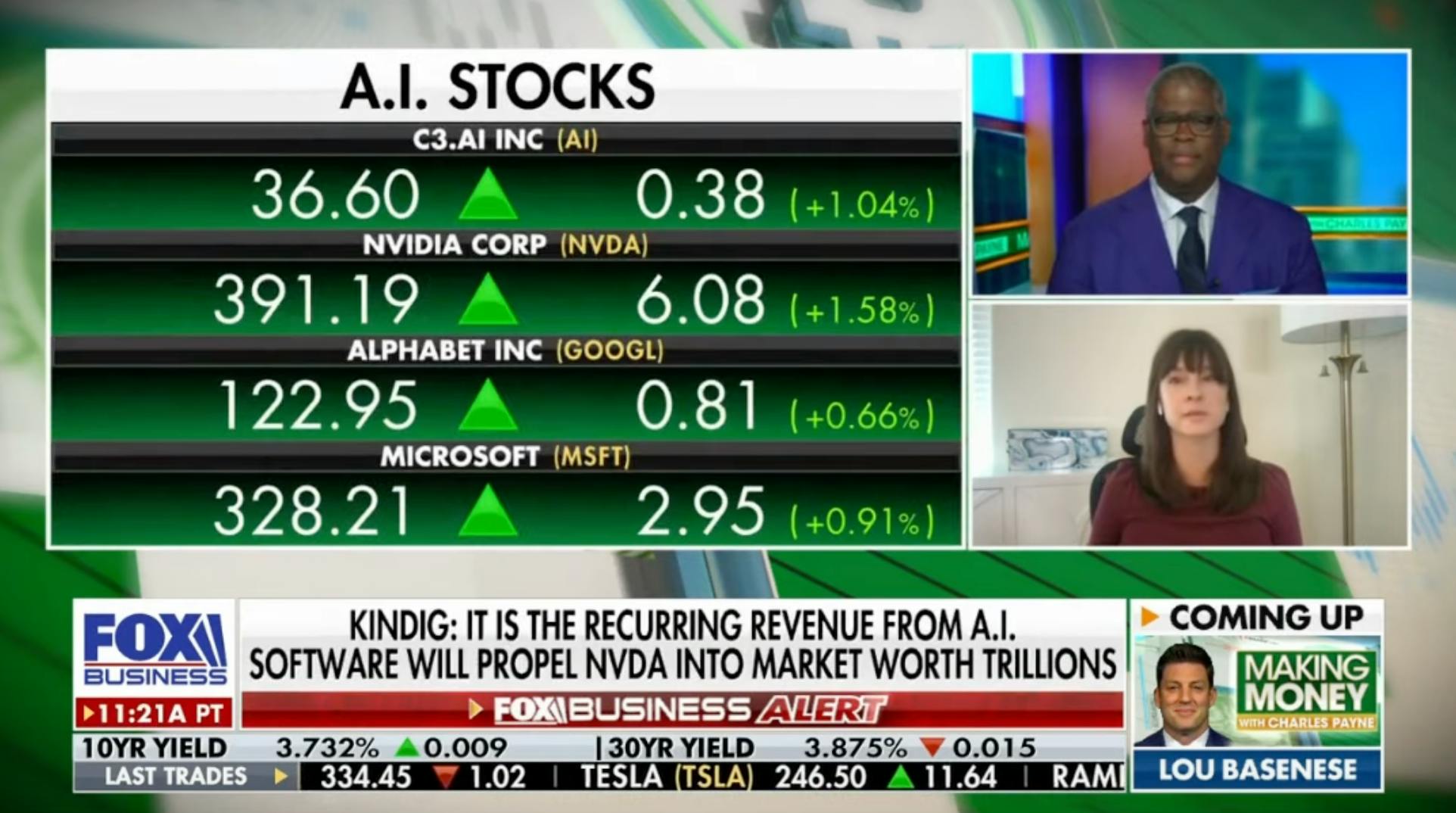
Beth on Fox Business News: Nvidia’s future AI dominance will be propelled by Software
In the clip below, Beth Kindig discusses with Charles Payne of Fox Business News how “it was a hardware that provided the $950 billion to $1 trillion market cap we see today [for Nvidia], but it will be software that will propels Nvidia into the Trillions for market cap.”
She specifically points toward DGX Cloud and AI-as-a-service for Nvidia’s software layer and how this is expected to eventually eclipse its hardware revenue. The cost of AI supercomputers can be several million dollars and Nvidia will help to lower the costs of AI development by allowing enterprises and startups to rent a supercomputer in the cloud for roughly $40,000 a month. Kindig states this is likely to be popular not only because the costs of AI development are prohibitive but because AI is a race in terms of time to market, as well.
The video below was originally recorded on June 9, 2023.
Beth on Fox Business News: AI will drive $100 billion in revenue for Microsoft
Microsoft is another AI stock that Charles Payne interviewed Beth Kindig about later in the month of June. Payne specifically asked Kindig about her research note that stated the company is well positioned to increase revenue by $100 Billion. She cites Microsoft CoPilot as a primary driver as it can immediately increase enterprise spend on the Office 365 productivity suite, as well Bing Search which will add $2 billion in revenue for every 1% of market share that Bing takes from Google as a result of Chat-GPT. In addition to this, cybersecurity is a $15 billion market and it can easily double by 2027 with the help of AI.
The video below was originally recorded on June 15, 2023. You can view the clip here.
Beth on Bloomberg Markets: Nvidia benefits from Accelerated Computing and Generative AI
Beth Kindig discusses Nvidia's competitive strength and AI. She speaks with Rishaad Salamat, David Ingles, and Yvonne Man on "Bloomberg Markets: China Open." Beth Kindig highlights that the company is very resilient and insulated. The reason is that companies have been saving cash to buy accelerated computing for the data center and Generative AI applications. Most tech companies are coming under tighter tech budgets, but the one area of growth is specifically AI within Big Tech capex budgets. This is the market Nvidia serves.
Every Thursday at 4:30 pm Eastern, the I/O Fund team holds a webinar for premium members to discuss how to navigate the broad market, as well as various stock entries and exits. We offer trade alerts plus an automated hedging signal. The I/O Fund team is one of the only audited portfolios available to individual investors. Learn more here >>Learn more here >>
Beth said that semiconductors will continue to be winners because this is what is enabling accelerated computing. In the past, data center investment was focused on processors. Now, they have to move to accelerated computing, and that’s where Nvidia benefits because NVDA is the leader in parallel processing.
At minute 3:00, Beth outlines the risks for China, stating that any long-term Nvidia investor should be prepared for China to be the primary threat for this company. “This can rock the stock, so to speak,” she stated. AI is an immense opportunity but “for these major design companies which includes AMD, China could not be more important.”
The video was originally recorded on May 25, 2023.
Beth was also interviewed by Real Vision, where she followed up on her initial call in January to buy Nvidia. At the time, she was asked what would cause her to sell the stock and she “absolutely nothing except maybe World War 3.” Fast forward, and today Beth has the highest returns from the 3 Ideas Series on Real Vision. The follow up is behind a paywall, but those with a Real Vision membership can view it here:
The video was originally recorded on May 25, 2023.
As stated in the article, Beth Kindig and I/O Fund currently own shares of NVDA. This is not financial advice. Please consult with your financial advisor in regards to any stocks you buy.
In the case of Microsoft, we have used a sum-of-the parts valuation model alongside traditional metrics to determine a price target. The SUTP helps to separate and value the three main businesses – Intelligent Cloud, Productivity and Personal Computing – as each have different growth profiles.
Factoring in the AI/ML drivers we’ve described, we revisited our sum-of-the parts analysis. These drivers will have the biggest impact on the Productivity and Intelligent Cloud Businesses.
We believe the implied market multiple assigned to the Intelligent Cloud and Productivity businesses still undervalues the potential revenue opportunities.
As Microsoft continues to further integrate AI/ML into its offerings, this will further strengthen its core offerings and be the catalyst for new ones. This will provide new revenue opportunities from its installed Fortune 500 client base which we believe warrants a higher multiple.
Under our base case scenario, these drivers increase the SUTP by $40 per share and under the bull case by $70 leading to a total SUTP of between $360 and $390 versus the current price of $330.
Conservatively assuming that Microsoft’s group operating margins remain at current levels, a $100 billion increase in revenue could potentially add an additional in $40B in operating profit.
Based on this scenario, MSFT AI could earn $4.67 (vs MSFT consensus of $9.65 FY 2023). Placing a 30x multiple on gets you about $140 per share. So MSFT + MSFT AI = $485.
To be conservative for now, we can say MSFT AI may generate between $4.00 to $5.00 per share in earnings.
We can also take the avg of the 2 SUTP (390 + 485) for a SUTP value of about $440 over the next few years under the 100B AI scenario.
Buy Plan:
Considering where we are in the business cycle, it’s best to understand Microsoft within the context of the broader market. Our general market outlook is that the market will likely experience a bout of volatility into the summer.
As long as the S&P 500 holds the 4225-4200 region, we can continue to see a continued bullish swing into later 2023/early 2024, before the recession starts to get priced into equities. Until the FED starts a fresh liquidity cycle, and we get eyes on the extent of damage the 2022 rate cycle caused in the economy, we expect choppy price action with a downward bias, with the potential for one more-larger push higher, at most. If this plays out, we could see the NASDAQ-100, and even the S&P 500 make new highs; however, small caps, financials, and many other economically sensitive areas of the market have likely topped.
That being said, there are two general paths we are tracking in MSFT:
Blue – As bullish as price action in Microsoft has been, we only have a 3-wave move off of the January low in Microsoft. This leaves the door open to the uptrend in 2023 being the corrective bounce in a much larger corrective pattern that began in early 2022. The catalyst would likely be macro, as it relates to the manifestation of a credit cycle downturn that is not currently being priced into equities right now. We would need to see price break below $260.50 in the coming summer volatility. If this happens, then we will be targeting a retest of the January lows.
Red – On the other hand, this 3-wave move off the January low, can turn into a 5 wave move. This would require the summer volatility to hold within the green target box below, and then turn back up to make a fresh high. If this happens, then THE low is likely in for MSFT.
Our buy plan is to accumulate based on both scenarios playing out. So, we will start adding to our position in the $300 – $265 region.
We share buy plans such as this one every week in our premium webinars held on Thursdays at 4:30 pm EST. We also issue real-time trade alerts when we do buy and are one of the only audited portfolios available to retail investors. Our performance exceeds institutional all-tech portfolios. Learn more here.Learn more here.
AI continues to be an investment theme in all investor’s minds. NVDA’s recent results only added fuel to the fire. We’re continually analyzing the AI stack to find other companies that will benefit. We’ve identified companies such as Nvidia, AMD, Microsoft, Taiwan Semiconductor, which we’ve written about on several occasions, plus ASML and Super Micro, more recently. Note: We also covered Marvell on our forum, which you can read here.which you can read here.
Summary of Cadence: AI-Based EDA
Cadence Design Systems provides semiconductor chip design and printed circuit board design tools. In the era of AI, the company has expanded to AI-Based EDA, which stands for AI-Based Electronic Design Automation.
Cadence’s tools eliminate defects in semiconductors early-on during the verification process, which is quite valuable, as catching a bug too late can be exponentially expensive and problematic for design companies.
In addition to improving product quality, there is also a large opportunity for Cadence in reducing the time required to design chips, especially as design companies move quickly toward smaller node sizes. In the past, semiconductor companies, pursued time-consuming methods such as transistor-level and cell-based designs. More recently, Design Reuse has been a popular design method to increase productivity, which is taking an IP block and dropping this into the new chip.
Cadence’s AI-Based EDA will greatly increase productivity by leveraging AI to augment human engineering. This is especially important as the nodes are shrinking, which increases the costs for the physical design process (dark blue in the chart below) and verification (dark green in the chart below).
Source: Cadence Design Systems, CadenceLIVE
Management made these general comments on the demand environment:
“Exploding chip and system design complexity will drive a significant non-linear growth in the workload requirements, opening up a massive opportunity for computational software to help realize these innovative products by investing more of the R&D spend in automation.”
Cadence offers a wide range of AI-based tools for digital implementation, regression and verification testing, or cell library characterization. However, more importantly, Cadence is moving into AI platforms which wrap the AI-based tools into frameworks. This expands the ways Cadence’s tools can be used.
Stock attributes that we like
Exposed to mission critical capex – Chips are shrinking, which adds complexity to the design. Before actually spending millions on a chip or system, hyperscalers and design companies need to ensure that the chips and systems will work. Computational Software is an integral part of that process to design and verify that the chips will operate as intended. Clients include not only the semiconductor heavyweights such as Nvidia, AMD, Samsung and Broadcom but across other industries, such as Electric Vehicle systems.
High switching costs for customers – After a client designs a successful chip using Cadence software. It’s less likely the client will switch to another software provider to design the next generation. This increases the likelihood that the client will renew the software licenses
Subscription model – 85% of revenue is recurring with a visible backlog which contributes to consistent FCF generation and steady operating margins
AI Platforms for EDA:
Cerebrus: Digital Design and Optimization – 28% of Revenue
Uses training data from reinforcement machine for full flow optimization. What reinforcement machine learning does well is trying new options and learning what works, which lowers the human effort in the design process. This platform can be used for both at the system level and for silicon optimization. If you think of a car, it has a large system that combines many components and it has chips and circuit boards. In this case, Cadence can be used for the system or the chips.
“Among others, [Cerebrus] is now deployed at 10 of the top 20 semiconductor companies, including 7 of the top 10 semis and at several major hyperscalers. In Q4, we successfully delivered an advanced HPC design and a CPU design using our digital full flow and Cadence Cerebrus on TSMC N5 process technology, delivering 8% reduced power and a 9% area improvement while significantly improving engineering productivity. In 2022, several market-shaping customers, including Intel, NVIDIA, Broadcom, Samsung and Renesas shared their remarkable successes with Cadence Cerebrus at our CadenceLIVE user conferences.”
Optimality: In-Design Optimization
The optimal electro-mechanical system needs to run many cycles of simulations until the system reaches its performance goals. This platform provides the parameters to reduce the number of simulations required. In a case study the company provided, Optimality reduces the number of simulations from 3125 to 79 simulations. This reduces the number of required engineering hours from 66 hours to 1.6hours. In a second case study, it reduces the number of simulations from 625 to 58 simulations, with a reduction of hours from 110 hours to 11.3 hours.
Verisium: AI-Driven Verification and Debugging – 26% of Revenue
Combines the AI-enabled tools for simulation, emulation and prototyping and uses AI techniques to find the failures. It can be very time consuming to figure out the cause of a failure. By using AI, the engineer can go quickly to the root cause of the failure and to the bug fix.
Per management, the verification business grew 28% year-over-year, and is used for mobile, hyperscale, high performance computing and electric vehicles. It was also stated that Verisium delivered up to 30X improvement in efficient root cause analysis.
Allegro X AI: AI-Driven PCB – 12% of Revenue
Allegro X helps to optimize circuit boards and systems using generative AI. It particularly helps with automating the placement and routing of components on a board.
Virtuoso: AI-Driven Custom Layout – 22% of Revenue
Virtuoso is a platform that helps move existing chips design and intellectual property over to a new generation through AI trained algorithms. One reason that Cadence is defensible against large language models is that these platforms require large data sets, whereas Cadence’s platforms can be trained on a much smaller yet highly specialized data set. This is ideal for chip designs, which are proprietary and are not shared. Cadence is ideal as the platforms can train using the smaller data sets that a company owns (and does not share).
Regarding the two generative AI platforms, Allegro and Virtuoso, the following was stated on the earnings call:
“Generative AI design tools are revolutionizing chip and system development by delivering unprecedented optimization and productivity benefits. Customers have already been benefiting from our ground-breaking generative AI solutions in the digital, verification and systems areas, and with the recent introductions of Virtuoso Studio and Allegro X AI, we now have an unmatched chip to package to board to systems generative AI portfolio.” Several customers including MediaTek, Renesas, Analog Devices and TSMC provided testimonials for the launch.
IP – 12% of Revenue
IP offerings consist of pre-verified, customizable functional blocks, which customers integrate into their ICs to accelerate the development process and to reduce the risk of errors in the design process.
JedAI: Joint Enterprise Data and AI Platform:
In September, the company released a platform to fuel the AI platforms called JedAI. This horizontal platform provides a knowledge repository between projects and serves as the big data analytics layer. There are many tools and projects required for hardware designs (listed above), and Jed AI provides the fuel (or a knowledge base) to improve efficiency for future designs from past projects. This is done by leveraging data from previous design projects, workload data (runtime, memory usage) and workflow data.
Below is an engineer’s view using Cadence’s chip design software.
Helping to improve Nvidia’s GPU Performance
For example, by integrating Computation Fluid Dynamics (CFD) with System Design Automation, Nvidia was able to improve the speed and power of efficiency of its GPU chips. Computation Fluid Dynamics (CFD) is an aspect of multi-physics system analysis that stimulates the behavior of fluid and their thermodynamic properties using numerical models.
“Recently with our collaboration with NVIDIA, Jensen talked about that Cadence CFD on GPU for the same cost is giving a 9x improvement in speed up and 17x improvement in power efficiency. And GPUs are slightly more expensive than CPUs. I mean, typically, I would guess, at least 3x to 5x. So, you're getting 30x to 50x speed up on GPUs that normalized for cost is still getting 10x or 9x improvement in speed. So that's a huge improvement based on our special algorithms, because we have a long history of massive parallelism in CPUs and now we are applying it to GPUs, especially in SDA, both for electromagnetic and CFD. So, I think that can also provide a lot of growth. I talked about AI and all for chip and system, but this acceleration on GPUs, accelerated compute for system analysis is another big vector.”
Evolving from EDA to SDA
Currently, there is a shift in electronic design systems from EDA (Electronic Design Automation) to SDA (System Design Automation). No longer can components be designed in isolation and integrated by systems engineers. As a result, electronic and mechanical design are increasingly becoming intermingled which requires the co-design and co-optimization of every component in an electronics system and every aspect of the physical nature of the systems.
Traditional EDA can already solve system simulations measured in billions of transistors. In the future, SDA will be able to process simulations involving 1 trillion transistors. Per the management team: “[…] some of these chips have 100 billion transistors, right, on 1 inch by 1 inch. And if you look at by 2030, they will have 1 trillion transistors, okay? So just in terms of size, it will be 10x more. And then the chips are more complicated and then you add software on top of it. So the design complexity that our customers need to do will go up by at least 20, 30x in the next 5 to 7 years. So the only way to meet that is by more (SDA) automation. That’s the history of our industry, And the best way to do more automation right now is using AI.”
Business model + Historical Growth (2016-2022)
Between 2016 and 2022, on the back of these positive secular tailwinds Cadence delivered a revenue CAGR of 11.9% and non-GAAP EPS of 23.4%. Despite selling products into an industry that can be cyclical, Cadence has been insulated from the profitability ups and downs of its semiconductor customers.
Because of its subscription model, 85% of Cadence’s revenue is recurring. Typically, Cadence enters into time-based license arrangements which grants customers the right to access and use all of the licensed products at the outset of an arrangement and updates are generally made available throughout the entire term of the arrangement, which is generally two to three years. Cadence’s updates provide continued access to evolving technology as customers’ designs migrate to more advanced nodes and as its customers’ technological requirements evolve. Payments are generally received in equal or near equal installments over the term of the agreement. Clients have the option to renew the license at the end of the agreement.
The 2022 revenue breakdown and 22/21 YoY growth rates for the 5 software segments:
The remaining 15% of revenue is upfront revenue mainly from the sale of Emulation and FPGA Prototyping hardware equipment. Typically, it’s the same clients who use the software and then use the hardware for testing and verification purposes.
China contributes 17% of revenue.
Profitability:
Similar to its Revenue and Non-GAAP eps, Cadence’s non-GAAP operating margins have steadily increased from about 26% in 2016 to ending at 36% in Q422.
Additionally, FCF generation increased coupled with share buybacks and healthy balance sheet.
Q123 Financials:
For q1fy23, Cadence reported revenue of $1.02b (+13.3% y/y) which matched the upper end of their guidance of between $1b-$1.02. Non-GAAP eps was $1.29 which beat their guidance of $1.27 and consensus of $1.25.
For q223, Cadence guided revenue $960 million to $980 million, non-GAAP EPS $1.15 to $1.19 and GAAP EPS $0.73 to $0.77.
For q1fy23, GAAP operating margin was 31.6%, right in the middle of company guidance, vs 35.4% last year. While non-GAAP operating margin 42.1%, lower than 44% in the prior year, but exceeded the upper end of management’s 42% guidance.
For q223, Cadence guided non-GAAP operating margin 40% to 41% and GAAP operating margin 29% to 30%.
Looking at the balance sheet, Cadence finished q1 with $917 million in cash and debt of $678m. Operating cash flow was $267 million. And repurchased $125 million worth of Cadence shares.
The Q123 backlog stood at $5.4b vs $5.8b Q422
2023 guidance
Cadence updated their 2023 full guidance. The revenue range was increased from $4.03b to $4.07b vs $4.0b to $4.06b. GAAP eps in the range of $3.26 to $3.34 versus $3.24 to $3.34 and non-GAAP eps in the range of $4.96 to $5.04 versus $4.90 to $5.00
GAAP operating margin in the range of 30% to 31% vs 30.5% to 32% and non-GAAP operating margin in the range of 41% to 42% vs 40.5% to 42%.
Operating cash flow in the range of $1.3b to $1.4b. Expects to use approximately 50% of free cash flow to repurchase Cadence shares.
Cadence’s full year 2023 guidance represents of +14% sales growth and 17%, non-GAAP EPS YoY. Full year guidance was very modestly raised by $20, spread evenly between hardware and software. Despite the better-than-expected hardware sales in Q1, Cadence is taking a wait and see approach and didn’t want to further raise the FY guidance at this time.
Initially, the stock reacted negatively to the Q1 earnings report likely on 1) disappointment that 2023 guidance was not raised higher, 2) sequential q4/q1 backlog decline and 3) q1/q2 decline in sales guidance. It has since recovered with the Nvidia’s blowout earnings likely driving it higher. See below for questions from analysts on these points.
Earnings Call:
Analysts were concerned about the 5% sequential decline in revenue provided in the guidance:
Question
Oh, sorry, yes. And then, my second question on the guide, it looks like second quarter is going to decline sequentially by about 5%, consistent with what we saw last year too. So maybe just a quick refresher on what's driving the seasonality here?
John Wall
Yes, when you look at it, it will be — it'll show up in the functional verification number next quarter. I think the — when I look at — like Q1 was great. I mean, functional verification was up 30% year-over-year. The quarter was up low teens. When I look at Q2, Q2 also looks great. It's going to be up low teens again compared to Q1 '22, but functional verification will be up probably closer to 20% rather than 30%.
But — so, it's our expectation that in our guide, we're assuming that the recurring revenue mix for the year stays at 85-15, 85% recurring, 15% upfront, same as what we experienced last year. Now, in Q1, it was 80%, 20%, so there was a lot of open revenue for the hardware deliveries that went out in Q1. In Q2 — we expect Q2, Q3, Q4 to be less than the 80-20, and it will average 85-15 for the year. So, you're seeing that in the Q2 guide”
Regarding Q4/Q1 decline in backlog from $5.8 to $5.4b. Bookings and renewal environment continue to be solid. H1 tend to be weaker. Q123 was also impacted by timing and big renewals in H1 2022.
“The second half of this year is very heavily weighted for bookings for the total year. We're very light in the first half of the year for software renewals. The second half of the year, Q3 and Q4, are very strong for software renewals this year. Unlike last year, last year, I think the first half was we had a number of big software renewals in the first half, we don't have that this year. And when you look at the second half, of course, I mean any big renewal you have in Q3 — at the end of last year, we had like nine months in RPO for that and now it's only six months at the end of this quarter. So, it's really just a function of renewal timing and the fact that the first half of the year is light for renewal timing [..] What I was trying to convey was that we had very few software renewals that came up for renewal in Q1 and therefore bookings were expected to be light. The beauty of the recurring revenue model that we have is that the timing of those renewals is not especially important, but it's the annual value of those renewals. And that we continue to see growth in the annual value of those bookings, and we see growth across all of the businesses.”
Key Risks
Currently, the biggest risk is Cadence’s 17% exposure to China where they sell software and hardware such as Emulation and FGPA Prototyping hardware equipment. Hardware sales to China were strong in Q123. Total hardware sales have ranged from 15-20% of sales and are recognized upfront.
Similar to other tech sectors, if the US gov’t restricts hardware citing competitive reasons, this will adversely Cadence.
However, at the moment there is nothing to indicate that this will happen. But any headline suggesting that will impact the stock price.
Conclusion:
Taking into consideration the recent AI rally that lifted Cadence stock price, coupled with the sequential decline in Q2 and premium valuation, we are sensitive to entry price levels.
We expect it to be a medium and long-term winner. Cadence occupies an important piece of the AI stack and is at the intersection of secular megatrends such as 5G, hyperscale computing and AI/ML that are driving sustained investments by its semiconductor and systems customers. Despite the macroeconomic uncertainty, Cadence’s clients continue making significant investment in their next-generation products, resulting in robust design activity.
Ultimately, we will want to see revenue accelerate beyond the mid-teens. It’s a matter of deciding if the story is strong enough to buy in advance of an acceleration or wait for higher revenue to be reported and forego an earnings pop.