The growth of cloud IaaS in China is why we are invested in Kingsoft Cloud. Below, we review this company in light of a missed earnings report and weaker price action than some of our other positions.
Background on KC:
Kingsoft Cloud specializes in internet streaming, yet has incredibly strong parent companies for an opportunity this size. The two parent companies are Xiaomi, the number three mobile device globally second to Apple and Samsung, and Kingsoft Corporation, which is a software company from the 1990s that is the equivalent of Microsoft Office in China.
Xiaomi gives its traffic to Kingsoft Cloud, and therefore, mobile streaming and internet traffic is a specialty. This is seen in the client list of ByteDance (Tiktok), iQIYI, Bilibili and NetEase. Notably, Xiaomi is on the blacklist but this isn’t too surprising as a mobile company.
What is interesting to me is the internet-of-thing (IoT) footprint that Xiaomi has, which is the largest in China. According to Harvard Business Review, Xiaomi has surpassed $37 billion in IoT revenue from more than 210 IoT devices excluding smartphones and laptops. The article is a good read as HBR did a “multi-year” review on how Xiaomi grew its market by targeting price conscious and tech savvy consumers. The company then strategically set up retail locations to attract IoT purchases.
Kingsoft Cloud is also moving quickly into the enterprise cloud, which should help the company diversify from public cloud (i.e. the mobile/internet streaming). You’ll see below in the Financials section that this is where the majority of the growth is coming from. The company noted verticals such as Finance and Health Care as their major focus. This entry shouldn’t be terribly difficult given the parent company Kingsoft Corporation holds a spot similar to Microsoft Office in China with enterprise customers using the WPS Office software.
The reason Kingsoft Cloud can be considered a bit safer than other Chinese stocks, in my opinion, is that the company is on a $1 billion annual run rate. In addition, China has made it clear that becoming a leader in 5G and AI is a primary focus and this is impossible without a larger cloud IaaS footprint. There is a serious gap here in the country’s ambitions compared to the country’s capabilities. We first covered this with our Alibaba premium research report where we said the following:
“China’s enterprise IT market is five to seven years behind the United States and Western European markets. Once fully mature, China’s need for cloud infrastructure will rival the United States with 3x the population and a bottomless appetite for smart cities, artificial intelligence and machine learning plus manufacturing IoT automation.
The reversal of where China is today with cloud IaaS, and where China will be in five years, could be a bigger story than the B2B marketplace as the growth is closely tied to China’s position as a global leader.
In 2017, China published a roadmap on how it seeks to become a global powerhouse in AI. According to the report entitled “Next Generation Artificial Intelligence Development Plan,” the domestic AI market will be worth a total of $150 billion. Today, China’s AI market is worth $6.2 billion.
Artificial intelligence and machine learning require private cloud and public cloud infrastructure-as-a-service (or a hybrid mix with on-premise servers) as storing data in separate silos weakens AI and ML capabilities, reduces training performance and lowers accuracy. Artificial intelligence and machine learning require speed with most AI solutions split between 40/60 with private/public cloud or 60/40 if you’re a regulated industry.”
Although we closed our position in Alibaba, a similar thesis applies to Kingsoft Cloud.
Overview of Cloud IaaS
In the Top 10 LTBH webinar when I covered Datadog, I had stated that if the tech giants all believe cloud IaaS is the most critical layer into the foreseeable future, who am I to argue with this?
The chess game has been set with AWS’s Andy Jassy now CEO of Amazon and Azure’s Satya Nadella as CEO of Microsoft. I’ve also made the case that Google better hurry up and find its focus because these two heavyweights have chosen their primary focus and direction for the next decade.
Basically, I want exposure to this strong positioning. Although SaaS shows the most revenue overall globally, it’s being clearly communicated from Big Tech that IaaS is the most important layer. I could write a whole report on why that is (and will when I cover Datadog soon). Primarily it’s not only the infrastructure for software but is also the infrastructure for AI, ML and 5G.
Regarding Kingsoft Cloud, it’s centered in this trend and in the region where the most growth will occur. In fact, China is unique from the United States because cloud IaaS is China’s largest category in terms of revenue whereas software is the largest globally.
The interesting part is that China grew much, much faster than these estimates predicted. In fact, due to Covid, Alibaba reported 60.1 billion Yuan in fiscal year 2021, or about $10 billion USD.
According to IDC, the Q4 cloud IaaS market in China was at $3.49 billion, or annual run rate of $14 billion. If we look at the size of the global IaaS market, which Gartner states was $82 billion in 2021, then we see China is equal to about 17% of the market if we calculate with the 2021 average of $14 billion.
The market in China is expected to grow at 28.3% CAGR compared to United States growth of 20.3% CAGR from 2019 to 2024. Notably, these estimates were given prior to Covid.
If we take only the public cloud market, Frost & Sullivan predicts the market will grow from 81 billion RMB to 368 billion RMB in 2024 – or nearly 5X. Right now, China has about 6.5% of the global public cloud market and this is forecast to grow to 10.5% by 2024.
As outlined in the S-1 filing, the same firm predicts that China’s internet cloud market will grow 4X from roughly $50 billion RMB to $215 billion RMB and the enterprise market will grow 3X from $108 billion RMB to $345 billion RMB.
Of the 17% that China has, Kingsoft Cloud stated in the S-1 filing from 2019 that they have 5.4% in terms of revenue from IaaS and PaaS.
The estimates indicate that China will take increasing market share in cloud IaaS as the country catches up to other developed regions. With many segments expected to double in percentages, we can comfortably assume China will own 20% of the cloud IaaS market.
If Kingsoft Cloud grows to own 10% of the market, and we figure $23 billion for the Chinese market in two years ($14 billion at 28% CAGR), then the company should hit around $2.3 billion in annual revenue.
$2.3 billion happens to be what the analyst estimates are, as well, for FY 2022
This implies growth of about 50% this year from annual revenue of $947 million to $1.5 billion and also 49% growth the following year.
Financials
This quarter, Kingsoft Cloud reported growth of 30% for $1.81 billion RMB in total revenues, equal to $277 million USD. This means Kingsoft is a $1 billion USD annual run rate, which is rare for China. Public cloud makes 77% of revenue with enterprise cloud 23% of revenue. The enterprise cloud grew 131.3% in the most recent quarter.
The revenue missed consensus of $1.88 billion RMB.
Despite tougher comps following Covid, Kingsoft is guiding for second quarter revenue growth of 39% to 45%, which represents a reacceleration from Q1. However, the company’s guidance of 2.13 billion RMB to 2.23 billion RMB is also under Q2 analyst consensus for 2.41 billion RMB.
Last year, the company reported 58% growth in Q2 2020. As with all Covid beneficiaries, analysts are timid as to KC’s growth in the back-half of the year as the company reported 75% and 72% in revenue, respectively. This means the hurdle is higher for KC in Q3 and Q4. Perhaps the stronger guide for Q2 is a good sign. The company repeated many times that the backlog is healthy with RMB 2.8 billion, or $432 million (a little over a quarter’s worth of revenue). This does not include new bids from Q1, which management alluded to included “some big internet companies.”
The adjusted gross margin increased from 4.9% last quarter to 6.7% this quarter. In the earnings call, management noted the improvement was attributed to the financial and health care verticals, and the contribution of public cloud’s revenue and margin.
The company has a cash position of RMB 5.46 billion, or about $840 million USD. The company’s loss per share improved from RMB 0.39 to RMB 0.11 or ($0.02) per share.
Valuation:
It takes about two seconds to see the massive discount Chinese that stocks are trading at compared to stocks in the United States. Kingsoft is not immune to the China discount as it has more revenue than cloud stocks Okta and Datadog yet trades at 1/6 the forward P/S.
When the chart below is adjusted for a 3-5 year time frame, we see it has been since March of 2018 that Chinese stocks and United States stocks traded in the same range of 15 P/S. There was a strong decoupling after early 2018.
Kingsoft held the 15 P/S range in February of 2021 so it’s not out of the question the company could return to this valuation. It would need to meet/exceed guidance on Q2 and to guide strong for Q3-Q4 to resume these levels. Cloud IaaS is fully capable of this because it tends to be a steady performer.
Management:
Jun Lei, the CEO of of Xiaomi, serves as the Chairman of the Board of Directors. He has been with Kingsoft since 1992 and was also previously the chairman of Cheetah Mobile. The CEO of Kingsoft comes from Phoenix New Media, an internet, mobile and television company in China. The Board also has members who previously held roles at Google/IBM and IDG Capital/McKinsey. Management has members with experience from Goldman Sachs Asia (CFO), enterprise cloud company Qiniu, gaming company Zynga and Baidu.
The most critical member is Jun Lei as he accomplished the unusual feat of rising to the top of China’s most treasured industry – mobile. He overcame Apple for the number one spot in China in 2014 and is now in the number three spot. To be frank, he did this by ripping off Apple, but nonetheless it was an accomplishment as United States companies dominated China prior to this breakthrough.
In 2013, he was appointed a delegate of the National People’s Congress.
Risks:
The risk to Kingsoft Cloud is not the addressable market, the growth/demand and timing, or even number of competitors. The risk is the size of its competitors. Cloud SaaS in the United States is a great example of a category where competitors tend to be similar sized, and therefore, the playing field is level. This isn’t the case with cloud IaaS where BAT (Baidu, Alibaba, Tencent) rules China like MAG (Microsoft, AWS and GCP) rules the United States. Now we have to add H to the acronym for China as Huawei is growing rapidly.
Kingsoft Cloud is the largest independent cloud provider, which means there is no conflict of interest for internet companies to work with KC as they don’t directly compete. Tencent and Baidu, for example, compete with smaller internet companies.
Another prominent risk is the costs associated with building out infrastructure. The adjusted gross margins are drastically lower than the SaaS category in the 70%+ range. You can also see the costs associated with IaaS reflected in the IDC costs, which cover bandwidth and racks. These costs range between 68% of revenue in 2020 to 77% of revenue in 2017.
We’ve covered the fact that Kingsoft Cloud is not audited in this write-up here.
Conclusion:
We try to have a diversified portfolio across tech and China is a region we want exposure to. With that said, China is not for everyone. For the I/O Fund, it’s easier to invest in a stock in China long-term that has solid parent companies and is participating in a predictable trend.
We will need to see one of two things happen for Kingsoft Cloud to resume its previous valuation of 15 P/S. The company needs to come in strong in the second half of the year or we need to see China come back in favor. The first one is where we have focused our efforts in this analysis.
We think a cloud IaaS company with $1 billion in revenue and 50% growth is investable. It has a rock bottom valuation coupled with the recent history of trading at a much higher valuation.
We’d like one more day to import the data from the old forum. We plan to start posting on Thursday, June 24th so please use Tribe for one more day.
As you’ll see, we are calling this a Wire rather than a Forum as we have begun to rely on the transmission of information on the community site. I find myself not wanting to miss out on the information posted on the forum and we think the word Wire best represents the critical and professional nature of the community.
Some bullet points:
Downvote and Upvote is enabled. Similar to Reddit or HackerNews, the forum will be organized by which posts are the most popular.
We are launching with “Trending” but plan to add “Most Recent” and “Most Popular” for sorting the posts. You will be able to quickly click through these three ways to sort the posts.
Bookmarks are enabled right now so if you like a post and want to save it for later, you can hit the upper right tab and it will save to your bookmarks.
You’ll be gaining points as you post. We will call this “equity” rather than “karma.” The benefit of this is that those who are down voted will see the effects of posting against our Forum Guidelines. On that note, the Forum Guidelines were written with the group in mind and after getting quality feedback from our members.
Formal moderation is coming soon. If the flag button is hit enough times by enough members, then the post will be removed until it can be moderated by our team.
I/O Fund Activity and Stock Setups in the menu will allow you to reference I/O Fund posts quickly. Knox’s trade setups will be going in the right hand where it says RECENT TRADE NOTIFICATIONS. These will automatically post when you get the SMS/email notification and will remain on the right side as you scroll through other posts.
You’ll see a placeholder for Crypto. The plan is to allow subscribers to either opt-in or opt-out of crypto posts so you have a choice as to whether you see those or not. This will go live in the next 1-2 weeks.
Slack and Mailchimp APIs are coming in the next 1-2 weeks to help you set alerts. For instance, you can get a weekly email of the top-ranking posts.
The New Members tab will be a separate space for New Members to voice questions. This will hopefully alleviate the influx of posts we get on the main feed.
You will have the ability to DM each other in the next couple of weeks.
Thanks again for your unwavering patience on this!
On March 2nd we provided a detailed webinar regarding the state of Bitcoin. We outlined that we could see one more push for Bitcoin into the $64,000 – $107,000 region before we see a major top form.
As the uptrend continued through April and May, Bitcoin topped at $64,895, which was the lower end of our listed range. Because of this, we began a selling campaign, where we took heavy gains by cutting our position in half.
We began buying Bitcoin at $7,717 in 2020, and continued to buy up through the $19,666 breakout. We have re-allocated our cash gains from Bitcoin into beaten down tech stocks. We have also begun buying back into Bitcoin in small increments.
Some of our premium members have shared that they are not getting premium updates in their emails anymore. We understand how important this issue is and want to show you a process called “whitelisting.”
How to whitelist Premium I/O Fund content by popular email services:
Below, we cover how to whitelist our emails in Gmail, Outlook, Yahoo, Mobile and other email clients.
Gmail Whitelisting Options
ADD A NEW CONTACT
From your Gmail: Select Hamburger Menu → Contacts → Create Contact
From your browser, go to: contacts.google.com → Create Contact
CHECK YOUR SPAM
Go to your Spam folder → Mark I/O Fund content as Not Spam
REVIEW EMAIL PROMOTIONS
Drag-and-drop the email from your promotions tab into your primary tab.
A notification prompt will ask you if you want to do this for all future messages from premium@io-fund.com, select yes.
CREATE CUSTOM FILTER
Select your Gmail settings (cog wheel icon)
Find your Filters and Blocked Addresses menu
Click "Create a new filter" → in the From field, type: Premium@io-fund.com → Click Create Filter again → Check the box "Never send it to Spam" → Press the final Create filter button to save.
Outlook Whitelisting
Update your email settings to establish who you want to Block or allow.
On mobile devices, tap the sender’s display picture or icon and it should populate options to “Add Contact” by creating a new contact or saving it as an existing one.
Watch Whitelisting Video Tutorial
3 easy ways to whitelist across email clients
If you use an email client, i.e. an application to manage your emails from multiple providers, you can use any of the three options to whitelist I/O Fund from your email application.
REPLY TO ONE OF OUR EMAILS! Search your inbox for premium@io-fund.com. After you find one of our emails, reply to the email with feedback or questions! When you reply to an email, it indicates the sender is someone you trust.
REPORT AS NOT SPAM
Scan your spam folder for an email from premium@io-fund.com. Report the email as “Not Spam” or “Move to Inbox”
A note for users whitelisting through email clients: if you still notice I/O Fund emails skipping your inbox, you may need to follow whitelisting instructions at the email provider level that was covered in the beginning of the article.
What to do after you whitelist premium@io-fund.com
Monitor your inbox in the weeks to come to see whether you’re getting your latest premium content. If for some reason you are still not receiving premium content notifications, please email us at support@io-fund.com and someone from our team will verify if you’re still subscribed to our premium membership list.
Below, we update the leaders in this space with a concentration on a small cap that is breaking grounds in areas where big tech is struggling – primarily the intersection of enterprise use cases and smart glasses, which are lighter weight and more ergonomical compared to headsets.
AR/VR Macro Overview
According to new statistics published this week, AR/VR is set to grow at a CAGR of 46% between 2021 and 2025 worth $162.71 billion of incremental growth. The growth in 2021 will be 25.13% implying the larger growth will come from the second half of the five-year period.
For virtual reality, Emergen Research points to gaming arcades, theme parks and medical training as key markets for headsets. For example, Snap has partnered with Disney to deliver VR to their theme parks and Vuzix is making key entries into medical training.
Head-Mounted Displays account for the second largest share as it provides an immersive environment for training purposes. The virtual reality market by itself is expected to grow at 27.5% to reach $43 billion by 2028.
The third driver for VR is robotic surgery, surgery simulation, and skills training. Vuzix overlaps in two markets – medical training (#1 driver) and surgery (#3 driver).
The report from Emergen also highlights APAC leading growth over North America. This is due to favorable government initiatives and the rapid rollout of 5G. We cover 5G in a separate section below as these two trends are intricately connected.
When we break the market down further for Vuzix’s sake, the estimate for smart glasses is at $33 billion by 2027. Statista also confirms healthy revenue growth for consumer and enterprise smart glasses in the near term, going from a nearly $0 market in 2019 to $13 billion in 2024.
Those leading AR/VR will have defensible positions based on being first movers. Artificial Intelligence, on the other hand, will like see a period of mergers and acquisitions as the bigger companies cherry pick innovation from the private markets (to compare the two).
The takeaway, is that we could see an influx of institutional interest in AR/VR this year if we see key companies break ground. It feels early because you and I are not using AR/VR in our everyday lives. This is why we need to be very careful to not use confirmation bias when choosing our investments. We also need to be prudent in knowing exactly what markets our AR/VR stocks are cornering as this market is tough to crack. The “what” is not as important in this case as the “how.”
Below, we revisit the larger companies in the space and we end with a deep dive on Vuzix. We expect to build our largest positions in Snap and Vuzix for now, and Unity later in the year or early next year, when we see signs software is reaching enough hardware.
AR/VR: Tough Nut to Crack
The caveat to AR/VR being a 0 to 100 market as we stated in the Unity PDF, is that the trend is very tough to crack. The most notorious failure is Google Glass yet Oculus hasn’t exactly crushed it since the $2 billion acquisition either. Facebook is losing money on the Oculus Quest 2 with some believing this is because they will make up for the losses with software. My personal opinion is that it’s tough to get consumers to adopt AR/VR and the price is being lowered to reflect this. Regardless of the reasons, these are two very capital efficient companies with thousands of engineers and large R&D budgets who have not done well in this trend.
Apple seems to be sleepy here, too, in terms of hardware with a headset rumored for 2022/2023 and smart glasses sometime after the headset. We see Apple foreshadowing the importance of AR/VR for the company in the ongoing augmented reality iOS updates, especially in iOS 14 along with the iPhone 12’s LiDAR that we covered in-depth here. We cover iOS 15 updates below.
Here is the “reality” to virtual reality:
1. Distribution is tough; people simply don’t want to put on a headset for entertainment.
2. If you’ve ever used a headset, you know the lack of 5G creates the obstacle of latency.
3. The demographic needs to be right; this technology requires early adopters who are keen on new experiences.
4. Consumers will be second to the enterprise to adopt AR/VR; meanwhile, the tech giants are broadly positioned across many demographics and are primarily consumer companies. In contrast, Microsoft’s HoloLens is likely seeing early success due to Microsoft having more exposure to defense and aerospace than its competitors.
5. Investors shouldn’t ignore the trust issues around FB and GOOGL. In fact, both Apple in ad campaigns and Snap in the earnings calls are capitalizing on these issues by emphasizing privacy with their software. We will see if this translates to consumers preferring smaller brands for AR/VR or those that place privacy first.
In reference to the list above, we want to circumvent the need for consumer buy-in by focusing on:
1. Lightweight hardware bc headsets are a tough sell
2. Early adopter industries
3. The availability of 5G
4. The right demographic
“Snap, Inc is a Camera Company”
The first slide of the Investor Presentation from Snap says it all: “Snap, Inc is a Camera Company.” Look for Snap to evolve away from social media by leveraging the lens software seen in the app today.
In February of this year, Snap had 150,000 lens creators globally, which is not a bad start considering Apple came out with the first features in 2017 with a bigger push when the iPhone 12 was released with LiDAR last year.
By the Partner Summit in May, Snap had updated the number of global creators to 200,000 at the Partner Summit in May, or 33% growth sequentially. I’m very keen to see what this number is by this time next year. 1 million lens creators should be tipping point and I imagine will connect the dots at that time as to the potential Snap has.
Snap is making it clear that the camera is the company’s biggest opportunity due to augmented reality Lenses. The CEO stated, “In the past few years, our substantial investments against our vision for augmented reality have put us in a position to lead the industry, and we’re doubling down on this strategy in 2021.
Augmented reality has evolved from something fun and entertaining into a real utility. Our camera can solve math equations; scan wine labels to find ratings, reviews, and prices; tell you the name of the song you’re listening to; and so much more… And we’ve barely scratched the surface of what’s possible.”
From the list above, #2 is demographic, and this is the primary reason Snap has true staying power. I had said in the Top 10 LTBH webinar that I’ve been watching this company closely because Millennials are a demographic we want exposure to. We first covered Snap for the premium site in July of 2019 when I was anticipating the launch of the Audience Network product. Audience Network didn’t happen, and instead, something much bigger is coming down the pipe.
The company boasts 90% of the 13 to 24-year old population in the high-spending regions of the United States and leading countries in Europe. Millennials and Gen Z have very high purchasing power with a combined value of direct spending power of $1 trillion. As Snap points out on slide 6, Millennials “are expected to drive over half of the increase in expenditure growth over the next decade.”
Snap held its Partner Day on May 20th when the company announced the launch of AR-enabled spectacles for creators only (not for purchase). The frames feature four built-in microphones, two stereo speakers, and a built-in touchpad. The frames have front-facing cameras to detect objects and surfaces for interacting with graphics (such as when Snap’s CEO caught a butterfly during the presentation). The glasses weigh 134 grams and can be worn indoors or outdoors. There is also a feature called Connected Lenses that allow for multiple people to interact.
The key thing to understand is that Snap is leading in the area of software due to its mobile phone Lenses and Snap’s software should continue to lead with its growing community of creators.
The NFL is an example of a brand that has partnered with Snap during the Superbowl when customized team lenses were offered. Another example is Disney, who is using Snap’s Camera kit to build geo-located branded lenses for its theme parks. Sticker kit offers the ability to build personalized Bitmoji avatars into games and Snap Map allows for geolocated AR experiences.
Brands embrace AR because it leads to higher engagement in ads. Dior recently partnered with Snap and saw 3.8X higher return on ad spend and 6.2X on Lens Carousel.
Management anticipates the advertising inventory potential for a fully integrated AR camera application within Snapchat will potentially lead to a flywheel effect:
We still have a lot of upside in terms of the level of optimization and efficiency that we can deliver, and are investing heavily across the board to both improve our ad platform and support our growing global advertiser base. This has developed into a positive flywheel where our improved efficiency has driven more advertisers and larger budgets to our platform, leading to more impressions and learnings, which in turn increases the rate at which we are able to further improve efficiency and ROI.
Despite all of the very important points made about Snap, the main issue is when consumers will adopt AR/VR hardware. Here is the statement the CEO made in 2019 on timing: “So I think it’ll be roughly ten years before there’s a consumer product with a display that could be really widely adopted.”
Experts from Gartner agree it can be a five to ten-year process before we see a big consumer hit in terms of hardware in this space.
This is why the iPhone and iPad are critical for Snap’s immediate-term distribution. Brands will pay for iOS users and Snap can build new revenue streams right now even without a widely adopted consumer hardware product.
iOS 15 Update: AR/VR
For the next 1-2 years, we are primarily interested in iPhone upgrades and iOS updates for our Snap position. In fact, the iPhone 12 release with LiDAR was probably one of the more bullish things to happen for Snap in its history as a public company. You can view some cool examples of how Apple’s LiDAR works here.
The latest version of Apple’s operating system added new experiences for FaceTime including Spatial Audio to position the location of sounds heard in a video call. Maps has added AR-enabled turn-by-turn walking directions and there are improved Siri features and voice input. This allows Safari browsing and other applications to be used by voice control. Visual lookup and live text allows you to dial numbers and recognize objects by looking them up online.
For developers, the release featured object capture for developers to create AR objects by taking pictures of the physical item to help speed up the time it takes to make virtual content. Spatial Audio was opened up to third-party developers and gaming also got an upgrade.
Apple’s N301 Prototype
According to reports, Apple plans to release a development kit and limited number of AR/VR headsets available as early as 2022. The prototype is named N301. The AR/VR chips have beat the M1 Mac processor in testing as Apple will attempt to deliver something with higher resolution than the competitors. Apple also plans to release AR glasses with codename N421 which could be unveiled as soon as 2023. The headset is not the final product, however, as Apple’s final consumer product will be smart glasses.
The beta headset is the size of the Oculus Quest, according to sources that spoke with Bloomberg. There are cameras to enable the AR features and gesture control. Apple has also been making acquisitions, such as NextVR, that records events such as concerts and sports games. Apple will also build an App Store for the device known as “rOS.”
Releasing AR/VR glasses will require years as Apple will be testing and iterating on how to serve the creation of app developers and how to overcome the hesitancy of consumers who don’t care to wear hardware on their face. There is also the technical challenges of supporting an internet connection with a long battery life and the various electronics that are required. As the article points out, “getting to that point requires years of work on lenses, hardware and software, component miniaturization, production techniques and content creation.”
The statement and general understanding that smart glasses are years out is one of a few reasons we like Vuzix, who is already delivering smart glasses to early adopter industries.
Unity:
In our analysis of Unity, we saw many forecasts that AR/VR would grow from nearly $0 to $100 billion in a short time frame of 3-5 years, depending on the source. We had stated in September that Unity will be a great way to participate in this trend as the company could have a near monopoly on 3D application development.
Notably, Unity and Snap are teaming up for in-game ads. The partnership allows Unity developers to use Snap Kit and tools like Snap Map, Bitmojis and other AR features. In return, advertisers on Snap can also access Unity’s inventory. This is likely the start of an important synergy on AR-related advertising across gaming and social media audiences.
Meanwhile, Unity’s primary competitor, Unreal Engine by Epic Games, is in a heated battle with Apple. This bodes well for Unity as this battle could be viewed as a risk by AR/VR app developers who want to get on Apple’s devices.
In this study done in 2019, Unity was the third most popular AR mobile platform ahead of Facebook and Amazon. ARKit from Apple is number one and ARCore from Google for Android was number two.
With that said, software will need ample hardware distribution. Therefore, we think Vuzix could see AR/VR growth sooner than Unity. We have a placeholder position in Unity, however, will look for bigger positions in Snap and Vuzix in the more immediate term.
Vuzix: Lightweight Glasses for the Enterprise
What Vuzix offers are smart glasses that are lightweight, comfortable and wireless. The company has two main products: the M4000 and the M400 wearable computers (or smart glasses). The products are backwards compatible with the M400 applications working on either device.
The M4000 Series is lightweight at 3.5oz[1], which the company says is comparable to a deck of cards. The upgraded wearable allows for see-through display and is powered by a lithium polymer battery that you can switch out during long jobs without powering down. The run time is between 2 to 12 hours depending on the battery choice and application. Other specs include PDAF 12.8mp auto-focus camera and 4K 30fps for video streaming output. The cost is $2499.
The M400 Series is the base model and drove the most revenue growth in the recent quarter with sales that tripled YoY. This model offers gesture control, voice commands and a high-performance camera for video streaming. This model also allows for a battery swap without powering down. Price is $1799.
Vuzix M4-Series is run on Android and uses the XR1 Qualcomm Snapdragon processor for AR and 4K phased-detect auto-focus camera. The glasses are IP67-rated, which means they’re waterproof and dust proof. The lightweight glasses are ideal compared to a bulky headset for industries ranging from medical work to utility work to automotive.
This has led to the adoption of the glasses for surgeries. Here are some of the recent partnerships Vuzix has made:
· Medacta International is using Vuzix glasses and the NextAR platform for knee, shoulder and spine applications. The platform uses algorithms alongside the preoperative scan to create a personalized biomechanical model for each replacement.
· Rod & Cones placed $1.2 million in orders for the M400 Smart Glasses “beginning immediately” to provide 4K broadcast imagery that allows more supported surgeries in a single day.
· Pixee has achieved FDA approval to use the M400 smart glasses for total knee replacement surgery. Pixee’s platform allows surgeons with little robotics training for better positioning of instruments using the field of view provided by Vuzix smart glasses.
· Medtronic uses Vuzix in the operating room and to also allow visiting surgeons to have the view of the operating surgeon for training purposes.
Here is a snapshot of the health care customer list which accounts for 25% of Vuzix’s revenue in the most recent quarter:
The company also mentioned a leading insurance company has become a customer with a $400,000 order and CooperVision is a manufacturing company that uses Vuzix for their warehouses.
Vuzix recently announced an advanced microLED display-based technology to be released in Q2 2021. The video here shows the microLED is the size of a pencil eraser and can be used in cameras, smart glasses and helmets.
Vuzix’s release of a microLED is important because weight is a primary issue with AR/VR hardware and an area that Vuzix is well ahead of Big Tech. This is one of 191 patents the company holds.
5G is Critical for AR/VR
Please note, we covered 5G on the premium site in anticipation for ramping up in 2020. Most 5G rollouts are delayed from Covid yet we are keeping an eye on this area. You can access 5G reports by going to the Dashboard on the Premium site and typing in “5G” in the search bar.
Commercialized AR/VR is a big challenge as the devices require heavy rendering, on-device processes and split workloads between the device and edge cloud. Because 5G is 100 times faster than 4G, the success of AR/VR is linked to the success of 5G.
For the optimal experience in AR/VR, graphics are ideally rendered on the edge cloud to reduce latency for on-device head tracking, controller tracking, hand tracking, motion tracking and photon processing. The ideal split rendering process in the cloud requires 5G in order for the intended, final experience.
Therefore, not only will it take ten years for consumer hardware to reach critical mass, yet it’ll take equally as long before 5G consumer networks are set up for network slicing on top of public networks with edge cloud infrastructure and also native core functions. Undoubtedly, telecom companies will own this space as they will own the 5G network. Qualcomm is seeing some early mover advantages in on-device processing for the headsets and Nvidia is seeing the early mover advantages across its RTX graphics processing units (GPUs), CloudXR and GPU virtualization software for the edge cloud VR servers.
With that said, urban areas are already set up for 5G with small cells in cities. Hospitals will be one of the first in terms of facilities to be 5G-enabled due to the immediate impact that will be seen in remote surgeries, the transfer of large files, and real-time monitoring. In a smart hospital, AR/VR, AI and robotic equipment that is linked to databases and sensors can aid in complex operations by recommending procedural steps based on the latest medical knowledge and data.
5G-enablement in hospitals was beginning to pick up prior to Covid with the first VA hospital in California becoming 5G-enabled in February of 2020. The first academic health system in Chicago, named Rush, is also a pioneer for 5G connectivity in medical facilities. Many forecasts project APAC to lead 5G including for hospitals and medical facilities. In January of 2000, Samsung and KT Corporation announced a partnership to build a 5G smart hospital.
Vuzix works with either 4G or 5G and has even struck partnerships with last-mile connectivity company Inseego on 5G (we covered this company here on our premium site). Vuzix is also an early partner with Verizon on Blue Jeans where the smart glasses offer support for the remote collaboration platform. Zoom Video has a blog about how AI, AR and VR will impact meetings written in 2018.
KDDI Asia is another early 5G partnership that Vuzix has with the relationship focused on remote support, facial recognition and language translation. KDDI Asia is a Fortune 3000 company that has 40 million mobile subscribers in Japan and Singapore.
Why the Enterprise is Important:
Enterprise drives 2/3 of the current revenue in AR/VR and is expected to lead through the forecast period, according to ARInsider. The forecast made in 2017 specifically points towards hardware as the main contributor as it sets up the install base for software to follow. According to more recent data, the enterprise is expected to generate more than 70% of AR/VR revenue through the end of 2022. (Please note, some of this needs to be adjusted by a year due to Covid delaying this category).
Here’s a snapshot from Perkins Coie as to the leading sectors in AR/VR:
Although a bit outdated, this article on Medium drills down into the challenges around consumer AR/VR and why enterprise will be the first market to adopt the technology. It helps solidify our understanding, which is that consumer AR/VR is a nice-to-have while enterprise is a must-have. According to the survey of 750 respondents, 88% said AR/VR had a positive impact on their business.
Financials:
As stated in the blog from Monday, the company is small in terms of revenue and market cap. Last quarter’s revenue was $3.9 million compared to $1.5 million in the year-ago quarter, or an increase of 156%. Smart glasses sales rose by 177% year-over-year to $2.4 million. The company was break even in terms of gross profit in the past yet posted $1 million in profit in the most recent quarter.
We also pointed out that gross margins are slim at 28% with product gross margins at 45%. As with many small cap companies, the bottom line is a bit ugly as the company has a net loss of $6.6 million. If the company continues to grow the top line, then some of this should resolve on its own as R&D is around $2 million per quarter and sales and marketing is $1.2 million.
Despite being a small cap, the company showed significant improvement year-over-year:
The company closed a public offering of 4,768,293 shares on April 1st for $97.75 million. The shares were priced at $20.50 while the stock was trading at $24.85. The companies proforma cash is $145 million as of April 1st. As with most small caps, the balance sheet and the need for future capital raises is the primary risk. Not only is this a concern for us investors but for larger customers who are buying into Vuzix’s technology and deserve longevity.
In addition to hardware, the company sells software for recurring SaaS revenue. This doesn’t drive meaningful revenue now but good to know there are more revenue streams in the future: “We expect that in the future, for every hardware sale that includes one of our vertical SaaS solutions, we would see an even more significant recurring revenue stream from the application itself.”
There are larger OEMs in the negotiation phase, including a Tier 1 aerospace and defense contractor in Phase 4 of contract negotiations for the company’s Waveguide-Based technology. An example of a completed OEM partnership in production phase is with Jade Bird Display, which manufacturers LED panels.
On June 9th, it was announced that Vuzix will be added to the Russell 3000 and Russell 2000 indexes on June 28th.
Valuation & Risks:
Valuation is an important risk to discuss with Vuzix. The company’s forward price-to-sales was a whopping 85 before correcting to the 50-60 range. This means the company competes with Snowflake and UiPath for the highest valued company in our portfolio.
However, when we look at 1-year forward P/S, then Vuzix looks more attractive at 28 whereas Snowflake trades at a 1-year forward P/S of 40. The consensus among the three analysts covering Vuzix is that revenue will roughly double year-over-year in 2022 at 90% growth from $22 million in fiscal year 2021 to $42 million in fiscal year 2022 ending in December.
We covered AR/VR in Q3 2020 and this was when we estimate the trend began with iOS 14. If the smart glasses market will be $13 billion by 2024, then Vuzix only needs to own 1/26 of the market to 10X revenue if we figure $40-50 million in FY 2022 and we invest in this company with the goal of reaching $500 million in revenue by 2024.
When a small cap has this kind of valuation, there is more pressure for the small cap to perform. The last earnings report had a slight $0.02 EPS miss and a beat on revenue, yet the stock fell from $17 to $15 off the report.
Investors in this company should be aware that this company has a streak of missed earnings estimates between 2016-2019.
There is about 18% institutional ownership, which is on the low side, although 3% increased institutional ownership in the past month.
Intel bought 30% ownership of the company in 2015 and gradually reduced its share of the company to 15% before selling all shares earlier this year. The loss of a large backer is a risk.
Competitors:
Vuzix has many competitors if you look at the broader AR/VR market. Specifically for the enterprise market, the main competitors are Microsoft’s HoloLens and Magic Leap, which has Google backing. Here’s a picture of Vuzix compared to those two, as seen in ZDNet.
Vuzix will need to work diligently to own 1/26 of the market, but as you can see above, it’s a doable. goal. We like the 24 years of experience the management has as it’s usually seen in these incremental product improvements over the competitors. For instance, according to some product analysts, Magic Leap One is inferior in terms of battery life offering only 3 hours before needing to power down the device to change the battery. We also put in a footnote above the comparison in weight to Apple and Microsoft with Vuzix being the lightest smart glasses among the top competitors.
Conclusion:
Enterprise (check).
Passionate and long-term Founder (check).
Early adopter market – medical industries, etc. (check).
Lightweight able to overcome the major hurdle of headsets (check).
Small caps are not without risk. However, we like that enterprise AR/VR is becoming a post-covid play and the forward consensus in the 90% range is certainly investable. We understand that Vuzix and our other small caps will be volatile at times, yet to get a $1 billion market cap entry into this space is worth the risk, in our opinion.
Being a contrarian in tech investing has been a rewarding strategy over the last 5 years. Believe it or not, as far back as 2016, the contrarian position in tech was to remain a bull. Each year since, floods of articles presented the popular thesis that the “tech bubble” was about to burst (2016, 2017, 2018, 2019, 2020, 2021).
For those that remained a contrarian, the cumulative returns of the NASDAQ100 since 2016 has been ~ 207% returns. Meanwhile, the average drawdown per year since 2016 was an eye popping 17%, while the average annual return for the year was about 21%.
Only those who ignored the talk of a bubble participated in the epic run that has resulted in the Nasdaq100 driving forward some of the world’s most valuable companies. Which leads to another point: analysts continually and consistently misunderstand tech in the early days of a company’s rise. Using value metrics to build the case for a bubble, these same analysts have gone silent when that bubble refuses to cooperate with soothsayer predictions.
Once again, this year is witnessing a rotation out of tech growth, as more articles claim that this is the actual popping of the tech bubble – for real, this time. Although I do believe the market will experience a true secular bear market at some point in the future, more importantly, I believe the market is setting up first for what appears to be the next leg higher.
I also believe that tech, as well as growth, will resume its lead in the next leg higher. I outline my reasons below.
1) Understanding Tech and What it is Telling us Now
From September of 2019 through January of 2020, the market narrative was that cloud computing was over stretched, resulting in a severe value rotation. At that time, we were hearing that the stocks in this sector had price/sales ratios greater than many of the tech stocks during the dot.com bubble.
A fair representation of these companies can be found in the ETF with the ticker symbol CLOU. This is a pure play on the cloud microtrend and was overweight many of the richly valued tech darlings of the time, such as Zoom, Shopify, Crowdstrike – just to name a few.
Despite cloud being “overstretched” with “dot-com like valuations,” from the February peak to the March low, CLOU saw a 32.94% drawdown, compared with the S&P500 that saw a 35.63%. Also, worth noting, CLOU finished the year up 77.9% while the S&P500 finished the year up 18.4%.
In other words, stocks with little to no earnings, and a price/sales ratio ranging between 20 – 40, provided more protection to investors during the March ’20 bear market than the value oriented broad markets. The reason behind this phenomenon is either ignored or shrugged off as an anomaly; however, understanding why this occurred is the type of information that would help one to identify companies like Amazon and Google in early stages, despite their rich valuations.
Beneath the negative earnings, and price/sales ratios well into the double digits, are powerful microtrends that can scale globally. Beth Kindig of the I/O Fund presciently wrote an article in 2019 stating that Cloud Computing would be a good safe haven in an economic contraction, even with bubble-like valuations.
“My prediction is this may be one of the last cycles when tech is considered less safe than value stocks. As the market will find out (the hard way), cloud software is actually very safe. It is insulated from trade wars and overseas manufacturing issues. It reduces costs for enterprises, which is ideal for a recession.”
Her thesis was simply that the cloud microtrend was still in the middle of its expansion, and the very nature of migrating to the cloud makes enterprises more efficient as well as reduces costly IT overhead, which can help them survive slowing GDP.
Furthermore, we are seeing companies within cloud grow YoY revenues at rates that are historical records. For example, in recent reports: Shopify grew YoY revenue by 110.4%, Zoom by 191.4% (this is after 3 consecutive quarters of greater than 350% growth), Snowflake grew by 110% and Crowdstrike grew by 70%.
All of these companies came in above consensus in the most recent quarter while most raised forward guidance. We are now lapping the most critical quarter for tougher comps from Covid and we think in the next couple of months, the words “tougher comps” will fade from memory as the better term will be “sustained growth.”
2) Technical Signals
Where is the money from growth flowing?
Since the February top in 2021, we have seen a large rotation from growth names into value. Some have posited that the growth trend is over, and the era of value is set to lead. To get a clue as to whether this thesis is correct, I think analyzing the flow of money from tech is key.
On a simple 3-month relative return, which takes us back to the start of the correction, we can see money flowing from high growth sectors and into value sectors.
However, if we dig down a little deeper, the money seems to be flowing into early-mid cycle sectors, such transportation, financials, industrials, materials. The standard late-cycle sectors, such as utilities and consumers staples, appear to be lagging, which suggests that the market is more likely positioning for a move higher than preparing for a protracted drawdown.
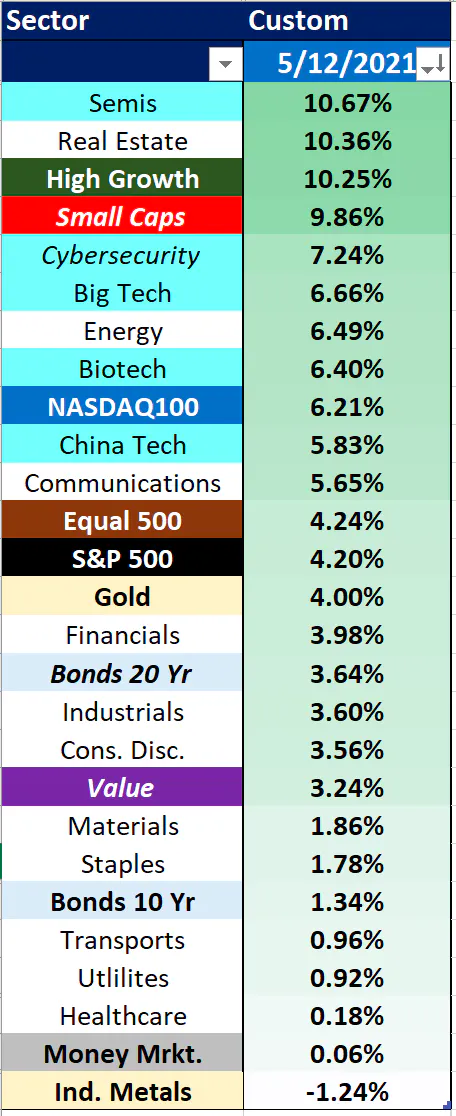
I further believe that the market put in an important bottom on May 12th. Below is a chart showing that since the May 12th bottom, quietly, we’re starting to see a rotation back to high growth names, and the selling of value as well as commodities.
It appears that underneath the moderate price movements in the broad market, we’re beginning to see a rotation back into growth names. We will need to see this trend continue, but so far, if the bottom is in, the up days in the market are suggesting a continuation of growth outperformance.
Breakouts Around the World
Just like in late 2016, we are seeing an abundance of analysts suggesting that the major top is in or we are close. This would be followed by a major and protracted bear market. Also, just like in late 2016, this thesis is not being supported by the price action in major markets around the world.
The above chart illustrates the breakouts we are seeing across the board: Global Blue Chips, Emerging Markets, Europe, India, even Small Caps are showing strength, as is China. These are typically not the intermarket signals we see just prior to a major bear market.
Strong Market Breadth
Market breadth is a technical measurement that measures the number of companies participating in a trend. In other words, if the number of companies that are participating in a broad market uptrend is growing with the market, then this is a healthy uptrend.
On the other hand, leading into most corrections, we see market breadth decreasing while the broad market continues higher. If fewer stocks are holding the markets up, this is typically a bad sign for an uptrend.
We use many methods to measure market breadth, but the simplest and oldest way is the advance decline line. Simply put, this indicator plots the difference between the number of stocks in the market that are increasing in price vs. the ones that are decreasing.
If we compare this indicator to the S&P 500, we can see an instance leading up to the September selloff in 2020 where the advance/decline line was signaling weakness, while the market continued higher. Today, we are not seeing this. In fact, the advance/decline line is breaking out to new highs before the market. This is indicating that more stocks in the market are moving up vs. down, and when we see this indicator breaking out ahead of price, more time than not, price follows.
The NASDAQ100
Most importantly, the NASDAQ100 (NDX) appears to be setting up for a large breakout move.
NDX is approaching a major resistance zone in blue on the chart (between 3800-4080). The upward-trending, zig-zag pattern into this resistance is typically a bullish pattern. Also, note how the price has respected the upward sloping trendline, which is highlighted with the dashed green line. This is also a promising sign, and gives us a clear level to work with regarding any coming weakness.
The Counter Argument
With as many bullish signals as we are getting, the NASDAQ100 must confirm the next leg higher with a breakout above 14080. Tech is simply too important of a sector both in the economy as well as being a large percentage of the broad market. If NDX fails to break out, and instead breaks below major support at 13200, we could see another correction before we can get another shot at a breakout setup.
Also, the transportation index is flashing a potential warning that this breakout could be premature.
Historically, the transportation index tends to lead the market. Because global commerce relies on transportation, a slowing down in this sector tends to signal a slow-down in the economy. Also, because equities are usually looking ~6 months out, the price of the transportation index can be a strong leading indicator.
As of today, the Dow Jones Transportation Index (DJT) is trending down while the rest of the major indexes are trending up. Because of the tight consolidation, this trend could change in an instant; however, I would not get too concerned unless supports break across the board in the U.S markets.
Supports to watch
Dow Jones Transportation Index – 15250
Dow Jones Industrial Index – 34300
NASDAQ100 – 13200
Regardless of the bullish signals and global breakouts we identified, if the above supports breakdown, we will likely look to hedge our portfolio over the short to intermediate-term time frame. We believe the outlook, as of now, is signaling a higher probability of another leg higher. However, until price agrees with our thesis, the I/O Fund remains cautiously bullish.
Founded in 1997 (yes, 24 years ago), Vuzix was the first company to release a AR/VR headset for the military and also the first to release a headset for consumer purposes. When we talk about being too early to a trend, we don’t typically mean 24 years too early, yet this is the case with Vuzix. Between now and then, the company has worked with Raytheon on digital night vision for weapons and has also contracted with DARPA to develop heads up display for military ground personnel.
Intel bought 30% ownership of the company in 2015 and the company partnered with BlackBerry in 2017 to deliver smart glasses for enterprise companies.
Fast forward, and Vuzix is becoming the smart glasses of choice for industries that are early adopters of the technology – primarily the medical field. This past month has been busy for the company. John Deere announced the company is using the Vuzix M400 smart glasses to provide remote support. The M400 and M4000 received clearance for medical training this past week and the company also received over $1.2 million in new orders from Rods and Cones for virtual surgical collaboration. There are many press releases in the medical industry that I will discuss in the full-length report, these are only the most recent.
The company is small in terms of revenue and market cap. Last quarter’s revenue was $3.9 million compared to $1.5 million in the year-ago quarter, or an increase of 156%. Smart glasses sales rose by 177% year-over-year to $2.4 million. The company was break even in terms of gross profit in the past yet posted $1 million in profit in the most recent quarter.
Regardless, gross margins are slim at 28% with product gross margins at 45%. As with many small cap companies, the bottom line is a bit ugly as the company has a net loss of $6.6 million. If the company continues to grow the top line, then some of this should resolve on its own as R&D is around $2 million per quarter and sales and marketing is $1.2 million.
The company closed a public offering of 4,768,293 shares on April 1st for $97.75 million. The shares were priced at $20.50 while the stock was trading at $24.85. The companies proforma cash is $145 million as of April 1st.
Here is how the company’s growth has looked over the past few quarters:
We began writing about this trend in Q3 2020 to discuss the start of this trend and that timing looks aligned with the graph above. Point being, I can’t imagine growth would be very impressive coming from any company in the AR/VR business until around Q3 2020 and so it seems like Vuzix’s growth is right on time.
The earnings call discussed there being “increased inbound interest in order flows related to the reopening of the economy” as industries such as logistics, warehousing, retail picking, e-commerce and third-party logistics are looking for “many 1000s of units.” The company explains that their technology increases worker productivity and can contribute to healthier margins. I find it interesting that AR/VR could be a covid rebound play. This is a bonus as the trend was set to take off around this time with or without covid.
The company also has a partnership with Verizon although this is not meaningfully adding to revenue at this point.
I’ll expand more on Vuzix soon as we are clearly focused on AR/VR as a fund. We were early to Unity and have discussed in detail our views on Snap – most recently in the LTBH webinar.
Knox likes the chart so he will probably enter soon.
Sea Limited showed tremendous performance in each of their three business segments in their Q1 earnings report. The dominant position Sea Limited has in three separate and growing businesses is what makes the company so strong. The biggest risk is that one or more of their three businesses will fall off its current pace and lag growing competition. In the company’s Q1 report, Sea Limited demonstrated that they are a company executing better than ever in each of their three business segments.
Shopee
In Q1, Sea Limited announced e-commerce revenue of $922.3M, representing 250% YoY GAAP revenue growth. Gross orders totaled 1.1 billion, a 153% increase YoY. Gross Merchandise Value (GMV) was $12.6B in the quarter, representing 103% YoY growth. Adjusted EBITDA declined to -$413M from -$264M in Q1 ’20 due to increased investments in S&M and R&D. However, Adjusted EBITDA loss per order decreased by 38% YoY to $0.38 compared to $0.61 in Q1 ’20. This indicates that Sea Limited continues to outgrow its costs in terms of gross order volume.
In Southeast Asia, Taiwan, and Indonesia, Shopee ranked #1 in the Shopping category by average MAUs and total time spent in app on Android for Q1, according to App Annie. These rankings are further indication that the strategy management has taken is to prioritize growth in favor of short-term profits – and this is paying off as the company continues to extend its leadership position in various regions.
Sea Limited has expanded its platform into parts of Latin America, but management did not separate out financials in the region. With that said, the company has previously discussed its plans to invest aggressively to building out the infrastructure necessary to compete with MercadoLibre.
Garena
Sea Limited announced digital entertainment (Garena) revenue of $781M, representing 111% YoY GAAP revenue growth. Bookings of $1.1B grew 117% YoY, while Quarterly Active Users increased 61% YoY to 649M. Quarterly paying users grew by 124% YoY to 80M and represented 12% of QAUs for the Q1 compared to 9% for Q1 2020.
The company’s blockbuster game, Free Fire, was the highest grossing mobile game in Latin America, Southeast Asia, and India for Q1. Moreover, Free Fire overtook PUBG Mobile and Call of Duty Mobile as the top grossing battle royale style game in the United States. App data from Sensor Tower shows that Free Fire has continued its momentum into Q2, as it was the 3rd most downloaded mobile app game in the world in April.
Source: Sensor Tower
SeaMoney
Sea Limited’s digital financial services segment saw $51.3M of revenue in Q1, representing 396% YoY growth. This segment is still just 3% of the company’s total revenue as we are in the very early innings of the shift to FinTech in Southeast Asia. Nevertheless, we are seeing promising growth metrics from SeaMoney, showing that they are primed to be a top FinTech player in the region.
Mobile wallet services recorded a total payment volume of $3.4B, which more than tripled compared to the $1.1B a year ago. Quarterly paying users surpassed 26.1M in the quarter.
In December 2020, Sea Limited was awarded a digital banking license in Singapore. A report by Financial Times shows that almost 50% of Southeast Asian adults are unbanked an additional 25% are underbanked.
This underscores the tremendous long-term opportunity Sea Limited is trying to capture in FinTech. There is a long runway for growth in digital banking as well as digital payments in Southeast Asia, and we are seeing Sea Limited begin to position themselves for future growth. Over the long-term, SeaMoney has the potential to be a legitimate source of revenue and capture a bigger piece of the revenue pie in addition to Shopee and Garena.
Q1 Earnings Results
Sea Limited announced Q1 results last month, growing GAAP revenue 147% YoY to $1.8B (US $). Total gross profit increased 212% YoY to $645M, while total adjusted EBITDA advanced to positive $88.1M compared to -$70M in the Q1 2020.
The Q1 adjusted EBITDA number missed the consensus estimate of $173M, but the company has been very transparent about its strategy to aggressively reinvest profits back into the business to focus on top line growth. In total, sales & marketing expenses increased 120% in the quarter while research & development expenses increased 118%. Management appears to be taking the right approach to stimulating growth and engagement in each segment of the business, as evidenced by some of the growth metrics discussed below.
Sea Limited has three distinct business segments in e-commerce, digital entertainment, and digital financial services. All three business segments executed tremendously in Q1, with each segment exceeding a triple digit growth rate. Below is the revenue breakdown in Q1 2021 versus the breakdown in Q1 2020.
Valuation
Sea Limited currently trades at a 12.4x EV/NTM revenue multiple, down from its peak valuation of around 27x last February. Below, we compare this valuation to other international e-commerce stocks MercadoLibre and Jumia. Notably, Sea Limited has higher forward growth projections for 2021 than MercadoLibre or Jumia. The table below shows a more detailed comparison of Sea Limited to MercadoLibre and Jumia. We also included Ozon Group and Coupang, two less expensive e-commerce leaders, for comparison.
Conclusion
Sea Limited did not give guidance for Q2 or FY21, but consensus estimates are calling for 89% YoY revenue growth for the full year. All three of Sea Limited’s business segments are performing better than ever, and the company has a long runway for growth as Southeast Asia continues to become more digitalized. Sea Limited has positioned itself as the dominant e-commerce company in the region with the success of Shopee, the top shopping platform in SE Asia. With Garena, Sea Limited has the most dominant gaming company in the region with no signs of slowing growth. SeaMoney, the company’s third segment, is ideally positioned to be one of the leading FinTech players in the region and will continue to benefit from increased digitalization.