Skip to content
Logo-main-white.860316a8

I/O Fund

  • Home
  • Free Stock Analysis
  • AI Stocks
  • BEST OF 2025
  • Analysts
  • Nvidia Hub
  • About
    • Case Studies
    • About Us
    • Premium Services
    • Pricing
    • Notable Wins
    • I/O Fund Reviews
    • Media
  • Contact Us

Category: Autonomous Vehicles

Tesla Stock: Margins Bounce Back For AI-Leader

Posted on October 30, 2024June 30, 2026 by io-fund
Tesla Stock: Margins Bounce Back For AI-Leader

This article was originally published on Forbes on Updated Oct 24, 2024, 09:01pm EDTForbesForbes on Updated Oct 24, 2024, 09:01pm EDT

Tesla is arguably one of the most advanced AI companies in the world, yet its stock is dictated by margins. Over the past three years, Tesla’s average gross profit per vehicle has declined by 60%, falling from more than $14,400 in Q3 2021 to less than $6,000 in Q2 2024, highlighting the difficulty Tesla has faced in a high-interest rate environment.

Higher interest rates have forced Tesla to place more emphasis on affordability, either via price cuts or promotional financing rates, pushing average selling prices lower and thus impacting margins. Q3’s report showed that margins may have bottomed, despite weakness in vehicle selling prices due to that focus on affordability.

Perhaps the long-term story is recurring software revenue from robotaxis and humanoid robotics, however, margins are driving the stock price for now.

Below, I look at the puts and takes of an AI front runner that is battling economic headwinds.

Deliveries Recover, But Revenue Doesn’t

Q3 saw Tesla report sequential growth for both production and deliveries after a weak Q1, where deliveries dropped below 400,000 for the first time since late 2022. Tesla reported deliveries of 462,890 EVs in the third quarter, a 6.4% increase from last year and a 4.3% increase from the second quarter.

Tesla Quarterly Production, Deliveries

Tesla reported deliveries of 462,890 EVs in the third quarter, a 6.4% increase from last year and a 4.3% increase from the second quarter.

Source: Tech Insider Network

For the third quarter, Tesla reported automotive revenue of $18.83 billion, up just 1.3% YoY and 1.6% QoQ, and short of the consensus estimate for $19.50 billion. As a result, Tesla’s overall revenue fell short of estimates, with Tesla reporting $25.18 billion in revenue, nearly half a billion below the consensus for $25.67 billion.

A quick look at the growth rates shows that automotive revenue growth lagged delivery growth by just over 5 percentage points, at 1.3% versus 6.4%. This tells investors that automotive selling prices declined once again, and to a large degree – Q3’s ASP fell below $42,000, down ~(1.7%) from Q2 and falling (5.6%) from nearly $44,500 last year.

Notably, there is risk the ASPs fall lower in Q4 as Tesla continues to cut some prices, with the Cybertruck seeing up to 20% cuts on different model variants in October. Musk mentioned that Tesla would be aiming for YoY growth, and with just Q4 left, that means Tesla would have to deliver more than 515,000 vehicles, a record high. This would also imply an acceleration to 11% QoQ growth, leaving the door open for more aggressive price cuts to spur demand, something management hinted at in the earnings call.

Tesla is aiming high for 2025, with Musk stating that the automaker is shooting for “20% to 30% vehicle growth next year,” or roughly at least 2.1 million vehicles assuming Tesla ends 2024 at around 1.75 million. Taneja added that Tesla’s “focus remains on growing unit volume, while avoiding a build-up of inventory. To support this strategy, we're continuing to offer extremely compelling vehicle financing options in every market.”

The Fed has forced Tesla to focus on financing and affordability, which in turn, has been a major driver of margin issues. I noted in July 2023 that the “comment on interest rates is the most important comment from the call as high interest rates mean Tesla must lower prices,” and that Tesla was “one of many tech stocks whose revenue growth and profitability is on borrowed time until the Fed instills a more dovish policy.”

Sign up for I/O Fund's free newsletter with gains of up to 2600% because of Nvidia's epic run – Click hereClick hereClick here

Tesla’s Profitability Improved on Cost Optimizations

Despite ASPs declining again sequentially, profitability improved and automotive margins recovered as Tesla captured some tailwinds from “lower raw material costs, freight and duties” and drove vehicle production costs to a record low.

Tesla headed into Q3’s report facing a tough test, as average selling prices were flat and vehicle production costs were rising. From Q4 2023 to Q2 2024, ASPs were relatively unchanged while production costs rose 3.7%, denting both automotive margins and impacting profitability. This had been hindering Tesla’s ability to revitalize automotive gross margins — as a result of those two changes, automotive gross margins took quite a large hit, falling from 17.2% to 14.6% in that two-quarter span.

Automotive Gross Margin

Q3 saw a sharp improvement in automotive gross margin, expanding ~240 bp QoQ and ~72 bp YoY, as Tesla drove production costs to a record low of ~$35,106.

Source: I/O Fund

Q3 saw a sharp improvement in automotive gross margin, expanding ~240 bp QoQ and ~72 bp YoY, as Tesla drove production costs to a record low of ~$35,106, dropping ~(4.6%) from $36,802 just last quarter.

Because of the large improvements in production costs, average gross profit per vehicle bounced back, increasing ~16.3% QoQ to reach ~$6,886, up from $5,921 last quarter. Essentially, Tesla manufactured and sold 14,000 more vehicles this quarter for ~$220 million cheaper than last quarter.

Tesla's Average Gross Profit Per Vehicle Recovers in Q3

Average gross profit per vehicle bounced back, increasing ~16.3% QoQ to reach ~$6,886, up from $5,921 last quarter.

Source: I/O Fund

Operating margin also rebounded significantly, expanding to 10.8% in Q3, up from 6.3% in Q2 and 5.5% in Q1. This newfound operating margin growth adds more confidence in the margin recovery story, which has been paramount for investors as share price declines have correlated quite closely with operating margin contraction.

Tesla Price and Operating Margin Charts

Tesla's share price declines since late 2021 have correlated quite closely with operating margin contraction.

Source: YCharts

Energy Storage was a bright spot in Q3 as even with a sequential decline in deployments and (21%) sequential decline in revenue, gross margin expanded from 24.5% to 30.5%. This aided company-wide gross margin expansion, with Tesla reporting a 19.8% gross margin in Q3, up from 18.0% in Q2.

Every Thursday at 4:30 pm Eastern, the I/O Fund team holds a webinar for premium members to discuss how to navigate the broad market, as well as various stock entries and exits. We offer trade alerts plus an automated hedging signal. The I/O Fund team is one of the only audited portfolios available to individual investors. Learn more hereLearn more hereLearn more here

Q4 Margins Will Be “Challenging” to Sustain

Q3’s profitability is a welcome sign, yet CFO Vaibhav Taneja cautioned that “sustaining these margins in Q4, however, will be challenging given the current economic environment,” due to vehicle affordability issues.

Investors may need to get comfortable with thinner margins moving forward on the automotive side. When the stock was at all-time highs in 2021 and early 2022, Tesla was reporting more than $14,000 in gross profit per vehicle, or automotive gross margins in the high-20% range, topping 30% once. Now, average gross profit per vehicle has fallen more than (52%) to $6,886 in Q3, with automotive gross margins back to 17%, though it has remained below 20% since the start of 2023.

This decline in gross profit per vehicle stems from weaker average selling prices, which have fallen quite dramatically since the start of 2023, and continue to fall. The reason margins were able to expand in Q3 was from reducing production costs, not vehicle pricing.

Tesla's Selling Prices, Vehicle Production Costs

Tesla's average selling prices, which have fallen quite dramatically since the start of 2023, continue to fall.

Source: I/O Fund

As long as Tesla continues to cut prices, margin gains will be primarily realized on the cost side. The path to higher margins will arise when Tesla can push production costs towards $30,000 and lower, and once the pressure on ASPs have resolved.

Musk said in Q3’s call that Tesla is “still on-track to deliver more affordable models starting in the first half of 2025,” which would require similar cost reductions to preserve margins. Musk also implied thin margins may be the norm for investors, as Tesla noted that affordable model production in the first half of 2025 “will result in achieving less cost reduction than previously expected.”

Robotaxis Still Not Here, Despite Numerous Timelines

While the robotaxi opportunity is promising for Tesla, it’s yet to provide tangible AI revenue. Tesla’s robotaxi reveal event earlier in the month was met with a lackluster response, sending shares down more than (8%) the day after, as the production timeline for its ‘robotaxi’ was pushed back once more, a familiar storyline for Tesla investors over the past few years.

At the unveiling of Tesla’s pedal and wheel-free purpose-built robotaxi, dubbed the Cybercab, CEO Elon Musk said that production may begin in 2026 or as late as 2027, saying that he “tend[s] to be optimistic about timeframes.” This is another years-long delay for Tesla’s most anticipated product, where in 2022, Musk had promised to reveal the robotaxi in 2023 and start production in 2024. This follows an initial promise from 2019 to have one million Tesla vehicles equipped with Level-5 autonomy in 2020. Years later, and Tesla has still not deployed the robotaxi, which places additional emphasis on the margins.

Musk reiterated Tesla’s goal to launch production of the Cybercab in 2026, adding that Tesla is “aiming for at least 2 million units a year of Cybercab.”

Following Q1’s earnings report in April 2024, I joined Bloomberg China to discuss the most pressing items for Tesla, saying that “as AI approaches, that’s the piece that Tesla has to execute on. So what we’re seeing is a moment where it’s a little too early for AI software…. we’re not in that cycle right now, and that’s what Tesla really truly needs for its stock to resume where it was before as a Wall Street darling [in 2021]. And that AI software cycle, if I were to give you my best estimate, it would be more of a 2026 discussion.”

Conclusion

Despite a mixed Q3 earnings report featuring a revenue miss and an EPS beat, Tesla’s report exceeded expectations in the one area that mattered most – margins. Automotive gross margin rebounded due to production cost improvements, even as selling prices fell, boosting operating margins back to the double-digit range.

While the AI story is one to watch, margins have been the behind-the-scenes driver for shares, and remain the data point to track until a credible, tangible revenue stream from robotaxis arises. I/O Fund Portfolio Manager Knox Ridley wrote in August 2023 as the I/O Fund cut our Tesla position for a 60% gain that the I/O Fund was “avoiding ‘Crocodile Jaw’ situations where the stock price is going up but fundamentals are decelerating.”

By closely following Tesla’s margins and fundamentals, the I/O Fund nailed Tesla's move off of 2022's lows and exited at a top in early 2023. The I/O Fund continues to track Tesla, but recently shared research with premium members on two AI beneficiaries in a lesser-known semiconductor space with standout EPS numbers. Learn more here.

Please note: The I/O Fund conducts research and draws conclusions for the Fund’s positions. We then share that information with our readers. This is not a guarantee of a stock’s performance. Please consult your personal financial advisor before buying any stock in the companies mentioned in this analysis.

Recommended Reading:

  • This Stock Is Crushing Salesforce, MongoDB And Snowflake In AI RevenueThis Stock Is Crushing Salesforce, MongoDB And Snowflake In AI Revenue
  • Nvidia, Mag 7 Flash Warning Signs For StocksNvidia, Mag 7 Flash Warning Signs For Stocks
  • Cybersecurity Stocks Seeing Early AI GainsCybersecurity Stocks Seeing Early AI Gains
  • 4 Things Investors Must Know About AI4 Things Investors Must Know About AI
Posted in Autonomous Vehicles, Consumer Tech, Electric VehiclesLeave a Comment on Tesla Stock: Margins Bounce Back For AI-Leader

Tesla Q4 Earnings Preview: Margins Likely To Slip Again

Posted on January 23, 2024June 30, 2026 by io-fund
Tesla Q4 Earnings Preview: Margins Likely To Slip Again

This article was originally published on Forbes on Jan 18, 2024,03:32pm ESTForbes Forbes on Jan 18, 2024,03:32pm EST

Tesla’s Q4 earnings are on tap after the market close on January 24, closing up a year in which aggressive price cuts helped the automaker top Q4 delivery estimates reach a new record and narrowly beat its 1.8 million volume target. Tesla’s continued actions to improve vehicle affordability throughout the year have been detrimental to margins, as average selling price is falling quicker than production costs.

We covered in the past how Tesla’s lower selling prices in China are having a detrimental effect on margins, as well as assessing how low Tesla’s margins could go. We reiterated after Q3 earnings that this continual decline in margins highlights a broader concern for investors in that Tesla has provided no concrete guidance on how far margins will decline.

Tesla kicked off Q4 with price cuts in the US for some Model 3 and Y versions after Q3 deliveries missed expectations, though it raised prices later in October for the Model Y Long Range and X Plaid AWD. Tesla also increased the price of the Model 3 and Y in China in Q4, reportedly due to rising production costs. Given these pricing trends, ASPs look set to remain pressured in Q4 while production costs may decline marginally, a combination likely to cause margins to slip again.

It is imperative for the bull case that operating margins show sequential improvement in Q1 should it fall to the low 7% range in Q4. Assuming a ~10% QoQ increase in operating expenses, about in line with historical trends, Q4’s operating margin is projected to be ~7.2%, for a ~40 bp sequential decline. The analysis below looks at what investors need to know moving into Q4, and equally important, a few red flags we see going into Q1 and Q2 to keep an eye on.

Sign up for I/O Fund's free newsletter with gains of up to 221% – Click hereClick hereClick here

Automotive Margin Remains a Key Item to Watch

While the promise of full autonomy and its potential value entice some investors, the core story remains margins heading into the Q4 release. Notably, margins topped in Q1 2022, and shares have returned (41.0%) since the end of that quarter.

Tesla Price Change

Source: YCharts

Automotive gross margin excluding regulatory credits topped in Q1 at 30.03%, before slumping to 16.33% in Q3 2023. Quarterly operating margin peaked at 19.21%, before falling to 7.6% in Q3 2023. Wall Street continues to search for a bottom in margins, which look set to decline again based on current trends in ASP and production costs per vehicle.

Tesla ASP per Vehicle

Source: Tesla, Author Calculations

Aggressive price cuts pulled ASPs below $45,000 in Q3, a level likely to stay in play as recent price hikes for certain models are unlikely to aid pricing given the pace of cuts throughout 2023. Looking forward to Q4, ASP is projected to decline (1%) to (1.5%) sequentially, impacted by recent price cuts and a slightly higher mix of retail sales in China in the quarter, at just over 35% in Q4 compared to 32% in Q3.

Production costs were reported to have risen slightly in China during the quarter, resulting in a price hike, but Tesla likely enjoyed favorable tailwinds to battery pack cost optimization as lithium prices continued to fall through the quarter. In addition, BloombergNEF estimated lithium-ion battery pack prices declined 14% YoY in 2023 to $139/kWh, with passenger BEV batteries falling to $128/kWh. Based on favorable tailwinds from raw materials prices and headwinds from reports of increased production costs, COGS is estimated to have declined between (0.5%) to (1%) sequentially.

As seen in the scenario analysis below, the incremental effects to gross margin from a 0.5% change in production costs are ~42 bp compared to ~50 bp for a 0.5% change in ASP – therefore, it is critical to margins bottoming that production costs decline faster and/or further than prices, or selling prices begin to increase.

Change in COGS, QoQ

Source: Author Calculations

Our current assumptions point to a slightly larger sequential decline for ASP, an unfavorable combination for margins. For Q4, automotive gross margin is projected at ~15.1%, excluding regulatory credits and operating leasing; including operating leasing, automotive gross margin would project to 15.71%, pointing to a ~60 bp sequential decline from Q3’s 16.33%.

Tesla Automotive Gross Margin

Source: Author Calculations

Every Thursday at 4:30 pm Eastern, the I/O Fund team holds a webinar for premium members to discuss how to navigate the broad market, as well as various stock entries and exits. We offer trade alerts plus an automated hedging signal. The I/O Fund team is one of the only audited portfolios available to individual investors. Learn more here.Learn more hereLearn more here.

Operating Margin May Be Approaching a Bottom

A sequential decline in automotive margin likely spells another sequential decline for operating margins, though there is increasing evidence that operating margins might be approaching a bottom in Q4.

We highlighted in late August via a competitive analysis framework that we believe Tesla’s Q3 operating margins can decline to a level between Honda and VW, or between 7.8% to 9.6%. However, if operating margins were to reach a level closer to — or below GM — that could be sign they’re close to the bottom. This highlights the broader concern for investors in that Tesla has not provided any parameters nor guidance to assess how low margins may go.

Vehicle Company Operating Margins (Quarterly)

Source: YCharts

Q3’s actual operating margin came in below that level, at 7.6%, landing between Honda’s 8.5% and VW’s 6.2%, while still sitting above GM’s 6.8% margin. With automotive gross margin estimated at ~15.7%, company-wide gross margin is expected to hover around 17.5%, assuming a ~180 bp benefit from regulatory credits and positive impact from Energy Storage and Services. Assuming a ~10% QoQ increase in operating expenses, about in line with historical trends, Q4’s operating margin is projected to be ~7.2%, for a ~40 bp sequential decline.

At that level, the spread between Tesla’s operating margin and GM’s would be less than 40 bp, adding evidence that operating margins are approaching a bottom. Aggressive price cuts look to be easing, a tailwind for ASP inflection, while declining lithium and Li-ion battery prices would add production cost reduction, a second tailwind for margins.

It is imperative for the bull case that operating margins show sequential improvement in Q1 should it fall to the low 7% range in Q4. This is crucial for earnings estimates to begin seeing upwards revisions once more, as forward earnings estimates have fallen significantly over the past six months:

  • Q4’s adjusted EPS estimate on June 30 was $0.98 for (17%) growth. This was later revised to $0.86 in mid-October for (28%) growth, and the current estimate sits at $0.74 for (38%) growth.
  • Q1’s adjusted EPS estimate on June 30 was $1.02 for 21% growth. October’s revision saw adjusted EPS at $0.95 for 12% growth, while the current estimate is pegged at $0.81 for (5%) growth.
  • Q2’s adjusted EPS estimate in mid-October was $1.11 for 23% growth, while the current estimate is $0.92 for 1% growth.

Q1’s trajectory, from pointing to over 20% YoY growth to now suggesting a low single-digit YoY decline raises red flags for Q2’s growth forecast, even after a 2100 bp revision lower. Weaker than expected margins in Q4 and/or Q1 could quickly see Q2’s adjusted EPS figure revised lower for another YoY decline. The bull case would need to have concrete evidence of margins bottoming in Q4/Q1 in order to avoid multiple quarters with YoY declines for EPS. Tesla has already cut prices twice in January, by (3%) to (6%) on the Model 3 and two Model Y variants in China, followed by (4%) to (8%) cuts on Model Y variants across Europe. This raises the risk that ASPs fall much further than COGS in Q1, driving a sequential decline in margins and adding more uncertainty to when and where margins will bottom.

Near-Term Focus on Volume Growth

CEO Elon Musk emphasized in Q2 that Tesla is focusing on volume growth at the detriment of margins, based on his view that unlocking full autonomy will lead to a substantial increase in the value of each vehicle and therefore for Tesla: “it does make sense to sacrifice margins in favor of making more vehicles because we think in the not too distant future, they will have a dramatic valuation increase.” CFO Vaibhav Taneja reiterated this in Q3, saying Tesla is “focused on reducing costs, maximizing delivery volumes, and continuing making investments in the future.”

Q4’s production of 494,989 took FY23’s total production to 1.85 million vehicles, while deliveries of 484,507 took the full year’s total to 1.81 million vehicles — this represented delivery growth of 38% YoY and production growth of 35% YoY.

This focus on volume growth via price cuts comes as Tesla is increasingly at risk of losing its title as the world’s largest BEV manufacturer on an annual basis, after losing the title on a quarterly basis this quarter to BYD. BYD has extended its lead against Tesla in China, especially so in Q4, proving that it can’t be ignored as a fierce competitor on the global stage.

BEV sales for BYD increased 22% QoQ in Q4 to reach 526,409 vehicles, almost 9% higher than Tesla’s total. BYD had nearly matched Tesla’s deliveries in Q3 as both held ~18% of the global BEV market that quarter, and BYD’s rapid growth allowed it to take the throne in Q4. Annually, BYD’s BEV sales came in at 1.57 million, +73% YoY, putting it on track to challenge Tesla’s annual volumes in 2024.

Tesla Technical Analysis

Many of the FAANGs are in the final throes of very mature long-term, uptrend patterns, some of which started in 2009. Many FAANGs are either at all-time highs, or just shy of them; however, Tesla trades roughly 50% lower than its 2021 highs, which signals relative weakness compared to other FAANGs.

Tesla Technical Chart

Source: TradingView

It’s worth noting the head and shoulders pattern that is close to confirming. This is the red count above, which implies that if Tesla breaks below $203, then the lower target will be sub-$100, as we likely press below the January 2023 lows.

If Tesla is going to have any chance at a sharp uptrend, it would need to break above $264 and $280 in a vertical manner. If this happens, we can start discussing the possibility of $345 – $400. This is the green count in the chart, and it has a low probability of manifesting.

The problem with this scenario is that no FAANG supports this type of move. This would be a 60% – 80% move higher in Tesla. Most FAANGs look like they have topped or have one more minor swing higher before topping.

Even the strongest FAANGs are suggesting a final push higher that doesn’t fit with the above green count. META, being one of the stronger FAANGs, only has room for a 4% – 10% move higher before completing a mature 5 wave pattern off the January low completes. NVDA, being the strongest FAANG, only has room for a 5% – 18% move, at most, before it becomes a better buy at lower levels. Therefore, neither the fundamentals, nor the technicals support this type of large move higher in Tesla, which makes the red count more likely at this time.

Conclusion

The main story for Tesla through 2023 and now entering 2024 has been when and where margins will find a bottom. Margins have declined significantly as Tesla prioritized growing delivery volumes via aggressive price cuts – automotive gross margin has fallen nearly 1400 bps in six quarters, while operating margin has pulled back to the mid-7% range. The two are both projected to slip again in Q4 as price cuts are expected to offset any incremental margin benefits from lowering vehicle production costs.

This rather rapid decline in margins is having a direct impact on forward earnings estimates, with Tesla now expected to report a single-digit YoY decline in fiscal Q1 and almost zero growth in fiscal Q2, compared to prior views for >20% YoY growth. Operating margins are nearing a level where we believe it will find a bottom, while more constructive pricing action through the rest of 2024 and/or continued improvements in lowering production costs will also help aid margin recovery.

If you own Tesla stock, or are looking to own Tesla, we encourage you to attend our weekly premium webinars, held every Thursday at 4:30 pm EST for premium members to discuss how to navigate the broad market, as well as various stock entries and exits. We offer trade alerts plus an automated hedging signal. The I/O Fund team is one of the only audited portfolios available to individual investors. Learn more here.

I/O Fund Equity Analyst Damien Robbins contributed to this analysis.

Please note: The I/O Fund conducts research and draws conclusions for the Fund’s positions. We then share that information with our readers. This is not a guarantee of a stock’s performance. Please consult your personal financial advisor before buying any stock in the companies mentioned in this analysis.

Recommended Reading:

  • Tesla’s China Market Share Continues To Slide
  • Social Media Stocks: One Metric Shows Meta’s Clear Leadership
  • Palantir, Three Other Cloud Stocks Poised For An Acceleration In 2024
  • Ad Spending Growth to Accelerate In 2024
Posted in Autonomous Vehicles, Consumer Tech, Electric VehiclesLeave a Comment on Tesla Q4 Earnings Preview: Margins Likely To Slip Again

Tesla Q2 Earnings – It’s About Margins

Posted on July 25, 2023June 30, 2026 by io-fund
Tesla Q2 Earnings – It’s About Margins

This article was originally published on Forbes on Forbes Forbes on Jul 21, 2023,08:15am EDT

After the strong rally, it appears the market is taking profits on commentary around the outlook for margins. It’s not only that they were lower quarter-over-quarter (QoQ), but also Tesla provided zero insight as to how much lower margins can go. The market does not like uncertainty. It’s somewhat ironic that during the call Musk can wax poetic about the complexities of AI, neural net training, the 6-million dollar man, and robotic taxis yet when it comes to basic profitability drivers, he can’t say anything. The former drove the price post Q123 and the latter is driving the price today.

Did reported automotive gross margins bottom?

Likely not.

Telsa had a reported Q223 automotive gross margin of 19.2% vs Q123 of 21.10% vs Q422 of 25.90%. Meanwhile, Q223 group operating margins were of 9.6% vs Q123 of 11% vs Q422 of 16%.

Reported automotive gross margins and operating margins peaked in Q222 at 32.9% and 19.3% respectively. Since then, both have been steadily declining downward. The stock is weaker today because the market does not know where or when these two metrics will ultimately bottom.

Looking ahead, Tesla will continue to focus on volumes through lower prices and at the expense of margins. Here’s what Zachary Kirkhorn, CFO said:

“Second, we continue to work towards our goals of maximizing volumes on both, our vehicle and energy business, but most importantly, doing so in a way that generates the capital to continue our pace of R&D and capital investments. This requires a strong focus on per unit COGS reductions in each of our key businesses, as well as working capital improvements on raw materials, work in process inventory and customer AR, all of which progressed appropriately in Q2.

If we look specifically at our automotive business, our gross margin showed a modest reduction and remained healthy, despite action taken to further improve vehicle affordability early in the quarter. We recognized – we realized per unit cost improvements in nearly every category, including material cost and commodities, manufacturing costs and logistics”

Sign up for I/O Fund's free newsletter with gains of up to 221% – Click hereClick hereClick here

In response to a question on pricing, Tesla continues the point that the company is having to lower prices due to the higher interest rate environment

Question:

“How has the order intake trended relatively to production levels during Q2? And how has it trended in the quarter-to-date period? Conceptually, how does Tesla decide when is it appropriate to reduce prices or at other sales incentives to increase demand?”

Elon Musk

“[…] Buying a new car is a big decision for vast majority of people. So, any time there’s economic uncertainty, people generally pause on new car buying at least to see what happens. And then obviously, another challenge is the interest rate environment. As interest rates rise, the affordability of anything bought with debt decreases, so effectively increasing the price of the car.

So when interest rates rise dramatically, we actually have to reduce the price of the car because the interest payments increase the price of the car. And this is — at least up until recently, it was, I believe, the sharpest interest rate rise in history. So, we had to do something about that […]

When asked again about automotive margins, management did not provide a direct answer. For our purposes, we prefer management teams to answer directly as it increases uncertainty to not provide visibility into contracting margins.

Question:

“With the emphasis of price cuts to drive volume growth eating into automotive gross margin, can investors expect to see automotive gross margin stabilize or even rise due to efficiencies outpacing the cuts? And if so, when?”

Elon Musk:

“Where’s that crystal ball, again? If I may, look, the short-term variances in gross margin and profitability really are minor relative to the long-term picture. Autonomy will make all of these numbers look silly.

Zachary Kirkhorn

“I fully agree with you. I mean, I think the only thing in the short term that matters is what I said in my opening remarks, which is are we generating enough money to continue to invest. And the portfolio of products and technologies that the technical teams are investing in right now, this is intense. It’s intense in terms of investment; it’s intense in terms of potential.”

Every Thursday at 4:30 pm Eastern, the I/O Fund team holds a webinar for premium members to discuss how to navigate the broad market, as well as various stock entries and exits. We offer trade alerts plus an automated hedging signal. The I/O Fund team is one of the only audited portfolios available to individual investors. Learn more here.Learn more hereLearn more here.

Conclusion:

The sentiment post Q223 isn’t much different than in Q123. As we all know, Tesla rallied after Q1. This time around, given the stock is at higher levels, there may be less AI sentiment to support it in the short term. Q3 won’t be a catalyst and analysts will likely reduce numbers.

While many will argue that Tesla is one of the most advanced AI companies in the world, my response is “sure” but Tesla is also heavily exposed to consumer spending — and this is entirely out of their control. The comment on interest rates is the most important comment from the call as high interest rates mean Tesla must lower prices. In a way, management is agreeing that quite a bit about the current situation is out of management’s control. While some will talk about recurring software revenue from robotaxis as the most important catalyst, the harsh reality is that the FED lowering rates is the most important catalyst for Tesla today. That may not be as exciting as AI, but Tesla is one of many tech stocks whose revenue growth and profitability is on borrowed time until the Fed instills a more dovish policy.

The I/O Fund Analyst Team contributed to this analysis.

Recommended Readings:

  • ON Semiconductor: Powering the EV Highway
  • First Solar Q1 Earnings: IRATC Timing, Strong Backlog, Higher ASP Per Watt
  • Tesla – Post Q1 23 takeaways
  • Tesla: Impact of Lower ASPs & Raw Materials, Margins, IRA and More.
Posted in Autonomous Vehicles, Autonomous Vehicles, Electric Vehicles, Energy StocksLeave a Comment on Tesla Q2 Earnings – It’s About Margins

Timeout for Tesla Stock: Where We Plan to Buy

Posted on February 22, 2023June 30, 2026 by io-fund
Timeout for Tesla Stock: Where We Plan to Buy

On 1/26/23, we sent out a trade alert notifying our readers that we purchased shares of TSLA after the release of its 1/25/23 Q422 earnings release. Based on the 2/17/23 closing price of $208.31, TSLA is up 31%. Since that Q4 report, we thought it be worthwhile to update our readers on our thoughts both fundamentally and technically on what we’re watching for in the upcoming weeks.

Knox Ridley Tweet

Right now, our technical analysis is at odds with our fundamental analysis, which is often good news, as it means we will be afforded a lower entry on a stock position we plan to build.

The technicals are telling us a lower entry is on the horizon. However, what will make or break Tesla stock in 2023 is the margins. As most Tesla investors are aware, the company has lowered its price on its vehicles. Coupled with the $7500 EV credit, Tesla's vehicles are more affordable in Q1 than ever before, with some price points below $50,000 for the Model Y SUV when combining the price cut with the EV Credit.

This has led to Model Y selling out in Q1, per a Reuters report on February 15th. Considering a Model Y is now priced at $52,990, down from $65,900, this means a 30% price reduction is possible with the additional $7500 EV credit with the total cost of $45,490.

With these incentives, most investors can see a path to Tesla meeting its delivery goal this year, however, the impending issue is if Tesla can do so while maintaining healthy margins.

The stakes are high for Tesla's stock because if the margins remain healthy, the stock will do quite well. However, if the margins contract, then the bears will be in control. This is a big moment for Tesla, as high average sales price has been a contentious issue for meeting its addressable market. Wall Street will want to see it's possible to do both — serve a wider total addressable market (TAM) with more affordable prices while maintaining a healthy bottom line.

Our in-depth analysis below discusses why the I/O Fund Analyst Team is forecasting that the margins will, indeed, overcome a lower average sales price to sustain operating leverage. Once we discuss the margins in-depth, which to reiterate, we believe is the most important piece to Tesla's 2023 story, we then go into how we plan to build this position while respecting the fact the broad market is in the driver's seat for growth stocks.

Tesla Stock: What to Look for in 2023

First, let’s take a quick look at Tesla through a few graphs. If you were presented with the following company, would you find this an attractive business?

  • A company with steadily increasing operating margins vastly superior to its competitors and greater that those in the S&P 500.
Tesla Operating Margins

Source: Tesla Q422 investor presentation

  • With historical y/y revenue growth also exceeding its peers due to strong demand for its product.
YoY Revenue Growth

Source: Tesla Q422 investor presentation

  • With a significant market share gain opportunity for its products
Tesla Market Share

Source: Tesla Q422 investor presentation

It’s these attributes that have drawn us to Tesla as an attractive business. However, as investors in the equity, there are several key factors we are monitoring that may drive the stock.

Sign up for I/O Fund's free newsletter with gains of up to 221% -Click hereSign up for I/O Fund's free newsletter with gains of up to 221% -Click hereClick here

Profitability: Gross margins (GM) vs Operating profit margins (OPM)

Both are impacted by different variables. For GM, the main drivers are the ASPs Tesla charges for their cars and number of cars sold less costs of goods sold such as raw materials costs, particularly lithium used in batteries. For reference, here's the 5-yr price chart of lithium ($/kg). Tesla does not break out this cost but they did refer to lithium battery demand as "quasi-infinite" and a "significant cost." It won't impact their production targets but it continues to be an unpredictable cost headwind. It also explains while there has been renewed speculation that Tesla is interested in purchasing lithium mining assets.

Lithium Prices

Source: Dailymetalprice.com

For OPM, it’s mainly related to R&D and factory ramp-up costs. Here’s a snapshot (2017 – 2022) of Tesla’s ASPs in relation to its GAAP operating margins. It’s grown from negative 14% to almost positive 17%.  

Tesla Q422 Presentation

Source: Tesla Q422 investor presentation

The chart above demonstrates that while ASPs have come down about 40% from a little over $100k to $47k, OPM has expanded. A reflection of the immense impact manufacturing efficiency has on operating leverage from higher utilization as the number of cars produced and sold increased.

In the most recent Q4 call, Tesla discussed how their future focus would be on increasing operating margins over time. A sign of the evolution of its mindset from that of a technology company needing to invest and sacrifice short term profitability to one with a large industrials-like manufacturing footprint and supply chain focusing on costs and efficiencies. A focus that long-term investors should find appealing.

Perhaps a simple picture provides insight on how Tesla thinks about manufacturing efficiencies versus its peers. If you compare the Q422 investor presentation of Tesla to GM and Ford. There's not one picture of a human. Rather, you see high precision Kuka German robots. There's not a single robot in GM or Ford's presentation. Tesla's Q4 opm were 16% compared to GM at 8.8% (adj) and Ford at 5.8% (adj).

GM:

GM Presentation Image

Source: GM Q422 Investor presentation

Tesla:

Tesla Presentation Image

Source: TSLA Q222 Investor Presentation

Ford:

Ford Presentation Image

Source: Ford 4Q22 investor presentation

The I/O Fund has launched a new $99/year Premium Newsletter called "Essentials" — this newsletter delivers premium samples for our readers who want more actionable analysis for their tech portfolios. This month, we released a stock pick that we believe will be a leader in 2023 plus a video with the buy plan.$99/year Premium Newsletter$99/year Premium Newsletter called "Essentials" — this newsletter delivers premium samples for our readers who want more actionable analysis for their tech portfolios. This month, we released a stock pick that we believe will be a leader in 2023 plus a video with the buy planbuy plan.

That said, at the moment, the investment community is understandably focusing on the automotive gross margins given the recent price reductions A positive takeaway from the call was that Tesla expects ASPs to stay above $47,000 and automotive gross margin to go above 20%. Indications that automotive gross margins have bottomed. This message contributed to the stock rally (emphasis added below).

“The next question from investors is, after recent price cuts, analyst released expectations that Tesla automotive gross margin, excluding leasing and credits, will drop below 20% and average selling price around $47,000 across all models. Where do you see average selling price and gross margins after the price cuts?Tesla automotive gross margin, excluding leasing and credits, will drop below 20% and average selling price around $47,000 across all models. Where do you see average selling price and gross margins after the price cuts?

Zachary Kirkhorn, CFO:Zachary Kirkhorn, CFO:

So there is certainly a lot of uncertainty about how the year will unfold, but I'll share what's in our current forecast for a moment. So based upon these metrics here, we believe that we'll be above both of the metrics that are stated in the question, so 20% automotive gross margin, excluding leases and rent credits and then $47,000 ASP across all models.we believe that we'll be above both of the metrics that are stated in the question, so 20% automotive gross margin, excluding leases and rent credits and then $47,000 ASP across all models.

An analyst pointed out that the avg COGS per car has gone from $36,000 in mid-2021, peaking at $42,000 back to almost $40,000 currently. Estimates that management did not refute. So a very simple back of the envelope calculation comes to about 18% auto gross margins currently ($(47,000-40,000)/($40,000)). The key takeaway is that pricing and costs efficiencies will both have an impact in getting margins above 20%. For example, using the prior calculation just a $1000 increase in ASPs or $1000 decrease in COGS alone will lead to 20% auto gross margin. If both happen at the same time, that's about a 23% auto gross margin.

There was a follow-up if COGS could go back down to $36,000. This exchange provided further insight.

Excellent. Zach, actually, I'd like to follow up on the data point you just gave on cost. If I look back at the COGS per car, you guys bottom close to $36,000 in the middle of 2021. And then the number went up as you had to face with inflation in input costs and the ramp of Berlin and Texas. And this quarter, I think we are close to $40,000 and we peaked maybe close to $42,000 at some point last year.

And so my question from here is, how much time do you think it takes you to get back to this kind of $36,000, which would mean Berlin and Texas and those input costs, all that stuff is normalizing, is that like — and that would be like a kind of like a 10% decline in the COGS per car? Is that something we can hope to see this year or is that too optimistic?

Zachary Kirkhorn, CFOZachary Kirkhorn, CFO

The Austin and Berlin ramp inefficiencies in 4680 will make a substantial amount of progress on that over the course of the year, and that's within Tesla's control. We're doing a lot of work on cost reduction outside of that. And we talked about supply chain costs, expedite, logistics, attacking everything.

On the raw materials and inflation side, where lithium is the large driver there and this was a meaningful source of cost increase for us, we'll have to see where lithium prices go. And we're not fully exposed to lithium prices, but I think in general, is what we've seen from our forecast here, cost per car of lithium in 2023 will be higher than 2022. So that's a headwind that would have to be overcome to return back to those levels. So, I don't think we'll get there this year, but I think we'll make progress. And we'll continue to find ways to offset these raw material costs that we don't have control over. [Indiscernible] is there anything on that?

Furthermore, to the extent the Fed’s actions have lowered non-lithium prices, there will be a lag.

Roshan Thomas, VP of Supply Chain, added the following.

“.. on the non-cells raw material, we begin to capture benefits of indexes tapering out, but due to the length of various supply chains, it does take time before this is reflected in our financials. And while alumina is down like 20% year-over-year, steel is about 30% down year-over-year, the global non-cells raw materials market continues to be influenced by geopolitical situations in Europe, high production cost due to labor cost increases and energy spikes and disruptions due to natural disasters like typhoon in Korea four months ago, pandemic lockdowns.

So, we believe that meaningful price corrections will ultimately come, but it remains uncertain exactly when. In the meantime, we continue to redesign supply chain to make it more efficient and work with our supplier partners to find more efficiencies, streamline logistics and transportation to reduce costs.”

Below, is a simple sensitivity analysis of the impact that changes in asp and cogs per car have on automotive gross margin per car. It excludes leasing and credits. The numbers are estimates only and the primary purpose is to illustrate the magnitude these changes have on automotive gross margins. The yellow highlight is where they are estimated to be currently, blue is the minimum level Tesla has guided, green is potential upside depending on the change only in price or cogs and gray is if both change. At the moment, a change in price will likely be the main driver in automotive gross margin improvement. So, an increase in asp to 49k or 50k results in an automotive gross of 23% and 25%, respectively.

Average Automotive Gross Margin

Gross Margins and Operating Margins for 2023

We outlined the variables that impact both. We will look for continued signs of stabilization in the Q123 report and further confirmation that we have seen the bottom in both.

In Q122, Tesla reported operating margins of 19.2% and ended Q422 with 16%. For 2022 it was 16.8% vs. 12.1% in 2021. If the operating margin stabilizes at a level similar to or greater than Q4, then a recovery in 2H23 is reasonable, if not sooner in Q2.

Tesla will have an investor's day on March 1st, this may provide further insight.

Long-term OPM Potential:

Tesla has not provided any medium to long-term OPM targets, but if they did, this would lead to a re-rating of the stock. The auto industry is still cyclical so that may be wishful thinking. At the moment, Tesla's OPM dwarfs its auto competition. Perhaps, we are getting closer to the point where the best comp will be other industrial companies with best in-class margins. A topic we will look at in the future.

This is what Musk had to say.

“As we mentioned many times before, we want to be the best manufacturer. But really, manufacturing technology will be our most important long-term strength. And we'll talk more about our upcoming plans at the March 1st Investor Day.”

For a point of reference, Mercedes Benz and BMW have about 13% group operating margins while Ferrari has 23%. Of course, they have different product mixes, price points and client bases but they are useful comparables to parameterize the margin potential.

In Q122, Tesla reported 19.2% operating margins. So, is a medium-term 20%+ operating margin realistic?

Another potential source of upside to margins is if Tesla acquires a lithium mining asset so that they will have better control over their lithium input costs.

Earnings Outlook

Fundamentally, analysts have reduced their adjusted 2023 EPS estimates to $3.97, compared to 2022 $4.07 EPS (actual) mainly due to a decrease in Q1 estimates. Reflecting management's guidance of operating margins similar to q422 due to recent pricing initiatives and raw materials costs but then stabilization and improvement over the course of the year. Upside to these estimates will likely come from higher ASP assumptions.

EPS Surprise and Estimate by Quarter

The Current Demand Outlook

One factor that contributed to the stock rally was management's comments that January orders were 2x that of production (emphasis added).

The most common question we've been getting from investors is about demand. Thus far — so I want to put that concern to rest. Thus far in January, we've seen the strongest orders year-to-date than ever in our history. We currently are seeing orders at almost twice the rate of production. So it’s hard to say that will continue twice the rate of production, but the orders are high. And we've actually raised the Model Y price a little bit in response to that.”Thus far in January, we've seen the strongest orders year-to-date than ever in our history. We currently are seeing orders at almost twice the rate of production. So it’s hard to say that will continue twice the rate of production, but the orders are high. And we've actually raised the Model Y price a little bit in response to that.”

There are signs that demand has remained strong and that the combination of Tesla price cuts and changes to incentives from the U.S. government have been positive for demand. According to Electrek, the Model Y is sold out for Q1. There are no more production slots for a Y order in Q1. Estimated delivery now is April to June. Model Y levels are estimated to be low.

Demand indicators that are supportive of higher pricing and moving automotive gross margin above 20%. Recall, that a $1000 asp increase alone will get to 20%.

Model Y Inventory Levels

Source: Tesla Inventory Charts

Cash flow

We had recently written that the decline in FCF, mainly due to an inventory build in Q4, was worth monitoring. From Q2 of last year to Q3 to Q4, it increased from 4 to 8 to 13 days of inventory. Although higher, these levels are much lower than peers. According to Statista, as of 2022 one of the highest was Dodge at 64 days. Ford had 41, GMC at 38, Hyundai at 37, BMW at 27, Toyota at 21 and Kia at 18.5 days. Here's a snapshot on how Tesla compares to its peers.

Inventory Days Chart

A glass half-full perspective would be that Tesla's lower inventory vs its peers is a product of their leading manufacturing capabilities. And that the recent inventory "build" (relative to its historic levels) was a reflection of their effective inventory management and anticipation of future demand in 2023.

Given the recent demand trends, we are less concerned and will check inventory levels at the end of Q1. These initial concerns were tempered by the large $20b cash balance that would allow Tesla to execute necessary investments if cash flow was tied up in inventory.

One factor that impacted Q4 cash flow that we are still looking into is the $4.4b spent on investments. Given the recent lithium asset acquisition speculation, could they be related?

More on FSD:

From a gross margin perspective, this is how Elon described (emphasis added) the impact of a customer paying for the FSD software.

Elon Musk

Yes. Something that I think some of these smart retail investors understand, but I think a lot of others maybe don't is that the — every time we sell a car, it has the ability, just from uploading software to have full self-driving enabled and full self-driving is obviously getting better very rapidly.

So that's actually a tremendous upside potential because all of those cars, with a few exceptions — I mean, only a small percentage of cars don't have Hardware 3. So that means that there's millions of cars were full self-driving can be sold at essentially 100% gross margin. And the value of it grows as the autonomous capability grows. And then when it becomes fully autonomous, that is a value increase in the fleet. That might be the biggest asset value increase of anything in history. Yeah. So that means that there's millions of cars were full self-driving can be sold at essentially 100% gross margin. And the value of it grows as the autonomous capability grows. And then when it becomes fully autonomous, that is a value increase in the fleet. That might be the biggest asset value increase of anything in history. Yeah

But it’s still a work in progress

There was recent headlines on 2/17/23 regarding concerns over the software. Tesla recalled about 300k cars and will update the software. The stock finished up over 3% for the day so the market does not seem to be concerned. But we will monitor it.

Conclusion

The recent data points have given us reasons to give more credence to Tesla’s Q4 constructive commentary around auto gross margins and company operating margins for 2023. 

The next catalyst will be the March Investor Day.

Things we will be updating our premium members at I/O Fund on:

  • Further evidence of a stabilization in automotive gross margins and group operating margins
  • Demand vs. production trends through January and February
  • Pricing trends
  • Manufacturing initiatives to increase cost inefficiencies
  • Efforts to secure lithium assets
  • Recent FSD concerns

How to position now and going into Tesla’s Investor’s Day on March 1st

The 2022 bear market appears to be a large degree correction within an even larger uptrend. Like some FAANGs, this implies that when the current macro cycle ends, and a new growth cycles begins, it has a probable chance of making new all-time highs. This cannot be said about all tech.

Tesla Chart 1

The question the next few weeks will answer is: Has TSLA bottomed at $102, or Does TSLA have one more low around $92 before bottoming?

If we look at the structure of the 2022 decline, it appears to be incomplete. In other words, the final drop only has 4 waves in place, and implies a 5th wave drop is soon to follow. Considering that strength of Tesla's recent earnings report, this decline, if it were to unfold, would be the result of a continuation of macro forces. This cannot be ruled out.

The below chart has two scenarios to address, one of which outlines this possibility. The blue count implies that TSLA bottomed at $102 and will need to make a higher low in the coming weeks/months that holds $138 and turns back up. The red scenario breaks below $138, and continues to make a slight new low into the $92 region, which would complete the large degree drawdown off the 2022 high.

Tesla Chart 2

In the above chart, you can see how the weekly momentum indicator is making a higher high while price makes a lower high. This is typically bearish, and a warning to anyone looking to buy TSLA at these levels.

If we zoom-in on the bounce, we have a what appears to be a bullish structure. Note the gap in the middle of the uptrend on heavy volume. This gap stayed open, and price continued higher. These gaps tend to occur in the middle of the move, which has proven to play out. We are now in the final moves of this bounce as momentum and volume continues to fade at these price levels.

Tesla Chart 3

If our blue scenario is in play, the coming pullback needs to hold $138. If we break below $138, the odds start to shift that the scenario in red is in play. Regardless of what plays out, we believe Tesla, Inc. is about to set up a great buying opportunity for years to come.

We issue real-time trade alerts to our research members when we enter, exit, add or trim to a stock. Our portfolio is actively managed with allocations that correlate to a stock's current technical strength or weakness, as well as the underlying fundamentals.

What's next

This Thursday at 4:30 pm Eastern, I will be holding a webinar for premium I/O Fund members to discuss how I plan to navigate the broad market, as well as various tech entries including Tesla. We offer trade alerts plus an automated hedging signal. In addition, we are holding an annual webinar on March 14th that discusses "How to Build a Defensible Tech Portfolio" Follow me on Seeking Alpha for more details.

The I/O Fund Analyst Team contributed to this article

Posted in Autonomous Vehicles, Autonomous Vehicles, Consumer Tech, Electric VehiclesLeave a Comment on Timeout for Tesla Stock: Where We Plan to Buy

Tesla Q4 Earnings: Solid ER and Valuation is Low 

Posted on January 27, 2023June 30, 2026 by io-fund

Given there will be very few perfect earnings reports in the coming weeks, the new macro will force investors to subjectively determine what is a good report and what is not a good report. Before we go into the pros and cons of the report, I want to say that Tesla’s low valuation is a primary reason we entered the stock coupled with a strong earnings report. We covered this yesterday in our notification blog:

“Tesla is trading quite low and has not traded this low since “the new macro.” The forward P/S is at 4.7 and the forward P/E is at 36.15. If you take the tumultuous market of 2022 as a comp, Tesla may have 20% and up to 100% room. For the best case scenario to happen, we need broad market participation.” 

It was not a perfect earnings report – but the point is the stock is not priced for perfection. I think there’s a disconnect basically between the company’s fundamentals and the current stock price (barring any unforeseen black swan macro event). 

The pros are the roughly 30% forward growth rate, no debt, $20 billion in cash on the balance sheet and an expanding operating margin (YoY) and expanding net margin (YoY). The catalyst is the lower prices that allow Tesla’s Model 3 to be included in the $7,500 EV credit. What was a $50K vehicle has now become a $40K vehicle with Tesla only eating $3K of the price as they’ve priced the vehicle at $47K to clear the $50K limitation on the EV credit. We covered this a few months back here.

Here is what the CFO said: “So based upon these metrics here, we believe that we'll be above both of the metrics that are stated in the question, so 20% automotive gross margin, excluding leases and rent credits and then $47,000 ASP across all models.”

The price cuts are between 7% to 20%. For example, a Model Y was originally $65,990 and will now be $52,990. Then, you add the $7500 EV credit and you get about $20K off the price of the smaller SUV.

An additional catalyst for Tesla stock is the manufacturing credits for battery cell packs, that were stated to be $3,700 per Model 3 and Model Y. Tesla’s manufacturing is partly overseas and the credit is only for domestic manufacturing. The CFO stated to expect this: “But we think on the order of $150 million to $250 million per quarter this year and growing over the course of the year as our volumes grow.”

Note: We discussed the credits Enphase was expecting on their microinverters here.microinverters here.

The cons are the free cash flow was down 50% this quarter to $1.4B and the gross margin is a bit softer. Notably, free cash flow increased 50% for FY2022 but it’s certainly something to watch as it’s partly due to higher inventories. However, given the zero debt and $20B in cash (Tesla makes substantial interest on this cash), the company has time on their side to recover the FCF margin.  In other words, to beat Tesla up over this while it’s far and above the better auto OEM on the bottom line, is perhaps lacking perspective. With that said, it’s earmarked as the number one thing to watch moving forward.

Financials:

Given the recent headlines, expectations going into Tesla’s 4th quarter earnings were fairly low. On an adjusted basis, Tesla reported an EPS of $1.19 eps vs consensus of $1.11. With that important hurdle cleared, Tesla’s 2023 outlook was in focus. In a market where companies have been providing dour outlooks based on the macro, there were enough positives to cause us to look closely at valuation.

  • 2023 Production of around 1.8m vehicles, in line with Tesla’s 50% long-term CAGR goal
  • $20b in cash will allow it to execute its expansion plans during uncertain macro environment
  • Although operating margins were down q/q and may stay at these levels in the short term, management stated that the longer-term trajectory was higher as the benefits of greater operating leverage take effect. Even at current levels, Tesla’s current operating margins are 2-3x more than traditional OEMs. 

Revenue came in at 37% growth for $24.03 billion total. Automotive growth was 33% for $21.3 billion in revenue. There were regulatory credits of $467 million. 

The FY2022 revenue came in at 51% for revenue of $81.5 billion. Automotive also came in at 51% for revenue of $71.462 billion. There were $177 million in regulatory credits.

The company reported EPS of $1.19 in Q4 compared to EPS of $1.05 in the third quarter. The FY2022 adjusted EPS was $4.07. The EPS for next quarter is expected to be $0.87 which is lower than the EPS of $1.07 in the year ago quarter.

It’s true that Tesla’s gross margin was soft at 23.80% with an automotive gross margin of 25.9%. This is 150 bps lower and 200 bps lower, respectively, than the September quarter.

It’s also true operating margin of 16% was weaker by 119 bps from the September quarter of 17.19%. However, it was higher than the June quarter at 15% and higher than the year ago quarter at 14.75%. I would consider this strong with anything below 14% to 15% would be contracting. But, this is where an earnings report becomes subjective – and why a lower valuation is helpful especially if a company is not priced for perfection, and rather, is priced for low expectations.

The adjusted EBITDA margin of 22.2% is on the low side for Tesla in FY2022 as the previous quarter was 23.2% and the year ago quarter was 23.1%. My opinion is that it’s not an egregious contraction (especially having a large cash position) and is noted as something to watch.

The net margin was higher than the September quarter at 16.8% compared to 15.30%. This was also higher than the year ago quarter at 13.10%. 

The operating cash flow and free cash flow is where the concern is with this particular earnings report. Operating cash flow of $3.27B was down from $4.58B in the year ago quarter. The Free Cash flow of $1.4B was down 49% YoY compared to $2.775B in the year ago quarter. Both were down sequentially as well with the September quarter reporting Op Cash Flow of $5.1B and FCF of $3.29B.

Looking closer, there were two line items weighing on cash flow:

· Change in operating assets and liabilities at ($2.191) billion

· Purchases of Investments ($4.368) 

The change in operating assets and liabilities points toward an increase in inventories and account receivables. Where the bears may have a good point to consider is the inventory supply has been steadily increasing since Q32022. This is reflected in the $2.191B.

Tesla Inventories

Where the bulls may win, is that the typical response to increased inventory is to lower prices. Not only is Tesla going to do this (with the idea it will increase selling volume) but is assisted in doing so with the $7500. 

As long as current stockholders understand that this is where the speculations remains – will the lower prices help to lower global inventory and days of supply, and meanwhile, can the management keep operating margin steady while doing so?and meanwhile, can the management keep operating margin steady while doing so?

For the purchase of investments of $4.36B, we may need the 10-Q as there weren’t questions on the call from the sell-side analysts to know exactly what this refers to.

Earnings Call:

Management has stated that operating margin is what to watch:

“The second comment I wanted to make here is that as a management team here, we're most focused on what our operating margin is. And so as other areas of the business become more important, particularly the energy business, which is growing faster than the vehicle business and as we're heavily focused on operating leverage here, improving efficiency of our overheads, we think the right metric for us to be focused on is operating margin.”

Short sellers will certainly ignore this comment, and it’s up to each investor if a consistent operating margin is enough to overlook the FCF this past quarter and the softer gross margin. 

The comment that has ruffled some feathers is this from Elon Musk:

“The most common question we've been getting from investors is about demand. Thus far — so I want to put that concern to rest. Thus far in January, we've seen the strongest orders year-to-date than ever in our history. We currently are seeing orders at almost twice the rate of production. So it’s hard to say that will continue twice the rate of production, but the orders are high. And we've actually raised the Model Y price a little bit in response to that.”

The first question on the call questioned if this statement was true or not:

Martin Viecha (moderator)

Thank you very much, Zach. Let's now go to investor questions. The first question is, some analysts are claiming that Tesla orders, net of cancellations, came in at a rate less than half of production in the fourth quarter. This has raised demand concerns. Can you elaborate on order trends so far this year and how they compare to current production rates? I think…

Elon Musk 

We already answered that question.

Martin Viecha

Yes, exactly.

Elon Musk 

Demand far exceeds production, and we actually are making some small price increases as a result.”


My take: I think they’re talking about two different things here. The question is asking about Q4 and Elon Musk is talking about January. With Q4 behind us, the January comment is more important but there's no evidence to back it yet. 

Notably, orders won’t move stock price, rather it will be if Tesla can meet the guide of 1.8M on production, for the 28.8% growth. It was mentioned on the call that Tesla can produce 2M this year barring any unforeseen “force majeure” such as an earthquake or a tsunami.

Secondly, and perhaps most importantly, deliveries are what will also move the price. However, if we assume the January comment is accurate, then production will be equally important this year to meet the demand.

Regarding the operating margin, the company is taking cost reduction efforts. However, the company did state there would be an impact to operating margin in the near term that will level out over the year.

“Second, on cost reduction, we're holding steady on our plans to rapidly increase volume, while improving overhead efficiency, which is the most effective method to retain strength in our operating margins.

In particular, we're accelerating improvements in our new factories in Austin, Berlin and in-house cells, where efficiencies are the highest. But we are attacking every other area of cost and unwinding cost increases created for multiple years of COVID-related instability. This includes logistics, expedites, accumulation of material buffers, part premiums, productivity and overheads as an example […] In that, we've priced our products with a view towards a longer-term cost structure. Thus, there will be an impact on operating margin in the near term. However, we believe our margins will remain healthy and industry-leading over the course of the year.” 

It's also important to note that deflationary pressures on Tesla’s supply chain will help the operating margin. The issue that is riling up the bearish thesis is that by cutting prices to $47,000 while the cost of goods (COGS) is at $42,000 will very little margin. Tesla’s answer to this is that COGS should go down as $42K is the peak, and $36K is the bottom, so somewhere in the middle is where it will land this year.

The company is working to optimize the supply chain and to also optimize the vehicle design, such as the powertrain. 

Here is what was said on the call:

“And we're gathering a lot of data out of that fleet to understand how we can sort of bring some margin that we didn't know we had out of the product. So, over the course of 2023 on the powertrain side, we're actually going to go after sort of some materials where we're paying for more performance than we need, or we have more content than we need, without impacting reliability at all.”

Valuation:

If I were to choose one thing to talk about with Tesla stock (in a 1-minute elevator ride), it would be the valuation. I do think there’s some weight to the $7500 tax credit and the fact a Tesla will be priced competitively with mid-range sedans, like Toyota or Acura. There are some people who could not afford a Tesla before that now can.

In the face of what I would call a “no bad news is good news” earnings report, it was really the valuation that caused us to enter the stock. If the stock was trading at a more median valuation using 2022 comps, it would have been a harder decision (perhaps we would wait for the Q1 report).

But, with Elon Musk buying Twitter and selling a lot of Tesla stock, the valuation is very low. Even with the current run-up we’ve seen, it remains very low.

In the tough macro of 2022, Tesla’s forward P/S was between 8 and 11.5. It’s currently at 5.5.

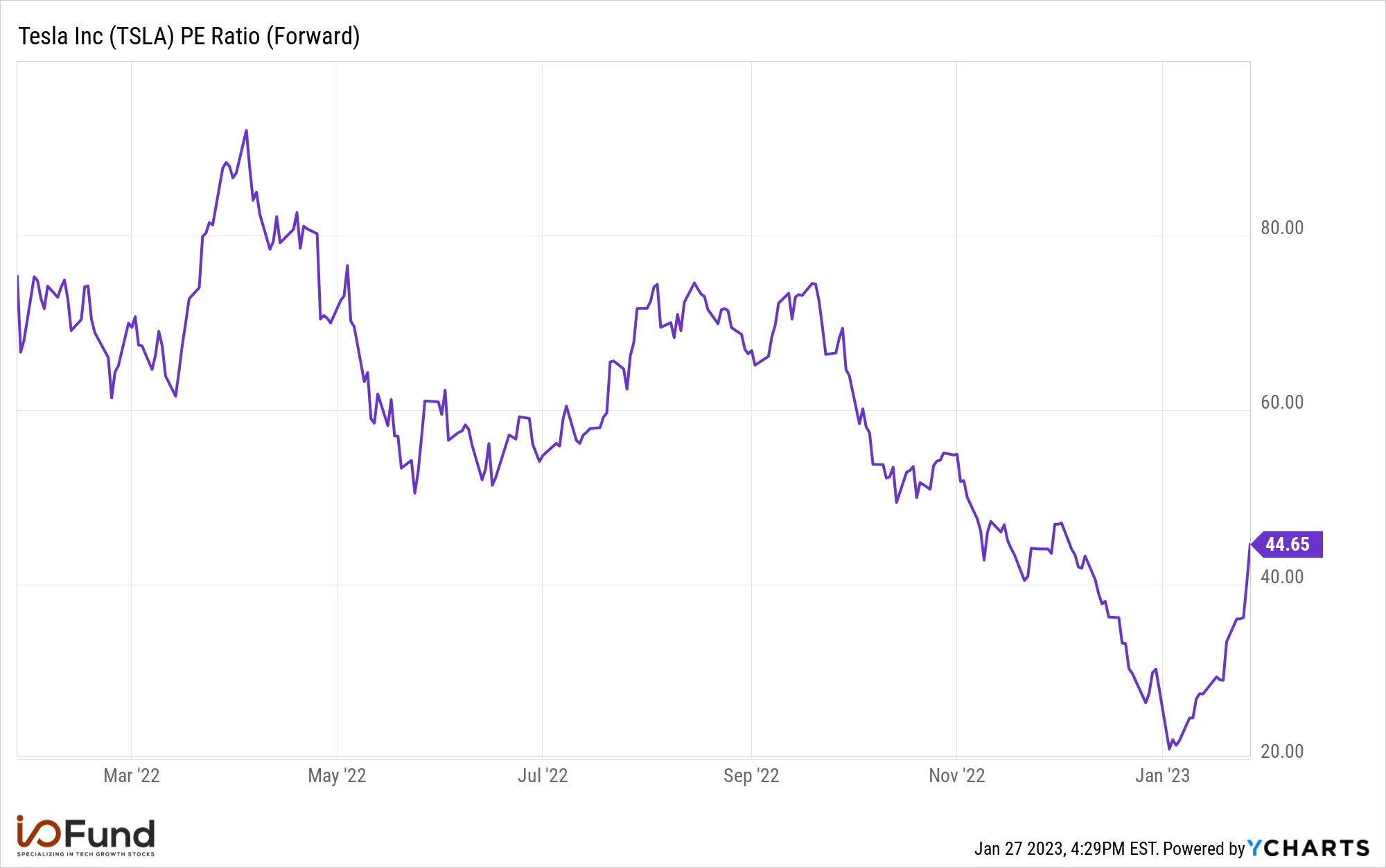
The forward PE Ratio is trading at a 45 forward and traded between 55 forward and 75 forward last year in the tough macro:

Finally, if we look at FCF, it’s trading at a steeper discount as it was at 125 prior to October and is now at a 55 EV/Revenue:

Conclusion:

Over the past few years, Tesla has demonstrated excellent operating leverage. The company has halved its average sales price (ASP) between 2017 and 2022, yet improved the GAAP operating margin from (14%) to 17%. This helps illustrate why a lower ASP may not necessarily weigh on the operating margin. The bull case for Tesla is that the higher volume of sales, optimized supply chains/vehicle design, and deflationary pressure on COGS will improve (and/or sustain) the margins over time. 

The bear case is that Elon Musk is misrepresenting January orders, that they’re lowering prices due to competition, and the softer gross margin and low FCF this quarter is forewarning of more margin contraction up ahead. 

Investors should be aware it was mentioned in the call that “there will be an impact on operating margin in the near term” from the lower prices. What could offset this is a beat on production and deliveries, which as you know, comes out monthly.

Posted in Autonomous Vehicles, Consumer Tech, Earnings Report, Energy StocksLeave a Comment on Tesla Q4 Earnings: Solid ER and Valuation is Low 

Tesla – Q4 Results Strong, Looking for Entry 

Posted on January 26, 2023June 30, 2026 by io-fund

We will provide a deeper dive on Tesla soon, however, we are strongly considering an entry for the following reasons:

·       Operating leverage: the company is delivering on margins and this is an important box to tick. There was concern that the lower prices would lead to a deteriorating bottom line, but this was not the case. 

·       Pricing leverage: Tesla’s pricing is becoming more affordable to the middle class and there’s some early evidence this could be met with enough demand to keep the company afloat on revenue growth.  

·       The valuation is very low, and with an ear towards technicals, we’d like to take advantage of the market’s deep discount on this particular stock.

Tesla reported revenue growth of 37% for revenue of $24.3B. Although this is a deceleration, the bottom line impressed with an operating margin of 16% compared to 14.75% in the year ago quarter. Again, there was built-up anticipation on the operating margin due to Tesla lowering prices, and this hurdle was cleared. 

Net income grew 60% in Q4 for a margin of 16.8% compared to 13.10% in the year ago quarter. For FY2022, net income more than doubled. 

Perhaps most importantly, Tesla is trading quite low and has not traded this low since “the new macro.” The forward P/S is at 4.7 and the forward P/E is at 36.15. If you take the tumultuous market of 2022 as a comp, Tesla may have 20% and up to 100% room. For the best case scenario to happen, we need broad market participation. 

Please follow the forum for entry updates and look for detailed earnings coverage next week.

Posted in Autonomous Vehicles, Consumer TechLeave a Comment on Tesla – Q4 Results Strong, Looking for Entry 

Autonomous Vehicles: Fact vs. Fiction at CES 2019

Posted on January 17, 2019June 30, 2026 by io-fund
Autonomous Vehicles: Fact vs. Fiction at CES 2019

Robot dogs from Continental prove that autonomous vehicle hype has gone too far. At CES 2019, Continental announced a way to automate last mile-delivery without requiring a human. This is where the robot dogs come in. The company’s official statement was, “With the help of robot delivery, Continental’s vision for seamless mobility can extend right to your doorstep. Our vision of cascaded robot delivery leverages a driverless vehicle to carry delivery robots, creating an efficient transport team.”

Virtual Representation of Autonomous Vehicles with AI Robots. Source: Continental

The problem with robot dogs, and many other AV gimmicks, is that the industry is not talking truthfully about what where we are with AV and what it will take to put an advanced AVs on the road. This is harmful to consumers who mistakenly believe autonomous vehicles are available for purchase and already on the road today. In fact, 71% of respondents around the world believe they can buy an AV – yet there is not one AV on the market. The top three brands that consumers mistakenly believe distribute self-driving cars include Tesla (40%), BMW (27%), and Audi (21%). It’s also harmful to investors who expect AV technologies to be profitable in the near term of two to three years.

CES is one of the world’s major marketing events where autonomous vehicles were first hyped. The main stage, the keynotes, the sessions, the booths, the competition between rival companies – all of it pushed for bigger and better car demos. Which is why CES is the perfect platform for the announcement of PAVE, which stands for The Partners for Automated Vehicle Education. PAVE is a new coalition that will help educate the public and policymakers about the potential of automated vehicles. Audi, Aurora, Cruise, GM, Mobileye, Nvidia, Toyota, Waymo and Zoox have joined the coalition, which has a central focus on education and safety – and also a focus on more credible information. As stated by Mark Del Rosso, President of Audi America, “Traditional automakers and newcomers are investing billions of dollars in the technology that will make automated vehicles possible. PAVE recognizes the need to invest in public information – in making sure consumers and policymakers understand what’s real, what’s possible, and what is rumor or speculation.”

Just the Facts: Level 2 Automation at CES 2019

Level 2 automation is a reference to the six levels of autonomous vehicles published by SAE International, and adopted as the industry standard for discussing the various stages and evolution of autonomous vehicles. Level 0 is no automation and Level 5 is full automation without a human driver and does not have brakes or a steering wheel. We are at Level 2 right now and the industry is experiencing notable delays in deploying Level 3.

(NOTE:NOTE:  I’ve published extensively on an autonomous vehicle bubble due to investors pouring money into AV technologies that won’t commercially deploy for many years. You can access the analysis on GM here, the analysis on Tesla here and the analysis on how autonomous vehicles are creating a bubble here).

Below are a couple of the more important (and realistic) announcements from CES that will deploy in the very near future.

Nvidia

Nvidia placed emphasis on gaming this year at its Sunday CES press conference with the announcement of the RTX 2060, whereas it has been Nvidia’s tradition to focus on autonomous vehicles (and data center technologies) at the CES press conference. One day later, on Monday at CES, Nvidia launched DRIVE AutoPilot, which will improve advanced driver assistance features, such as enabling lane changes, pedestrian and cyclist detection, parking assist, and personal mapping. This improved automation strengthens the Level 2 vehicles we see on the road today.

Intel

Intel had a showy display that included a Gotham City themed BMW X5 equipped with large screen TVs, projectors, sensors and haptic feedback. Visual distractions aside, the real news from Intel at CES is the company’s ongoing focus on China. Intel did not officially state they are redirecting their efforts from the United States to China, however, the announcements speak for themselves:

  • Mobileye, Beijing Public Transport Corp. and Beijing Beytai Collaborate to Bring Autonomy to China’s Public Transportation
  • 2019 CES: Great Wall Motors, Mobileye Join Forces to Deliver ADAS and Autonomous Driving Solutions in China and Beyond
  • Intel and Alibaba Team on New AI-Powered 3D Athlete Tracking Technology Aimed at the Olympic Games Tokyo 2020

My newsletter subscribers get this information first. Sign up here.My newsletter subscribers get this information first. Sign up here.here.

This is in addition to a hard-to-miss announcement back in July that Baidu was partnering with Mobileye on their Apollo vehicle. At CES 2019, Baidu had on display the successful implementation of Mobileye’s Responsibility Sensitivity Safety (RSS) in the simulation engine of Apollo (I personally tried out the simulator).

Baidu Spokesperson at CES discussing Data-Centric Innovation

It’s important to note that China is not immune to the issues the industry faces in advancing from Level 2 automation to Level 3 automation. China, too, is idling at Level 2 (apologies for the pun). For instance, Great Wall Motors released a statement at CES 2019 that “GWM hope to integrate Mobileye’s solutions into its vehicles. Starting with L0-L2+ within the next three to five years, the companies are also exploring opportunities for Mobileye’s Level 3 products.”

Baidu and Mobileye have both made promises to deliver Level 3 by 2019 and Level 4 autonomy by 2021. These dates were announced in 2017 but there has been no recent updates as to the estimated delivery for L3 – including at CES this year.

Mercedes Benz

The best AV investments over the next three to five years will come from companies who are taking baby steps towards a better and safer driving experience. Mercedes-Benz is one company making the most of Level 2 partial automation by announcing a new CLA class. The CLA class is a more tech-driven option with augmented reality for navigation, and an Interior Assistant that understands indirect voice commands and operational gestures. (Read my analysis on how we have reached a tipping point for AI-powered assistants here). An example of this is when a driver reaches over in the seat, and lights automatically illuminate the area. You can also set a command such as “navigate me home” or ask the voice assistant something complicated like “find child-friendly Asian restaurants nearby with 4-star rating which are neither Chinese nor Japanese,” which was one example given in the demo.

New Autonomous Vehicle Mercedes Benz CLA class. Source: TechCrunch

Takeaway:

Nvidia and Intel had a different tone at CES this year in regards to autonomous vehicles. Nvidia’s launch of DRIVE AutoPilot is a smart strategy to boost sales in the short term while the AV future of Level 3 or Level 4 sorts itself out. The Mercedes CLA class is another great example of a strong Level 2 automation strategy. Intel is clearly betting on China, especially Baidu, although China is not immune to the difficulties of how to get a machine to react like a human. Notably, there was no Level 3 follow up from Baidu at this year’s CES despite promises for arrival in 2019 (although the year is young).

Regardless of make or model, AVs are stuck at Level 2, and there are too high of expectations as to when advanced AV will turn a profit. Therefore, the AV market will struggle as the delivery of reliable and safe automation continues to see delays. Nvidia, Intel and Mercedes are a few companies preparing for the slow down, and I’m betting we will see others do the same this year.

Posted in Autonomous Vehicles, Autonomous Vehicles, Broad Market Today, Consumer Tech, Market Updates, Tech StocksLeave a Comment on Autonomous Vehicles: Fact vs. Fiction at CES 2019

Recent Posts

  • The IPO Glut of 2020: Why Valuations Have Gone Too Far
  • Zoom Discusses Two Important Catalysts In Q1 Earnings
  • Three Risk Management Tools the I/O Fund Offers
  • Micron Is Up 900%. Here’s Why the AI Memory Trade May Still Have Room to Run
  • Credo: Reliability Leader Aggressively Moves into Optics

Recent Comments

No comments to show.

Archives

  • June 2026
  • May 2026
  • April 2026
  • March 2026
  • February 2026
  • January 2026
  • December 2025
  • November 2025
  • October 2025
  • September 2025
  • August 2025
  • July 2025
  • June 2025
  • May 2025
  • April 2025
  • March 2025
  • February 2025
  • January 2025
  • December 2024
  • November 2024
  • October 2024
  • September 2024
  • August 2024
  • July 2024
  • June 2024
  • May 2024
  • April 2024
  • March 2024
  • February 2024
  • January 2024
  • December 2023
  • November 2023
  • October 2023
  • September 2023
  • August 2023
  • July 2023
  • June 2023
  • May 2023
  • April 2023
  • March 2023
  • February 2023
  • January 2023
  • December 2022
  • November 2022
  • October 2022
  • September 2022
  • August 2022
  • July 2022
  • June 2022
  • May 2022
  • April 2022
  • March 2022
  • February 2022
  • January 2022
  • December 2021
  • November 2021
  • October 2021
  • September 2021
  • August 2021
  • July 2021
  • June 2021
  • May 2021
  • April 2021
  • March 2021
  • February 2021
  • January 2021
  • December 2020
  • November 2020
  • October 2020
  • September 2020
  • August 2020
  • July 2020
  • June 2020
  • May 2020
  • April 2020
  • March 2020
  • February 2020
  • January 2020
  • December 2019
  • November 2019
  • October 2019
  • September 2019
  • August 2019
  • July 2019
  • June 2019
  • May 2019
  • April 2019
  • March 2019
  • February 2019
  • January 2019
  • December 2018
  • November 2018
  • October 2018
  • September 2018
  • August 2018
  • July 2018
  • June 2018
  • May 2018
  • April 2018
  • February 2018
  • January 2018

Categories

  • 5G
  • About
  • Accounting Tips
  • AdTech
  • Ai Platforms
  • Ai Platforms
  • Ai Platforms
  • Ai Platforms
  • Ai Platforms
  • Ai Platforms
  • Ai Platforms
  • Ai Platforms
  • Ai Platforms
  • Ai Platforms
  • Ai Platforms
  • Ai Platforms
  • Ai Platforms
  • Ai Platforms
  • Ai Platforms
  • Ai Platforms
  • AI Stocks
  • AI Stocks
  • Analysts
  • Application Monitoring
  • Application Monitoring
  • Applications
  • Applications
  • Applications
  • Applications
  • Applications
  • Applications
  • Applications
  • AR
  • Audit Reports
  • Autonomous Vehicles
  • Autonomous Vehicles
  • Autonomous Vehicles
  • Autonomous Vehicles
  • Autonomous Vehicles
  • Autonomous Vehicles
  • Autonomous Vehicles
  • Avod
  • Avod
  • Battery Charging
  • Bear Market
  • Bitcoin
  • Bitcoin
  • Bitcoin
  • Bitcoin
  • Bitcoin
  • Bitcoin
  • Bitcoin
  • Blockchain
  • Blockchain
  • Blockchain
  • Blockchain
  • Blockchain
  • Blockchain
  • Blockchain
  • Broad Market Today
  • Bull Market
  • Bull Market
  • Chainlink
  • Chainlink
  • Chainlink
  • Chainlink
  • China Stocks
  • Cloud
  • Cloud Infrastructure
  • Cloud Infrastructure
  • Cloud Infrastructure
  • Cloud Infrastructure
  • Cloud Infrastructure
  • Cloud Infrastructure
  • Cloud Infrastructure
  • Cloud Platforms
  • Cloud Platforms
  • Cloud Software
  • Cloud Software
  • Cloud Software
  • Cloud Software
  • Cloud Software
  • Cloud Software
  • Cloud Technology
  • Company
  • Company
  • Console Gaming
  • Console Gaming
  • Console Gaming
  • Consumer
  • Consumer
  • Consumer
  • Consumer
  • Consumer
  • Consumer
  • Consumer
  • Consumer
  • Consumer
  • Consumer
  • Consumer
  • Consumer
  • Consumer
  • Consumer
  • Consumer Tech
  • Corrections
  • Crypto Investment
  • Ctv
  • Ctv
  • Ctv
  • Ctv
  • Ctv
  • Ctv
  • Ctv
  • Ctv
  • Ctv
  • Ctv
  • Cybersecurity
  • Cybersecurity
  • Cybersecurity
  • Cybersecurity
  • Cybersecurity
  • Cybersecurity
  • Cybersecurity
  • Cybersecurity
  • Cybersecurity
  • Cybersecurity
  • Cybersecurity
  • Cybersecurity
  • Data
  • Data Analytics
  • Data Analytics
  • Data Analytics
  • Data Center
  • Data Center
  • Data Center
  • Data Center
  • Data Center
  • Data Center
  • Data Center
  • Data Center
  • Data Center
  • Data Center
  • Data Center
  • Data Center
  • Data Center
  • Data Center
  • Data Center
  • Data Center and Processing
  • Data Warehousing
  • Data Warehousing
  • Data Warehousing
  • Data Warehousing
  • Databases
  • Databases
  • Databases
  • Databases
  • Dating
  • Defi
  • Digital Ads
  • Digital Ads
  • Digital Ads
  • Digital Ads
  • Digital Ads
  • Digital Ads
  • Digital Ads
  • Digital Ads
  • Digital Ads
  • Digital Ads
  • Digital Ads
  • Digital Ads
  • Digital Ads
  • Digital Ads
  • E-Commerce
  • Earning Updates
  • Earning Updates
  • Earning Updates
  • Earning Updates
  • Earning Updates
  • Earnings Report
  • Earnings Report
  • Earnings Report
  • Earnings Report
  • Earnings Report
  • Earnings Report
  • Earnings Report
  • Earnings Report
  • ECommerce
  • Electric Vehicles
  • Electric Vehicles
  • Electric Vehicles
  • Electric Vehicles
  • Electric Vehicles
  • Electric Vehicles
  • Electric Vehicles
  • Energy Stocks
  • Enterprise
  • Enterprise
  • Enterprise
  • Enterprise
  • Enterprise
  • Enterprise
  • Enterprise
  • Enterprise
  • Enterprise
  • Ethereum
  • Events1
  • Events1
  • Exchange
  • Faq
  • Finance
  • Financial Analysis
  • Financial Analysis
  • Financial Analysis
  • Financial Analysis
  • Financial Analysis
  • Financial Analysis
  • Financial Analysis
  • Financial Analysis
  • Financial Analysis
  • Financial Analysis
  • Financial Analysis
  • Financial Analysis
  • Financial Markets
  • FinTech
  • Fundamental Analysis
  • Gambling
  • Gaming
  • Genomics
  • Glossary
  • Green Energy
  • Growth Stocks
  • Growth Stocks
  • Growth Stocks
  • Headsets
  • Headsets
  • Health Tech
  • Hydrogen
  • Identity
  • Identity
  • Identity
  • Inflation
  • Inflation
  • Inflation
  • Internet of Things
  • Interviews
  • Interviews
  • Interviews
  • Interviews
  • Investing
  • Investing
  • Ltbh
  • Ltbh
  • Ltbh
  • Ltbh
  • Ltbh
  • Macro Trends
  • Macro Trends
  • Market Trends
  • Market Trends
  • Market Trends
  • Market Trends
  • Market Trends
  • Market Trends
  • Market Trends
  • Market Updates
  • Market Updates
  • Market Updates
  • Market Updates
  • Market Updates
  • Market Updates
  • Market Updates
  • Market Updates
  • Market Updates
  • Market Updates
  • Media
  • Membership
  • Mining
  • Mobile
  • Mobile
  • Mobile
  • Mobile
  • Mobile Gaming
  • Mobile Gaming
  • Mobile Gaming
  • Multimedia
  • Music Streaming
  • NVDA | NVIDIA Corporation
  • Performance Updates
  • Pin Content
  • Podcasts
  • Podcasts
  • Podcasts
  • Portfolio
  • Premium Research
  • Press Releases
  • Press Releases
  • Productivity
  • Productivity
  • Productivity
  • Productivity
  • Productivity
  • Productivity
  • Productivity
  • Reports and Whitepapers
  • Research Services Preview
  • Resources
  • Resources
  • Semiconductor Stocks
  • Semiconductors
  • Semiconductors
  • Semiconductors
  • Semiconductors
  • Semiconductors
  • Semiconductors
  • Semiconductors
  • Semiconductors
  • Semiconductors
  • Semiconductors
  • Semiconductors
  • Semiconductors
  • Semiconductors
  • Social Media
  • Social Media
  • Social Media
  • Social Media
  • Social Media
  • Social Media
  • Social Media
  • Software
  • Software
  • Software
  • Software
  • Software
  • Software
  • Software
  • Software
  • Software
  • Software
  • Software
  • Software
  • Software
  • Software
  • Software
  • Solar
  • Solar
  • Stock Analysis PDFs
  • Stock Updates
  • Stock Updates (Blogs)
  • Supplychain
  • Supplychain
  • Supplychain
  • Supplychain
  • Supplychain
  • Supplychain
  • Svod
  • Svod
  • Svod
  • Svod
  • Svod
  • Svod
  • Tech Podcast
  • Tech Stock News
  • Tech Stock News
  • Tech Stock News
  • Tech Stock News
  • Tech Stock News
  • Tech Stocks
  • Tech Stocks
  • Tech Stocks
  • Tech Stocks
  • Tech Stocks
  • Tech Stocks
  • Tech Stocks
  • Tech Stocks
  • Tech Stocks
  • Tech Stocks
  • Tech Stocks
  • Tech Stocks
  • Tech Stocks
  • Tech Stocks
  • Technical Analysis
  • Telehealth
  • Telehealth
  • Telehealth
  • Telehealth
  • Testing Equipment
  • Testing Equipment
  • Top Tech Stock News
  • Travel
  • Trends Report
  • Tutorials
  • Uncategorized
  • Updates
  • Updates
  • Updates
  • Video
  • Video
  • Video
  • Video
  • Video Footage
  • VR
  • Webinar Alerts
  • Webinar Alerts
  • Webinars
Proudly powered by WordPress | Theme: iofund by iofund.co.uk.