910af809-34a0-434f-9da1-62aee604ee76_MongoDB-2019-Analysis.pdf
SECTION 1: What Is NoSQL?
Data storage is the invisible layer to the back-end that large-scale applications rely on to store passwords, product data, files, content, and accounting information. Website and applications are made of files containing data and this data needs to be stored and easily retrieved. NoSQL stands for Not only SQL, referring to relational databases that define and manipulate data based on structured query language (SQL).
The drawback to SQL databases, which MongoDB’s NoSQL database competes with, is that SQL databases are restrictive and require you to use predefined schemas. The data must follow the same structure with SQL databases, whereas MongoDB’s NoSQL database allows you to store data with dynamic schema for unstructured data, such as document-oriented, column-oriented, graph-based and as a key-value store.
MongoDB is a popular and well-supported NoSQL database that offers a database-as-a-service (DBaaS) product to reduce the operational complexity of on-premise databases. As an open source database, MongoDB has many competitors outlined below. The moat, if you will, comes from the time it requires for software developers to learn a new database platform. Platforms that are known universally, like MongoDB, are desirable as it is not a requirement to learn a new platform if a software developer changes employment. The friction in changing databases for companies is also very costly.
1A: MongoDB Products:
MongoDB Enterprise Advanced runs in the cloud, on-premise, and in a hybrid environment. This subscription package represented between 56-65% of revenue subscriptions over the past three years. In June of 2016, a cloud-hosted database-as-a-service (DBaaS) product was introduced, MongoDB Atlas, which recently represented 23% of revenue up from 7% of revenue in the year prior.
Community Server is a free-to-download database that has seen over 60 million downloads over the past ten years with 20 million downloads occurring in the last year.
1B. Market Opportunity:
IDC updated its forecast and expects the worldwide database software market to grow from $64 billion in 2019 to $98 billion in 2023. There are six segments in the big data management space: enterprise data warehouse, NoSQL, Hadoop, big data integration, data virtualization, and in-memory data fabric.
The NoSQL market is growing quickly and outpacing overall IT, but the market size is small compared to other big data segments. Some estimates place the NoSQL market at $1.6 billion in 2021 while other sources state the near-term opportunity is $4 billion.
Here’s a glimpse of the growth from natural language processing (NLP), growing from $720 million in 2019 to over $4 billion by 2025. MongoDB is well situated to capitalize on this specific software segment. You can add another $1 billion to the market potential for deep learning. IoT data may also become a driver for NoSQL, adding to the trajectory.

To complicate addressable market, up to 25% of databases are entirely open source and unpaid without licensing fees, such as PostreSQL. MongoDB is also open source, however, competing corporations must license the code and the company charges for enterprise-level products, cloud database-as-a-service products and analytics.
It’s important to remember we are in a transition as indicated by the developer survey. Big data has evolved over the last decade and will face more complex challenges that go beyond predictive modeling to include natural language processing, deep learning, IoT connectivity and new methods, such as data lakes.
1C. Competitors:
MongoDB has competitors from all sides. As stated, the moat in software platforms and languages is established by becoming universal as there is a time prohibitive learning curve in switching to new platforms/languages/frameworks which prevents customers from switching frequently.
Tech companies also need to hire based on universal database skills. There cannot be too much fragmentation or it will impede technological progress.
This works both ways as MongoDB may be the better product, yet many companies may find it hard to switch from Oracle or another legacy, relational database.

Due to becoming a universal NoSQL option, MongoDB is in the lead for most wanted database skills as of early 2019. Being agnostic certainly helps, meaning that the competition between Oracle-owned MySQL, Microsoftowned SQL Server and Amazon-owned DynamoDB helps MongoDB because it is neutral and does not compete with these companies across other, more lucrative revenue segments. When Microsoft hires, they will not advertise for DynamoDB experience but they will seek MongoDB experience, helping MongoDB establish itself as a universal database program.
1D. MySQL Still Dominates the Market
MySQL is the leading database technology with nearly 55% of developers responding they use it or have used it.
The free and open-source software was bought by Sun Microsystems, which in turn, was bought by Oracle in 2010. The founders of MySQL decided to fork the project and create MariaDB, most likely as a rebuttal against Oracle. MariaDB now competes with MySQL.
The debate between SQL and NoSQL is still very heated, but as we can see from the skills most sought-after, NoSQL has a bright future ahead. The best growth stocks are at the beginning of a trend with future market share dwarfing current market share. Not only is MongoDB the leading NoSQL database (current market), it is also the most in demand database (future market).
“When I joined MongoDB, about 5 percent of all projects were relational (SQL) migrations – now it’s 30 percent as companies look to transform.
Cost can be a factor, but more often it’s development speed and running at scale. It’s not unusual to see developer productivity up 3 to 5x after switching [from a SQL database], coupling MongoDB with a shift to cloud, microservices, and agile/devops.”
– Mat Keep, director of product marketing at MongoDB, 2018
MongoDB’s growth depends on converting developers from SQL databases (relational) and also convincing developers to pay for features when open source is traditionally free. Startups also compete with MongoDB, such as YugaByte, which raised $16 million last year to combine SQL and NoSQL into a single database.
Within the segment of NoSQL, MongoDB has a few competitors, as well – hence the reason I stated there were competitors from all sides (from free open source, SQL and also NoSQL). MongoDB is the leading NoSQL database although Redis, Cassandra, and Couchbase are competitive NoSQL products that vie for market share.

According to Stack Overflow, Redis is the closest competitor to MongoDB. Forrester positions Couchbase as a more serious contender than Statista indicates, although Statista is more insightful as over 80,000 developers were polled on the Stack Overflow survey as opposed to 26 vendors from Forrester.
Section 2: Fundamentals
MongoDB has reported solid revenue growth YoY of $65 million, $114 million, $186 million and $267 million in the most recent year. The revenue growth of MongoDB YoY is nearly 70% from a fairly mature company that was founded in 2007.
As a percentage of revenue, net losses decreased from 62% to 51% to 38% revenue in the most recent year ending January 31st, 2019. Gross profit margins were lower in the most recent quarter at 68% gross margin, compared to 73% gross margin in the year-ago period.
Free cash flow improved in the most recent quarter to $2.8 million compared to negative $8.4 million in the year-ago period.
Sales and marketing costs are over 50% of revenue and R&D costs are over 30% of revenue; this represents an increase of 36% in sales and marketing costs YoY and an increase of 44% in R&D.
The company is choosing to not be profitable and instead is going after market share, and this strategy will likely continue over the next few quarters. Dismissing profitability for critical early-trend growth should pay off as we are in an important window of opportunity for AI and ML development. Also, once customers are converted, there is too much friction to switch, and therefore, time is of the essence to win this market.
Despite strong earnings reported in June (fiscal Q1 2020) that beat estimates on all accounts, MongoDB stock has dipped from the $165 range to the $145 range, currently, due to revised guidance on expected losses for the full year to $1.04 to $1.11. Wall Street had expected a full-year loss of $1.01 per share.
Most notably, MongoDB is courting Google Cloud Platform, which should further its compatibility with Kubernetes, a container system that originated from Google, and Tensorflow, a machine learning framework and language that is rising in popularity.
I’ve reached out to MongoDB, who stated MongoDB 4.2 will be released in a few weeks, which should strengthen fundamentals with increased Kubernetes functionality and more competitive features for Atlas, including full-text search to take on Elastic. Kubernetes has gained in popularity from 10% of survey respondents using container orchestration in 2015 to over 71% respondents using Kubernetes in 2017.
For these reasons, I expect MongoDB’s growth to continue its trajectory.
2A. Amazon Endorses MongoDB as Segment Winner
Amazon has been a leading cause of MongoDB stock dropping two times this year. In January, MDB lost over
15% of its value in one day following the announcement of Amazon’s competing database-as-a-service product DocumentDB. In March, the news that Lyft was leaving MongoDB for Amazon was enough to shake the stock by 5%. Therefore, further analysis of Amazon is required to forecast the fundamental strength of MDB.
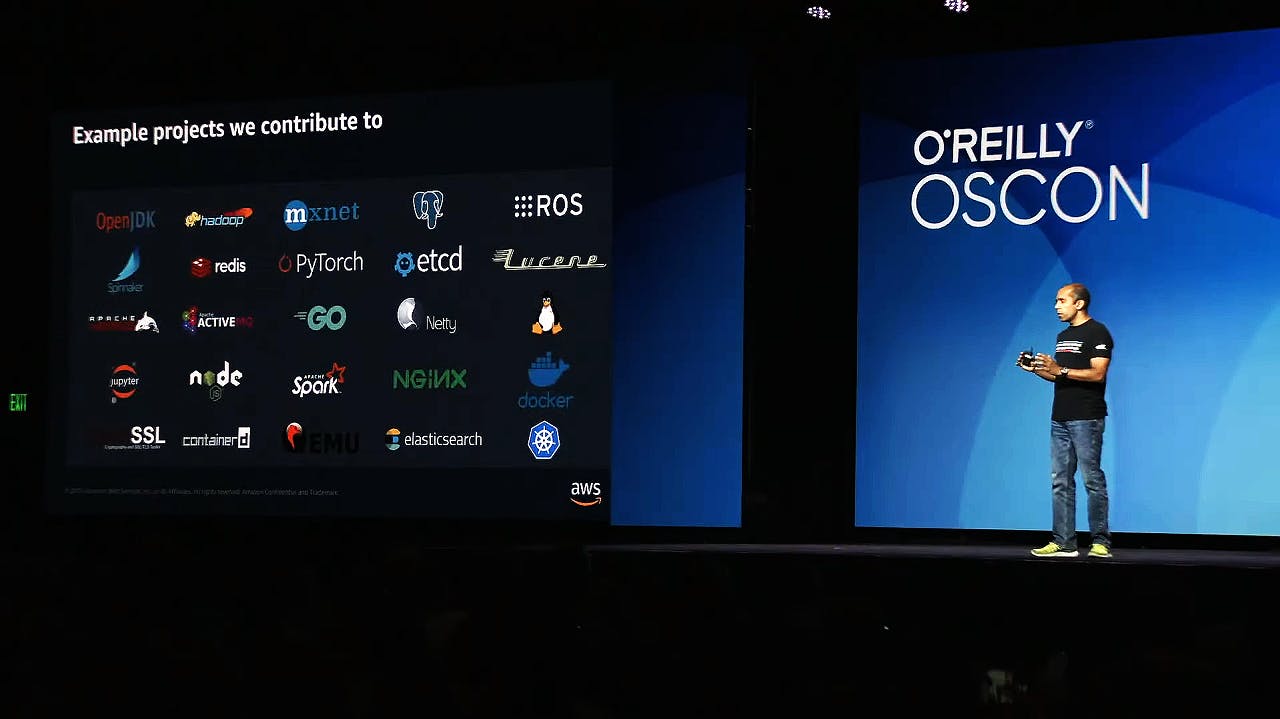
Last week, I wrote a public article about Amazon’s keynote at O’Reilly’s open source conference, OSCON. There was a disproportionate amount of endorsement for MongoDB coming from Amazon, stating “AWS effectively endorses MongoDB Atlas as the segment winner” and that MongoDB Atlas is an “AWS reinvent 2019 top level sponsor.” The speaker also made it clear that Amazon and Microsoft have cloned MongoDB’s Atlas but this has not slowed down growth from Atlas.
There was a slide that shows MongoDB’s growth from 22% as a percentage of revenue to 35%, despite DocumentDB’s launch in January. This matches the reported 400% growth of Atlas to account for 34% of MDB’s revenue in fiscal Q4 2019 and 35% in fiscal Q1 2020 (reported in June 2019).
One concern is if the Atlas growth of 34% of revenue in fiscal Q4 to 35% of revenue QoQ in fiscal Q1 was due to DocumentDB. According to Amazon’s presentation, MongoDB is still dominating, and this was welcomed intel directed towards NoSQL and SQL software developers, who Amazon is not likely to lead astray.
You can read my public article here. Here’s a video of Amazon’s presentation that I attended that was shared on our RS Forum.
Product and Fundamental Analysis Conclusion:
As of now, customer or competitor statements have a positive outlook on MongoDB. Developers are preferring MongoDB as the most wanted database skills in early 2019, per a survey of over 80,000 developers. Atlas’ growth was light QoQ compared to previous quarters, yet Amazon recently conceded that MongoDB remains the segment winner. Although this endorsement was based on industry insider information rather than from actual fiscal Q2 2020 results, I do not believe this would be in a keynote if Amazon did not truly believe MongoDB is currently the segment winner at the time of the keynote.
MongoDB is spending its resources on gaining market share. The company may not be profitable in the near future as it attempts to cement itself as the universal NoSQL option with a major ramping up in R&D and sales and marketing. I believe you can play this to your advantage as a buy and hold investor as the market is likely to penalize MongoDB for losses now to hold its position for the future. To build a buy and hold position, wait for a pullback.
I place the addressable market on the high end of estimates as charging for commercial open source software is a new trend that is gaining traction. Enterprises will pay if the tools are faster and cheaper for their teams. Database-as-a-service is a newer category that is also likely to grow faster than current analyst estimates.
MongoDB is a volatile stock as seen from the Amazon news and revised guidance for EPS. From my research, MongoDB will continue to perform well in the competitive landscape and buying the stock on perceived weakness is a good strategy.
3. TECHNICAL ANALYSIS

Technical Analysis provided by Knox Ridley.
Shortly after its IPO in October of 2017, MDB began an uptrend of a breathtaking 300%. With less than two years of trading, we have enough data to gauge major support and resistance levels, as well as gauge the strength of the current trend, which can give us a reasonable guess at the best entry.
3A. Internals:
The MACD is in a very weak state. It’s made lower highs as the stock has made higher highs, indicating negative divergence, which we usually see leading up to a pullback. You’ll also notice the volume decreasing as the price is rising, which is characteristic of weakening buying pressure.
However, the biggest warning to me is the puncturing of the Bollinger Bands, which can be seen below:

You can see the move initiated on high volume, broke straight through the bottom band with a widening upper band. This is followed by 2 days of lower lows on higher than average volume. This move confirms that MDB is in a downtrend (making lower highs and now lower lows).
Also, MDB is comfortably below it’s 50-day moving average, with that average now pointing down. It has respected this moving average through-out its bull run, so to see it break through with force and comfortably staying below it is something to watch carefully.
It is currently touching the line in the sand support at $141, bouncing around for 3 days. The more a stock tests the support, the more likely it is to break that support. Bellow this support and I think we will visit the 200-day moving average, which is around $115. The 200-day sits directly in the middle of our entry target in the green box between $128 and $95
3B. Scenarios:
• The more likely scenario is that MongoDB will break the $141 support and our entry will be between $95 and $128. There is a saying, “The market abhors a vacuum.” More times than not, the market will attempt to fill a gap up or down. If we break the $141 support, that will be the target region, which also line up with a Wave 4 (ABC) retrace. This is the most likely scenario if the 200-day moving average breaks.
• It’s lower risk to wait and buy MongoDB when/if it reclaims it’s 50-day moving average. Depending on how quickly MDB regains its 8, 21, 50-day EMA, we may enter before the $167 resistance.
• If MDB breaks $167, we will buy with the assumption of a broader bull market.