Skip to content
Logo-main-white.860316a8

I/O Fund

  • Home
  • Free Stock Analysis
  • AI Stocks
  • BEST OF 2025
  • Analysts
  • Nvidia Hub
  • About
    • Case Studies
    • About Us
    • Premium Services
    • Pricing
    • Notable Wins
    • I/O Fund Reviews
    • Media
  • Contact Us

Category: Data Center

Nvidia Stock: Evidence Gaming Bottomed And Why It’s Important

Posted on November 29, 2022June 30, 2026 by io-fund
Nvidia Stock: Evidence Gaming Bottomed And Why It’s Important

This article was originally published on Forbes on Nov 23, 2022,12:52pm ESTForbes on Nov 23, 2022,12:52pm EST

Nvidia has overcome strong headwinds over the past few years, including United States-China tensions, supply chain disruptions spanning many components, tough comps on the data center, tough comps on gaming, and a less-than-rosy macro environment. However, the most impactful of all has been Ethereum’s merge to Proof of Stake (POS), which led to a $2.5 billion cumulative miss in revenue.

In September, we made a prediction in the analysis entitled “Nvidia Stock Is Ready to Rumble with RTX 40 Series and H100 GPUs” that Nvidia’s new gaming release would soften the blow when we said the following:

“First, Nvidia is restricting supply on its current gaming model. Per the CFO: ‘Across those two quarters, the Q2 of ‘23, the Q3 of ‘23, we have likely undershipped gaming to our end demand significantly.’

[…] We estimated for our premium members that the amount undershipped is a minimum of $1 billion. The reason behind this is to help keep prices stable and to increase demand for the RTX 40 Series.

Second, Nvidia announced its GeForce RTX 40 Series at the GTC 2022 Conference this week.

The new Ada Lovelace architecture uses 76 billion transistors and a 4nm production process. In the keynote, the CEO stated: ‘Nvidia engineers worked closely with TSMC to create the 4N process optimized for GPUs. This process let us integrate 76 billion transistors and over 18,000 CUDA cores, 70% more than the Ampere generation.’

The improvement from 8nm to 4nm means more transistors on the GPU, which results in better performance as the 4nm processes data faster.

In the gaming world, this much anticipated release is expected to be 2-4X faster than the RTX 3090 Ti. The flagship AD102 GPU model will have 144 individual streaming multiprocessors (SMs) in one die compared to 84 SMs in the Ampere architecture. As stated, the AD102 will also have a 70% increase in CUDA cores over the RTX 3090 Ti […]

The popularity of this release will help determine if Nvidia can stage a comeback in the gaming segment.” You can read the full analysis here. Fast-forward and not only was the GeForce RTX 40 Series with Ada Lovelace architecture popular, management stated “the Ada launch was a homerun.” Below, we look at the most recent earnings report and then we break out additional details that support Nvidia’s Q3 reaching a gaming bottom.

Sign up for I/O Fund's free newsletter with gains of up to 221% – Click HereSign up for I/O Fund's free newsletter with gains of up to 221% – Click HereClick Here

What Q3 Earnings Results Says About a Gaming Bottom

First, I’ll provide a general overview of Nvidia’s earnings results before I discuss what to expect in the gaming segment specifically.

Nvidia reported as expected for Q3 ending in October with revenue of $5.93 billion for growth of (17%) which matched management guidance of $5.90 billion. Analyst consensus for revenue was $5.85 billion, or (17.7%) growth.

Fiscal Q4 ending in January was a slight miss with guidance of $6 billion compared to analyst consensus of $6.17 billion. This represents growth of (21%).

Nvidia reported adjusted EPS of $0.58 which missed adjusted EPS estimates of $0.71. This compares to the July quarter of $0.51 adjusted EPS.

Management indicated that profitability will increase from here: [GAAP and non-GAAP operating expenses were] primarily due to higher compensation expenses related to headcount growth and salary increases and higher data center infrastructure expenses. Sequentially, both GAAP and non-GAAP operating expense growth was in the single-digit percent, and we plan to keep it relatively flat at these levels over the coming quarters.”

In Q3, the GAAP gross margin was 53.6% and the adjusted gross margin 56.1%. This was a miss from management Q3 guidance of 62.4%. The reason for the miss related to China: “Gross margins reflect $702 million in inventory charges largely related to lower data center demand in China, partially offset by a warranty benefit of approximately $70 million.”

Nvidia is signaling that gross margin will return to normal next quarter with a guide for GM of 63.2%.

For the most part, Nvidia’s bottom line showed signs that last quarter was a bottom for the company with marginal, yet crucial improvement sequentially. As long as the company does not increase operating expenses, which the CFO stated the opex would be flat and not increase, then these margins should improve from here.

  • The company reported GAAP operating profit of $601 million for an operating margin of 10.1%. This compares to an operating margin of 7.44% last quarter. Nvidia’s typical OM is in the 37%-38% range.
  • The adjusted operating profits of $1.56 billion with a margin of 25.9% in Q3 compares to an adjusted operating margin of 19.76% in Q2. This is down from Nvidia’s typical adjusted OM of 47%.
  • The adjusted net margin of 24.5% in Q3 compares to an adjusted net margin of 19.27% last quarter.

The free cash flow margin was (2.6%) for free cash flow of ($156) million compared to a 12% margin last quarter for free cash flow of $824 million. The company has $13.14 billion in cash and $10.95 billion in debt.

The company returned $3.75 billion to shareholders with share repurchases and cash dividends. with $8.3 billion remaining under the share repurchase authorization through December 2023.

The biggest names in tech are reporting their earnings right now, and our premium members are getting updates almost daily. Learn more about about our premium membership here.The biggest names in tech are reporting their earnings right now, and our premium members are getting updates almost daily. Learn more about about our premium membership here.Learn more about about our premium membership here.

Evidence that Gaming Bottomed in Q3

Gaming revenue was down (51%) for revenue of $1.57 billion. Admittedly, even if Q3 is the bottom, there is still quite a ways to go before the company returns to growth in this segment. The reason it’s important to identify a fundamental bottom is because it typically correlates with a bottom in the stock price.

Nvidia Management Points Toward Q3 as the Bottom in the Earnings Callas the Bottom in the Earnings Call

In addition to saying “the Ada launch was a homerun,” management expects gaming to grow sequentially from Q3 to Q4. Management also stated “our new Ada Lovelace GPU architecture had an exceptional launch” and “we sold out quickly in many locations and are working hard to keep up with demand.”

Most importantly, management stated gaming will return to sequential growth in Q4 and that channel inventory will “approach normal levels” as the company exits Q4 to where the company can more adequately match supply with demand.

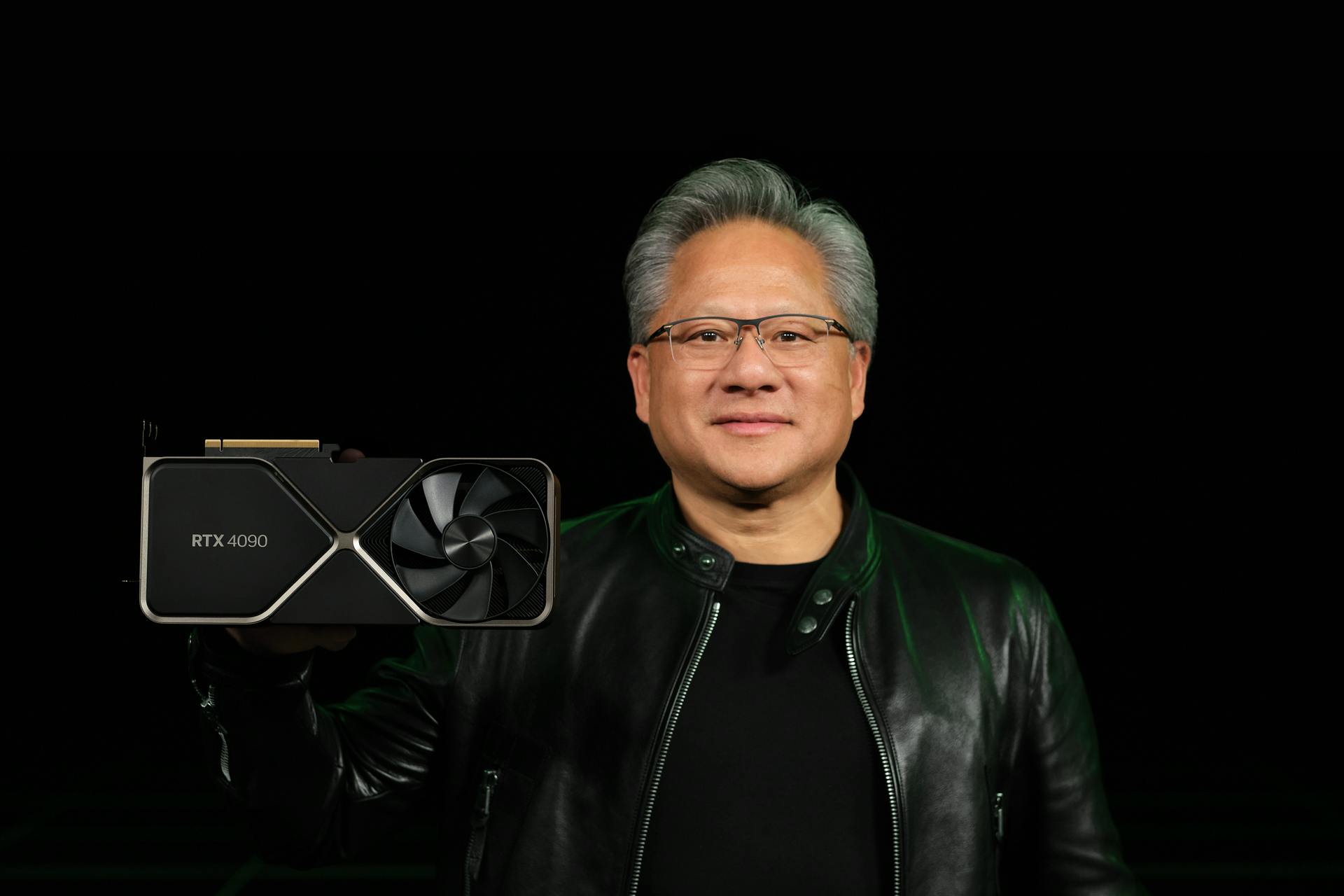
On the call, Kress discussed that the sell-through rate across two quarters for gaming is $5 billion total, which helps prove the popularity of Nvidia’s RTX 40 series. The CEO also stated: “That 4090 — we shipped a large volume of 4090s because as you know, we were prepared for it. And yet within minutes, they were sold out around the world. And so, the reception of 4090 and the reception of 4080 today has been off the charts.”

The first release date for the RTX4090 models was October 12th with a starting price of $1,599. There was a second release date in November for the RTX4080 models with prices of $1,199 and $899. Notably, the mid-range RTX 40 series outperforms the previous generation’s high-end models, which also helps to drive demand because customers receive an upgrade at the $899 and $1,199 level. This is due to the Ada Lovelace architecture which offers 1,400 Tensor TFLOPs versus 320 Tensor TFLOPs which means the DLSS is superior and the high-end RTX 30 Series cannot compete with the mid-range RTX 40 series.

Deep learning super sampling (DLSS) refers to using AI to predict the next pixel. The new DLSS 3.0 not only predicts pixels but will also use AI to predict frames. This results in “up to four times” better performance over traditional rendering.

In addition to this, Nvidia released a new feature powered by Shader Execution Reordering (SER) which will improve ray-tracing performance by 3X with 25% faster frame rates. Rather than deliver workloads sequentially, the GPUs are able to reorder the workloads to process more workloads at once which results in more power and better performance.

Conclusion:

Despite a historic revenue miss, Nvidia is rising to the occasion with the perfectly timed Ada Lovelace architecture. As we said in our previous analysis, Nvidia is flexing their product muscles by meeting head-on the wave of negative sentiment on the stock. Investors should keep in mind, that despite enormous headwinds, Nvidia has been the best performing mega cap stock over the past few years (reference our analysis here for more details).

The company’s swift and concise answer to the crypto mining selloff helps illustrate why Nvidia stands apart from its peers – primarily, that its products are superior, end-market demand remains strong, and management has many levers it can pull to quickly reverse a bottom.

The I/O Fund targeted NVDA on October 13th for a price of $108. After a 50% gain in less than a month, we trimmed some NVDA around $162 with real-time trade alerts. We did this to raise cash, so that we can buy more at lower levels. Please join us next week, Thursday, 12/1, at 1:30 PST, for our premium webinar. We will discuss NVDA in depth and lay out our targets for adding to this position.

If you would like notifications when my new articles are published, please hit the button below to "Follow" me. You can also sign up for my newsletter here to receive weekly tech stock analysis for free.

Posted in AI Stocks, Data Center, Semiconductor StocksLeave a Comment on Nvidia Stock: Evidence Gaming Bottomed And Why It’s Important

AMD Q3 Earnings: Data Center is Resilient

Posted on November 17, 2022June 30, 2026 by io-fund

We covered AMD’s pre-announcement in “The One Critical Reason I’m Still Feeling Zen.” The company has a lot of lost ground to recover and I believe it has enough horse power in its product line up to do so.

This was a stronger report than first glance because by guiding flat from Q3 to Q4 for 14% revenue growth, AMD stated data center and embedded will grow sequentially to absorb PC weakness. One analyst mentioned working with a number between $800M to $900M on Client Revenue for Q4, which would be down from $1 billion in Q3. It was also directly stated gaming revenue would be flat sequentially.

Rough Idea of Q4:

$850M Client Segment, at midpoint (hinted at)
$1,600 Gaming (confirmed)
$1,750 Data Center (rough estimate)
$1,350 Embedded (rough estimate)

This would mean sequential data center growth of 9% from Q3 to Q4 compared to 6.6% sequential growth from Q2 to Q3. Embedded was flat sequentially from Q2 to Q3.

I believe the timing of the Genoa product and the glimpse of Meta’s capex means we are setting up for a strong 2023 with data centers. I believe the analysts fully understood this point on the call as PCs were certainly discussed but was not the main focus. Data center discussions had more air time in the Q&A.

Note: we go into more specs and a great detail on AMD’s products on I/O Fund Advanced. Below is a summary.I/O Fund Advanced. Below is a summary.

Q3 Financials

Most notable from the Q3 report is that the company missed on Q4 revenue guidance with $5.97 billion for growth of 23.8% expected versus $5.5 billion reported for actual growth of 14%. The market shrugged this off as AMD stated data center and embedded would grow year-over-year and sequentially. I believe this was a solid reaction as AMD is becoming a leading AI company and holding the stock hostage to cyclical PC sales is missing the larger picture.

This brought the full year estimates down by $300 million from $23.8 billion to $23.5 billion. This will represent growth of 43% down from 44.9% expected. We can see that PCs will have a $2.8 billion drag on revenue this year as originally revenue was expected to be $26.3 billion.

Adjusted EPS of $0.67 missed estimates of $0.76 adjusted EPS. GAAP EPS was $0.04.

Where AMD had some positive surprises was in the adjusted margins and cash flow. The adjusted GM of 50% is higher than the year ago quarter at 48%. This is also true for Q4’s guide of 51% adjusted GM, which is higher than the year ago quarter at 50%.

The adjusted operating margin was also higher than what we had for expectations. It came in at 23% versus 13% expected and is flat from the year ago quarter. This led to adjusted operating income of $1.3 billion for 20% growth YoY and adjusted net income of $1.1 billion compared to $893 million a year ago for 23% growth YoY. Notably, this is down from $1.7 billion in Q2.

The GAAP GM was at 42% and GAAP OM was at ($64) million and both are lower than usual due to PCs/Client Segment.

The operating cash flow of $916 million is up from $849 million in the year ago quarter and free cash flow of $842 million helped maintain a steady FCF margin of 15%.

Apples-to-apples, I think this was a stronger report than Microsoft’s – a tech titan exposed similarly to PCs – because AMD’s other segments are so strong the company is able to maintain double digit growth of 14% next quarter compared to Microsoft’s low guide of 2%.

Data Center Strength:

This was an important comment regarding cloud spending specifically within the data center segment:

“Cloud revenue more than doubled year-over-year and increased sequentially as multiple hyperscalers expanded deployments of EPYC processors to power their internal properties and more than 70 new AMD instances were launched by Microsoft Azure and Amazon, Tencent, Baidu and others in the quarter.”

Analysts pressed AMD on if they expect 20% to 30% growth in the data center next year but management declined to comment “precisely” this early. Instead, AMD went on to call out North America hyperscale spending as a key driver for next year and mentioned China will not see a significant recovery (similar to 2022).

“Now it varies by segment, and so if I go through each of the segments, what we are seeing is I think North America cloud is, probably, the most resilient out of the segments within the Data Center market and this is where AMD is the strongest […] As we go into 2023, we expect growth in that market, particularly customers moving more workloads to AMD, just given the strength of our product portfolio, and overall, Genoa coming forward.

“Moving more workloads to AMD” = That’s a comment on Intel losing market share. Woohoo! Let’s gooooo!

Below is a notable conversation about how analysts are viewing Big Tech capex and cloud infrastructure growth as a leading indicator for AMD:

Harlan Sur

Great. Thank you. And despite the macro concerns, and as you mentioned, some near-term workload optimization, your North American cloud customers, I mean, they are still growing their cloud services business at a strong 30%, 40% year-over-year growth rate and I assume that these types of growth rates like the consumption of compute networking, storage workloads and therefore, installed utilization, like, this is all quite strong in driving the need to build out more compute capacity. Is this what’s driving the team’s sort of strong mid-term outlook for this segment or is it more a function of your strong product lineup with Genoa and continuing to capture greater compute share or both?

Dr. Lisa Su

Yeah. Right. Harlan, I would say, it’s a little bit of both and I think you said it well. In the very near-term, there is a little bit of optimization that each cloud vendor is doing. But in the medium-term, what our customers are telling us is they need more compute.

And the more compute is for additional workloads building out. It’s also for upgrade of, let’s call it, older compute, given our new products have very strong TCO, power efficiency, given the cost of power and energy around the world. We are actually seeing that also be a driver for some of the conversion to AMD in the cloud as we go into 2023.

Notably, one analyst stated the company missed their model and estimate for data center revenue. The CEO replied this is due to GPUs having a tough comp from last year due to the timing of a high-performance computing release – Frontier Exascale Supercomputer. She also pointed toward lower enterprise revenue.

In addition to Data Center, Embedded was strong and AMD called out 5G infrastructure specifically. I’m hoping this translates well for Marvell.

Information on PC Market for 2023

The data center may be resilient but certainly PCs are weighing on this company. I think this question and answer was important for AMD investors to hear so I’m quoting the conversation.

“Vivek Arya

[…] what does client recovery look like, do you get back to the $2 billion quarterly rate, do you get to $1.5 billion? And I asked that because your competitor was suggesting that next year the PC TAM would only be down 4% or 5%, which seems a little bit optimistic. What do you think AMD is kind of — what kind of PC TAM does AMD have in mind for next year so that we get a sense for how this de-risk the model is from a PC perspective?

Dr. Lisa Su

Yeah. So, a couple of different points, Vivek. Let me just answer the sort of the expectations around Q4. I would say, we are guiding, let’s call it, modestly down for Client and Gaming, and obviously, we are coming off of what is already a low base in Q3. We want to do that to correct the sort of the inventory situation as quickly as possible, and as a result, we are going to under ship consumption again in the fourth quarter to do that.

As it relates to next year, I think, there are a lot of factors. I mean this year PCs will be down quite a bit, let’s call it, high-teens, close to 20%. As we go into next year, I think, the industry is calling mid-single digits. I think that would be a good case. I think we should model down to minus 10%.

And again, within our PC business, we expect as we get through this inventory correction, I mean, we have very good products, and I feel very good about our product portfolio and very good about our platforms overall. So I do think the PC business will recover as we go into 2023, but we will have to work through these dynamics over the next quarter or so.

My translation: Perhaps I am being optimistic but I believe AMD is saying the recovery will happen earlier in 2023 (H1) rather than later in 2023 (H2) per the language chosen and that AMD plans to be on the earlier side within H1 by under shipping in Q4.

Conclusion:

AMD had a better earnings report than Microsoft and a better report than Nvidia is expected to have. These companies are comparable because of the one-time event hitting a non-thesis segment. Where they are not comparable is that AMD’s strongest segments are keeping the company in double digit growth territory.

I like Microsoft and Nvidia very much but it is uncanny how AMD continually finds a way to unexpectedly have a good report. I get to call this stock The Dark Horse for a little longer until it surpasses Intel on the data center; which means the name will likely be retired by 2024.

There's a lot to look forward to. If you’re looking for more than I/O Fund Essentials is providing, learn more about becoming an advanced member today.

Posted in Data Center, Semiconductor StocksLeave a Comment on AMD Q3 Earnings: Data Center is Resilient

November 2022 Stock Pick – AMD

Posted on November 16, 2022June 30, 2026 by io-fund

At I/O Fund, we provided deep dive research and two 1-hour webinars that predicted AMD would take away a huge chunk of Intel’s market share to have double-digit market share in the data center. At the time, AMD had only 4% market share. The prediction was bold as Intel is the 800 lb. gorilla — yet the prediction fully materialized and AMD today has “low 20 percent” market share in the data center.

AMD’s comeback is nearly unheard of, with only Apple posting a comeback of this proportion in the history of the tech industry.

 If you’re interested in hearing more beyond this write-up, I recommend our exclusive webinar provided to I/O Fund Members where we discussed in great detail AMD’s “EPYC” improbable comeback: AMD Webinar

The abbreviated version is that AMD plans to take even more market share from Intel — and then will take this new lead over Intel to help fill the role of duopoly in AI accelerator chips.  

Note: by the time you’re reading this, AMD comeback over Intel is more evident than when we first discussed it as we began discussing this and built a leading position with real-time alerts when AMD had 4% share in the CPU-data center and the company has grown this market share over 5X since our original prediction. In fact, the strategic comeback was so little recognized by industry analysts that we nicknamed AMD “the Dark Horse” which means an unexpected competitor who secures victory.

How Did “The Dark Horse” Get Here?

AMD’s Zen architecture was introduced in 2017. The company proved it wasn’t down for the count by offering a chipset-free design, resulting in energy-efficient processors capable of executing more tasks per cycle and more cores than Intel.

AMD’s first-gen Zen architecture helped prove AMD had a pulse and a heartbeat— however faint it may have been with a tiny 2% CPU market share— but it was circa 2020 when the company found its wings again. In that phase, it grew by 400%, catapulting to 8% of the CPU market. Today, its share stands at an estimated 20%-24% and while the company is unlikely to increase six times over again, with continued excellent management, market dominance of 50% market share or greater is very much in the real realm of possibilities. This is the move we want to capture in 2023/2024.

Second Gen

Note: we go into more specs and a great detail on AMD’s products on I/O Fund Advanced. Below is a summary.I/O Fund Advanced. Below is a summary.

When the company released the second generation of its Zen architecture, AMD showed it was outpacing Intel in terms of computing power, memory and energy use. More importantly, it was doing all this at a lower cost, thanks to multi-chip modules that combine a 7nm with a 14nm to use the most advanced technology when and where it’s needed most by leveraging the more mature process node. 

At the time, Intel was still producing a 14nm chip, although it promised that a 10nm was on the way. Essentially, AMD leapfrogged their competitor with a more power-efficient product, and one that allows for more cores per chip. 

 Interestingly enough, Intel was expected to catch-up with a comparable 10nm release planned for Q2 or Q3 2020 called the Ice Lake Xeon Scalable. Then, at the height of the pandemic, just four months before Intel’s expected release, the I/O Fund covered AMD, calling it “the one that got away” in 2019. “It’s estimated that for every $1.00 in Rome chip sales, Intel loses $2.25 on average in Intel Xeon SP sales,” we noted. "The savings are then deployed to buy more Rome chips, which can further depress Intel’s revenue.”

The Milan EPYC Series announced in August of 2020 was officially launched in March of 2021. The Milan is built on 7nm technology and has up to 64 cores and 128 threads with increased clocks compared to the Rome series. At the time of launch, Milan had a 100% advantage over Intel’s Sky Lake on server processor scores, according to Geekbench.

This was the momentthe moment Intel was expected to go gangbusters but instead Intel drove into a brick wall. Ice Lake’s release was delayed for two years, finally launching with 40 cores, up from 28 cores, versus a whopping 68 cores for AMD.

When it was finally released, an unbiased analyst had this to say:

“We won’t rehash the delay, denial, and begrudging admittance cycle that is Ice-SP’s gestation, just be aware that it was a 2019 CPU and is now a mid-2021 CPU. We know it launches today and Intel is officially claiming, ‘We have shipped over 200,000 Ice Lake CPUs for revenue’ and the shipping parts are the D-2 stepping […] let’s do the math and assume those 200K Ice-SPs shipped in three months or about 66K CPUs/month. If the server market is about 30M CPUs/year, let's call it 32M for the sake of round numbers, that would be 8M/quarter for normal production. = or about 2.28 days worth of production. This is not a figure I would be mentioning in public if I was aiming to boost confidence.”just be aware that it was a 2019 CPU and is now a mid-2021 CPU. We know it launches today and Intel is officially claiming, ‘We have shipped over 200,000 Ice Lake CPUs for revenue’ and the shipping parts are the D-2 stepping […] let’s do the math and assume those 200K Ice-SPs shipped in three months or about 66K CPUs/month. If the server market is about 30M CPUs/year, let's call it 32M for the sake of round numbers, that would be 8M/quarter for normal production. = or about 2.28 days worth of production. This is not a figure I would be mentioning in public if I was aiming to boost confidence.”

In my world, that’s the equivalent of a good Comedy Central Hollywood roast!

Why 2023 will be AMD’s Year

When we first covered AMD, it had a 4% share of the data center; now, it sits at roughly mid-20% of the CPU data center over Intel, a spectacular comeback.

However, the move we want to capture is when AMD goes from owning “mid-20%” of the CPU data center to owning 40% to 50% of the market— and this is entirely possible due to Intel’s most recent stumble.

AMD has the 5-nanometer line scheduled for release in Q4, which includes Zen-4 architecture, and Zen-5 architecture planned for 2024 (reference our AMD Q3 2022 earnings update provided for you in the Blog updates). 

The company also stated that the Zen-3 Milan Series is still outstripping supply with visibility six quarters out, implying for full year 2023. Zen-2 was CEO Dr. Lisa Su’s comeback, while Zen-3 is responsible for the current move in data center market share.

Source: Tom’s Hardware’s Hardware

Pictured Above: AMD has grown from 2% market share to “mid 20-percent market share”


AMD’s Dominance Over Intel Has Never Been More Obvious


AMD reported an 83% year-over-year increase in data center revenue for Q2 2022. Meanwhile, Intel dropped 16%. AMD appears to have gained 6% market share, which, one analyst noted, is “the highest share gain in the data center business that [AMD] has reported even going back to 2005.”

We began covering AMD when it had 4% total market share versus 96% Intel and the recent gains places AMD now in the “mid 20%” total market share for the data center against Intel. When asked if this was the correct math, Su stated to the analyst: “I think your math is in the ZIP code from our point of view.”

We have been quite thrilled to see the team at AMD led by Lisa Su and Forrest Norrod overtake Intel at times. However, what happened last quarter with Intel’s stumble is an exponentially greater mistake than the last stumble that we prepared for in March of 2020, which later materialized that July.


Meta: You say Capex, I think AMD

You may have seen tech commentators poking fun at Meta’s recent keynote. Zuckerberg demonstrated adding legs to Metaverse avatars, “progress” that doesn’t quite match up with the company’s mammoth investment. Most investors look at Facebook’s cash and think “this will make a great stock,”— yes, the FCF margin has been impressive. Many of Meta’s newfound critics are wondering: “Will the Metaverse succeed?”

What we want as investors is second-level thinking. Where is Big Tech capex going? Regardless of whether or not Meta succeeds, AMD stands to greatly benefit.


Other Factors

Meanwhile, we have to consider that outside of cybersecurity, there are going to be very few growth markets in tech in 2023, and of the growth markets we are tracking, very few will hit double digits.

Note: for more information on cybersecurity stocks and growth trends, please upgrade to I/O Fund’s full service where we also provide real-time trade alerts.upgrade to I/O Fund’s full service where we also provide real-time trade alerts.

 Big Tech capex is important as it’s the one catalyst that can raise revenue estimates for next year for AMD, which subsequently raises bottom line estimates. We covered this in a free analysis going into earnings here:

“The news has been in an uproar about crypto mining and the consumer-related PC markets. However, it has been our stance for some time that Big Tech capex is the true leading indicator for AI semiconductor companies. Despite an enormous increase in Big Tech capex primarily driven by data centers, this line item does not get the attention it deserves in terms of follow-through to the semiconductor industry. Below, we look at FY2022 budgets to draw the conclusion that H2 spending on data center chips is equal if not greater than the first half of 2022 […] The Data Center Systems segment, however, is expected to grow fastest among all the segments. It is expected to grow 11% YoY to $212 billion, higher than the 6.4% growth in 2021.”

Where AMD Is Headed

Artificial Intelligence and Machine Learning Will Exceed the Mobile Economy

Smartphones had a 10-year cycle of maturation beginning with the iPhone in 2008 and the app economy proved to have a similar maturation for digital advertising. Following a decade-long run. 

·       The smartphone market was valued at $720 billion in 2019 and the global mobile application size was $155 billion.

·       The mobile advertising market was valued at $60 billion — Facebook

·       The total global ad spend worldwide is valued at $560 billion — Google


The mobile market is worth roughly $2 trillion yet the combined market cap of these companies is $4 trillion. Meanwhile, PricewaterhouseCoopers is predicting the AI market will reach $15.7 trillion, which some experts believe will put its impact on par with the advent of electricity. 

Semiconductors will not comprise the entire $15.7 trillion but according to McKinsey, they will “capture 40 to 50 percent of the total value from the technology stack. 

“These diverse solutions, as well as other emerging AI applications, share one common feature: a reliance on hardware as a core enabler of innovation, especially for logic and memory functions.”

The artificial intelligence economy will be four times larger than the mobile economy. Picture this: if mobile gave us companies with $2 trillion market caps, it makes sense that AI will give us businesses with $8-$10 trillion market caps.

Breakdown

There’s also a lot to look forward to. Should you choose to upgrade to become a I/O Fund Premium member, you’ll receive AMD’s next five-year thesis, which will include Xilinx, long before anyone else know what they’re up to. This acquisition is more offensive for growth rather than defensive (along the lines of how YouTube impacted Google or Instagram impacted Facebook).

Our premium site owns two lesser-known semiconductor names. The first is centered in an important shift for electric vehicles and is up 58% in our portfolio this year. The second is an up-and-coming AI stock that doubles as a 5G infrastructure stock. There is something very big on the horizon for the AI/5G semi company in H2 2023 and we believe now is the time to look more closely as this company. We reserve these stock picks for our Premium I/O Fund Members, which you can learn more about here.

Posted in Data Center, Semiconductor StocksLeave a Comment on November 2022 Stock Pick – AMD

AMD Q3 Earnings: Data Center is Resilient

Posted on November 2, 2022June 30, 2026 by io-fund

We covered AMD’s pre-announcement in “The One Critical Reason I’m Still Feeling Zen.” The company has a lot of lost ground to recover and I believe it has enough horse power in its product line up to do so.

This was a stronger report than first glance because by guiding flat from Q3 to Q4 for 14% revenue growth, AMD stated data center and embedded will grow sequentially to absorb PC weakness. One analyst mentioned working with a number between $800M to $900M on Client Revenue for Q4, which would be down from $1 billion in Q3. It was also directly stated gaming revenue would be flat sequentially.

Rough Idea of Q4:

$850M Client Segment, at midpoint (hinted at)
$1,600 Gaming (confirmed)
$1,750 Data Center (rough estimate)
$1,350 Embedded (rough estimate)

This would mean sequential data center growth of 9% from Q3 to Q4 compared to 8% sequential growth from Q2 to Q3. Embedded was up 4% sequentially from Q2 to Q3.

I believe the timing of the Genoa product and the glimpse of Meta’s capex means we are setting up for a strong 2023 with data centers. I believe the analysts fully understood this point on the call as PCs were certainly discussed but was not the main focus. Data center discussions had more air time in the Q&A.

Q3 Financials

Most notable from the Q3 report is that the company missed on Q4 revenue guidance with $5.97 billion for growth of 23.8% expected versus $5.5 billion reported for actual growth of 14%. The market shrugged this off as AMD stated data center and embedded would grow year-over-year and sequentially. I believe this was a solid reaction as AMD is becoming a leading AI company and holding the stock hostage to cyclical PC sales is missing the larger picture.

This brought the full year estimates down by $300 million from $23.8 billion to $23.5 billion. This will represent growth of 43% down from 44.9% expected. We can see that PCs will have a $2.8 billion drag on revenue this year as originally revenue was expected to be $26.3 billion.

Adjusted EPS of $0.67 missed estimates of $0.76 adjusted EPS. GAAP EPS was $0.04.

Where AMD had some positive surprises was in the adjusted margins and cash flow. The adjusted GM of 50% is higher than the year ago quarter at 48%. This is also true for Q4’s guide of 51% adjusted GM, which is higher than the year ago quarter at 50%.

The adjusted operating margin was also higher than what we had for expectations. It came in at 23% versus 13% expected and is flat from the year ago quarter. This led to adjusted operating income of $1.3 billion for 20% growth YoY and adjusted net income of $1.1 billion compared to $893 million a year ago for 23% growth YoY. Notably, this is down from $1.7 billion in Q2.

The GAAP GM was at 42% and GAAP OM was at ($64) million and both are lower than usual due to PCs/Client Segment.

The operating cash flow of $916 million is up from $849 million in the year ago quarter and free cash flow of $842 million helped maintain a steady FCF margin of 15%.

Apples-to-apples, I think this was a stronger report than Microsoft’s – a tech titan exposed similarly to PCs – because AMD’s other segments are so strong the company is able to maintain double digit growth of 14% next quarter compared to Microsoft’s low guide of 2%.

Data Center Strength:

This was an important comment regarding cloud spending specifically within the data center segment:

“Cloud revenue more than doubled year-over-year and increased sequentially as multiple hyperscalers expanded deployments of EPYC processors to power their internal properties and more than 70 new AMD instances were launched by Microsoft Azure and Amazon, Tencent, Baidu and others in the quarter.”

Analysts pressed AMD on if they expect 20% to 30% growth in the data center next year but management declined to comment “precisely” this early. Instead, AMD went on to call out North America hyperscale spending as a key driver for next year and mentioned China will not see a significant recovery (similar to 2022).

“Now it varies by segment, and so if I go through each of the segments, what we are seeing is I think North America cloud is, probably, the most resilient out of the segments within the Data Center market and this is where AMD is the strongest […] As we go into 2023, we expect growth in that market, particularly customers moving more workloads to AMD, just given the strength of our product portfolio, and overall, Genoa coming forward.

“Moving more workloads to AMD” = That’s a comment on Intel losing market share. Woohoo! Let’s gooooo!

Below is a notable conversation about how analysts are viewing Big Tech capex and cloud infrastructure growth as a leading indicator for AMD:

Harlan Sur

Great. Thank you. And despite the macro concerns, and as you mentioned, some near-term workload optimization, your North American cloud customers, I mean, they are still growing their cloud services business at a strong 30%, 40% year-over-year growth rate and I assume that these types of growth rates like the consumption of compute networking, storage workloads and therefore, installed utilization, like, this is all quite strong in driving the need to build out more compute capacity. Is this what’s driving the team’s sort of strong mid-term outlook for this segment or is it more a function of your strong product lineup with Genoa and continuing to capture greater compute share or both?

Dr. Lisa Su

Yeah. Right. Harlan, I would say, it’s a little bit of both and I think you said it well. In the very near-term, there is a little bit of optimization that each cloud vendor is doing. But in the medium-term, what our customers are telling us is they need more compute.

And the more compute is for additional workloads building out. It’s also for upgrade of, let’s call it, older compute, given our new products have very strong TCO, power efficiency, given the cost of power and energy around the world. We are actually seeing that also be a driver for some of the conversion to AMD in the cloud as we go into 2023.

Notably, one analyst stated the company missed their model and estimate for data center revenue. The CEO replied this is due to GPUs having a tough comp from last year due to the timing of a high-performance computing release – Frontier Exascale Supercomputer. She also pointed toward lower enterprise revenue.

In addition to Data Center, Embedded was strong and AMD called out 5G infrastructure specifically. I’m hoping this translates well for Marvell.

Information on PC Market for 2023

The data center may be resilient but certainly PCs are weighing on this company. I think this question and answer was important for AMD investors to hear so I’m quoting the conversation.

“Vivek Arya

[…] what does client recovery look like, do you get back to the $2 billion quarterly rate, do you get to $1.5 billion? And I asked that because your competitor was suggesting that next year the PC TAM would only be down 4% or 5%, which seems a little bit optimistic. What do you think AMD is kind of — what kind of PC TAM does AMD have in mind for next year so that we get a sense for how this de-risk the model is from a PC perspective?

Dr. Lisa Su

Yeah. So, a couple of different points, Vivek. Let me just answer the sort of the expectations around Q4. I would say, we are guiding, let’s call it, modestly down for Client and Gaming, and obviously, we are coming off of what is already a low base in Q3. We want to do that to correct the sort of the inventory situation as quickly as possible, and as a result, we are going to under ship consumption again in the fourth quarter to do that.

As it relates to next year, I think, there are a lot of factors. I mean this year PCs will be down quite a bit, let’s call it, high-teens, close to 20%. As we go into next year, I think, the industry is calling mid-single digits. I think that would be a good case. I think we should model down to minus 10%.

And again, within our PC business, we expect as we get through this inventory correction, I mean, we have very good products, and I feel very good about our product portfolio and very good about our platforms overall. So I do think the PC business will recover as we go into 2023, but we will have to work through these dynamics over the next quarter or so.

My translation: Perhaps I am being optimistic but I believe AMD is saying the recovery will happen earlier in 2023 (H1) rather than later in 2023 (H2) per the language chosen and that AMD plans to be on the earlier side within H1 by under shipping in Q4.

Conclusion:

AMD had a better earnings report than Microsoft and a better report than Nvidia is expected to have. These companies are comparable because of the one-time event hitting a non-thesis segment. Where they are not comparable is that AMD’s strongest segments are keeping the company in double digit growth territory.

I like Microsoft and Nvidia very much but it is uncanny how AMD continually finds a way to unexpectedly have a good report. I get to call this stock The Dark Horse for a little longer until it surpasses Intel on the data center; which means the name will likely be retired by 2024.

Posted in Data Center, Semiconductor StocksLeave a Comment on AMD Q3 Earnings: Data Center is Resilient

Big Tech Continues To Buy Semiconductors At Record Levels In 2022

Posted on October 19, 2022June 30, 2026 by io-fund
Big Tech Continues To Buy Semiconductors At Record Levels In 2022

This article was originally published on Forbes Oct 14, 2022,09:31am EDTForbes Oct 14, 2022,09:31am EDT

Semiconductors have been rocked this year due to slower consumer spending on PCs, mobile and also slowing enterprise budgets that further affect hardware purchases, including PCs, notebooks and servers. The silver lining is Capex spending by Big Tech companies, which we’ve covered in the past for our premium members, when we stated that the increased Capex from companies like Google, Microsoft and Amazon and other big tech companies greatly benefit the semiconductor market.

The news has been in an uproar about crypto mining and the consumer-related PC markets. However, it has been our stance for some time that Big Tech capex is the true leading indicator for AI semiconductor companies. Despite an enormous increase in Big Tech capex primarily driven by data centers, this line item does not get the attention it deserves in terms of follow-through to the semiconductor industry. Below, we look at FY2022 budgets to draw the conclusion that H2 spending on data center chips is equal if not greater than the first half of 2022.

Market Opportunity

According to Gartner, the overall IT spending is expected to grow 3% to $4.5 trillion in 2022. It is lower than the 10% growth in 2021. The slowdown was mainly due to the cutdown in spending on personal computers, tablets, and printers.

The Data Center Systems segment, however, is expected to grow fastest among all the segments. It is expected to grow 11% YoY to $212 billion, higher than the 6.4% growth in 2021.

Hyperscale data centers, which are very large data centers primarily operated by Amazon, Microsoft and Google, are expected to outpace overall data center systems.

According to data from Allied Market Research, the global hyperscale data center market is expected to grow from $59 billion in 2020 to $585 billion by the year 2030, representing a Compound Annual Growth Rate of 26% from 2021 to 2030.

Similarly, the Artificial Intelligence chip market is expected to grow from $8.02 billion in 2020 to $194.90 billion by the year 2030, representing a CAGR of 37% from 2021 to 2030.

According to a report published by Dell’Oro Group, the global data center Capex is expected to be $377 billion by the year 2026 – which implies the majority of the growth noted by Allied Market Research will occur in the next few years.

The private markets are also signaling growth will continue as there has been quite a bit of deal activity in data centers.

According to data from Synergy Research Group, 87 data center focused merger and acquisition deals were closed in the first half of 2022, worth $24 billion. There is an additional $18 billion of pending deals in the pipeline that are agreed and are yet to be officially closed. The research group mentioned that 209 deals were closed in 2021 for over $48 billion, up 41% from 2020.

One of the more significant deals this year that was completed is the acquisition of CyrusOne for $15 billion by KKR and Global Investment Partners. John Dinsdale, Chief Analyst at Synergy Research Group, said, “There is an ever-increasing demand for data center capacity, driven by rapidly growing cloud markets, aggressive expansion of hyperscale operator networks and continued growth of data-rich digital services.”

Earnings season kicked off this week and our premium members are receiving deep-dive tech earnings analysis straight to their inbox each week. We also offer real-time trade notifications, weekly webinars, a completely transparent portfolio of 20+ positions and more. Learn more about our premium membership.premium members are receiving deep-dive tech earnings analysis straight to their inbox each week. We also offer real-time trade notifications, weekly webinars, a completely transparent portfolio of 20+ positions and more. Learn more about our premium membership.

Big Tech Capex H2 2022

Alphabet’s Q2 Capex grew by 24% YoY to $6.9 billion. Ruth Porat, CFO of Alphabet, said, “Turning to CapEx. The largest investments in the second quarter were in servers followed by data centers and office facilities.” were in servers followed by data centers and office facilities.” The company had invested $24.6 billion in Capex in the year 2021, up 11% YoY. The management expects Capex to rise in 2022. In the Q2 2022 earnings call, Ruth Porat said, “We continue to expect an increase in CapEx in 2022 versus last year. For the balance of 2022, the increase will be particularly reflected in investments in technical infrastructure globally with servers as the largest component.” Earlier this year, the company announced its plan to invest about $9.5 billion in data centers and offices in the U.S. for the year 2022. This is up from about $7 billion spent in 2021.

Similarly, Microsoft’s Capex including financial leases, grew by 19% YoY to $8.7 billion in the Q4 FY2022 quarter (i.e., Q2 CY2022). Amy Hood, CFO of Microsoft, said, “Maybe let me start by talking about Q4's capital spend. Obviously, the big driver of our growth this quarter was in data center spend, both new and newbuilds as well as adding capacity to existing data centers. We are seeing, obviously, good demand signal.” data center spend, both new and newbuilds as well as adding capacity to existing data centers. We are seeing, obviously, good demand signal.” The management expects a sequential decrease in the next quarter due to the normal variability in the quarterly spend. In the CY 2021, Microsoft’s Capex including financial leases, grew by 33% YoY to $27.5 billion.

Amazon incurred capital expenditures, including equipment financial leases, of about $60 billion in 2021. About 40% of this is made up of technology infrastructure supporting AWS and worldwide stores business. The management expects Capex to increase over the last year with the increase in technology infrastructure.

Brian Olsavsky, senior VP and CFO, said in the Q2 2022 earnings call, “For full-year 2022, we do expect to spend slightly more on capital investments than last year, but the proportion of capital spending shifts among our businesses. We expect technology infrastructure spend to grow year-over-year, primarily to support the rapid growth in innovation we are seeing with AWS. We expect infrastructure to represent a bit more than half of our total capital investments in 2022.”

Meta’s capital expenditures in Q2, including principal payments on finance leases were $7.75 billion, up 64% YoY. The company’s CFO, Dave Wehner, said in the Q2 earnings call, “Capital expenditures, including principal payments on finance leases, were $7.7 billion, driven by investments in servers, data centers and network infrastructure. The big step-up in CapEx, both year-over-year and sequentially related to server spend, including for our AI infrastructure.”driven by investments in servers, data centers and network infrastructure. The big step-up in CapEx, both year-over-year and sequentially related to server spend, including for our AI infrastructure.”

The company expects 2022 capital expenditures, including principal payments on financial leases, to be $32 billion at the mid-point of the guidance, representing a 66% YoY growth. Tracking the Capex in the first two quarters, Meta Platforms had spent $13.3 billion which suggests the spend will be higher in 2H 2022. When we deduct from the mid-point of the guidance, it comes to $18.7 billion for H2.

Meta also recently announced its plan to expand the Eagle Mountain data center project. It is Phase 3 expansion plan and brings the total investment in the project to over $1.5 billion.

Earnings season kicked off this week and our premium members are receiving deep-dive tech earnings analysis straight to their inbox each week. We also offer real-time trade notifications, weekly webinars, a completely transparent portfolio of 20+ positions and more. Learn more about our premium membership.premium members are receiving deep-dive tech earnings analysis straight to their inbox each week. We also offer real-time trade notifications, weekly webinars, a completely transparent portfolio of 20+ positions and more. Learn more about our premium membership.

Conclusion

Thanks to very big Big Tech capex budgets, Nvidia’s data center revenue grew 71% YoY to $7.6 billion in 1H 2022. Similarly, AMD’s data center revenue grew by 83% YoY to $1.5 billion in Q2 2022 and doubled in Q1 2022.

Due to consumer-related weakness, the data center is now the leading segment for these companies, which we had predicted would occur in 2018 in my free weekly newsletter. We also provide regular deep dives for our premium research Members on a more granular level as to what will happen next in the semiconductor industry.

Royston Roche, Financial Analyst for the I/O Fund contributed to this article.

Please note: The I/O Fund conducts research and draws conclusions for the Fund’s positions. We then share that information with our readers. This is not a guarantee of a stock’s performance. Please consult your personal financial advisor before buying any stock in the companies mentioned in this analysis.

Posted in Ai Platforms, AI Stocks, Data Center, Semiconductor StocksLeave a Comment on Big Tech Continues To Buy Semiconductors At Record Levels In 2022

Nvidia Stock Is Ready To Rumble With RTX 40 Series And H100 GPUs

Posted on September 28, 2022June 30, 2026 by io-fund
Nvidia Stock Is Ready To Rumble With RTX 40 Series And H100 GPUs

This article was originally published on Forbes on Sep 23, 2022,04:33pm EDTForbes on Sep 23, 2022,04:33pm EDT

Nvidia had a big week with GTC 2022 and management is clearly ready to rumble against any excess inventory from crypto mining. The negative catalyst from crypto mining and Nvidia's price action is eerily similar to Q4 2018/Q1 2019 —- yet the company is not the same company it was four years ago. This is apparent by Nvidia flexing some major product muscle by timing it's best-ever gaming release and it's best-ever AI chip to hit the market in October.

We draw important parallels (pun intended) between the last crypto mining selloff and this selloff with key reasons as to why this time the stock's comeback will be quicker.

Nvidia stock has been in the clutches of a steep drawdown after the company has faced nearly every headwind imaginable: United States-China tensions, supply chain disruptions spanning many components, tough comps on the data center, tough comps on gaming, and a less-than-rosy macro environment.

The most impactful headwind, however, was Ethereum’s merge to Proof of Stake (PoS), which ultimately lowers demand for gaming GPUs. This contributed to a $2.5 billion cumulative miss in revenue driven by the gaming segment.

Nvidia’s stock performance in 2018 and 2022 feels eerily similar as the stock sold off 54% in 2018 specifically because of a gaming miss tied to crypto mining. Today, Nvidia is currently 57% YTD.

It took eighteen months for Nvidia to recover its all-time high from the Q4 2018 selloff (Sept 2018 through Feb 2020). Despite the uncanny similarity that 2018 and 2022 may have — Nvidia is actually a much stronger company today than it was four years ago.

Below, we discuss a few key reasons Nvidia stock will recover quicker this time around.

Drilling into Parallels Around the Gaming Miss

During the Q3 2018 results released in November 2018, Nvidia gave Q4 2018 revenue guidance of $2.7 billion, below the analysts’ consensus estimate of $3.4 billion. In January 2019, the company again lowered revenue guidance from $2.7 billion to $2.20 billion, which suggests a total revenue miss of $1.2 billion. Gaming revenue in Q3 2018 was $1.76 billion, up 13% YoY and down 2% QoQ. In Q4 2018, gaming revenue was $954 million, down 45% YoY and down 46% QoQ.

In the most recent quarter ending July 2022, the company missed on gaming with revenue of $2.04 billion, which is 33% lower than the year ago quarter and 44% lower sequentially. The company is expecting a further decline in gaming sequentially for Q3. According to one analyst on the call, they are modeling for a further 30% sequential decline in gaming and professional visualization offset by low to mid-single digit growth in data center and automotive. The CFO affirmed this understanding is correct.

After 2018, although it took Nvidia eighteen months to reclaim its all-time highs, in 2020-2021, Nvidia would go on to stage a remarkable turnaround as the stock led tech mega cap stocks in gains. This was not simply because all tech performed well during those years – if you compare Nvidia to Meta, Amazon and Google, you’ll see something unique occurred with Nvidia that caused the stock to outpace its peers. In all cases except Apple, Nvidia doubled, tripled or quadrupled the performance of other mega cap stocks.

Chart Nvidia leading over all mega cap stocks

Source: YCHARTS

Perhaps most impressive, Nvidia is still in the lead over all mega cap stocks despite a 57% drawdown this year. It’s the company’s past performance that makes it well worth the time to answer: can Nvidia do it again?

Sign up for I/O Fund's free newsletter with gains of up to 403% – Click hereSign up for I/O Fund's free newsletter with gains of up to 403% – Click hereClick here

Nvidia’s GeForce RTX 40 Series is Perfectly Timed

Next quarter, Nvidia was expected to report $6.92 billion and the company guided for $5.9 billion. This is down from $7.10 billion in Q3 of last year. This will be a 17% decline in revenue. Due to this, analysts expect Nvidia to end fiscal year 2023 with 0.8% revenue growth, or $27.13 billion in total revenue.

It’s not only the top line valuation that is affected by this cut in guidance but it’s the bottom line, as well. In previous quarters, high average sales prices drove $2 billion to $3 billion in operating profits and net profits, whereas in the most recent quarter, the company is reporting $500 million and $656 million, respectively.

The GAAP EPS reported was $0.26 compared to $0.94 in the year ago quarter. Adjusted EPS was $0.51 versus $1.04 for the year ago quarter.

Although it’s tempting to redirect the conversation toward higher-growth segments, the $2.5 billion total miss between two quarters came from gaming and it’s prudent for investors to start here (for now) when analyzing the stock for a potential recovery.

The company stated the miss was driven by both lower units and lower average sales prices including reduced consumer demand. The company is not commenting on crypto as they state they have no visibility here as to how the GPUs are being used, however, it’s certainly contributing to the bulk of this decline.

Notably, AMD reported gaming growth of 32% to $1.7 billion which provides a better picture of reduced gaming demand minus crypto. Nvidia believes some of their weakness is also from preparation for a new product generation that will be announced this month.

Per the earnings call, there are two ways that Nvidia plans to overcome the crypto mining selloff which could produce a faster rebound than 2018.

First, Nvidia is restricting supply on its current gaming model. Per the CFO: “Across those two quarters, the Q2 of ‘23, the Q3 of ‘23, we have likely undershipped gaming to our end demand significantly.”

Following the call, we estimated for our premium members that the amount undershipped is a minimum of $1 billion. The reason behind this is to help keep prices stable and to increase demand for the RTX 40 Series.

Second, Nvidia announced its GeForce RTX 40 Series at the GTC 2022 Conference this week.

The new Ada Lovelace architecture which uses 76 billion transistors and a 4nm production process. In the keynote, the CEO stated: “Nvidia engineers worked closely with TSMC to create the 4N process optimized for GPUs. This process let us integrate 76 billion transistors and over 18,000 CUDA cores, 70% more than the Ampere generation.”

The improvement from 8nm to 4nm means more transistors on the GPU, which results in better performance as the 4nm processes data faster.

In the gaming world, this much anticipated release is expected to be 2-4X faster than the RTX 3090 Ti. The flagship AD102 GPU model will have 144 individual streaming multiprocessors (SMs) in one die compared to 84 SMs in the Ampere architecture. As stated, the AD102 will also have a 70% increase in CUDA cores over the RTX 3090 Ti.

In addition to this, Nvidia is releasing a new feature called Shader Execution Reordering (SER) which will improve ray-tracing performance by 3X with 25% faster frame rates. Rather than deliver workloads sequentially, the GPUs are able to reorder the workloads to process more workloads at once which results in more power and better performance.

Deep learning super sampling (DLSS) refers to using AI to predict the next pixel. The new DLSS 3.0 not only predicts pixels but will also use AI to predict frames. This results in “up to four times” better performance over traditional rendering.

The first release date for the RTX4090 models is October 12th with a starting price of $1,599. There is a second release date in November for the RTX4080 models with prices of $1,199 and $899. Notably, mid-range RTX 40 series will outperform the previous generation’s high end models. This is due to the Ada Lovelace architecture which offers 1,400 Tensor TFLOPs versus 320 Tensor TFLOPs which means the DLSS is superior and the high-end RTX 30 Series cannot compete with the mid range RTX 40 series.

The popularity of this release will help determine if Nvidia can stage a comeback in the gaming segment. Here is what analysts are saying:

“Morgan Stanley analyst Joseph Moore said his "biggest takeaway" from the keynote at Nvidia's GTC conference were the higher prices of gaming GPUs, which increases his conviction about the pace of gaming revenue recovery next year. Prices that are 28% higher than the baseline price from two years ago for the higher volume 4080 should drive material growth in revenue, said Moore, who sees revenues in the gaming segment rebounding from the current quarter run rate of $5.5B or so to $9.5B next year.”

“Given the channel inventory work downs in the July and October quarters, the products should be "strong demand catalysts" into 2023, Harlan Sur of Chase tells investors in a research note.”

Nvidia Continues to Build a GPU Moat with H100

In 2018, we stated in our free newsletter that Nvidia had built a moat in the GPU-powered data center. This was a bold statement as the company would go on to have negative year-over-year data center revenue in 2019. Yet, fast-forward and it’s quite clear that Nvidia is unshakeable in this segment, which has surpassed gaming as Nvidia’s most valuable segment.

I’ve written quite a bit about Nvidia, which you can reference here and also here. However, I will keep it simple by saying the A100 GPU is what led the company’s gains since Q2 2020 (detailed here) and the Hopper H100 GPU is what will lead the company’s gains for the next two yearsdetailed here) and the Hopper H100 GPU is what will lead the company’s gains for the next two years.

In the most recent quarter, data center revenue of 61% is down from 83% last quarter yet accelerated YoY from 35% growth in the year ago quarter. The earnings call reviewed some of the challenges Nvidia faced in the quarter that led to the 1% sequential growth.

First, Chinese hyperscalers slowed their infrastructure investment this year yet the slowdown is unlikely to last much longer. Due to being a large market for Nvidia, the data center growth was impacted by this. The reason Nvidia was able to meet expectations is because “North America doubled year-over-year in revenues.” As of now, supplying the Chinese military is restricted for Nvidia, but this does not include supplying the hyperscalers.

Second, demand continues to outstrip supply yet there are many components to Nvidia’s systems and they are experiencing supply chain issues.

“We were challenged this quarter with a fair amount of supply chain challenges because as you know, we don’t just sell the GPU chip, but these systems are really complex with a large number of chips in the system components that we offer like HGX […] all of the components that have to come together for us to be able to deliver the final component.”

H100 Hopper Coming in October

On the earnings call, an analyst asked if the company expects data center growth to re-accelerate when Hopper ships: “Do you think that Hopper, as that comes fully available, it sounds like in fiscal 4Q, that you actually see Data Center growth reaccelerate as that product cycle materializes.”

The CFO Kress stated: “Our Data Center yes, we do expect it to grow. It may grow about what we just saw between Q1 and Q2. We’ll continue to look at it.”

I believe this means the data center will accelerate above 61% but not to exceed the 83% from Q1. Ultimately, the CFO may not have full visibility into Hopper sales until the units ship and are tested by customers, who in turn, often buy more if the product exceeds expectations.

On that note, the new 4nm chips are bound to impress. The H100 GPUs and the DGX H100 server pods and super pods offer Nvidia the next leg-up as the company has solved an important bandwidth issue.

Hopper tackles some of the bigger issues around previous generations like speeding up algorithms by offering dynamic programming on GPUs to break down problems to simpler subproblems. The new GPUs also boost bandwidth by 3X with SHARP in-networking computing and Infiniband Switches, and the H100 can leverage NVLink to connect eight H100s into one giant GPU for 640 billion transistors, 32 petaflops, 640GB of HBM3, and 24 terabytes per second of memory bandwidth.

The H100 has about 50% more memory and interface bandwidth than the A100. That’s 1.5X more bandwidth with the NVLink connection and PCIe 5.0 doubling the bandwidth of PCIe 4.0. The H100 will ship with support for 80GB of HBM3 memory at 3 TB/s speed

Where the H100 really stands apart is the leap in performance with about 3X more performance than the A100 and the H100 is up to 6X faster. The A100 lacked support for FP8 compute at default whereas the H100 will leverage a transformer engine to switch between FP8 and FP16, depending on the workload.

According to Nvidia, the H100 delivers 9X more throughput in AI training, and 16X to 30X more inference performance. The company also states in HPC application-specific workloads, the H100 is 7X faster. The goal of the H100 was not only to add more transistors and make the H100 faster, but to also offer function-specific optimizations. This is achieved through the transformer engine.

Last week, MLPerf published artificial intelligence performance tests. The parent company MLCommons provides the industry standard for benchmarking deep learning, AI training, AI inference and HPC. The H100 Tensor Core GPUs delivered 4.5X more performance than the A100 in offline scenarios and 3.9X more in the server scenario compared to its predecessor the A100.

The Hopper H100 GPUs are in full production and availability starts next month and will have over 50 server models by the end of the year and “dozens more in the first half of 2023.”

Sign up for I/O Fund's free newsletter with gains of up to 403% – Click hereSign up for I/O Fund's free newsletter with gains of up to 403% – Click hereClick here

Nvidia’s Automotive Opportunity is Massive

Nvidia’s lead in automotive across dozens of OEMs requires its own analysis, which we will write for our free newsletter subscribers next year. Hyperion 8 is shipping in 2024 and Hyperion 9 will ship in 2026. However, as long-term Nvidia investors, now is a good opportunity to remind my readers of the long-term vision for yet another large and sweeping revenue segment.

Although a small segment today of only $220 million, automotive grew 59% sequentially and 45% year-over-year. The company has a $11 billion automotive design win pipeline.

At GTC this week, Nvidia announced a new superchip named “Thor” which will deliver 2,000 teraflops of performance, up from 200 teraflops from the current generation “Orin.” The chip has a transformer engine which can process video data as a single perception frame and offers 8-bit floating point (FP8) precision to avoid task loss when converting model data from one platform to another platform.

More on the Omniverse

We’ve covered the Omniverse platform in the past including an interview with Nvidia’s Richard Kerris you can view here.

At GTC this week, Nvidia launched Omniverse Cloud, which is a infrastructure-as-a-service software offering to reduce the complexity around building 3D virtual worlds and assets. This removes the need for local compute power and opens up the ability for more creators to access 3D world creation.

Regarding the China Restrictions

The United States government is restricting sales of high-performance chips to China as Nvidia’s AI chips could be used for military purposes. A spokesperson for Nvidia stated the products where the new licensing requirement applies is the A100, H100 and systems that include DGX.

The restrictions apply to Russia yet Nvidia has stated there is no exposure to Russia for their products. In a recent SEC filing, the company stated: The Company’s outlook for its third fiscal quarter provided on August 24, 2022 included approximately $400 million in potential sales to China which may be subject to the new license requirement if customers do not want to purchase the Company’s alternative product offerings or if the USG does not grant licenses in a timely manner or denies licenses to significant customers.

At this time, Nvidia has applied for an exemption and there has also been a clarification that Nvidia can continue to develop the H100 in China through September 1, 2023 through the company’s Hong Kong facility.

Per the SEC Filing dated August 31, 2022:

The U.S. government has authorized exports, reexports, and in-country transfers needed to continue NVIDIA Corporation’s, or the Company’s, development of H100 integrated circuits after the Company filed its Current Report on Form 8-K with the U.S. Securities and Exchange Commission on August 31, 2022. The authorization also allows the Company to perform exports needed to provide support for U.S. customers of A100 through March 1, 2023. Additionally, the U.S. government authorized A100 and H100 order fulfillment and logistics through the Company’s Hong Kong facility through September 1, 2023.

Some analysts have stated that being granted an exemption is “feasible.” Mark Lipacis of Jefferies is modeling for a $200 million hit to October rather than the $400 million identified risk. Harlan Sur of JP Morgan noted AMD is working on getting export licenses for its customers and helping them transition to products that fall below the performance threshold to help mitigate the downside risk.

According to a new report, Nvidia has asked TSMC to rush high-end GPU orders before the US sanctions begin. The report says that TSMC has a special program to speed delivery of orders at a higher negotiated price and can help to cut the delivery time in half. This could lead to a surprise bump in Q4 revenue for the company.

Conclusion

Nvidia is not the same company that it was four years ago. In 2018, Nvidia was a gaming company with promising AI tailwinds. Today, Nvidia’s AI products serve nearly every enterprise company’s artificial intelligence and machine learning ambitions.

The company has an impressive launch schedule starting in October for two flagship products – the RTX 40 Series and the H100 GPU. The timing of these releases is no coincidence as it’s a rapid two months following the crypto/gaming revenue miss. Suffice to say, Nvidia’s management team is prepared to rumble —- putting its very best release in gaming and its most powerful AI chip to-date up against the crypto mining selloff. If history is any indication, the turnaround will only be a matter of time.

Please note: The I/O Fund conducts research and draws conclusions for the company’s portfolio. We then share that information with our readers and offer real-time trade notifications. This is not a guarantee of a stock’s performance and it is not financial advice. Please consult your personal financial advisor before buying any stock in the companies mentioned in this analysis. Beth Kindig and the I/O Fund own shares in NVDA at the time of writing and may own stocks pictured in the charts.

Posted in AI Stocks, Data Center, Semiconductor StocksLeave a Comment on Nvidia Stock Is Ready To Rumble With RTX 40 Series And H100 GPUs

Nvidia Q2 Earnings: Gaming Weighs on The Real Thesis

Posted on August 27, 2022June 30, 2026 by io-fund

The Hopper architecture is ramping and it’s yet again going to disrupt the GPU and AI accelerator market. I’ve written quite a bit about Nvidia, which you can reference here. However, I will keep it simple by saying the A100 GPU is what led the company’s gains since Q2 2020 (detailed here) and the Hopper H100 GPU is what will lead the company’s gains for the next two years.

But first, we have to get over the gaming hump. This has singlehandedly taken Nvidia’s revenue down to +3% growth this quarter with Nvidia expected to report $8.2 billion in revenue which came in at $6.7 billion.

For next quarter, Nvidia was expected to report $6.92 billion and the company guided for $5.9 billion. This is down from $7.10 billion in Q3 of last year. This will be a 17% decline in revenue. The company is expected to end fiscal year 2023 with 1.2% revenue growth, or $27.24 billion in total revenue.

It’s not only the top line valuation that is affected by this cut in guidance but it’s the bottom line even more so. In previous quarters, high average sales prices drove $2 billion to $3 billion in operating profits and net profits, whereas in the most recent quarter, the company is reporting $500 million and $656 million, respectively. The GAAP EPS reported was $0.26 compared to $0.94 in the year ago quarter. Adjusted EPS was $0.51 versus $1.04 for the year ago quarter.

Data center revenue of 61% decelerated sequentially down from 83% last quarter yet accelerated YoY from 35% growth in the year ago quarter. Gaming revenue fell 33% YoY whereas it had grown 31% YoY in the previous quarter. Professional Visualization also fell 4% whereas it had grown 67% in the previous quarter and had 100% growth in previous quarters, as well. Automotive was up 45% and along with data center helped to absorb the fall-off from Gaming and ProViz.

Gaming Hump: How Long Will It Last?

The company missed on gaming with revenue of $2.04 billion, which is 33% lower than the year ago quarter and 44% lower sequentially. The company is expecting a further decline in gaming sequentially for Q3. According to one analyst on the call, they are modeling for a further 30% sequential decline in gaming and professional visualization offset by low to mid-single digit growth in data center and automotive. The CFO affirmed this understanding is correct.

This is driven by both lower units and lower average sales prices including reduced consumer demand. The company is not commenting on crypto as they state they have no visibility here as to how the GPUs are being used, however, it’s certainly contributing to the bulk of this decline.

Notably, AMD reported gaming growth of 32% to $1.7 billion which provides a better picture of reduced gaming demand. Nvidia believes some of their weakness is also from preparation for a new product generation that will be announced next month.

Here was the first question on the call:

C.J. MuseC.J. Muse

I think the question we all have is what is normalized revenues for gaming for you guys? Obviously, this is a challenge to you as well. But curious how you’re thinking about it today. Is the fiscal ‘20 recovery post the first half ‘19 correction an appropriate framework, or was that inflated by crypto as well? And I guess, as part of that, how do we think about the cascading in of the new product cycle? And is there potential for future reserves needed to be taken if gaming does not meet your new updated outlook? Thanks so much.I think the question we all have is what is normalized revenues for gaming for you guys? Obviously, this is a challenge to you as well. But curious how you’re thinking about it today. Is the fiscal ‘20 recovery post the first half ‘19 correction an appropriate framework, or was that inflated by crypto as well? And I guess, as part of that, how do we think about the cascading in of the new product cycle? And is there potential for future reserves needed to be taken if gaming does not meet your new updated outlook? Thanks so much.

Management avoided the crypto question and instead answered the following:

The CFO Collette Kress stated: “Across those two quarters, the Q2 of ‘23, the Q3 of ‘23, we have likely undershipped gaming to our end demand significantly. We expect that sell-through or essentially our end demand for those combined two quarters of Q2 and Q3 to be approximately $5 billion […].”We expect that sell-through or essentially our end demand for those combined two quarters of Q2 and Q3 to be approximately $5 billion […].”

She is referring to about $1 billion being under shipped (or reduced sell-in) if we assume flat growth for gaming next quarter as the company attempts to rebalance inventory. It would be even more of an under shipment if gaming does decline sequentially.

Note: the next-generation GeForce RTX 40 Series the company is referring to is to be announced in September at GTC 2022.

The CEO Jensen Huang stated: “Our strategy is to reduce the sell-in — reduce the sell-in this quarter, next quarter to let channel inventory correct. Obviously, we’re off the highs, and the macro condition turned sharply worse. And so, our first strategy is to reduce sell-in in the next couple of quarters to correct channel inventory. We’ve also instituted programs to price position our current products to prepare for next-generation products.”And so, our first strategy is to reduce sell-in in the next couple of quarters to correct channel inventory. We’ve also instituted programs to price position our current products to prepare for next-generation products.”

The next question was similar and also about gaming, which the CEO responded again that they are rebalancing the supply and demand by reducing the sell-in (or essentially limiting the supply side).

“We believe that by the end of the year, we’ll be in a good shape going into next year. And so, I hope that answers your question. But, the important thing is our sell-in rate is far below what is happening in the market for sell-throughs. The sell-through is solid, has increased 70% since pre-COVID. And so, the gaming market is really quite vibrant.”We believe that by the end of the year, we’ll be in a good shape going into next year. And so, I hope that answers your question. But, the important thing is our sell-in rate is far below what is happening in the market for sell-throughs. The sell-through is solid, has increased 70% since pre-COVID. And so, the gaming market is really quite vibrant.”

My takeaway is that we have two more quarters before gaming rebalances. Management said this again toward the end of the call: “Still, the fundamentals of gaming are strong. We’ll get through this over the next few months and go into next year with our new architecture.” Nvidia states their gaming GPUs command the Top 15 list for Steam with 1,350 titles and there are 20 million registered GeForce NOW members.

Data Center Has More Runway

The information on the call about the data center was especially interesting because the company met expectations at 61% growth yet saw many challenges in the quarter. The challenges resulted in 1% sequential growth. As detailed below, revenue from North American hyperscalers doubled revenue year-over-year and it was Chinese hyperscalers that weighed on growth.

Demand continues to outstrip supply yet there are many components to Nvidia’s systems and they are experiencing supply chain issues.

“We were challenged this quarter with a fair amount of supply chain challenges because as you know, we don’t just sell the GPU chip, but these systems are really complex with a large number of chips in the system components that we offer like HGX […] all of the components that have to come together for us to be able to deliver the final component.

And then furthermore, these data centers sit idle until the last piece comes together. And the last piece includes very complicated switches and very complicated NICs and networkings and cables. And so these — building these high-performance computing data centers at very large scale for the world’s cloud is not particularly easy. And so the supply chain challenges have been somewhat disruptive. But the demand is there.”

The CFO elaborated by saying: “Some of our supply arrived very late in the quarter. We had very little time from a logistics and availability to get those things out. Customers were impacted as well by availability of key third-party other components that we weren’t offering, which were slowing down some of their deployments. So what we did in our Q2 orders that couldn’t be delivered in Q3, given that some of these supply constraints existed, and we had Q3 demand where we did have supply in Q2.”

Management also discussed how Chinese hyperscalers slowed their infrastructure investment this year and how this slowdown can’t last forever. Due to being a large market for Nvidia, the data center growth was impacted by this. The reason Nvidia was able to meet expectations is because “North America doubled year-over-year in revenues.”

We’ve discussed in detail the Hopper H100 GPUs and the DGX and HGX systems, as well as the Grace CPUs, which you can reference here. According to management “With respect to Hopper, we’re in full production now. And we’re racing to get Hopper 2, all of the CSPs are dying to get them […] We expect to ship substantial Hoppers in Q4.”

An analyst snuck a question in asking if the company expects data center growth to re-accelerate when Hopper ships: “Do you think that Hopper, as that comes fully available, it sounds like in fiscal 4Q, that you actually see Data Center growth reaccelerate as that product cycle materializes.”

The CFO Kress stated: “Our Data Center yes, we do expect it to grow. It may grow about what we just saw between Q1 and Q2. We’ll continue to look at it.”

My note: the data center was at 83% growth for Q1 and 61% growth in Q2.

The CEO Huang stated: “The first thing I’d say, Aaron, is that we are selling in or we’re selling far below the market demand, far — excuse me, far below the market sell-through. And the reason for that is to allow the inventory the channel inventory, the OEM inventories to correct. And this allows us to prepare for our next generation. And our next generation has Hopper for compute, but we also have the next generation for computer graphics that will be coming to market.”

The takeaway is that the data center is very likely to re-accelerate from Hopper.

Transformers

Since our new thesis published in July discussed the importance of transformers, I wanted to pull out some comments on the call as it was the primary growth driver the CEO discussed. Notably, he discussed it many times in an effort to explain the importance of transformers to the company’s strategy moving forward.

“And then, of course, over the last several years, a very important model has emerged called transformers. You and I’ve spoken about this model several times in the past. And it’s been found that this transformer model, this large language — this language model, which when scaled up in size, exhibits really spectacular and effective capabilities for — to be used to learn skills with either few shots or almost no shot, meaning it could learn skills, it could perform skills that it has never learned because the knowledge was somehow encoded from the large amount of data that it had learned from.”it could perform skills that it has never learned because the knowledge was somehow encoded from the large amount of data that it had learned from.”

The CEO elaborated again on Transformers when he was asked about whether Hopper can help re-accelerate the company’s data center revenue:

“Hopper is a giant new generation because it is designed to perform this new type of AI model called Transformers. It has an engine inside it called Transformer engine with numerical formats and pipelines that allows us to do a spectacular job on Transformer-type of models, which includes large language models, but it also includes computer vision models that are now able to be processed with this new type of AI model called Transformers.Hopper is a giant new generation because it is designed to perform this new type of AI model called Transformers. It has an engine inside it called Transformer engine with numerical formats and pipelines that allows us to do a spectacular job on Transformer-type of models, which includes large language models, but it also includes computer vision models that are now able to be processed with this new type of AI model called Transformers.

And so I fully expect Hopper 2 to be the next springboard for future growth. And — and the importance of this new model, Transformer, can’t possibly be understated and can’t be overstated. This is the impact of this model across robotics, computer vision, languages, biology, chemistry, drug design is just really quite spectacular. And I’m sure that you’ve been hearing about this new breakthrough in AI, and Hopper was designed for this.”And so I fully expect Hopper 2 to be the next springboard for future growth. And — and the importance of this new model, Transformer, can’t possibly be understated and can’t be overstated. This is the impact of this model across robotics, computer vision, languages, biology, chemistry, drug design is just really quite spectacular. And I’m sure that you’ve been hearing about this new breakthrough in AI, and Hopper was designed for this.”

And, there were more comments which I’m inclined to continue quoting because I think this company is doing very important things that are being overlooked by the gaming miss. So, bear with me as I provide yet another quote:

“Hopper was designed for transformers. The new transformers was going to be important. Nobody could have predicted the profound importance of large language models […] And to have AI that was never trained on a particular skill and yet within 1 shot or 1 shot of trying or even no shots, are able to perform that skill is beyond anybody’s expectations, I would think. And so I think the — the success of Hopper is — reflects the amount of work and pent-up demand for large training systems that Hopper is going to go into. If that’s an indicator, I think Hopper is going to be a spectacular success.”And so I think the — the success of Hopper is — reflects the amount of work and pent-up demand for large training systems that Hopper is going to go into. If that’s an indicator, I think Hopper is going to be a spectacular success.”

Automotive

The word “inflection” was used for automotive. Although a small segment of only $220 million, it grew 59% sequentially and 45% year-over-year. The company has a $11 billion automotive design win pipeline. This segment was the focus of a recent deep dive so I’ll keep it simple for now and just say there are promising things happening here and this may have been the first quarter of many where we see automotive continue to grow quickly.

Professional Visualization

Professional Visualization was a blemish this quarter and is expected to decline sequentially next quarter. Of the 30% sequential decline expected in Q3 in gaming and professional visualization, one-fourth will come from this segment and three-fourths from the gaming segment.

Analysts were poking around to see if this means enterprise spending is weaker than anticipated but I believe it simply means the Omniverse is discretionary compared to automotive and data center (which are industries that are very competitive at the moment).

Conclusion:

We have a high conviction company taking a breather on growth and each investor should approach this in a way that’s best for them. Some will decide to hold and ignore the noise, and others will want to re-allocate for the next quarter to a stronger company fundamentally in CY2022. There could be signs of a stock bottoming but this is different than a stock rallying. How I/O Fund handles this is subjectively up to us, but we will of course disclose our trades in the event they are useful.

I’ve given Knox the green light to trim from Nvidia 2-3% and add this to AMD, which I believe is a bit fundamentally stronger right now. AMD doesn’t have a gaming hump to get over and I don’t have a strong feeling if one has the leading allocation over the other for a period of time so we will see how we adjust here as they are both high conviction. Certainly, Nvidia is a high valuation, and considering the time-out the company is going to be taking for a quarter or two on revenue growth, we have to be realistic on what the stock price will be capable of compared to its peer AMD. Those are my thoughts fundamentally, which I covered here for AMD, but we will use technicals to guide this, as well. I wrote something similar in a brief note on Wednesday night.

Anything we trim from Nvidia now will be added back to take full advantage of the Hopper-inspired data center growth and the automotive (positive) surprises we have in store over the next few years.

Note: Information above has been updated 08/27 to reflect new analyst expectations for fiscal year 2023 of 1.2% revenue growth, or $27.2 billion.

Posted in AI Stocks, Data Center, Semiconductor StocksLeave a Comment on Nvidia Q2 Earnings: Gaming Weighs on The Real Thesis

Semiconductor Q3 2022 Overview

Posted on August 16, 2022June 30, 2026 by io-fund
Semiconductor Q3 2022 Overview

This article was originally published on Forbes on Aug 12, 2022,01:21 pm EDTForbes on Aug 12, 2022,01:21 pm EDT

Semiconductor stocks have gained prominence due to growth drivers such as artificial intelligence, high-performance computing, 5G, robotics, machine learning, and electric vehicles. Despite semiconductor companies underperforming YTD, there is evidence that more supply will come online by the end of the year that will be met with equal or greater demand. Here is what AMD stated in their most recent earnings call:

“Certainly, on the Embedded side, we were supply constrained in the second quarter. And even on the Server side, we were tight in the second quarter. We have additional supply that’s coming online, especially as we get towards the end of the year. That will help us really meet more of the demand from customers. So, we feel pretty good about all of those puts and takes.”

Below, we review the stocks in the sector to find out which companies stand out in terms of revenue growth, profits, cash flows, and earnings surprise.

Sign up for I/O Fund's free newsletter with gains of up to 403% – Click hereSign up for I/O Fund's free newsletter with gains of up to 403% – Click hereClick here

Top Semiconductor stocks with the highest revenue growth rates for the current fiscal year

Chart: Revenue Growth Estimate for Current Fiscal Year

Revenue Growth Estimate for Current Fiscal Year – SOURCE: YCHARTS AND SEEKING ALPHA

Indie Semiconductor is leading with the expected year-over-year growth of 131% in the current fiscal year. The company is benefitting from the growth trend in advanced-driver assistance systems and electric vehicles. The company expects to be profitable by the end of 2023. The company has a Serviceable Addressable Market (SAM) of $40 billion by 2026. The company supplies chips and software to the automobile sector. Its chips power sensor capabilities like LiDAR and Radar, and vehicle electrification.

Monolithic Power Systems (MPWR) is expected to grow 50% in the current fiscal year. The company’s recent Q2 2022 results were strong. Revenue grew by 57% YoY to $461 million, beat the analysts' estimates by $30.41 million. The adjusted EPS came at $3.25 and beat estimates by $0.31. The Storage & Computing revenue grew by 112% YoY to $122 million; enterprise data revenue grew by 118% YoY to $65 million, and automotive grew by 25% YoY to $61 million. The management expects Q3 revenue of $490 million, representing a 51% YoY growth at the mid-point of the guidance. It was also significantly higher than the analysts' initial estimate of $400 million.

Top Semiconductor stocks with the highest revenue growth rates for the next fiscal year

Chart: Revenue growth estimate for the next fiscal year

Revenue growth estimate for the next fiscal year – SOURCE: YCHARTS AND SEEKING ALPHA

Aehr Test Systems has developed a unique technology that provides tangible benefits for testing emerging semiconductor components, such as silicon carbide and silicon photonics. Silicon carbide (SiC) is increasingly being used in EVs, while silicon photonics is being integrated into edge computing data centers. Tesla was the first to start using SiC in its vehicles with its Model 3. More EV manufacturers could follow suit due to SiC’s ability to withstand hostile conditions, improve efficiencies, and lower failure rates.

The company’s recent fiscal year ending May 2022 results were strong as revenue grew by 206% YoY to $50.8 million. The adjusted net income was $11.7 million or $0.42 per share compared to an adjusted net loss of $3.2 million or $(0.13) per share in the previous year. The management has guided revenue of $65 million for the FY ending May 2023, representing a YoY growth of 28% at the mid-point. The analyst expects revenue to grow 22% in FY ending May 2023 and 60% in the next fiscal year ending May 2024.

Sign up for I/O Fund's free newsletter with gains of up to 403% – Click hereSign up for I/O Fund's free newsletter with gains of up to 403% – Click hereClick here

Semiconductor Stocks with Top Forward P/S multiples

Chart: Semiconductor Stocks with Top Forward P/S multiples

PS Ratio (Forward) – SOURCE: YCHARTS

The companies that outperform the market deserve a premium valuation. Nvidia is leading the sector. Nvidia has a solid long-term growth prospect in AI data centers and from the automotive chips. Similarly, Wolfspeed, which is a leading company in Silicon Carbide Technology, has a premium valuation.

Ambarella is another notable company trading at a fwd P/S ratio of 10. The company’s chips which were previously popular for using in drones and cameras have recently found a niche in the automobile sector. The company’s AI computer vision chips benefit from the Internet of Things, ADAS, and autonomous driving.

Quarterly Revenue Surprise

Chart: Quarterly Revenue Surprise

Quarterly Revenue Surprise – SOURCE: YCHARTS

Semiconductor Equipment Company ACM Research crushed the analyst’s consensus revenue estimates by 44%. The company’s Q2 revenue grew by 94% YoY to $104.4 million. The revenue also included $12.9 million that could not be shipped in Q1 due to the Covid-related restrictions in China. The company also maintained the revenue guidance for the year 2022 in the range of $365 million to $405 million, representing a YoY growth of 48% at the mid-point of the guidance.

Texas Instruments beat analysts' revenue estimates by 12%. The company’s Q2 revenue grew by 14% YoY to $5.2 billion. Susquehanna analyst Christopher Rolland in a note to the clients said, "[Texas Instruments] reported better results and guidance, in part as management overestimated China shutdown impacts of ~10% of [second-quarter] sales (~$500mln), and in part on the back of solid Automotive and Industrial demand,"

Top ranked semiconductor stocks based on Free Cash Flow Margin

Chart: Top ranked semiconductor stocks based on Free Cash Flow Margin

Top ranked semiconductor stocks based on Free Cash Flow Margin – SOURCE: YCHARTS

Companies with a high cash flow margin also have a premium valuation. ASML Holding is leading the sector with the highest free cash flow margin. This is an important financial metric in the current environment, and we have noticed in the last few earnings seasons that shares were sold off when companies fell short on this metric.

Top ranked semiconductor stocks based on Net Profit Margin

Chart: Top ranked semiconductor stocks based on Net Profit Margin

Top ranked semiconductor stocks based on Net Profit Margin – SOURCE: YCHARTS

Texas Instruments leads the sector in this metric with a 44% net profit margin in the company’s recent quarterly results. Leading foundry, Taiwan Semiconductor, ranks second with a 41% net profit margin. TSMC’s revenue growth was strong, with good profits and cash flows also helped by the hike in chip production prices for its clients.

Royston Roche, Equity Analyst at the I/O Fund, contributed to this article.

Please note: The I/O Fund conducts research and draws conclusions for the Fund’s positions. We then share that information with our readers. This is not a guarantee of a stock’s performance. Please consult your personal financial advisor before buying any stock in the companies mentioned in this analysis.

Posted in 5G, Ai Platforms, AI Stocks, Autonomous Vehicles, Data Center, Electric Vehicles, Gaming, Semiconductor Stocks, SupplychainLeave a Comment on Semiconductor Q3 2022 Overview

Semiconductor Stocks: Q2 2022 Overview

Posted on June 3, 2022June 30, 2026 by io-fund
Semiconductor Stocks: Q2 2022 Overview

This article was originally published on Forbes on May 28, 2022,11:54pm EDTForbes on May 28, 2022,11:54pm EDT

Semiconductor stocks have gained prominence due to growth drivers such as artificial intelligence, high-performance computing, 5G, robotics, machine learning, and electric vehicles. Despite supply constraints and the challenging macro environment, semiconductor stocks have withstood the tech sell-off better than other sectors. This is due to many semiconductor companies being profitable with strong free cash flows.

We reviewed the stocks in the sector to find out which companies stand out in terms of revenue growth, profits, cash flows, and earnings surprise.

Top 20 semiconductor stocks with highest growth rates for the current fiscal year.

Chart showing the Top 20 semiconductor stocks with highest growth rates

Source: YCharts

In the above chart, Indie Semiconductor leads with the expected growth of 130% year-over-year in the current fiscal year. The company is riding the growth trend in advanced-driver assistance systems (ADAS) and electric vehicles. It has a Serviceable Addressable Market (SAM) of $40 billion by 2026. The company supplies chips and software to the automobile sector. It’s chips power sensor capabilities like LiDAR and Radar, and vehicle electrification.

The company’s revenues accelerated by 171% YoY to $22 million in the recent quarter. The management expects revenue to grow 178% at the mid-point in the next quarter. While the company is not profitable at the moment. The management expects it to be profitable in the second half of next year.

AMD is expected to grow 60% this year due to the Xilinx acquisition. The company had initially guided for organic growth of 31% during Q4 results. The Xilinx acquisition was completed in February this year, and partly by better demand from end markets. In the recent quarter, the company’s revenue grew by 71% YoY to $5.9 billion, with organic revenue growth of 55%. Even if we exclude Xilinx, the company is a leading growth stock among the semis due to data center growth and gaming.

Top 20 semiconductor stocks with highest growth rates for the next fiscal year.

Chart showing Semiconductors revenue growth estimates for Next Fiscal Year

Source: YCharts

Navitas Semiconductor has the highest growth rate in the above chart. The company is a leading player in the Gallium Nitride (GaN) chips. The benefits of GaN include fast charging and better power efficiency. Currently used in mobile phones & laptops, EVs are the future opportunity. Ambarella is another interesting company to watch. The company’s chips which were previously popular for using in drones and cameras have recently found a niche in the automobile sector. The company’s AI computer vision chips benefit from the Internet of Things, ADAS, and autonomous driving. The company’s revenue in the 4Q FY2022 grew by 45% YoY to $62.1 million. The computer vision revenue accounted for more than 25% of the FY2022 revenue and is expected to be 45% of FY2023 revenues.

Semiconductors with Top Forward P/S Sales multiples

Chart showing Semiconductors with Top Forward P/S Sales multiples

Source: YCharts

In the above chart, SiTime Corporation has the highest forward P/S ratio. The company is a leading provider of Silicon Timing Solutions. In the recent quarter results, the company’s revenue grew by 98% YoY to $70.3 million. The revenue is expected to grow 50% this year and 23% in the next year. The strong growth rates are reflected in the company’s share price, which has doubled in the past year.

Sign up for I/O Fund's free newsletter with gains of up to 403% – Click hereSign up for I/O Fund's free newsletter with gains of up to 403% – Click hereClick here

Wolfspeed is another leading company that has a premium valuation due to the company’s expertise in Silicon Carbide chips. The company’s revenue is expected to grow 38% this year and 44% in the next year. According to MarketsandMarkets, the Silicon Carbide market is expected to grow at a compound annual growth rate of 19% from 2021 to 2026. Hybrid and electric cars are the future growth drivers for Silicon Carbide.

The company recently entered a deal with Lucid Motors to supply Silicon Carbide devices from the newly opened Mohawk Valley Fab. According to Gregg Lowe, CEO of Wolfspeed, “As the world advances towards an all-electric future for transportation, Silicon Carbide technology is at the forefront of the industry’s transition to EVs, enabling superior performance, range and charge time. Our investment in the Mohawk Valley Fab ensures our customers, including Lucid, have access to the advanced products they need to deliver innovative solutions to the market.”

Nvidia has seen some weakness recently due to the broader tech sell-off. However, the company deserves a premium valuation due to the company’s growth prospects in the AI data center and solid long-term prospects in the automotive chip industry.

Quarterly Revenue Surprise

Chart showing company's Quarter Revenue Surprise

Source: YCharts

Cirrus Logic crushed analysts’ consensus revenue estimates by 17%. The company’s Q4 FY2022 revenue grew by 67% YoY to $490 million. The company’s guidance for the next quarter is between $350 million to $390 million, representing a YoY growth of 26% at the mid-point of the guidance. It was higher than the analysts’ consensus estimates of $295 million. John Forsyth, CEO of the company, said, “We delivered strong financial results in FY22 as revenue increased 30 percent year over year driven by high-performance mixed-signal content gains.”

Top 5 ranked semiconductor stocks based on Free Cash Flow Margin

Chart showing the Top 5 ranked semiconductor stocks based on Free Cash Flow Margin

Source: YCharts

Cirrus Logic not only beat analysts’ revenue estimates it also ranked the highest among the semiconductor companies with the highest free cash flow margins. This is an important financial metric in the current environment as we have noticed in the current earnings season that many companies that fell short in this metric the shares got sold off.

Top 5 ranked semiconductor stocks based on Net Profit Margin

Chart showing the Top 5 ranked semiconductor stocks based on Net Profit Margin

Source: YCharts

In the above chart, Indie Semiconductor, which we discussed earlier in our article, also ranked the highest among the companies with the highest net profit margins. Intel ranks third in the category. However, the company faces significant competition from AMD, which can be seen in the lower valuation the company is trading.

Posted in 5G, Ai Platforms, AI Stocks, Autonomous Vehicles, Data Center, Electric Vehicles, Gaming, Semiconductor Stocks, SupplychainLeave a Comment on Semiconductor Stocks: Q2 2022 Overview

Posts navigation

Newer posts

Recent Posts

  • The IPO Glut of 2020: Why Valuations Have Gone Too Far
  • Zoom Discusses Two Important Catalysts In Q1 Earnings
  • Three Risk Management Tools the I/O Fund Offers
  • Micron Is Up 900%. Here’s Why the AI Memory Trade May Still Have Room to Run
  • Credo: Reliability Leader Aggressively Moves into Optics

Recent Comments

No comments to show.

Archives

  • June 2026
  • May 2026
  • April 2026
  • March 2026
  • February 2026
  • January 2026
  • December 2025
  • November 2025
  • October 2025
  • September 2025
  • August 2025
  • July 2025
  • June 2025
  • May 2025
  • April 2025
  • March 2025
  • February 2025
  • January 2025
  • December 2024
  • November 2024
  • October 2024
  • September 2024
  • August 2024
  • July 2024
  • June 2024
  • May 2024
  • April 2024
  • March 2024
  • February 2024
  • January 2024
  • December 2023
  • November 2023
  • October 2023
  • September 2023
  • August 2023
  • July 2023
  • June 2023
  • May 2023
  • April 2023
  • March 2023
  • February 2023
  • January 2023
  • December 2022
  • November 2022
  • October 2022
  • September 2022
  • August 2022
  • July 2022
  • June 2022
  • May 2022
  • April 2022
  • March 2022
  • February 2022
  • January 2022
  • December 2021
  • November 2021
  • October 2021
  • September 2021
  • August 2021
  • July 2021
  • June 2021
  • May 2021
  • April 2021
  • March 2021
  • February 2021
  • January 2021
  • December 2020
  • November 2020
  • October 2020
  • September 2020
  • August 2020
  • July 2020
  • June 2020
  • May 2020
  • April 2020
  • March 2020
  • February 2020
  • January 2020
  • December 2019
  • November 2019
  • October 2019
  • September 2019
  • August 2019
  • July 2019
  • June 2019
  • May 2019
  • April 2019
  • March 2019
  • February 2019
  • January 2019
  • December 2018
  • November 2018
  • October 2018
  • September 2018
  • August 2018
  • July 2018
  • June 2018
  • May 2018
  • April 2018
  • February 2018
  • January 2018

Categories

  • 5G
  • About
  • Accounting Tips
  • AdTech
  • Ai Platforms
  • Ai Platforms
  • Ai Platforms
  • Ai Platforms
  • Ai Platforms
  • Ai Platforms
  • Ai Platforms
  • Ai Platforms
  • Ai Platforms
  • Ai Platforms
  • Ai Platforms
  • Ai Platforms
  • Ai Platforms
  • Ai Platforms
  • Ai Platforms
  • Ai Platforms
  • AI Stocks
  • AI Stocks
  • Analysts
  • Application Monitoring
  • Application Monitoring
  • Applications
  • Applications
  • Applications
  • Applications
  • Applications
  • Applications
  • Applications
  • AR
  • Audit Reports
  • Autonomous Vehicles
  • Autonomous Vehicles
  • Autonomous Vehicles
  • Autonomous Vehicles
  • Autonomous Vehicles
  • Autonomous Vehicles
  • Autonomous Vehicles
  • Avod
  • Avod
  • Battery Charging
  • Bear Market
  • Bitcoin
  • Bitcoin
  • Bitcoin
  • Bitcoin
  • Bitcoin
  • Bitcoin
  • Bitcoin
  • Blockchain
  • Blockchain
  • Blockchain
  • Blockchain
  • Blockchain
  • Blockchain
  • Blockchain
  • Broad Market Today
  • Bull Market
  • Bull Market
  • Chainlink
  • Chainlink
  • Chainlink
  • Chainlink
  • China Stocks
  • Cloud
  • Cloud Infrastructure
  • Cloud Infrastructure
  • Cloud Infrastructure
  • Cloud Infrastructure
  • Cloud Infrastructure
  • Cloud Infrastructure
  • Cloud Infrastructure
  • Cloud Platforms
  • Cloud Platforms
  • Cloud Software
  • Cloud Software
  • Cloud Software
  • Cloud Software
  • Cloud Software
  • Cloud Software
  • Cloud Technology
  • Company
  • Company
  • Console Gaming
  • Console Gaming
  • Console Gaming
  • Consumer
  • Consumer
  • Consumer
  • Consumer
  • Consumer
  • Consumer
  • Consumer
  • Consumer
  • Consumer
  • Consumer
  • Consumer
  • Consumer
  • Consumer
  • Consumer
  • Consumer Tech
  • Corrections
  • Crypto Investment
  • Ctv
  • Ctv
  • Ctv
  • Ctv
  • Ctv
  • Ctv
  • Ctv
  • Ctv
  • Ctv
  • Ctv
  • Cybersecurity
  • Cybersecurity
  • Cybersecurity
  • Cybersecurity
  • Cybersecurity
  • Cybersecurity
  • Cybersecurity
  • Cybersecurity
  • Cybersecurity
  • Cybersecurity
  • Cybersecurity
  • Cybersecurity
  • Data
  • Data Analytics
  • Data Analytics
  • Data Analytics
  • Data Center
  • Data Center
  • Data Center
  • Data Center
  • Data Center
  • Data Center
  • Data Center
  • Data Center
  • Data Center
  • Data Center
  • Data Center
  • Data Center
  • Data Center
  • Data Center
  • Data Center
  • Data Center and Processing
  • Data Warehousing
  • Data Warehousing
  • Data Warehousing
  • Data Warehousing
  • Databases
  • Databases
  • Databases
  • Databases
  • Dating
  • Defi
  • Digital Ads
  • Digital Ads
  • Digital Ads
  • Digital Ads
  • Digital Ads
  • Digital Ads
  • Digital Ads
  • Digital Ads
  • Digital Ads
  • Digital Ads
  • Digital Ads
  • Digital Ads
  • Digital Ads
  • Digital Ads
  • E-Commerce
  • Earning Updates
  • Earning Updates
  • Earning Updates
  • Earning Updates
  • Earning Updates
  • Earnings Report
  • Earnings Report
  • Earnings Report
  • Earnings Report
  • Earnings Report
  • Earnings Report
  • Earnings Report
  • Earnings Report
  • ECommerce
  • Electric Vehicles
  • Electric Vehicles
  • Electric Vehicles
  • Electric Vehicles
  • Electric Vehicles
  • Electric Vehicles
  • Electric Vehicles
  • Energy Stocks
  • Enterprise
  • Enterprise
  • Enterprise
  • Enterprise
  • Enterprise
  • Enterprise
  • Enterprise
  • Enterprise
  • Enterprise
  • Ethereum
  • Events1
  • Events1
  • Exchange
  • Faq
  • Finance
  • Financial Analysis
  • Financial Analysis
  • Financial Analysis
  • Financial Analysis
  • Financial Analysis
  • Financial Analysis
  • Financial Analysis
  • Financial Analysis
  • Financial Analysis
  • Financial Analysis
  • Financial Analysis
  • Financial Analysis
  • Financial Markets
  • FinTech
  • Fundamental Analysis
  • Gambling
  • Gaming
  • Genomics
  • Glossary
  • Green Energy
  • Growth Stocks
  • Growth Stocks
  • Growth Stocks
  • Headsets
  • Headsets
  • Health Tech
  • Hydrogen
  • Identity
  • Identity
  • Identity
  • Inflation
  • Inflation
  • Inflation
  • Internet of Things
  • Interviews
  • Interviews
  • Interviews
  • Interviews
  • Investing
  • Investing
  • Ltbh
  • Ltbh
  • Ltbh
  • Ltbh
  • Ltbh
  • Macro Trends
  • Macro Trends
  • Market Trends
  • Market Trends
  • Market Trends
  • Market Trends
  • Market Trends
  • Market Trends
  • Market Trends
  • Market Updates
  • Market Updates
  • Market Updates
  • Market Updates
  • Market Updates
  • Market Updates
  • Market Updates
  • Market Updates
  • Market Updates
  • Market Updates
  • Media
  • Membership
  • Mining
  • Mobile
  • Mobile
  • Mobile
  • Mobile
  • Mobile Gaming
  • Mobile Gaming
  • Mobile Gaming
  • Multimedia
  • Music Streaming
  • NVDA | NVIDIA Corporation
  • Performance Updates
  • Pin Content
  • Podcasts
  • Podcasts
  • Podcasts
  • Portfolio
  • Premium Research
  • Press Releases
  • Press Releases
  • Productivity
  • Productivity
  • Productivity
  • Productivity
  • Productivity
  • Productivity
  • Productivity
  • Reports and Whitepapers
  • Research Services Preview
  • Resources
  • Resources
  • Semiconductor Stocks
  • Semiconductors
  • Semiconductors
  • Semiconductors
  • Semiconductors
  • Semiconductors
  • Semiconductors
  • Semiconductors
  • Semiconductors
  • Semiconductors
  • Semiconductors
  • Semiconductors
  • Semiconductors
  • Semiconductors
  • Social Media
  • Social Media
  • Social Media
  • Social Media
  • Social Media
  • Social Media
  • Social Media
  • Software
  • Software
  • Software
  • Software
  • Software
  • Software
  • Software
  • Software
  • Software
  • Software
  • Software
  • Software
  • Software
  • Software
  • Software
  • Solar
  • Solar
  • Stock Analysis PDFs
  • Stock Updates
  • Stock Updates (Blogs)
  • Supplychain
  • Supplychain
  • Supplychain
  • Supplychain
  • Supplychain
  • Supplychain
  • Svod
  • Svod
  • Svod
  • Svod
  • Svod
  • Svod
  • Tech Podcast
  • Tech Stock News
  • Tech Stock News
  • Tech Stock News
  • Tech Stock News
  • Tech Stock News
  • Tech Stocks
  • Tech Stocks
  • Tech Stocks
  • Tech Stocks
  • Tech Stocks
  • Tech Stocks
  • Tech Stocks
  • Tech Stocks
  • Tech Stocks
  • Tech Stocks
  • Tech Stocks
  • Tech Stocks
  • Tech Stocks
  • Tech Stocks
  • Technical Analysis
  • Telehealth
  • Telehealth
  • Telehealth
  • Telehealth
  • Testing Equipment
  • Testing Equipment
  • Top Tech Stock News
  • Travel
  • Trends Report
  • Tutorials
  • Uncategorized
  • Updates
  • Updates
  • Updates
  • Video
  • Video
  • Video
  • Video
  • Video Footage
  • VR
  • Webinar Alerts
  • Webinar Alerts
  • Webinars
Proudly powered by WordPress | Theme: iofund by iofund.co.uk.