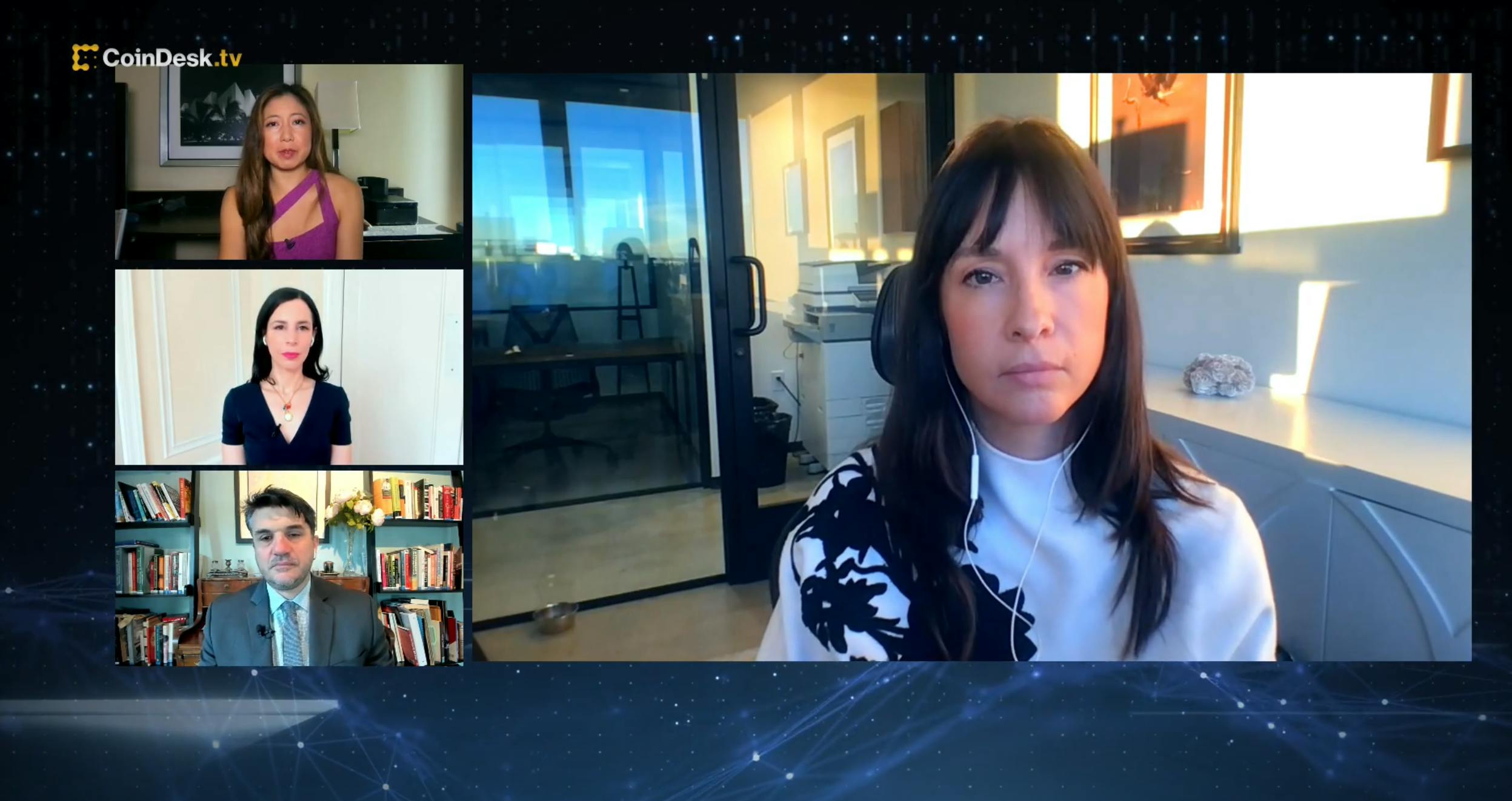
Beth Kindig shared her views on Square’s name change to Block, Jack Dorsey stepping down as Twitter’s CEO, and the upcoming opportunities to watch in an interview with CoinDesk.
Here’s an overview of the discussion.
Square is technically getting disrupted by Blockchain and this is prompting Jack Dorsey to embrace Bitcoin. I had discussed this two years ago in an article for MarketWatch where I stated the following:
“Finance is changing rapidly through mergers and acquisitions, but not rapidly enough. There will be tremendous pressure for traditional payment processors to get with the times and adopt blockchain, or else they will be left behind by lower-cost competitors …. The real value to consumers and merchants has yet to be seen. Square may have replaced cash registers, but the fees the company charges are as old-school as ever. Square charges 2.6% plus 10 cents per transaction … Digitization in the finance industry is built atop age-old infrastructure and ignores the most obvious area in need of disruption: transaction fees. Visa and Mastercard are making acquisitions to remain relevant and competitive, while PayPal and Square are getting on more devices with peer-to-peer apps such as Venmo and Cash App. Those moves won’t lead to massive growth. An overhaul of the infrastructure via blockchain will take some time, and only then will investors enjoy serious investment returns.”charges 2.6% plus 10 cents per transaction … Digitization in the finance industry is built atop age-old infrastructure and ignores the most obvious area in need of disruption: transaction fees. Visa and Mastercard are making acquisitions to remain relevant and competitive, while PayPal and Square are getting on more devices with peer-to-peer apps such as Venmo and Cash App. Those moves won’t lead to massive growth. An overhaul of the infrastructure via blockchain will take some time, and only then will investors enjoy serious investment returns.”
The fees that Square and other fintech names charge are the fees that blockchain promises to disrupt over time. We do not think Square is pushing for Bitcoin adoption and changing its name to Block out of strength, rather we think this is a defensive move.
Regarding Twitter, Beth Kindig points out in the interview that the social media site has many bots which can affect the number of advertisers on the platform sees. According to a Pew Study, 66 percent of tweeted links are shared by bots. Most websites do have some bot traffic at an estimated 29 percent, therefore some of this is unavoidable. The reason Twitter has higher bot traffic is because it does not require a network of friends/family to have a presence and someone with a very low follower count or brand new account can immediately click on ads and links. The CTO of Twitter has recently become the CEO, Parag Agrawal, and these problems are likely to persist under the new leadership as they did when he led the technical side.
How to Find the Next Opportunity
Cloud has been very resilient and we believe this sector will perform well during times of high inflation. We also think the market is currently oversold with the Russell 2000 index being more oversold than during March of 2020. During these times of indiscriminate selling, we stay firm on product and fundamentals as cloud, for example, drives down costs for the companies.
We believe the current sell-off was driven by a high inflation number rather than the Omicron variant. We believe Bitcoin will perform well during times of inflation while more speculative and high beta stocks will not perform well, such as IPOs. The bottom line will also begin to matter more.
Disclaimer: This is not financial advice. Please consult with your financial advisor in regards to any stocks you buy.
In November, Beth Kindig shared her views on bitcoin miners, Microsoft and other tech stocks on the Fox Business show “Making Money with Charles Payne.” Below are video previews of her discussion and an overview of what the two of them discussed.
Beth Kindig is known for her stock-picking skills, focusing primarily on the tech sector. Roku, for example, has given four-digit returns to its readers. Other prominent winners include Nvidia, Zoom, and Bitcoin, which have all provided triple-digit returns from Beth’s free newsletter.
New sizzling stocks
One of the I/O Fund’s top holdings is Bitcoin. As we continue to see rapid adoption and more accessibility on a global scale, we currently like the risk/reward with Bitcoin miners. We have discussed this trend and our picks in the sector with our premium members.
In the interview above, Beth discusses that China’s losses will be gains for the United States.
Furthermore, investing in miners is, we believe, a leveraged way to play the crypto space. It’s closely correlated to the Bitcoin’s movements, so as the larger trend in Bitcoin continues up, we expect the miners to follow, yet at a higher rate of change. These plays come with levels of realized volatility that relegate these positions to small satellite plays, with an expiration date as well as stop underneath, just in case we are too early.
We think that this space will eventually attract a lot of institutional interest as the migration of miners to the US continues. As investing in crypto becomes more desirable, and regulations continue to make it difficult for portfolios to trade, mining infrastructure allows institutions to exposure to Bitcoin through the public markets. We like that China is giving away a profitable business that the United States, primarily Texas, can host. We have traded Bitcoin miners in the past year and were able to booked a 44% gain in less than a month. We continue to closely watch this sector for any companies that are outperforming. We are holding another miner with a minimal loss of 6%, at time of writing.
A brief snapshot of the bitcoin miner’s recent earnings
Marathon Digital Holdings released its Q3 results on November 10th. The company’s revenue accelerated an impressive 6,091% YoY and 76% QoQ to $51.7M. Despite this, it missed consensus revenue estimates by $15.67M. The adjusted earnings per share (EPS) came in at $0.85 and beat analysts' estimates by $0.42. The company produced 1,252 bitcoins in the recent quarter, up 91% QoQ. For the next quarter, the analysts estimate revenue to grow 3,530% to $96.05M and adjusted EPS is expected to come at $0.65. For the most part, the four digit growth is priced in and we will need to see what MARA provides for forward guidance.
Another bitcoin miner, Riot Blockchain, released its Q3 results on November 15th. The company’s revenue jumped 2532% YoY to $64.8M. It missed the consensus revenue estimates by $2.35M. The GAAP net loss per share came at ($0.16) and missed estimates by 50 cents. The company produced 1,292 bitcoins in the recent quarter, up 482% YoY and up 91% QoQ. The analysts estimate revenue to grow 1,710% YoY to $95.57M for the next quarter and GAAP EPS is expected to come at $0.50. The company recently raised its hash rate to 9.0 EH/s from 8.6 EH/s.
Hut 8 Mining Corp released its Q3 results on November 11th. The company’s revenue grew by 768% YoY to C$50.3M (beat estimates by C$9.24M). The GAAP EPS came at C$0.15, which beats the estimates by C$0.04. The company mined 905 bitcoins in the recent quarter.
Bitfarms Ltd released its Q3 results on November 15th. The company’s revenue grew by 559% YoY and 22% QoQ to $44.8M. It missed the analysts’ consensus estimates by $1.83M. The company mined 1,051 bitcoins, up 38% QoQ. For the next quarter, the analysts expect revenue to grow 453% YoY to $62.6M.
Cloud Stocks
We have been tracking Cloud stocks in this earnings season to see which companies beat analysts’ estimates. We also track the key performance indicators like net retention rates and recurring revenues, which give us a better understanding of the forward growth estimates of the companies.
We have several winners in the Cloud industry. For example, Beth strongly believed that Microsoft’s focus on the hybrid cloud would help win the competition from other cloud companies.
We have published various articles on Microsoft, which can be found below:
I/O Fund is comprised of a team of analysts who share their research publicly as they build a portfolio of 30 stocks. Our team has record results for a retail Fund and we also have four-digit gains on some of our free newsletter coverage. You can learn more about our premium service by clicking here or sign up for our free newsletter here. clicking here or sign up for our free newsletter here.
Disclaimer: This is not financial advice. Please consult with your financial advisor in regards to any stocks you buy.
Beth had previously discussed the I/O Fund's interest in Marathon Digital Holdings (MARA) in this forum post. Below, I expand on MARA and the key drivers that correlate the company to Bitcoin's price.
MARA – a play on Bitcoin.
There are a few different BTC miner stocks on the market, and one of the top performers recently has been Marathon Digital, MARA. MARA has gone all-in on owning BTC miners, and has invested its capital into buying the most efficient bitcoin miners (S19 Pro), rather than investing in infrastructure to host these miners.
The company primarily buys BTC miners, and pays hosting fees to 3rd party infrastructure providers who store and power the miners on MARA’s behalf. The benefit of this approach is that the company can focus and invest its capital into BTC miners rather than invest in infrastructure.
In early 2020, MARA ordered 10,500 S-19 Pro miners from Bitmain, which are some of the most efficient bitcoin miners on the market. MARA then ordered another 90,000 S19 miners from Bitmain later in 2020, which was Bitmain’s largest order ever.
If all of MARA’s BTC miners were deployed today, then MARA would account for 11% of bitcoin’s global hash rate, yielding 87 BTC/day. At $60,000/BTC that’s $162m in sales per month, or $1.9 billion in sales per year. The significance of MARA’s mining capabilities leverages the company to changes in bitcoin’s price. The more bitcoin goes up in price, the more MARA will make from mining it.
MARA will have all of its bitcoin miners deployed and installed by Summer of 2022. Note – bitcoin’s global hash rate will likely increase from now until summer 2022 so MARA’s daily BTC production may not reach 87 BTC/day. However, this could be offset by a continued rise in bitcoin’s price.
Another driver of returns for MARA is its “HODLing” strategy, or long-term holding BTC strategy. The company owned ~7,035 BTC as of 10/01/202, which was valued at $436 million. The company intends to hold more of the BTC that it mines going forward, which will further increase the company’s correlation to the price of Bitcoin.
Going forward, the two main driver’s that will increase the company’s valuation is the price of bitcoin and the company’s hash rate. If bitcoin’s price continues to rise and MARA’s production capacity remains near ~10% of global hash rate, then company will earn outsized returns. MARA estimates that its ROI on S-19 Pro bitcoin miners is close to 109% annually(@ a constant $30,000 BTC price). If BTC remains near $60k, then the ROI will likely double.
Disclosure: Bradley Cipriano and the I/O Fund may own shares in Marathon Digital Holdings and may change their respective positions within the next 72 hours. You can access the I/O Fund’s positions herehere. The above article expresses the opinions of the author, and the author did not receive compensation from any of the discussed companies
Please note: As we roll out new features, we are sending Members a Notice of Proper Registration. We simply can’t keep prices low if analysts, bloggers, or others who represent themselves on social media as stock pickers are subscribing to us and foregoing copyright laws to repurpose what we publish. (e.g. if you read our analysis and then tweet or blog about the tickers to grow a following, that’s a copyright violation). If you work for a competing service and use our analysis in any form, that’s a copyright violation. This does not apply to individual investors who are simply discussing their portfolios.Notice of Proper RegistrationNotice of Proper Registration. We simply can’t keep prices low if analysts, bloggers, or others who represent themselves on social media as stock pickers are subscribing to us and foregoing copyright laws to repurpose what we publish. (e.g. if you read our analysis and then tweet or blog about the tickers to grow a following, that’s a copyright violation). If you work for a competing service and use our analysis in any form, that’s a copyright violation. This does not apply to individual investors who are simply discussing their portfolios.
The notice you were sent outlines what I/O Fund’s attorney has prepared in terms of copyright violations. It also means if you improperly registered as an individual rather than a blogger/analyst, it means you must pay for a commercial publication license. This helps us keep pricing structures low for individuals and institutions/funds. If you are improperly registered, you will need to re-register appropriately – please visit this page here.If you are improperly registered, you will need to re-register appropriately – please visit this page here.
Introducing YO/LO Fund: The Blockchain is Going to Eat the Internet
In this analysis, we will discuss why blockchain and crypto is a movement and the ideology behind the technology.
We’ve stated why we are crypto enthusiasts across various research papers over the past 2-3 years, however, I want to take the opportunity to connect these dots on why blockchain may be the technology that our generation is remembered for in the centuries to come. I call this section a Quick Oscar Speech so you’re prepped for a more sentimental appeal. Context is key as to the importance of this shift and I want to get you fired up about the big picture. Considering we’ve had select cryptos as part of our LTBH since the beginning, we are clearly not seeing this as a swing trade or a way to get rich quick. Without the big picture, crypto could look silly. It’s not; rather it could be the most influential technology in history and this goes beyond decentralized finance.
We also discuss Ethereum, primarily why the window is open for competitors and what those competitors are doing to entice developer adoption on their networks. We do a brief overview of the tokens we plan to enter. Due to crypto breaking out, we will likely move quickly on this. However, our analysis is one in a series of reports that we will space out with our ongoing earnings coverage. As we go along, we will also do deep dives on individual crypto names but want to be sensitive with the upcoming earnings season and take good care of the other names in our LTBH and Momo portfolio. As you know, we are a small team with big ambitions and we juggle many balls at once. So, expect to see entries as soon as today and expect to see ongoing coverage of this space as time allows.
What is YO/LO Fund? On the forum, I discussed an upcoming launch of a new, explorative Fund where we maximize crypto exposure while having funwhile having fun. We will start small with each position and add to the tokens on breakouts. I can’t imagine a better team considering Knox’s performance record on Bitcoin in terms of risk management along with our ability to sift through trends to find winners via in-depth analysis. The reason Bitcoin and Link have done well as LTBH positions is that Knox adds and trims accordingly. You’ll also know why we are owning each coin plus full diversification within the trend. I want you to be able to go to dinner and tell your friends what a token does and why it’s important.
My Oscar Speech on why Blockchain is Important:
The blockchain is proposing a complete overhaul to how we are conditioned to believe the world must work. On one hand, opponents call crypto a tulip craze. On the other hand, the top 1% in America now has more wealth than the entire middle class at 60%. This strikes at the core of why blockchain and crypto has become a movement. To challenge the effects of society, we must look at the cause: how has centralized finance and also the centralized internet created what Silicon Valley technologists are now calling an “oligarchy.”
The Federal Reserve was created in 1913, however, many claim Richard Nixon’s altering of the Bretton Wood system and the untethering of the US dollar from gold set in motion the accumulation of wealth for the 1% as wages stagnated despite an increase in productivity.
As a technologist, I would also point to the advent of the internet but most importantly mobile and how this contributed to the “oligarchy” of Big Tech. If you want to listen to a great podcast about this oligarchy, I recommend Naval Ravikant’s interview here from 2018 or here on Spotify. It’s well worth the hour and he connects the dots on the overwhelming importance of the blockchain. I’ll expand on my unique perspective of what I think contributed to the oligarchy he speaks of, and why centralization is one of the biggest issues that society faces. Finally, we will discuss how blockchain will dissolve the concentration of power.
The Centralized Internet and “the Walled Castles”
The internet was intended to become a democratization of information, yet the concentration of who controls the information became greatly concentrated once the mobile device began to leak data through various sensors. For example, there have been many independent reports such as here and also here of Facebook using the microphone to transcribe conversations and to later target keywords for ads. This would be very easy for Facebook to accomplish with a taxonomy, such as “Hawaii” or “golfing.” This started in 2014 and was caught by security professionals. It was debated and denied for years, buried by Facebook’s corporate communications team. Finally, in 2019, it was reported by Bloomberg that Facebook does transcribe messages — for your protection, of course — and Amazon does it too with Alexa. According to independent security professionals, you are not imagining it when you say something in a private conversation and later see an advertisement later on a browser or inside of an application. They pinpoint this beginning in 2014.
What I call “the surveillance era” began in 2008 yet really took off around 2012. The drawbridge to what Greylock calls “the walled castles” (i.e., not a quaint walled garden) were firmly closed by 2014. The drawbridge snapped shut when the more powerful tech companies became capable of collecting exponentially more data than the competitors through software installed on the device. Or, in Google’s case, the Android operating system. Wall Street will tell you it’s all about revenue, the ads, and the number of users. That’s wrong, of course, as the walled castles were created from an advanced use of data and gobbling up many online properties that produced more data. Why would Facebook buy Whatsapp for $19 billion? The phone numbers enriched their datasets.
The mobile device era created reckless abandon in terms of collecting data. The far majority will shrug and say “how does collecting data affect me? I’m okay with ads.” For starters, if you’re okay with it (I’m not) then every tech company should be able to run surveillance software, track your browser and native app activity and transcribe your conversations to run them through a taxonomy. Why do you only allow Google, Facebook and Amazon? What’s special about them. If you’re okay with it, then all companies should be able to track what you do on the mobile device. For those that are privacy complacent, that would be thousands of them.
That seems absurd yet we’ve allowed three key companies to do this without consent. Teams of engineers and data scientists built algorithms using private data to determine what you see and what you don’t see. Freedom of the press is at the core of a free society (i.e., ask China why they tightly control the media). Section 230 has been debated for nearly a decade, yet it’s raising a question that has become increasingly more important – where do the lines blur between publishers and tech? Big Tech has enough money to make sure Section 230 turns out in their favor, and thus, we are in a vicious cycle.
The enormous amounts of data that the top 3 companies have collected has led to a concentration of who controls the information that is consumed, seen and absorbed. In an attempt to have as much data as possible, the gatekeeper for media and communications leads back to these three companies. The definition of an oligarchy is “government by a few.” Algorithms are built to determine what information is seen rather than by meritocracy and these algorithms are centralized and built by a handful of companies. Freedom of the press is not possible in a society where media must pay to be at the top of a feedmedia must pay to be at the top of a feed. Technically, press has the right to publish but it’s not seen as we no longer pay 10 cents for a newspaper to support the press. Instead, you must pay thousands (and probably millions) for content to be seen.
My very first analysis for the public markets was on Facebook’s privacy issues and I followed this up later with details on the surveillance-network in HackerNoon. Although ethics and stocks don’t tend to go together, Facebook is not one I could look past knowing the amount of data they were collecting without consent. Twitter has always been easy for me to pass up as an investment because the platform is infiltrated by bots. Social media users are not necessarily aware of this but paying advertisers certainly are as click fraud and click bots are the ad industry’s biggest issue. Basically, it’s not the best platform to run ads because advertisers have to pay for bot clicks.
On Twitter, 66% of shared news links are from bots. That’s enough to control what’s trending. What else would be the purpose of the bots? The exact answer for that is above my paygrade. However, this leads back to the issues with centralization. In a decentralized network, social media users will be validated and bot activity will be penalized, often by removing the tokens. More independent reporting will be surfaced, and we can go back to some sense of normality around how information is accessed rather than viewing content that is paid by the highest bidder (or the most active botnet).
So, how does this relate to the blockchain? First off, the centralization of the internet has far and wide-reaching effects when those with the most money are able to determine what information is seen and whose articles surface. Of course, what you see with your eyes all day/everyday affects you. It doesn’t matter if this is done through bots on Twitter, Google’s algorithms and advertising pay structures, or Facebook’s dopamine-inducing newsfeed that is largely driven by your personal data which required tens of billions of dollars to collect.
The solution is blockchain as it results in a meritocracy for content creators and a democratic, verifiable process to what is surfaced and viewed.
The benefits of democratizing the internet goes beyond social media, traditional media and journalists. There is now a Spotify competitor called Audius that distributes the profits to artists. Normally, artists make 12% of revenues in the traditional structure. With Audius blockchain, artists make 90% of the revenues. This is because there are no middlemen or agencies and the music is freely distributed. We don’t need gatekeepers that decide the music we listen to and then takes the majority of the revenue.
Although I won’t go into decentralized finance here as I already have a few times in the past, you can imagine something along the lines as music artists where there is a redistribution away from centralized banks and into the pockets of the 99%. Primarily, the credit card fees, transfer fees for wires, recording fees for documents, costs for redundant paperwork (think taxes and the IRS), the amount we pay to prevent fraud — and even on a larger scale, the ability to lend and borrow in a peer-to-peer fashion.
I want to take a moment to revisit what our original Bitcoin analysisour original Bitcoin analysis had said in August of 2019:
My prediction is that once the Lightning Network is built out, bitcoin will surpass the market cap of Apple, Google, Microsoft and Amazon to reach a minimum of $50,000 per token. This is because the protocol solves critical needs for global populations, including the reduction of financial fees for 7 billion people, and offers a need to store money during times of inflation.This is because the protocol solves critical needs for global populations, including the reduction of financial fees for 7 billion people, and offers a need to store money during times of inflation.
Bitcoin is based on the most secure network in the world, and this solves a very real need for the financial system – which cannot be automated without a decentralized blockchain solution. Technically speaking, bitcoin is also the world’s most secure financial network. The transfers eliminate 3% in processing fees and hedges against inflation. This can, and should be, worth as much as a search engine, enterprise software, a social media network, warehouse fulfillment (AMZN) or iPhone hardware.Technically speaking, bitcoin is also the world’s most secure financial network. The transfers eliminate 3% in processing fees and hedges against inflation. This can, and should be, worth as much as a search engine, enterprise software, a social media network, warehouse fulfillment (AMZN) or iPhone hardware.
Apple, Google, Microsoft and Amazon reached market caps of $1 trillion because their products scale to global populations and are required on a daily basis. Bitcoin not only scales to the global population but it also protects their livelihood – a necessity rather than a convenience. In fact, we see populations who are not necessarily tech savvy most enthusiastic about bitcoin, and this is a strong signal that it will scale beyond the reach of $1 trillion market cap. “Bitcoin not only scales to the global population but it also protects their livelihood – a necessity rather than a convenience. In fact, we see populations who are not necessarily tech savvy most enthusiastic about bitcoin, and this is a strong signal that it will scale beyond the reach of $1 trillion market cap. “
Fast forward two years, and we see that more citizens of El Salvador have crypto wallets than bank accounts (that quickly!). While the top 1% like Jamie Dimon is saying “it can’t, it won’t,” the 99% are saying “we can and we will.”
How could you not get behind that?
[Insert Oscar Music telling me to exit the stage as I’ve gone over my time][Insert Oscar Music telling me to exit the stage as I’ve gone over my time]
I want to get you fired up on this for a few reasons:
My job is to bring you important trends in technology and to silence the noise. I want to make sure I/O Fund Members do not turn away from crypto and keep an open mind.
You didn’t miss the boat; Web 3.0 starts now. But be prepared to trim/exit at the top and re-enter. We plan to do this for YO/LO.
Many of the centralized applications and websites you use today are going to come under pressure long-term. We need to lower the barrier for blockchain adoption for dapps like Audius but it’ll happen.
Because the world needs a decentralized system, global populations will be willing to pay nominal amounts for this (hence, the importance of tokens). It’ll be like paying for the newspaper again. Pocket change well spent.
This nominal amount being paid will actually save people money in the long run as the blockchain will reduce costs, reduce fraud, and increase wealth for the middle class through decentralized consensus mechanisms that don’t require a middleman. (yes! It’s that big of a deal).
In terms of contributions to society, blockchain may be the one technology that future generations remember us for as the majority of the world lives beneath the poverty line. (To compare, AI would be more of a contribution to productivity.) Those beneath the poverty line in El Salvador are showing record adoption rates for Bitcoin wallets.
Media is bought and paid for, and I believe the headlines have retail believing crypto is still a high-risk and an undesirable asset, yet institutional buying is telling us a different story. Consider that Algorand (see below), has received a $700 million round.
However, the crypto world is confusing and high risk because there are so many products to consider – this is why many investors throw up their hands and walk away or they’ll buy one of the many ETFs that are launching. We think the bigger gains come from learning to fish and so we are inviting you to fish alongside us.
Most importantly, this site offers risk management (Knox) for entries and exits. Without this, crypto can be a blood bath. The reason investors keep a separate crypto fund is they aren’t able to handle risk management whereas I/O Fund specializes in this for all tech growth stocks and assets. We did not hesitate to add BTC and LINK to our long-term buy and holdto our long-term buy and hold due to Knox’s confidence in managing risk.
We can’t guarantee there won’t be losses as crypto is extremely volatile. Only invest what you can afford to lose.
We may need to be aggressive with entering and exiting. Don’t be surprised if we exit an entire position in YO/LO Fund to buy again later at a lower price. This isn’t about convictions or fundamentals. Risk management comes first with crypto and convictions are second to this.
Ethereum’s Scaling Issue: An Opportunity for Competitors
The blockchain and decentralized networks offer three key benefits over centralized networks. These three benefits are: decentralization, security and scalability. The issue is that most decentralized networks cannot offer all three without some compromise.
This was first discussed with decentralized data in what is known as the CAP Theorem as distributed databases cannot deliver Consistency, Availability and Partition Tolerance (CAP) without some compromise. This is because if a node goes down, either the system has decided to replicate the data (make a copy) on the other node or to partition the data (split the data) between two nodes. If partitioning the data is chosen, then consistency is sacrificed. If replication is chosen, then partitioning has been sacrificed.
MongoDB is a distributed database that elects a secondary node by whichever one received the most recent update. Therefore, MongoDB offers consistency and partition tolerance all of the time and availability most of the time except when a new node is synchronizing to become a primary node.
In addition to the proof of stake mechanism helping Ethereum to scale transactions, our report also discussed the importance of shards for scalability. Rather than every node downloading every transaction, calculating it and replicating it, shards create a subset of the network where nodes are dispersed for more efficient processing. We also discussed Rollups, which allows for hundreds of transactions to be rolled into a single transaction. This replaces Plasma, the current option where only a single transfer is made per transaction.
Here is what we had said about rollups. I’m copying this so it’s understood where the delay is as the merging to Proof of Stake is happening in the next few months while sharding and rollups are delayed:
“In the ZK-Rollup scheme, a transactor and relayer are needed. The transactors create a transfer and broadcast it to the network. In this case, a shortened 3 or 4 byte indexed version of the address helps to reduce resource needs. The relayers collect hundreds of transfers and roll them up, essentially, to generate a hash that compares a snapshot of the blockchain before the transfers and a snapshot of the blockchain after the transfers. In most cases, the transfers will be recorded by a change in the wallet values. The hash that represents the wallet values or the delta to the blockchain is called SNARK proof. The changes to the hash are reported to the blockchain.4 byte indexed version of the address helps to reduce resource needs. The relayers collect hundreds of transfers and roll them up, essentially, to generate a hash that compares a snapshot of the blockchain before the transfers and a snapshot of the blockchain after the transfers. In most cases, the transfers will be recorded by a change in the wallet values. The hash that represents the wallet values or the delta to the blockchain is called SNARK proof. The changes to the hash are reported to the blockchain.
Relayers are established by staking a required bond, or token amount, in the smart contract. The result will be fewer transaction fees that are processed faster than the previous Plasma framework. In the ZK-Rollup framework, blocks are computed in a parallel computing model that lends itself to decentralization. There will be less data than the previous framework which increases throughput and scalability.”
The Ethereum network has more security risks than Bitcoin as ZK-Rollups assume a trusted state and relies on a small group of developers to establish this initial trusted state and one of the developers could manipulate the code. Quantum computing could crack ZK-Rollups if the correct hash is guessed. This is more likely than guessing an encrypted protocol.”
Ethereum’s High Gas Prices
The term “gas” refers to the computational effort required to execute specific operations on the Ethereum network. Each transaction requires that a fee be paid called “gas” to offset the costs of computational resources. The market price for gas is determined by demand. If you want your transaction executed quickly or if you have a larger contract, you’ll pay more gas. As of August, the London Upgrade has changed how transactions are charged with every block having a base fee and a minimum price per unit of gas that is calculated based on demand for the block. Users also tip to compensate miners for executing the transaction.
The goal of the London Upgrade is to allow for variable-sized blocks. Previously, blocks would hit total capacity and users would have to wait for the demand to subside. You can see in the chart below that Ethereum’s gas prices are inching upward with a notable spike in September even after the London upgrade went into effect. The average gas price of 58 GWEI is about 10X higher than the Binance smart chain at 6.1 GWEI.
In September, TIME Magazine recently sold NFTs called TIMEPieces and minted 4676 tokens for the digital art. It sold out within minutes with 4,000 transactions occurring within a short period of time. The price for 10 NFTs was around 1 ETH or $2500 to $2800, yet due to gas fees, one buyer paid as much as $70,000. In addition, the wait time to transact ranges from 30 seconds to 16 minutes.
We had estimated in March that Ethereum 2.0 will need “another year minimum or about three years maximum” to reduce energy use and increase throughput for transactions per second (TPS). Recently, Buterin stated that what he thought would take one year has actually taken six years. The current roadmap for the Proof of Stake merge is for late this year in 2021 while sharding and rollups are expected by late 2022 or early 2023.
However, the delay in terms of scalability with sharding and rollups leaves an open window for competitors for about eighteen months if we assume early 2023, which is a substantial amount of time considering the activity we are seeing in NFTs and decentralized finance. The other issue facing Ethereum is that even though the network certainly has a defensible position in terms of the ecosystem and sheer number of dapps built on the network, there are competitors who are arguably stronger as scalability was solved for at time of launch. Some of this may be that the latecomers had the advantage of hindsight and could observe and improve upon the gas issues that Ethereum faced from being a first mover.
Quick Glimpse at Mid Cap:
Avalanche (AVAX):
Ethereum competitor that has a maximum supply of tokens and technically a decreasing supply due to burning. The network is unique in that Avalanche utilizes three interoperable blockchains. The X-Chain is for creating and exchanging assets including NFTs, the P-Chain validates and creates subnets, and the C-Chain is for executing Ethereum Virtual Machine (EVM) contracts. The C-Chain is critical for AVAX’s growth as developers can build applications that have easy interoperability with Ethereum while improving the base layer.
The layer one blockchain hosts smart contracts like Ethereum and has a low Nakamoto coefficient, which is a quantitative method of measuring decentralization. Although transactions per second (TPS) is lower than Solana at 4,500 TPS, Avalanche has a faster time to finality of less than a second compared to Solana’s 12.5 seconds. Avalanche is also compatible with Ethereum dapps and wallets. The company recently introduced a $180 million mining incentive program to add dapps to its decentralized ecosystem. The program is called Avalanche Rush and will help popular protocols to expand from Ethereum to Avalanche.
Emin Gun Sirer, the founder of Avalanche, predates even Satoshi’s Bitcoin whitepaper. He and a research team are credited with the first cryptocurrency developed in 2003 called the Karma system, which was based on proof-of-work.
Aave (AAVE):
On the Chainlink webinar, we discussed that one major issue with centralized finance is that a regular person (such as you or myself) cannot lend money to another person in order to get the interest rates that Chase Bank gets on credit cards or a mortgage lender gets on home loans. As artificial intelligence and the blockchain remove barriers to understanding creditworthiness, there should be no reason to not pool money together to achieve these returns. We don’t need a centralized bank to do this as it’s preventing regular people from earning income (and on the flip side, it also prevents regular people from getting the credit lines they need at an affordable rate).
Aave is the leading borrowing and lending protocol. Not only can you earn interest on your deposits but you can also borrow assets. The platform also issues flash loans, which means that the lender is repaid the money upfront through a smart contract rather than providing collateral. In the event something falls through or a condition is not met, then the transfer is automatically reversed. This is one illustration as to why smart contracts promise to revolutionize the way things are currently done as they are automatic, decentralized and secure.
The company launched as ETHLend in 2017 but has expanded to other networks. Within 6 months of launch, Aave was issuing more than $100 million in flash loans per day. One year later in June of 2021, the platform had issued over $4 billion in loans (total).
Curve (CRV) & Yearn.Finance (YFI):
When we think of the issues surrounding crypto, one that comes to mind is liquidity and stability. Not only do exchanges and trades take a long time due to lack of liquidity, but the price fluctuates to such an extent that common day uses are prohibitive. The TIME NFTs are a great example.
Curve is a popular DeFi platform and automated market maker (AMM) that reduces slippage between the expected price of a trade and the price at which it’s executed. Curve allows digital assets to be traded by using a liquidity pool, or a shared consortium of tokens. These pools are optimized to stabilize pricing and those who place their tokens into the pool are rewarded. Because Curve focuses on stable coins, volatility is greatly minimized. Originally, Curve launched to assist with lower fees for trades and to also offer the additional benefit of rewards in fiat currency. The decentralized exchange (DEX) is also integrated with Yearn Finance and Synthetix for users to participate in both the fees from the Curve pool, and also the yields from yield-bearing tokens. Curve also offers interoperability with other networks to maximize access to the DEX and increase its availability, which is called composability where you can earn across the DeFi ecosystem. We are especially keen on Layer 2 solutions that remain with Ethereum yet expands to new networks during Ethereum’s 2.0 transition. Curve recently expanded to Avalanche and the composability also is a key feature as the DeFi ecosystem grows.
There are 39 pools for swapping stablecoins. Curve competes with companies like Uniswap, which provides for swapping of tokens but with high fees. From my perspective, it makes sense that the best market maker and exchange would be a stable coin pool. A typical pool will include DAI, USDT and USDC, which are pegged to the US dollar. The automated market maker uses an algorithm rather than buyers and sellers to trade from liquidity pools, with a rebalancing that occurs partly from arbitrage traders buying any excess. The goal is stability from stable coins and also high-interest rewards from lending protocols. The automated money maker algorithm allows for high volume trading. We like this company because it solves for stability and having exposure to this is a good idea, in my opinion.
Algorand (ALGO):
Algorand is an East Coast company founded from an award-winning professor from MIT. Silvio Micali has won numerous awards including the Turing Award, Godel Prize and RSA Prize. He has been working with cryptography for decades and is known as the co-inventor of probabilistic encryption, Zero-Knowledge proofs and Verifiable Random Functions. As of now, more than 700 global organizations have partnered with Algorand including Koibanx, a LatAm asset tokenization, and the El Salvadorian government to build the blockchain infrastructure for the country.
Algorand handles 1,000 TPS and has a five-second finality. The blockchain network launched with Proof of Stake (PoS) in 2019 that awards all ALGO coin holders rather than rewarding only validators that stake a large number of tokens. The company calls this Pure Proof of Stake (PPoS) with on 1 ALGO coin required for staking whereas Ethereum requires 32 ETH or roughly $100,000 USD to stake tokens. Due to rewards being split across all tokens rather than only validators, the ALGO coin earns a 7.5% annual yield.
There is also a bifurcation between two layers that helps the network achieve a high throughput. Layer 1 executes smart contracts as ASC1s and Layer 2 executes more complex smart contracts and dapps as ASC2s, or off-chain.
Right now, it’s speculated that the Algorand network could become popular for government-backed stable coins.
Quick Glimpse at Small Caps:
Ocean:
Ocean is built to facilitate data exchanges. OCEAN tokens are used to access datasets and run AI and ML models through marketplaces. In turn, data providers earn OCEAN tokens for supplying data. The Ocean Market is an automated market maker (AMM) that facilitates the minting and exchange of data tokens. Compute-to-Data allows data sharing while preserving privacy. This allows AI and ML applications to utilize data while adhering to privacy standards. Considering that my Oscar speech was in regards to privacy as a primary pain point for centralization, I’d like to own a token that specifically addresses this ☺
The Graph:
The Graph indexes servers and powers data queries for many popular decentralized finance apps, such as Uniswap and Synthetix. Tokens are spent to perform the queries. By opening up data across the ecosystem, more dapps can be built utilizing blockchain data and APIs. By decentralizing the data layer, The Graph leverages a network of indexers to reduce the amount of overhead cost required to index servers.
API3:
You’re probably seeing a pattern here as to the trend I am preferring for small cap coins (the data layer). API3 has been called the “Chainlink killer.” Although I’m not convinced it will kill Chainlink, I’m always open to having more diversification on how to securely onload off-chain data. Rather than having a node sit between the API provider and the smart contract like Chainlink, API3 enables the API provider to run their own nodes. API3 argues that adding a middleman (Chainlink) creates a new attack surface and adds more costs.
Quick Glimpse at the Heavyweights:
Cardano:
Cardano launched with Proof of Stake (PoS) in 2017 and has been in a constant state of development since. For instance, IOHK is an engineering company that updates Cardano’s codebase with verifiable, high-liability code using the same approach as spacecrafts and high-frequency trading software. Cardano has two structures, a settlement layer and a computational layer. The consensus protocol enables ADA coin holders to delegate a stake pool, or a node, with the opportunity of becoming a slot leader as the stake increases. The rewards are distributed to ADA token holders. The blocks change every five days and the slots change every twenty seconds.
Cardano’s consensus mechanism is also very energy efficient as the PoS algorithm pushes energy back to the edge. The company is also working towards true decentralization by handing over access of Cardano’s open-source infrastructure to the community, which in turn, will allow more enterprises to leverage Cardano. The Cardano Foundation is a non-profit from Switzerland.
Polkadot:
Polkadot’s goal is for interoperability for a decentralized internet for applications to seamlessly communicate across networks. Its role is to connect networks for cross-blockchain transfers with a cross-chain system. Network validators can also be leveraged for security and consensus across multiple blockchains. Polkadot also updates without the need for a fork, which allows it to be compatible with new networks and blockchain features as they are developed. Polkadot was founded by Ethereum’s former CTO, Gavin Wood. It is backed by the Web3 Foundation, a non-profit research foundation in Switzerland that specializes in cryptography and provides grants to startups.
Solana:
Solana is an Ethereum competitor that has a very high throughput of 65,000 transactions per second on GPUs although Avalanche has a higher time to finality. Solana accomplishes this without second layers or side chains by using the Proof of History (PoH) consensus mechanism. PoH creates a historical record that proves an event has occurred at a specific moment in time. Rather than validators agreeing on a time, Solana validators maintain their own clock by encoding the time with a cryptographic hash function (SHA-256). This circumvents the need to wait for confirmation, thereby resulting in a higher throughput. The founder is from Qualcomm and Dropbox and he recruited engineers from Qualcomm to create Solana labs.
YO/LO Positions – Subject to Change:
(Friendly reminder: all of our positions are subject to change – more so in YO/LO and Momentum but LTBH can change at times too!)
Despite Bitcoin’s recent decline, volatility is actually decreasing and the asset is beginning to stabilize in terms of historical performance. The last crypto peak to trough in 2019 saw a decline of 84% in price while this sell-off’s peak to trough was 55%It took three years to recover the all-time high from 2017 for Bitcoin yet the I/O Fund thinks Bitcoin will recover its current all-time high quicker this time as the long-term pressure for Bitcoin is up.
Naturally, with the steep drawdown of 55% (yet the very promising future of crypto – see our price targets below) we were wondering how crypto trading apps are faring after the Q2 sell-off now that Coinbase and Robinhood have gone public, two of the biggest names in the space. Below, we highlight data that is offered by Apptopia (and is also available on the Bloomberg Terminal) to show that in some cases crypto trading apps are down sequentially while others are down even year-over-year. Robinhood is stock trading app too, of course, yet we think any Q3 declines will be largely contributed to crypto trading. We also discuss Voyager, a company we have done a deep dive on before and currently hold a position in.
Two Popular Crypto Trading Apps Went Public in Q2
The I/O Fund figured it would be a good idea to check on the health of crypto trading apps to see how the asset class underperformance may have affected crypto trading apps. When Bitcoin and crypto go through a rally there will be a correlation with the crypto trading apps, yet how much of a fall-off do crypto apps see when there is a sell-off?
Coinbase and Robinhood seized the crypto rally to go public as the companies posted 1080% growth and over 309%+ revenue growth, respectively in the March quarter. You’ll see below in the downloads and sessions that there was unusually high activity during the period the two companies went public.
Coinbase was listed on April 14th at $381. The shares were off to a good start on the day of direct listing, but the shares sold drastically a month later. Lock-up periods are standard for Initial Public Offerings (IPOs). However, Direct Listings usually don’t have lock-up periods. There could be exceptions like Palantir, which despite the direct listing, had lock-up restrictions. Coinbase, which did a direct listing, did not have lock-up agreements. This is important because shares can come under pressure following a soft quarter.
Robinhood shares were listed on July 29th at $38, which was at the lower end of the offering range. The shares peaked at $70.39 and are currently trading above the IPO price at $47.15. Many IPOs have 180 day lock-up periods yet Robinhood has a partial lockup schedule. In Robinhood’s case, 15% of the employees were able to sell their shares on the day of the company’s listing. The next 15% of the shares will be eligible for sale on October 27, 2021. There is mention of a final lockup expiring on December 1st in the amended S-1 filing here. There will likely be volatility during this period as insiders tend to sell after lockups expire. A soft quarter or two could exacerbate this. Doge Coin also peaked around $0.60 and is now trading around $0.20. Per Robinhood’s financials, this coin drives 62% of Robinhood’s crypto trading activity.
Quick Glance at Q2 Financials for Crypto Trading Apps:
Before we look at the current downloads and sessions for Q3, we want to review the Q2 financials for Coinbase, Robinhood and Voyager Digital.
Coinbase reported $1.3 billion in revenue in 2020 compared to $533.7 million in 2019 for growth of 143.6%. Revenue growth in Q2 was impressive at $2.2 billion compared to $186.4 million for 1080% growth. A similar trend was seen in H1 2020 compared to H1 2021 for 936% growth. Net income grew in line with the top line at net income of $1.6 billion and adjusted EBITDA of $1.15 billion compared to a net income of $32.3 million and adjusted EBITDA of $61 million for the same period last year.
Retail Monthly transacting users (MTUs) rose to 8.8 million in the recent quarter when compared to 2.8 million at the end of December 2020 and 1.5 million for the 2Q 2020. Verified users were 68 million. Absent a rally in Bitcoin and crypto, these will be tough comps to clear in future quarters this year. The data from July showed that retail MTUs came at 6.3 million. The management expects MTUs and total trading volume to be lower in the third quarter when compared to the second quarter with the company stating, “as volatility and crypto asset prices are highly correlated with trading revenue, the crypto market environment heavily influenced our Q2 financial results” citing declines of 45% in Bitcoin and Ethereum.
Coinbase emphasized they have 9,000+ institutional customers and 160,000 ecosystem partners. Trading volume is primarily driven by institutions at $317 billion compared to $145 billion from retail (about two-thirds) with trading volume at 24% for Bitcoin, 26% Ethereum and 50% other crypto assets. In terms of assets on the platform, the mix is more equal at $88 billion for retail and $92 billion for institutions with 47$ Bitcoin, 24% Ethereum and 25% other crypto assets.
The company derives its major revenues from the transaction revenue. This is correlated with the trading volume. The company plans to reduce the focus on the transaction revenue since it’s volatile and focus on the subscription & services revenue in the long run. The subscription & services revenue include custodial fees, blockchain rewards which includes staking revenue, earn campaign revenue, interest income and other subscription & services revenue. The third classification of revenue is other revenue which includes crypto asset sales revenue and corporate interest income.
Robinhood grew Q2 revenue by 131% YoY to $565.3 million. Revenue growth has been strong yet may have peaked in Q1 as growth has been slowing down. For the full year 2020 it rose by 245% to $959 million and in the 1Q 2021, it was up 309% to $522 million. Transaction-based revenue grew by 141% to $451.2 million, net interest revenue grew by 69% to $67.7 million, and other revenue grew by 177% to $46.5 million. Looking deeper into the transaction-based revenue, options revenue grew by 48% to $165 million while cryptocurrencies revenue increased to $233 million from $5 million in the same period last year. The equities transaction-based revenue dropped 26% to $52 million.
As stated above, Dogecoin accounted for 62% of crypto trading in Q2, which was up compared to 34% in the first quarter. Due to the price decline in this asset, it’s unlikely Q3 will comp well with Q2 partly due to this alt-coin.
Operating expenses increased 169% to $500.7 million. Notably, technology and development expenses increased 248% to $156.3 million and operations expenses rose 232% to $101.1 million. Due to the strong trading activity, the company procured additional cloud infrastructure, which increased technology expenses. Operations expenses were high due to the increase in the headcount of customer support staff.
The company also recorded stock-based compensation in the current quarter and expects to record a charge of $1 billion in stock-based compensation for RSUs related to the IPO in the third quarter. It reported a net loss of $502 million in the recent quarter and adjusted EBITDA of $90 million. In contrast, the company reported a net income of $58 million and adjusted EBITDA of $63 million in the same period last year.
According to the management, due to the seasonal nature of the business, trading activity has been generally strong in the first half of the year. On similar lines, they expect lower trading activity in the third quarter. The sessions and downloads confirm that Q3 will be much softer than Q2. At the end of June 2021, the company had about 22.5 million net cumulative funded accounts compared to 18 million at the end of March 2021 and 12.5 million at the end of December 2020. The customer growth has been strong due to the strong word-of-mouth referrals yet appears to have declined for Q3 (see below).
The company earns the majority of its revenues from payment for order flow (PFOF). This is a method in which the brokerages like Robinhood receive compensation for routing orders to market makers. The transaction-based fees represent 81% of the total revenues of the 1Q 2021 and 80% of the 2Q 2021. Notably, there are conversations going on in Congress about the risks and SEC might consider banning or putting restrictions on payment for order flow.
Similar to its peers, Voyager Digital demonstrated strong revenue growth in the first half of the year. The earnings release for May shows Q3 FY 2021 revenue came in at $60.4 million, up from $3.6 million in the previous quarter fiscal Q2, representing 21,000%+ growth (yes, you read that right). Fee revenue was $53.7 million and interest revenue from custodians was $6.7 million. Operating profit was $30 million for the 3Q FY 2021. There was a press release in July that showed revenue for fiscal Q4 ending in June in the range of $103 million to $107 million, up from less than $1 million in revenue in the year-ago quarter. Sequentially, this represented over 65% growth. Total funded accounts have exceeded 665,000, and total verified users are more than 1.75 million. You can read our full analysis here.
According to Steve Ehrlich, CEO and Co-founder, "Our June quarter reflects continued growth of our platform, with revenues up more than 65% from the March Quarter. Although we have seen a significant decrease in crypto market volume since mid-June we continue to see significant net new funded account growth, net asset inflows, and consistent basis points on spread revenues on our platform continue through today."
The Impending Question is Performance in Q3 and Subsequent Valuations:
Crypto trading apps may be the hardest vertical in tech when it comes to forward guidance as crypto is extraordinarily volatile and trading volumes can greatly fluctuate. The I/O Fund uses app data primarily to see if a company is trending up or down. We do not use app data to predict exact numbers. Please also note, that companies often report various key metrics, such as monthly transacting users (MTU) rather than downloads or sessions. Therefore, Apptopia provides an important glimpse on app activity, however, we are not making predictions on what Q3 earnings will report rather we track the overall trend.
Coinbase’s provided a glimpse for July, stating that retail MTUs were at 6.3 million compared to 8.8 million in the previous quarter. The company stated they believed total trading volume would be lower in Q2 compared to Q3. Apptopia data is showing roughly 5 million downloads with still two weeks to go in the quarter or a decrease of roughly 60% if we factor in the additional two weeks that remain in September.
Here is a glimpse of the sessions which show a similar trend as downloads are indicating more of a 40% decline (roughly speaking if we figure a total of 550,000 with the remaining days). In both cases, Coinbase is doing well year-over-year although the growth has tapered off from the 900% to 1000% range to what may be more in the 100% to 200% range year-over-year. According to analyst consensus, there have been 8 downward revisions with revenue estimated at $1.46 billion in the upcoming quarter down from $2.23 billion in the previous quarter. EPS estimates are currently at $1.4 billion compared to $6.78 billion.
Robinhood did not provide guidance but issued the following statement in August: “For the three months ended September 30, 2021, we expect seasonal headwinds and lower trading activity across the industry to result in lower revenues and considerably fewer new funded accounts than in the prior quarter.” In this case, it’s looking certain that Robinhood will report a steep sequential decline and the company is on track to also report a decline year-over-year unless there is a catalyst in the next week or so.
Sessions look stronger than downloads with Robinhood showing slight year-over-year growth. The number of upward or downward revisions available is not available for this newly public company, yet the revenue estimates are at $427.3 million compared to $565 million last quarter. EPS estimates are at ($0.34) compared to $0.18 last quarter.
Voyager released an update for the quarter ending in June but did not offer forward guidance on the press release. Year-over-year is still extraordinarily strong and Voyager is also the strongest app between the three in terms of downloads sequentially, as well. We discuss the key differences between Voyager and Coinbase in a previous analysis here
The Investors Presentation shows an increase in verified users from 1.75 million reported in fiscal Q4 to 2 million on September 7th. Sessions show similar information as downloads, which is very strong year-over-year activity with a decline sequentially although much less impact compared to its peers. Voyager Digital is listed on the OTC market and does not have analysts covering it at this time.
Conclusion:
We don’t expect crypto trading apps to maintain peak traffic, yet as the market attempts to price these apps with no forward guidance, we could see some volatility. Because we track Bitcoin and other alt-coin holdings very frequently, we performed this research to check on the health of Voyager Digital, another holding at the I/O Fund. Due to its strong retention and rock-bottom valuation, we will continue to hold Voyager. The issue we see with Coinbase and Robinhood at this time are the lockup expirations (or having no lockup for Coinbase) combined with the sequential weakness and the likelihood the two companies can’t provide adequate forward guidance. We are in the early days for crypto so anything could happen, and stories can certainly strengthen. However, absent a strong bitcoin rally, Q3 looks weak for the bigger players yet comparatively strong for the small cap Voyager.
As for Bitcoin, the I/O Fund has been covering this asset for the public markets since 2019 when we added a position alongside other tech stocks to a portfolio when we called for a market cap of $1 trillion. We did not budge on this target even when the asset dropped from the $10-$13K region to the $4K and $7K region. Today, our price target is $120,000 to $160,000. We are not financial advisors, rather we perform deep drive research for our own positions and share our conclusions. Our first published piece on crypto was in 2013 when I published a guest blog from Chris Larsen of Ripple on my early-stage tech blog (now archived). Here is a snapshot of our trading history during the most recent sell-off. These are verified through real-time trade notifications sent to our members at the time of the trade.
In early 2021, we warned our readers that a top was forming in Bitcoin. With our initial downside targets showing a likely bottom in the$37,000-$22,000 region, we cut our position in half, alerting our readers that Bitcoin was in a complex topping process, and to be prepared. However, we also stated, and still believe, this drawdown is part of a much larger uptrend. This last point is key.
As stated in the article, Beth Kindig and I/O Fund currently own shares of Voyager Digital and Bitcoin. This is not financial advice. Please consult with your financial advisor in regards to any stocks you buy.
Royston Roche contributed to this article.
Please note: The I/O Fund does not make earnings calls and we do not "play earnings." There are many things that can be reported to affect a stock beyond downloads or sessions. Gross margins, EPS beat or miss, etc, will not be reflected by downloads or sessions alone. We pull data to reduce risk in positions we already own and share the publicly available information with our readers. Please consult your personal financial advisor before buying any stock. You can read Apptopia’s response to the SEC action with AppAnnie and how the company provides quality information for the public markets.read Apptopia’s response to the SEC action with AppAnnie and how the company provides quality information for the public markets.
As posted on the forum here on Saturday, I/O Fund has plans to initiate a position in Riot Blockchain. Below is a quick summary.
Despite Bitcoin miners’ troubled past with China throughout the years, China’s Central Bank is getting serious about its intent to shutdown cryptocurrencies in the country. In May, China banned financial institutions and payment companies from crypto-related services. In June, there were mass arrests in China of people suspected of using crypto in so-called illegal ways. In July, the Weibo, the Twitter of China, shutdown crypto-related accounts. There are many theories as to why China is moving quickly to shutdown Bitcoin mining, including to meet its climate goals. The more likely reason is to launch a digital Yuan stable coin
The result from these measures is that half the crypto mining world went offline in July. Notably, we are seeing a recovery in terms of TH/s.
Riot Blockchain is a company that offers an interesting hedge with Chinese tensions as the company facilitates bringing Bitcoin mining to the United States. During the crypto boom of 2018, China supplied 74% of the world’s bitcoin production. The crackdown creates a new market for locations like Texas, the only state in the continental United States that owns their own power grid.
In April, Riot signed an agreement to buy Whinstone’s Texas operations, the largest mining organization in North America, for $80 million in cash and 11.8 million shares of Riot stock for a total value of $651 million. The high-performance mining facility is based in Rockdale, Texas, with up to 750-megawatt of capacity after expansion in 2022. In the same month, Riot agreed to buy 42,000 mining machines from Bitmain Technologies, increasing Riot’s mining hash rate by 97%. From December 2019 to December 2020, Riot increased its hash rate by 461%.
RIOT Financials
By Bradley Cipriano
RIOT has yet to report Q2 results (it filed a late filing notice) so our financial analysis is based on Q1 figures which were released in May 2021. Q1 sales increased 872% YoY to $23 million, which missed topline estimates by 5% ($1 million). Gross margin increased 2,650 bps YOY to 68%, which was also above the prior quarter (Q4 2020) gross margin of 60%. Further down the income statement, Q1 EPS was positive at $0.09, but came in well below estimates of $0.20/share.
We are not too concerned with RIOT’s Q1 top and bottom-line misses because the firm is investing heavily right now for an anticipated acceleration in growth in the future. This is happening at an opportune time, as China recently banned bitcoin mining. This is a favorable trend for Riot, as bitcoin’s network hash rate has decreased in recent months, meaning it is relatively easier for RIOT to mine bitcoins. As a quick overview, if RIOT’s hash rate increases as a percentage of bitcoin’s total network hash rate, then RIOT will earn relatively more bitcoins going forward. This will also increase sales and earnings going forward.
Looking forward, analysts are expecting an acceleration in Riot’s sales. This is likely due to two main trends: 1) result of bitcoin’s decreased network hash rate and 2) Riot’s investments in capex. We believe that the robust forward growth rate is more of a function of capex (more bitcoin miners), as Riot has invested heavily in new bitcoin miners in recent months.
Riot is forecasting a material increase in its hash rate going forward. This is because Riot acquired Whinstone in May 2021. Whinstone is a 100-acre site in Rockdale Texas with 190k sq ft. of bitcoin mining hosting space, with another 60k sq ft of hosting space being built right now. This acquisition followed large investments in new bitcoin miners, and Riot will need a place to host them. Importantly, the scale of the new facility also significantly lowers Riot’s costs of electricity. Riot disclosed that its expected costs per kWh will be ~$0.025, which is nearly half of MARA’s costs of $0.045 per kWh at its new facility. This should be a significant advantage in the long run as Riot can operate more efficiently than its peers.
A risk going forward is that Bitcoin’s network hash rate increases going forward. Luckily, Riot invested early in new bitcoin miners and will start receiving the new equipment before the competition. This will allow Riot to reap the benefits of a subdued network hash rate before the competition. RIOT has spent $100 million in capex in the last twelve months, mostly on new mining equipment. Since manufacturers (i.e. Bitmain) require down payments ahead of deliveries, RIOT’s $100 million of capex (which are mostly prepayments on btc miners) will allow the company to receive its equipment faster than the competition.
As of Q1, Riot had 13,750 BTC miners deployed, but this number is expected to 4x by Q4 2022. For example, RIOT has the following outstanding purchase orders for new bitcoin miners:
· 25,400 btc miners (s19) to be delivered in monthly batches between Q1 2021 and October 2021
· 43,500 btc miners (s19) to be delivered in monthly batches between November 2021 and October 2022
This delivery schedule appears favorable to the competition, as MARA has purchase orders for 30,000 machines to be delivered in January 2022 through June 2022. Since bitcoin’s network hash rate is currently subdued due to the purge in Chinese miners, being first to market with new machines will be a significant advantage. This is because RIOT will be able to earn relatively more bitcoins with its new machines since the network hash rate will likely be lower in 2021 than in 2022. It should be noted, however, that MARA has order s19pro bitcoin miners. The pro version of s19 has a higher hash rate but is more expensive.
Given the scheduled deliveries of new bitcoin miners, we estimate that RIOT will have ~24,000 BTC miners deployed as of Q2. This is above the competition, as MARA had 20,000 miners deployed as of Q2. RIOT will also start receiving its next batch of orders in November 2021, or three-months before MARA starts receiving its orders. Furthermore, Riot is getting to market sooner, which we believe is a significant advantage given Bitcoin’s relatively low network hash rate.
Concerns:
While we believe that Riot is positioned well to benefit from bitcoin’s subdued hash rate, the company is not without issues. As mentioned above, RIOT has yet to report Q2 results and had to issue a late filling notice (NT10Q) as a result. The firm also reported a material weakness in its internal controls in its most 10K, which stated that the company had improper controls and a lack of segregation of duties. There has also been some management reshuffling recently, as the old CEO is now the CFO and the new CEO (as of February 2021) is just 35 years old. There is also a new COO as of April 2021. Generally, a late filing, a material weakness and management turnover can be signals that a company has low quality accounting.
We also note that RIOT is a significantly capital-intensive business, meaning that it needs to spend money on capex in order to grow sales. The company is also at the mercy of Bitmain, the Chinese bitcoin mining designer & manufacturer juggernaut. Given Bitmain’s market dominance, buyers of its miners must pay well in advance and received orders in batches. This places miners such as Riot at a disadvantage as they must pay upfront and wait months to receive their equipment, which negatively impacts ROI.
However, we do not believe that these concerns are significant at the moment. Riot made a material acquisition in Q1 which helps explain why it needs more time to file its Q2 results. The firm’s material weakness and management reshuffling are issues to watch going forward, but do not appear to be headwinds to future growth. While Riot is capital intensive, so are its competitors. This also provides a “moat” as it takes significant investments and time to build out industrial grade mining facilities.
Conclusion:
Riot is well positioned to benefit from two market trends: an increased bitcoin price and a decreased network hash rate. Riot had invested early in ordering new bitcoin miners and the company will be rewarded as it will receive the orders earlier than the competition. Given bitcoin’s subdued network hash rate, Riot will be able to mine more bitcoins as its hash rate grows faster than the competition. Riot’s costs of electricity is also half of MARA’s, which should helps further support Riot’s premium position over the competition. If Riot can continue to scale and report lower unit costs, it will likely outperform in the future.
On March 2nd we provided a detailed webinar regarding the state of Bitcoin. We outlined that we could see one more push for Bitcoin into the $64,000 – $107,000 region before we see a major top form.
As the uptrend continued through April and May, Bitcoin topped at $64,895, which was the lower end of our listed range. Because of this, we began a selling campaign, where we took heavy gains by cutting our position in half.
We began buying Bitcoin at $7,717 in 2020, and continued to buy up through the $19,666 breakout. We have re-allocated our cash gains from Bitcoin into beaten down tech stocks. We have also begun buying back into Bitcoin in small increments.
We began covering cryptocurrency and the blockchain after a month of launching our premium site because we felt it was an important component to any tech portfolio. The debate around crypto/blockchain is distracting investors from the opportunity that the blockchain will deliver.
Below is a full-length analysis on Ethereum as the Ethereum Network is going through extensive iteration that will propel the platform to become the backbone for crypto payments and decentralized apps. If you like my Nvidia thesis on the CUDA platform for AI development or if you understand the Apple thesis over the past ten years which centers around developers supporting the iOS ecosystem (rather than only the iPhone) – then you should like Ethereum.
The blockchain is coming … and debates over Bitcoin can’t stop the blockchain from maturing. If you don’t like Bitcoin, then that’s okay. But it shouldn’t deter you from considering blockchain investments. Ethereum is another choice and Chainlink is one I’ve been particularly keen on. In fact, Chainlink was my choice for the inaugural LTBH one-hour webinar because I think there could be notable upside and I don’t want my subscribers to overlook the technology because it trades as a crypto.
In my opinion, Ethereum also has notable upside and we want the I/O Fund to have some allocation here. As many of you know, we lean heavily on Knox for entering, exiting, or trimming crypto as it’s especially volatile. We will not necessarily enter right away — and also be prepared for Knox to require more than one entry if the crypto market turns. However, it’s well worth the effort as its early days for the blockchain.
You could see us trim Bitcoin and add to Ethereum in an attempt to participate in the blockchain trend while having proper allocation as Bitcoin had neared 10% of our portfolio and it’s now at 7% through trimming. Ethereum also helps diversify us for decentralized applications and other tokens. Or, we could add more to LINKUSD.
The analysis below describes what Ethereum is setting out to achieve and why some of the best blockchain investments are not likely to come from a traditional stock (they’ll come from crypto). In other words, if you want to participate in the early blockchain trend, then you’ll have to get comfortable with crypto.
History of Ethereum
In October of 2008, the markets came to the realization that the Lehman Brother’s bankruptcy was likely not an isolated incident. While the world was scrambling to discern the severity and extent of financial crisis, the stock market hit a new low that resembled a genuine panic. At the same time, a mysterious person or group of people, under the pseudonym of Satoshi Nakamoto quietly published a white paper. This report described a new monetary system that would rely on a decentralized network of computers to verify all peer-to-peer value exchanges through a digital token called bitcoin.
Largely unnoticed at the time, while the centralized banking system was in a full melt down, Bitcoin was suggesting a new monetary system that could make the centralized banking system largely obsolete. It wasn’t until January of 2009 that Bitcoin was released with an initial market price of $0.08/bitcoin. Still, it took just over 10 years, and over 15,800,000% appreciation before Bitcoin’s stated thesis gained public acceptance from institutional buyers.
Next to Bitcoin’s dominance, the undisputed runner-up is Ethereum, which is the second most valuable coin in terms of market cap, as well as public mindshare. Without a full understanding of why this is, most people would assume that Ethereum must have been launched soon after Bitcoin. This is not the case.
The second cryptocurrency to launch in April of 2011 is known as Namecoin. Nearly identical to bitcoin, including the same number of coins in existence, it’s stated goal was to improve anonymity for miners. Roughly six months later, Litecoin was launched and was able to take on the moniker of being known as silver to bitcoin’s gold. It also was similar to bitcoin, but offered double the number of coins, and allowed for quick mining transactions.
Most altcoins track a similar path – using the same, if not closely identical mathematics in an attempt to provide slight variation of bitcoin and compete as the dominant cryptocurrency of choice. We saw hundreds of these alt coins hit the markets prior to Ethereum’s launch in 2015, including Ripple, Monero, and Dash. Unlike the previous altcoins, what Ethereum offers is a network and platform for developers to expand the use of blockchain rather than to compete with Bitcoin as a cryptocurrency.
Ethereum Network 2.0
The primary difference between Ethereum and Bitcoin is that Ethereum is not trying to compete as a currency. The focus of Ethereum is on its network, not the coin. Butkin’s vision is to create an open network for decentralized applications (dapps[1]) and smart contracts based on the Turing complete programming language Solidity.
The main issue that Ethereum has had to overcome is the constraints in transactions per second (TPS) and how to overcome the high energy costs of mining that comes with decentralized security. The network simply couldn’t scale without the recent release of Ethereum 2.0.
To understand this further, we need to break down Proof of Work (PoW) and Proof of Stake (PoS). The previous method for decentralization was run through PoW, which is an algorithm that requires a miner and large amounts of computational power to create blocks and to confirm transactions. Due to the high costs in terms of both speed and energy, the Ethereum Network struggled to scale. Last November, Ethereum 2.0 was released and introduced PoS. Instead of a large consumption of energy, PoS requires a financial commitment of 32 ETH to become a validator. The network required 524.224 ETH or 16.384 validators by December 1st in order to start the new phase of Ethereum 2.0. As of mid-December, more than 1.1 million ETH had been staked from 33,000 validators. The most recent number is 1.6 million ETH.
The Ethereum that is staked in the new protocol receives interest with early yields up to 20%. The more Ethereum that is staked, the lower the interest. Interestingly, Ethereum has not built the algorithm that will allow you to unstake them, so this is a long-term bet on Ethereum for anyone that is staking their coins.
Shards are another critical improvement for network bandwidth and the low transactions per second (TPS) as Ethereum 2.0 (ETH2) allows for improved data processing. Nodes in the previous network must download a transaction, calculate it, archive it and read every transaction in Ethereum’s history, which is terribly inefficient. Shards create a subset of the network where nodes are dispersed for more efficient processing. The Beacon Chain ensures the nodes are synchronized and the validators are reporting the blocks of transactions.
The original Ethereum network will run in parallel with ETH2.
Phase 0 of Eth2 went live on December 1st and there are a total of four phases. Phase 0 included the launch of Proof of Stake Beacon Chain.
The most recent road map released by Ethereum does not show the subsequent phases. The shaded green shows the current progress in the link provided. Missing deadlines is an issue with Ethereum so perhaps the removal of these phases is to make it easier on the team/network.
The term Rollups refers to ZK Rollups, which allows for hundreds of transfers to be rolled into a single transaction. This will replace Plasma, the current option where only a single transfer is made per transaction. In this case, the smart contract will verify all of the transfers in the Rollups. The goal is to reduce computing and storage resources by reducing the amount of data held in a transaction.
In the ZK-Rollup scheme, a transactor and relayer are needed. The transactors create a transfer and broadcast it to the network. In this case, a shortened 3 or 4 byte indexed version of the address helps to reduce resource needs. The relayers collect hundreds of transfers and roll them up, essentially, to generate a hash that compares a snapshot of the blockchain before the transfers and a snapshot of the blockchain after the transfers. In most cases, the transfers will be recorded by a change in the wallet values. The hash that represents the wallet values or the delta to the blockchain is called SNARK proof. The changes to the hash are reported to the blockchain.
Relayers are established by staking a required bond, or token amount, in the smart contract. The result will be fewer transaction fees that are processed faster than the previous Plasma framework. In the ZK-Rollup framework, blocks are computed in a parallel computing model that lends itself to decentralization. There will be less data than the previous framework which increases throughput and scalability.
Zero-knowledge proof techniques use mathematical equations for authentication without requiring passwords or sensitive information. The words “Zero-knowledge” means that the verifier can prove the first party can be trusted without revealing sensitive information. This is done through probabilistic assessments where the validity has a high probability.
Zero-knowledge is essential to cryptocurrencies because a crypto transaction can be verified without revealing information about where the payment came from, where it was sent or how much currency was exchanged. Bitcoin does not use zero-knowledge as all of this information is revealed and recorded.
The Ethereum network has more security risks than the Bitcoin protocol. The initial setup of ZK-Rollups assumes a trusted state and relies on a small group of developers to establish this initial trusted state and one of the developers could manipulate the code. The initial setup is not a decentralized.
Quantum computing could crack ZK-Rollups if the correct hash is guessed by the computer. This is more likely than guessing an encrypted protocol.
Ethereum is becoming the blockchain of choice through the Enterprise Ethereum Alliance, which is a list of over 200 companies, including AMD, Banco Santander SA, FedEx, Intel, JP Morgan, Microsoft, and VMWare. These companies have agreed to build smart contracts on the Ethereum blockchain, further increasing the value of Ethereum. We think the number of endorsements as Ethereum 2.0 is built out.
Decentralized Finance (DeFi)
DeFi, or decentralized finance, began in a telegram chat between Ethereum developers in August of 2018. The term refers to the open ecosystem of financial applications built on the Ethereum blockchain. Peer-to-peer (P2P) is used interchangeably as the network is verified by peer computing systems rather than one centralized source.
1) No Custodian. In other words, there is no bank or custodian in-between transactions. Each individual controls access to their own crypto, transactions and data around their activity.
2) The network is Global. There are no borders, exchange rates, currency differentials, or waiting for global transfers. Everyone on the network, regardless of country, will be able to transact instantly with anyone else in the world with ease.
3) The network is open source. This allows developers to view the code of any and all applications on the Ethereum blockchain and for the ecosystem to evolve.
4) Decentralized network. The Ethereum blockchain is run off of thousands of “nodes.” These nodes are constantly computing the transactions within the blockchain from around the world, making it nearly impossible to hack as well as regulate.
There is $24 billion locked into DeFi projects as of 2020.
Decentralized applications (dapps)
We discussed the difference between centralized and decentralized in the Chainlink webinar and why decentralized results in a more secure protocol or transaction. Ethereum’s network is often called a platform or the “world’s computer” because it allows for decentralized applications. Rather than having backend code on a centralized server, backend code is run on a decentralized network when built for the Ethereum platform. Developers use the Ethereum blockchain for data storage and smart contracts for the app logic.
We also discussed smart contracts on the Chainlink webinar. Ethereum is primarily set up for currency right now while Chainlink addresses off chain data for non-currency smart contracts. However, the principal is the same where there is a set of rules which self-execute like a vending machine. Dapps will rely on smart contracts.
Dapps deployed on the Ethereum network are controlled by logic written into the smart contract and cannot be altered by the developer. Smart contracts function like APIs (we also talked about this in the Chainlink webinar). This allows applications to build on one another similar to the way applications use APIs today; except blockchain applications will build on smart contracts.
The front-end application can be written in any language with calls made to the backend. The main qualities are that the applications are decentralized, can perform any action given the required resources (whereas Bitcoin is not Turing complete) and are executed in a virtual environment such as the Ethereum Virtual Machine. The virtual machine acts as a buffer to where if the application is faulty, it does not affect the blockchain network.
There are a few key benefits to dapps:
• Dapps are more secure and inherently protected from denial-of-service attacks.
• Censorship will be nearly impossible as a single entity will not be able to block users from utilizing the blockchain.
• Fraud and other malice will be prevented as the data has complete integrity from the decentralized and cryptographic qualities of the blockchain.
• Because smart contracts are self-executing, they remove the need for a centralized institution. Realworld identities can also be anonymous with dapps.
There are also some drawbacks to dapps:
• Most developers do not want to relinquish complete control over their creation*.
• If there is a bug that need to be fixed, that developer is unable to take back control of the dapp once it’s launched onto the Blockchain*.
• Dapps will need Ethereum 2.0 to achieve its final phase as applications will create too much network congestion at the 10-15 transactions per second.
• User experience needs to evolve in order for users to interact with the blockchain in a secure fashion.
• Some developers may utilize centralized servers for the frontend or to store business logic which could eliminate many of the decentralized security/anonymity benefits of the blockchain.
There are some applications that are decentralized but not built on the blockchain, like BitTorrent for peer-topeer file sharing. Tor is open-source software that enables anonymous communication and is also decentralized.
Some of the early DeFi applications allowed for seamless swapping of coins for Ethereum and lending of collateralized loans with built in interest payments to the borrowers. Contracts can also be created between crypto and non-crypto assets like gold, silver, stock, currencies, etcetera. People are allowed to deposit what are known as “synths”, or synthetic coins that allows for the contract to be written and then exchanged. This allows individuals to trade assets on Ethereum without the intermediary of exchanges and broker/dealers.
There are even applications known as yield farms that allow investors to deposit their crypto into liquidity pools, which are loaned out, which allows them to receive yields on their crypto.
Conclusion:
The Ethereum Network is becoming the backbone for decentralized finance and decentralized applications. Ethereum 2.0 needs another year minimum or about three years maximum to reduce energy use and increase throughput for transactions per second (TPS). Once this is achieved, Ethereum will be able to process payments faster than Visa, Mastercard or Paypal combined– going from 15 transactions per second to 100,000 transactions per second. For reference, most major credit card companies process about 2,000 TPS with 5,000 TPS as the upper limit.
Cardano and Polkdot are competitors yet Ethereum is receiving global acceptance among developers and major endorsements from companies who are likely to be the first to develop dapps and embrace defi, as well. If Ethereum 2.0 delivers what it promises to, I believe ETH will become the backbone for the blockchain and this will be hard to disrupt.
Since the market topped on February 16th, the current correction is a very different experience depending on if one’s style of investing (value or growth). While the S&P500 only dipped 5.6% and is currently at new highs, the tech-heavy NASDAQ100 dipped 12% from peak to trough, and is still 7% from new highs. After value has underperformed for years, we are finally seeing a meaningful rotation out of tech and into beaten down value names.
The story on the rotation has to do with the quick rise in the US 10-year treasury yield. There are many reasons why bonds are being sold off, which inversely pushes up yields – inflation pressure has the bond market believing the FED will have to raise rates, which would likely stop this economic expansion. Also, the amount of fiscal debt written since the pandemic is creating a glut of supply, which the FED will likely not be able to fully absorb and this will put pressure on rates
Regardless, since many high growth stocks are projecting positive cash flow into the future, higher yields on longer duration bonds will affect future cash flows, causing a reset of current valuations. While the speed of the rise is unusual and unnerving to some investors, it is important to zoom out to gain some perspective on the recent move in yields.
As we can see above, the US 10-year treasury yield is still at historically low levels. In the chart above, bear markets are highlighted in gray. Going back to 1970, we have never seen a bear market begin with a US 10-year treasury yield below 3%. Our current rate is around 1.75%.
Further assurance comes directly from the Fed Chair, Jerome Powell, when he recently said the Fed expects to observe a momentary bump in inflation in March and April as the $1,400 stimulus checks shows up in economic data, but that they are not concerned about inflation rising above their 2.5% tolerance threshold. If inflation start to rise more than expected, Fed officials believe they have the tools to control it.
The Fed further claimed that they will be able to control inflation and has stated they will want to see maximum employment before changing their policy. This suggests it could be at least 2023 before we see major policy changes from the Fed, which is in line with the timeline they have outwardly discussed.
What’s Next?
With numerous microtrends in play, and recent earrings reports confirming or even raising future guidance, we view this correction in tech stocks as normal and temporary. We believe central banks are and will continue with an accommodative monetary policy for the foreseeable future. Corrections in growth stocks are not uncommon or unusual, no matter how painful they may be. A short-term price correction does not ultimately affect the underlying businesses of the stocks that we own.
In 2019, we saw a similar correction in tech growth. That year, the focus was on cloud pure plays, where the popular narrative at the time was stressing the overvalued cloud stocks as the neo-bubble stocks. While the S&P500 dipped 6.6%, and quickly recovered, many names like Twilio, Zoom, Fastly, Shopify, Okta, etc. saw corrections between 30-50%.
Our portfolio is geared towards taking advantage of powerful, long-lasting industry microtrends that will shape future generations. It is therefore illogical to stress over daily price movements in these innovative companies.
Growth Vs. Value and the NASDAQ100
Since the current secular bull market began in March of 2009, there is not an extended period of time where value has outperformed growth. This has been a growth driven bull market, with tech leading the way.
Even since the March low in 2020, tech has continued this trend. After the pandemic shutdown, many tech names saw outsized growth due to ongoing microtrends, while others saw a bump due to a stay-at-home economy leaning heavier on tech for support. Many of the value names were hit exceptionally hard, further widening this gap. With valuations stretched in the tech sector, rates on the rise and the economy opening up, we are starting to see a real value rotation.
As the chart above shows, the 14% Gap between Tech Growth and Value has nearly closed. In fact, while many growth names are down, much like the cloud names in 2019, value stock in the same timeframe are actually up.
We view this rotation as a positive sign for the overall market. We need all sectors participating in a bull market for it to remain healthy. Furthermore, we do not believe this market will continue with value leading the charge. There are simply to many exciting and profitable microtrends unfolding in tech, which we do not see ending anytime soon. Instead, we view this moment as an opportunity.
We have been focusing on the NASDAQ100 for several reasons. For one, it is predominantly tech focused. Also, it has been leading this bull market, and for the market to continue higher, we don’t see that being possible without the NASDAQ100. We really need it to join the other major indexes to new highs before we can count this correction as being over.
In short, if the NASDAQ100 can break above last Wednesday’s high at 13300, the probability increases that the low is in for this growth selloff. However, if we fail to break above this level, we could see another leg lower before we can write this correction off.
With the NASDAQ100 showing a negative RSI reversal signal, coupled with many charts we track whose current corrections appear to be incomplete, we may add hedges going into next week. We are 3% from the 13300 breakout, and about 10% from our downside target, if the NASDAQ100 cannot breakout above the 13300 region. This is the type of risk/reward we are willing to take for a hedge, if this final leg lower does unfold.
Relative Strength
Regardless, if we breakout and continue up, or need one final leg lower, we do not believe this bull market is over yet, and that this drawdown has provided some fantastic opportunities. In periods of market weakness, it is important to look at areas of strength. The future leaders tend to be stocks that go down less than their peers, bottom first, and lead out of a correction. That being said, the bounce off the March 5th low has provided some clues on where who might lead the next leg higher.
As the above chart shows, to lump all of tech into one category would be a mistake. Even though the S&P500 Tech Sector is showing poor relative strength in the chart above this year, as well as from the March 5th bottom, it’s important to identify what dominates that sector. Being a market cap weighted index, Apple and Microsoft makes up over 40% of the index, so it is heavily influenced by big tech.
If we dive into other microtrends within tech, there are a handful of sectors that are showing strong relative strength, even in light of the tech sell-off. What interests us are the sectors that are showing the most strength since the March 5th bottom.
Bitcoin/Crypto Currencies
The number one performer since March 5th is bitcoin/cryptos, and the businesses around this microtrend. Bitcoin is up over 58% YTD, and more notable is that it has continued its strength since the March 5th bottom. Bitcoin is our largest position, and though we are forecasting a bout of weakness in the near future, we do believe the uptrend will ultimately continue into 2022.
However, there are several businesses that benefit from the crypto market, such as Square, Silvergate Capital, eToro, Coinbase, Voyager Digital, just to name a few. We currently own Voyager Digital (VYGVF), which is a crypto exchange as well as a fintech company.
After being up over 500% YTD, we believe Voyager’s best days are ahead of it. It’s also the leader of the group just mentioned in terms of projected forward growth. If Voyager Digital continues with the revenue it already posted in February at $20 million per month, the valuation below will be cut in half.
China Tech and Green Energy
Another trend we have seen since the March 5th bounce is green tech and Chinese tech. In fact, they rank as the #2 and #3 micro sectors within tech since the March 5th bottom.
This falls in line with one of our favorite tends in 2021 – Chinese EVs. XPeng has been in a large downtrend, which we have thoroughly tracked and bought into along the way. Since the March 5th bottom, XPEV has bounced as much as 48%, showing outstanding relative strength. Nio has also bounced as much as 38% from the bottom. We used this bout of weakness in Nio to begin our position. Even if we do see another leg lower in the market, the reaction from March 5th further confirms the opportunity we see in the Chinese EV market in 2021, which we will continue to target.
You can read Beth’s analysis on XPEV and NIO here and here.
OTT/CTV Ads
Finally, OTT/CTV Ads has also shown considerable relative strength since the March 5th bottom. Going into 2021, it was one of our biggest convictions and we allocated our portfolio accordingly. This micro sector has been considerably strong YTD, outperforming all major sectors in the broad market, short of beaten down energy stocks. It currently ranks #4 in terms of strength since the March 5th bottom, suggesting that this trend still has more room to run.
We currently own Roku, Magnite, Fubo within this trend. Even after a considerable drawdown in these names, they are still showing outperformance against the NASDAQ100.
Stocks on our Radar that are Showing Solid Relative Strength
Two more stocks that made news from a relative strength perspective include UPST and VUZI. UPST recently raised 2021 revenue guidance by over 50% and the stock roared higher, while VUZI stock also reacted very positively to its earnings beat.
Conclusion
We do not believe that this is the end for tech leadership in the bull market. There simply too many important microtrends at play, and more about to go online. This rotation is healthy. We want as many stocks and sectors participating in the bull market, which is typically what we see going into the strongest leg of a bull market.
We believe this correction has provided a fantastic opportunity to buy shares of out-of-favor tech names, which we do not believe will stay out of favor for long. The relative strength in certain micro sectors is telling us what areas will likely lead into the next leg up, and we are pleased to see that they are lining up with Beth’s 2021 thesis so far.
After reaching a new all-time high of more than $61,200 per coin last weekend, Bitcoin is currently trading around $59,000.
After a large bounce off a low of $45,260, Bitcoin cleared the lower level we indicated in our last Bitcoin analysis: $53,000 to $56,000, which we used to trim our position. We stated the next level to watch is $70,000/$80,000 and we continue to believe that Bitcoin will make a local top.
After recent price action, my target is now $65,000/$75,000 before we potentially see a larger drawdown. We will continue to hold our position as long-term it will trade higher but we think there is an opportunity where we see Bitcoin trade at lower levels in the near future.
Below we look at what might be next for the world’s most popular cryptocurrency.
Levels to Watch
Bitcoin is now approaching our upside targets for the end of this larger 3rd wave, which is on the chart in blue. Several cues are pointing to this region, with a focus on $65,000, $75,000 and $107,000.
However, the internal momentum is weakening, which suggests that the lower targets are more probable than breaking the $100,000 region on this uptrend. The RSI may be particularly important. The RSI has respected the upward trend channel since the 3rd wave started in March of 2020. If this breaks to the downside, the 3rd wave is likely over.
Even more concerning is the negative divergences developing in the RSI on the daily chart. As the price makes a higher high, the RSI is making a lower high. This suggests that price is on faulty support at these levels.
Bitcoin is one of our largest holdings in our I/O Fund. We purchased Bitcoin in March 2020 at around $7,750 and sent an alert to our premium subscribers. We alerted premium subscribers for additional entries at around $10,000, $11,000, $12,000, $20,000, and $49,000.
Even with the potential for a larger drawdown in the near future, we do not have any intention to make any drastic moves with Bitcoin. We have trimmed some in the $55,000 region, and may trim some more if we reach the $65,000. However, we see any large drawdown to be an opportunity for Bitcoin and we will likely enter again if/when this happens.
Bitcoin is up almost 100% this year, and we’re long since $7,753 for a gain of more than 650% in our I/O Fund, which is invested in the most important tech microtrends.
While some traders were calling for a crash in Bitcoin after the last dip, we saw no reason to sell, and instead identified the $28,000 as a likely shallow bottom to target.
Download our free e-book on Bitcoin.free e-book on Bitcoin.
Disclaimer: Knox Ridley and the I/O Fund is currently invested in Bitcoin. The content in this article is intended to be used for informational purposes only. The content is the expressed opinions of the author and is intended for educational and research purposes. Any thesis presented is not a guarantee of any particular stock’s future prices, so please factor this risk into your own analysis.
The author is not a licensed professional advisor. Please seek counsel from a licensed professional before acting on any analysis expressed in this article, to see if it is appropriate for your personal situation.