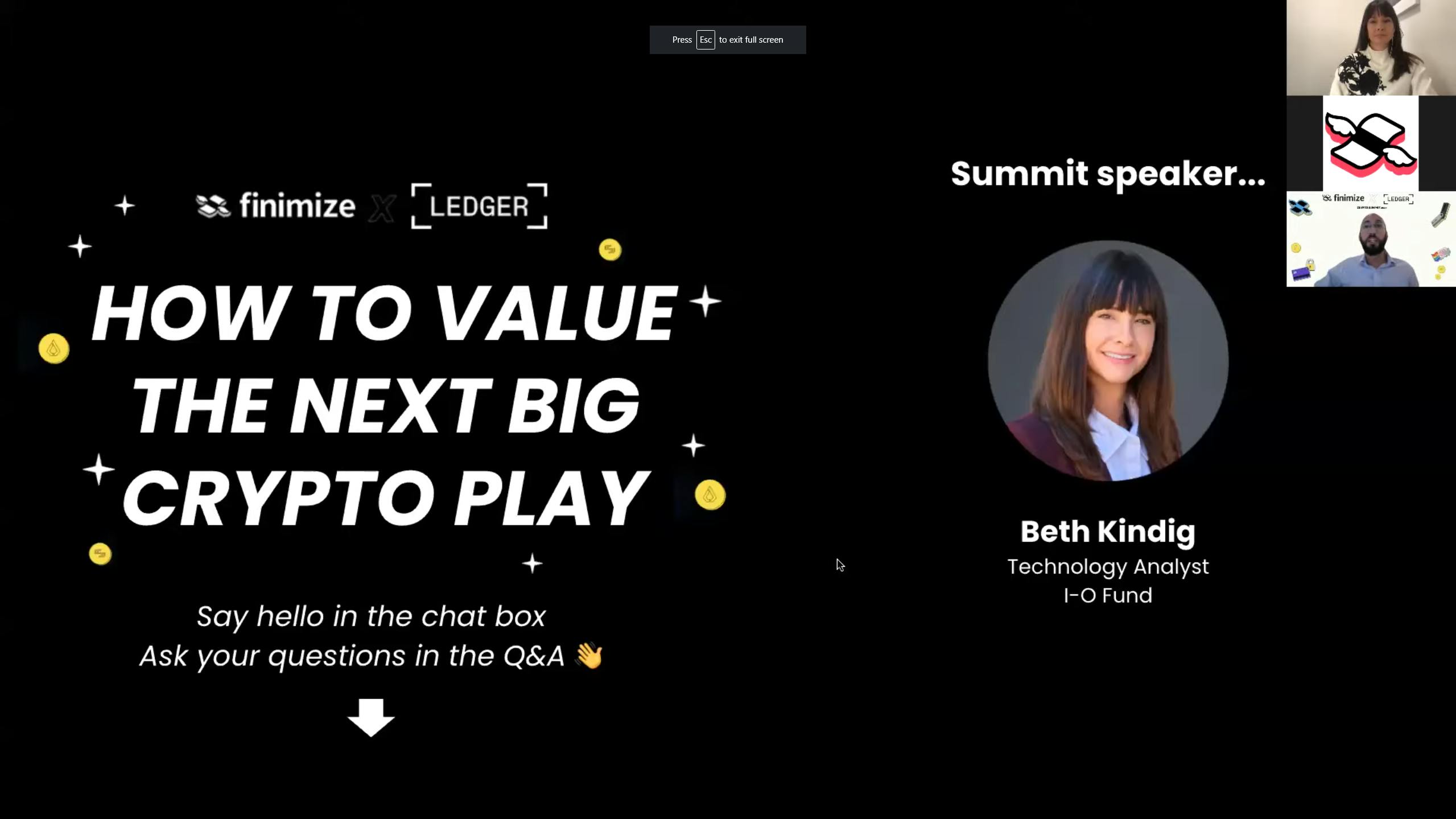
I/O Fund’s Lead Tech Analyst Beth Kindig shared her views on cryptocurrency in the Finimize X Ledger Crypto Summit 2021. Here is the video “How to Value the Next Big Crypto Play” and an overview of the discussion.
Time Stamps:
04:00 Methodology to value Crypto or De-Fi project
08:56 Sentiment analysis
16:03 Sentiment Drives Hypergrowth
16:40 How I/O Fund traded Bitcoin
19:08 Audience Q&A
29:00 Promising Ethereum competitors
31:30 Final takeaways
How to Value Crypto:
There are a few valuation metrics that are used to value crypto and Decentralized Finance (DeFi). Total value locked (TVL) is emerging as one of the leading indicators. If you divide the market capitalization by TVL, the ratio could potentially help investors value crypto assets similarly as price-to-sales ratio, which is based on revenue. Crypto does not offer financials or quarterly results so the next best thing is to look at growth in terms of the total amount of funds locked into DeFi projects. In 2021, total value locked grew over 1200% with Ethereum claiming 62% of TVL. Notably, TVL growth benefits from increase in the underlying token price.
In 2018, Ethereum had a much larger share of TVL in the >90% range. This year, Ethereum’s dominance in TVL was challenged by Binance, Solana, Polygon, Terra and others.
Institutional inflows can also be a leading indicator, with Solana seeing upwards of $2 billion in venture capital with $250 million invested into SOL-based exchange-traded products (ETPs) with $42.2 million invested in one month. In a research report from Coinshares dated November 29th, “in terms of inflows relative to assets under management (AuM), Polkadot and Solana continue to be the winners, with inflows representing 8.6% (US$11.5m) and 5.9% (US$14.6m) of AuM respectively last week.”
Polygon’s popularity can be tracked in terms of network usage and the number of addressees from senders/receivers. In early October, the network saw a high of 566,516 which surpassed Ethereum’s 527,158. This represents 30-day growth in October of 168% compared to Ethereum’s 0.6%. Polygon’s usage is driven by NFTs on the OpenSea market and gaming with Arc8 seeing over 100K users within days of launch.
Metrics are fairly fragmented and hard to track yet unique addressees and number of developers on the platform can be tracked. For example, Solana has 2.3 million monthly active addresses on its network, 1 million active users for its Phantom wallet and 1,750 developers as of November.
Network hash rate is a lagging indicator for Bitcoin yet helps determine if the trend is up or down.
The I/O Fund’s Unique Approach:
In a contrarian stance, the I/O Fund does not believe valuation is what drives crypto. Instead, the portfolio manager, Knox Ridley, tracks sentiment in order to actively manage these assets. Notably, the I/O Fund was a pioneer in adding crypto alongside stocks with proper allocation and active management. Most funds and portfolios avoid this as the volatility in crypto is complex. We also send real-time trade notifications for every entry/exit and this helped us drive market-leading returns of 236% in one-year.
Sign up for I/O Fund's free newsletter with gains of up to 1100% – Click hereSign up for I/O Fund's free newsletter with gains of up to 1100% – Click hereClick here
Below is an example of how crypto performs like high beta stocks. On the chart, you can see the price fluctuations for Bitcoin, Ethereum and Upstart are nearly identical in terms of drawdowns. While many investors become concerned by this price action, it’s actually quite normal for the pricing in disruptive tech to be volatile. Over the long term, the gains almost always outweigh the losses, which is why the holding period for tech must be a minimum of three years and up to ten years. Near the bottom, when fear is at its most extreme levels, investors begin to question their holding period and decide to exit early, which is a behavior that leads to devastating losses. It’s much better to assume disruptive tech will have extreme fluctuations and to hold firm to the original plan of holding for an extended period of time. The only exception to this is if the story fundamentally changes.
Source: Ycharts; data as of December 1st
To give you a good example of what we mean by sentiment is that when Bitcoin was trading around $19,000 — everyone wanted to buy (extreme greed), and when it dropped to $4,000 — nobody wanted to buy (extreme fear). The I/O Fund specializes in disruptive tech stocks and Knox Ridley helped guide entries in the $7000 range during this time period. We provide a chart of our Bitcoin entries and exits below. The point is not to time the exact bottom, rather to get in at a reasonable price.
Source: I/O Fund, Portfolio with real-time trade notifications for stocks and crypto assets
According to the technical analysis from our portfolio manager, Bitcoin has the potential to reach $108-$160K before the next major selloff (i.e., note: assets and stocks do not go up in a linear fashion; therefore, pullbacks are distinguished from selloffs). You can also follow our portfolio manager Knox Ridley on Twitter and sign up to our free newsletter to get regular updates on Bitcoin’s price movements.
Lead analyst for the I/O Fund, Beth Kindig, has been covering crypto since 2013 which is three years before Ethereum’s launch. Therefore, we are more comfortable than most in weathering the fundamentals and technicals for crypto. This has helped the research firm build a unique subset of crypto positions. We believe Ethereum competitors have an advantage right now and should be closely assessed for opportunities. This is due to Ethereum’s high gas fees, longer-than-expected proof of stake merge, further 1-2 year delays on shards and rollups, and overall, a complex product road map where many things can create delays for the #1 DeFi network.
We discuss this and more in the Finimize Crypto discussion.
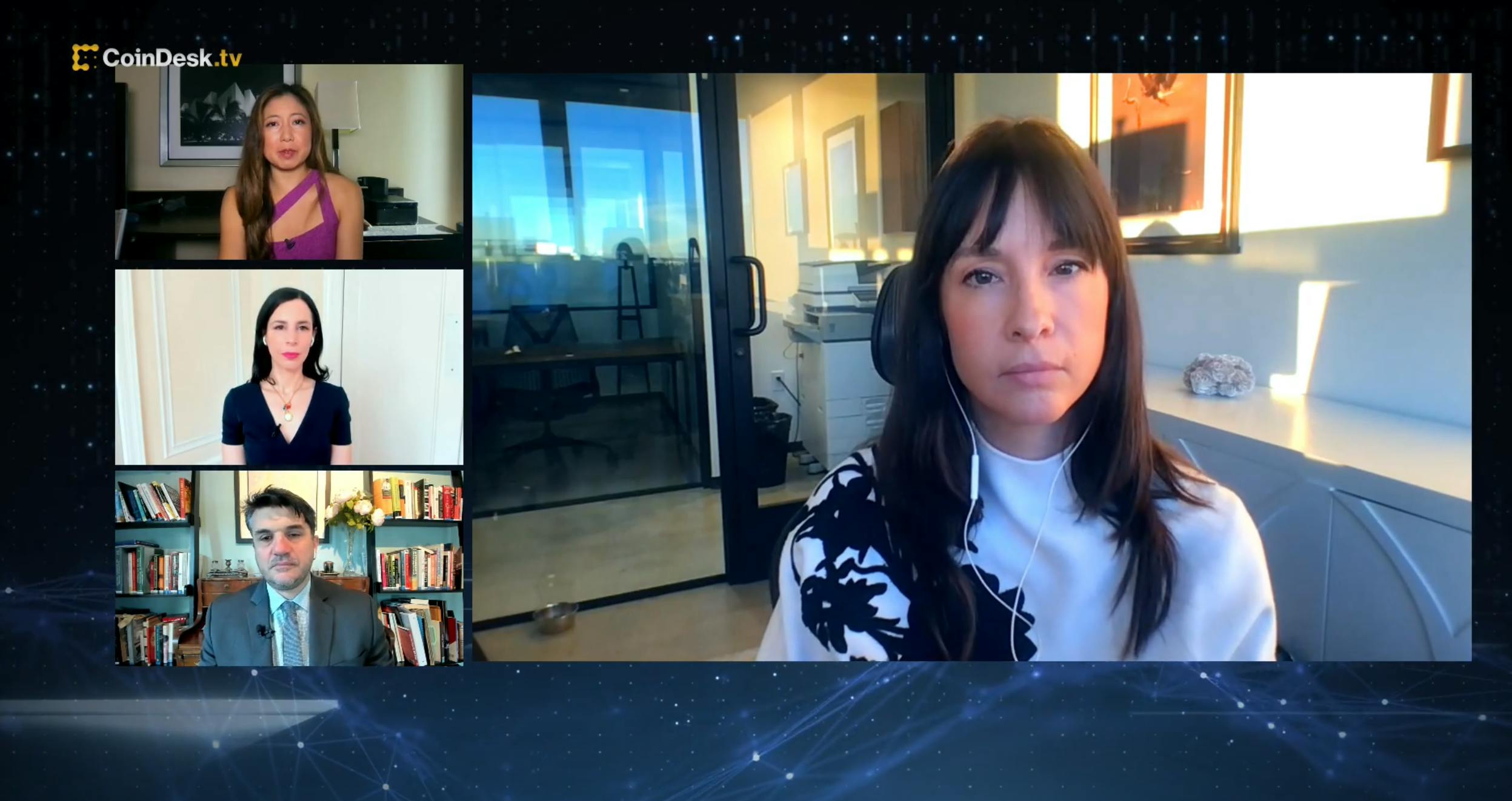
Beth Kindig shared her views on Square’s name change to Block, Jack Dorsey stepping down as Twitter’s CEO, and the upcoming opportunities to watch in an interview with CoinDesk.
Here’s an overview of the discussion.
Square is technically getting disrupted by Blockchain and this is prompting Jack Dorsey to embrace Bitcoin. I had discussed this two years ago in an article for MarketWatch where I stated the following:
“Finance is changing rapidly through mergers and acquisitions, but not rapidly enough. There will be tremendous pressure for traditional payment processors to get with the times and adopt blockchain, or else they will be left behind by lower-cost competitors …. The real value to consumers and merchants has yet to be seen. Square may have replaced cash registers, but the fees the company charges are as old-school as ever. Square charges 2.6% plus 10 cents per transaction … Digitization in the finance industry is built atop age-old infrastructure and ignores the most obvious area in need of disruption: transaction fees. Visa and Mastercard are making acquisitions to remain relevant and competitive, while PayPal and Square are getting on more devices with peer-to-peer apps such as Venmo and Cash App. Those moves won’t lead to massive growth. An overhaul of the infrastructure via blockchain will take some time, and only then will investors enjoy serious investment returns.”charges 2.6% plus 10 cents per transaction … Digitization in the finance industry is built atop age-old infrastructure and ignores the most obvious area in need of disruption: transaction fees. Visa and Mastercard are making acquisitions to remain relevant and competitive, while PayPal and Square are getting on more devices with peer-to-peer apps such as Venmo and Cash App. Those moves won’t lead to massive growth. An overhaul of the infrastructure via blockchain will take some time, and only then will investors enjoy serious investment returns.”
The fees that Square and other fintech names charge are the fees that blockchain promises to disrupt over time. We do not think Square is pushing for Bitcoin adoption and changing its name to Block out of strength, rather we think this is a defensive move.
Regarding Twitter, Beth Kindig points out in the interview that the social media site has many bots which can affect the number of advertisers on the platform sees. According to a Pew Study, 66 percent of tweeted links are shared by bots. Most websites do have some bot traffic at an estimated 29 percent, therefore some of this is unavoidable. The reason Twitter has higher bot traffic is because it does not require a network of friends/family to have a presence and someone with a very low follower count or brand new account can immediately click on ads and links. The CTO of Twitter has recently become the CEO, Parag Agrawal, and these problems are likely to persist under the new leadership as they did when he led the technical side.
How to Find the Next Opportunity
Cloud has been very resilient and we believe this sector will perform well during times of high inflation. We also think the market is currently oversold with the Russell 2000 index being more oversold than during March of 2020. During these times of indiscriminate selling, we stay firm on product and fundamentals as cloud, for example, drives down costs for the companies.
We believe the current sell-off was driven by a high inflation number rather than the Omicron variant. We believe Bitcoin will perform well during times of inflation while more speculative and high beta stocks will not perform well, such as IPOs. The bottom line will also begin to matter more.
Disclaimer: This is not financial advice. Please consult with your financial advisor in regards to any stocks you buy.
Please note: As we roll out new features, we are sending Members a Notice of Proper Registration. We simply can’t keep prices low if analysts, bloggers, or others who represent themselves on social media as stock pickers are subscribing to us and foregoing copyright laws to repurpose what we publish. (e.g. if you read our analysis and then tweet or blog about the tickers to grow a following, that’s a copyright violation). If you work for a competing service and use our analysis in any form, that’s a copyright violation. This does not apply to individual investors who are simply discussing their portfolios.Notice of Proper RegistrationNotice of Proper Registration. We simply can’t keep prices low if analysts, bloggers, or others who represent themselves on social media as stock pickers are subscribing to us and foregoing copyright laws to repurpose what we publish. (e.g. if you read our analysis and then tweet or blog about the tickers to grow a following, that’s a copyright violation). If you work for a competing service and use our analysis in any form, that’s a copyright violation. This does not apply to individual investors who are simply discussing their portfolios.
The notice you were sent outlines what I/O Fund’s attorney has prepared in terms of copyright violations. It also means if you improperly registered as an individual rather than a blogger/analyst, it means you must pay for a commercial publication license. This helps us keep pricing structures low for individuals and institutions/funds. If you are improperly registered, you will need to re-register appropriately – please visit this page here.If you are improperly registered, you will need to re-register appropriately – please visit this page here.
Introducing YO/LO Fund: The Blockchain is Going to Eat the Internet
In this analysis, we will discuss why blockchain and crypto is a movement and the ideology behind the technology.
We’ve stated why we are crypto enthusiasts across various research papers over the past 2-3 years, however, I want to take the opportunity to connect these dots on why blockchain may be the technology that our generation is remembered for in the centuries to come. I call this section a Quick Oscar Speech so you’re prepped for a more sentimental appeal. Context is key as to the importance of this shift and I want to get you fired up about the big picture. Considering we’ve had select cryptos as part of our LTBH since the beginning, we are clearly not seeing this as a swing trade or a way to get rich quick. Without the big picture, crypto could look silly. It’s not; rather it could be the most influential technology in history and this goes beyond decentralized finance.
We also discuss Ethereum, primarily why the window is open for competitors and what those competitors are doing to entice developer adoption on their networks. We do a brief overview of the tokens we plan to enter. Due to crypto breaking out, we will likely move quickly on this. However, our analysis is one in a series of reports that we will space out with our ongoing earnings coverage. As we go along, we will also do deep dives on individual crypto names but want to be sensitive with the upcoming earnings season and take good care of the other names in our LTBH and Momo portfolio. As you know, we are a small team with big ambitions and we juggle many balls at once. So, expect to see entries as soon as today and expect to see ongoing coverage of this space as time allows.
What is YO/LO Fund? On the forum, I discussed an upcoming launch of a new, explorative Fund where we maximize crypto exposure while having funwhile having fun. We will start small with each position and add to the tokens on breakouts. I can’t imagine a better team considering Knox’s performance record on Bitcoin in terms of risk management along with our ability to sift through trends to find winners via in-depth analysis. The reason Bitcoin and Link have done well as LTBH positions is that Knox adds and trims accordingly. You’ll also know why we are owning each coin plus full diversification within the trend. I want you to be able to go to dinner and tell your friends what a token does and why it’s important.
My Oscar Speech on why Blockchain is Important:
The blockchain is proposing a complete overhaul to how we are conditioned to believe the world must work. On one hand, opponents call crypto a tulip craze. On the other hand, the top 1% in America now has more wealth than the entire middle class at 60%. This strikes at the core of why blockchain and crypto has become a movement. To challenge the effects of society, we must look at the cause: how has centralized finance and also the centralized internet created what Silicon Valley technologists are now calling an “oligarchy.”
The Federal Reserve was created in 1913, however, many claim Richard Nixon’s altering of the Bretton Wood system and the untethering of the US dollar from gold set in motion the accumulation of wealth for the 1% as wages stagnated despite an increase in productivity.
As a technologist, I would also point to the advent of the internet but most importantly mobile and how this contributed to the “oligarchy” of Big Tech. If you want to listen to a great podcast about this oligarchy, I recommend Naval Ravikant’s interview here from 2018 or here on Spotify. It’s well worth the hour and he connects the dots on the overwhelming importance of the blockchain. I’ll expand on my unique perspective of what I think contributed to the oligarchy he speaks of, and why centralization is one of the biggest issues that society faces. Finally, we will discuss how blockchain will dissolve the concentration of power.
The Centralized Internet and “the Walled Castles”
The internet was intended to become a democratization of information, yet the concentration of who controls the information became greatly concentrated once the mobile device began to leak data through various sensors. For example, there have been many independent reports such as here and also here of Facebook using the microphone to transcribe conversations and to later target keywords for ads. This would be very easy for Facebook to accomplish with a taxonomy, such as “Hawaii” or “golfing.” This started in 2014 and was caught by security professionals. It was debated and denied for years, buried by Facebook’s corporate communications team. Finally, in 2019, it was reported by Bloomberg that Facebook does transcribe messages — for your protection, of course — and Amazon does it too with Alexa. According to independent security professionals, you are not imagining it when you say something in a private conversation and later see an advertisement later on a browser or inside of an application. They pinpoint this beginning in 2014.
What I call “the surveillance era” began in 2008 yet really took off around 2012. The drawbridge to what Greylock calls “the walled castles” (i.e., not a quaint walled garden) were firmly closed by 2014. The drawbridge snapped shut when the more powerful tech companies became capable of collecting exponentially more data than the competitors through software installed on the device. Or, in Google’s case, the Android operating system. Wall Street will tell you it’s all about revenue, the ads, and the number of users. That’s wrong, of course, as the walled castles were created from an advanced use of data and gobbling up many online properties that produced more data. Why would Facebook buy Whatsapp for $19 billion? The phone numbers enriched their datasets.
The mobile device era created reckless abandon in terms of collecting data. The far majority will shrug and say “how does collecting data affect me? I’m okay with ads.” For starters, if you’re okay with it (I’m not) then every tech company should be able to run surveillance software, track your browser and native app activity and transcribe your conversations to run them through a taxonomy. Why do you only allow Google, Facebook and Amazon? What’s special about them. If you’re okay with it, then all companies should be able to track what you do on the mobile device. For those that are privacy complacent, that would be thousands of them.
That seems absurd yet we’ve allowed three key companies to do this without consent. Teams of engineers and data scientists built algorithms using private data to determine what you see and what you don’t see. Freedom of the press is at the core of a free society (i.e., ask China why they tightly control the media). Section 230 has been debated for nearly a decade, yet it’s raising a question that has become increasingly more important – where do the lines blur between publishers and tech? Big Tech has enough money to make sure Section 230 turns out in their favor, and thus, we are in a vicious cycle.
The enormous amounts of data that the top 3 companies have collected has led to a concentration of who controls the information that is consumed, seen and absorbed. In an attempt to have as much data as possible, the gatekeeper for media and communications leads back to these three companies. The definition of an oligarchy is “government by a few.” Algorithms are built to determine what information is seen rather than by meritocracy and these algorithms are centralized and built by a handful of companies. Freedom of the press is not possible in a society where media must pay to be at the top of a feedmedia must pay to be at the top of a feed. Technically, press has the right to publish but it’s not seen as we no longer pay 10 cents for a newspaper to support the press. Instead, you must pay thousands (and probably millions) for content to be seen.
My very first analysis for the public markets was on Facebook’s privacy issues and I followed this up later with details on the surveillance-network in HackerNoon. Although ethics and stocks don’t tend to go together, Facebook is not one I could look past knowing the amount of data they were collecting without consent. Twitter has always been easy for me to pass up as an investment because the platform is infiltrated by bots. Social media users are not necessarily aware of this but paying advertisers certainly are as click fraud and click bots are the ad industry’s biggest issue. Basically, it’s not the best platform to run ads because advertisers have to pay for bot clicks.
On Twitter, 66% of shared news links are from bots. That’s enough to control what’s trending. What else would be the purpose of the bots? The exact answer for that is above my paygrade. However, this leads back to the issues with centralization. In a decentralized network, social media users will be validated and bot activity will be penalized, often by removing the tokens. More independent reporting will be surfaced, and we can go back to some sense of normality around how information is accessed rather than viewing content that is paid by the highest bidder (or the most active botnet).
So, how does this relate to the blockchain? First off, the centralization of the internet has far and wide-reaching effects when those with the most money are able to determine what information is seen and whose articles surface. Of course, what you see with your eyes all day/everyday affects you. It doesn’t matter if this is done through bots on Twitter, Google’s algorithms and advertising pay structures, or Facebook’s dopamine-inducing newsfeed that is largely driven by your personal data which required tens of billions of dollars to collect.
The solution is blockchain as it results in a meritocracy for content creators and a democratic, verifiable process to what is surfaced and viewed.
The benefits of democratizing the internet goes beyond social media, traditional media and journalists. There is now a Spotify competitor called Audius that distributes the profits to artists. Normally, artists make 12% of revenues in the traditional structure. With Audius blockchain, artists make 90% of the revenues. This is because there are no middlemen or agencies and the music is freely distributed. We don’t need gatekeepers that decide the music we listen to and then takes the majority of the revenue.
Although I won’t go into decentralized finance here as I already have a few times in the past, you can imagine something along the lines as music artists where there is a redistribution away from centralized banks and into the pockets of the 99%. Primarily, the credit card fees, transfer fees for wires, recording fees for documents, costs for redundant paperwork (think taxes and the IRS), the amount we pay to prevent fraud — and even on a larger scale, the ability to lend and borrow in a peer-to-peer fashion.
I want to take a moment to revisit what our original Bitcoin analysisour original Bitcoin analysis had said in August of 2019:
My prediction is that once the Lightning Network is built out, bitcoin will surpass the market cap of Apple, Google, Microsoft and Amazon to reach a minimum of $50,000 per token. This is because the protocol solves critical needs for global populations, including the reduction of financial fees for 7 billion people, and offers a need to store money during times of inflation.This is because the protocol solves critical needs for global populations, including the reduction of financial fees for 7 billion people, and offers a need to store money during times of inflation.
Bitcoin is based on the most secure network in the world, and this solves a very real need for the financial system – which cannot be automated without a decentralized blockchain solution. Technically speaking, bitcoin is also the world’s most secure financial network. The transfers eliminate 3% in processing fees and hedges against inflation. This can, and should be, worth as much as a search engine, enterprise software, a social media network, warehouse fulfillment (AMZN) or iPhone hardware.Technically speaking, bitcoin is also the world’s most secure financial network. The transfers eliminate 3% in processing fees and hedges against inflation. This can, and should be, worth as much as a search engine, enterprise software, a social media network, warehouse fulfillment (AMZN) or iPhone hardware.
Apple, Google, Microsoft and Amazon reached market caps of $1 trillion because their products scale to global populations and are required on a daily basis. Bitcoin not only scales to the global population but it also protects their livelihood – a necessity rather than a convenience. In fact, we see populations who are not necessarily tech savvy most enthusiastic about bitcoin, and this is a strong signal that it will scale beyond the reach of $1 trillion market cap. “Bitcoin not only scales to the global population but it also protects their livelihood – a necessity rather than a convenience. In fact, we see populations who are not necessarily tech savvy most enthusiastic about bitcoin, and this is a strong signal that it will scale beyond the reach of $1 trillion market cap. “
Fast forward two years, and we see that more citizens of El Salvador have crypto wallets than bank accounts (that quickly!). While the top 1% like Jamie Dimon is saying “it can’t, it won’t,” the 99% are saying “we can and we will.”
How could you not get behind that?
[Insert Oscar Music telling me to exit the stage as I’ve gone over my time][Insert Oscar Music telling me to exit the stage as I’ve gone over my time]
I want to get you fired up on this for a few reasons:
My job is to bring you important trends in technology and to silence the noise. I want to make sure I/O Fund Members do not turn away from crypto and keep an open mind.
You didn’t miss the boat; Web 3.0 starts now. But be prepared to trim/exit at the top and re-enter. We plan to do this for YO/LO.
Many of the centralized applications and websites you use today are going to come under pressure long-term. We need to lower the barrier for blockchain adoption for dapps like Audius but it’ll happen.
Because the world needs a decentralized system, global populations will be willing to pay nominal amounts for this (hence, the importance of tokens). It’ll be like paying for the newspaper again. Pocket change well spent.
This nominal amount being paid will actually save people money in the long run as the blockchain will reduce costs, reduce fraud, and increase wealth for the middle class through decentralized consensus mechanisms that don’t require a middleman. (yes! It’s that big of a deal).
In terms of contributions to society, blockchain may be the one technology that future generations remember us for as the majority of the world lives beneath the poverty line. (To compare, AI would be more of a contribution to productivity.) Those beneath the poverty line in El Salvador are showing record adoption rates for Bitcoin wallets.
Media is bought and paid for, and I believe the headlines have retail believing crypto is still a high-risk and an undesirable asset, yet institutional buying is telling us a different story. Consider that Algorand (see below), has received a $700 million round.
However, the crypto world is confusing and high risk because there are so many products to consider – this is why many investors throw up their hands and walk away or they’ll buy one of the many ETFs that are launching. We think the bigger gains come from learning to fish and so we are inviting you to fish alongside us.
Most importantly, this site offers risk management (Knox) for entries and exits. Without this, crypto can be a blood bath. The reason investors keep a separate crypto fund is they aren’t able to handle risk management whereas I/O Fund specializes in this for all tech growth stocks and assets. We did not hesitate to add BTC and LINK to our long-term buy and holdto our long-term buy and hold due to Knox’s confidence in managing risk.
We can’t guarantee there won’t be losses as crypto is extremely volatile. Only invest what you can afford to lose.
We may need to be aggressive with entering and exiting. Don’t be surprised if we exit an entire position in YO/LO Fund to buy again later at a lower price. This isn’t about convictions or fundamentals. Risk management comes first with crypto and convictions are second to this.
Ethereum’s Scaling Issue: An Opportunity for Competitors
The blockchain and decentralized networks offer three key benefits over centralized networks. These three benefits are: decentralization, security and scalability. The issue is that most decentralized networks cannot offer all three without some compromise.
This was first discussed with decentralized data in what is known as the CAP Theorem as distributed databases cannot deliver Consistency, Availability and Partition Tolerance (CAP) without some compromise. This is because if a node goes down, either the system has decided to replicate the data (make a copy) on the other node or to partition the data (split the data) between two nodes. If partitioning the data is chosen, then consistency is sacrificed. If replication is chosen, then partitioning has been sacrificed.
MongoDB is a distributed database that elects a secondary node by whichever one received the most recent update. Therefore, MongoDB offers consistency and partition tolerance all of the time and availability most of the time except when a new node is synchronizing to become a primary node.
In addition to the proof of stake mechanism helping Ethereum to scale transactions, our report also discussed the importance of shards for scalability. Rather than every node downloading every transaction, calculating it and replicating it, shards create a subset of the network where nodes are dispersed for more efficient processing. We also discussed Rollups, which allows for hundreds of transactions to be rolled into a single transaction. This replaces Plasma, the current option where only a single transfer is made per transaction.
Here is what we had said about rollups. I’m copying this so it’s understood where the delay is as the merging to Proof of Stake is happening in the next few months while sharding and rollups are delayed:
“In the ZK-Rollup scheme, a transactor and relayer are needed. The transactors create a transfer and broadcast it to the network. In this case, a shortened 3 or 4 byte indexed version of the address helps to reduce resource needs. The relayers collect hundreds of transfers and roll them up, essentially, to generate a hash that compares a snapshot of the blockchain before the transfers and a snapshot of the blockchain after the transfers. In most cases, the transfers will be recorded by a change in the wallet values. The hash that represents the wallet values or the delta to the blockchain is called SNARK proof. The changes to the hash are reported to the blockchain.4 byte indexed version of the address helps to reduce resource needs. The relayers collect hundreds of transfers and roll them up, essentially, to generate a hash that compares a snapshot of the blockchain before the transfers and a snapshot of the blockchain after the transfers. In most cases, the transfers will be recorded by a change in the wallet values. The hash that represents the wallet values or the delta to the blockchain is called SNARK proof. The changes to the hash are reported to the blockchain.
Relayers are established by staking a required bond, or token amount, in the smart contract. The result will be fewer transaction fees that are processed faster than the previous Plasma framework. In the ZK-Rollup framework, blocks are computed in a parallel computing model that lends itself to decentralization. There will be less data than the previous framework which increases throughput and scalability.”
The Ethereum network has more security risks than Bitcoin as ZK-Rollups assume a trusted state and relies on a small group of developers to establish this initial trusted state and one of the developers could manipulate the code. Quantum computing could crack ZK-Rollups if the correct hash is guessed. This is more likely than guessing an encrypted protocol.”
Ethereum’s High Gas Prices
The term “gas” refers to the computational effort required to execute specific operations on the Ethereum network. Each transaction requires that a fee be paid called “gas” to offset the costs of computational resources. The market price for gas is determined by demand. If you want your transaction executed quickly or if you have a larger contract, you’ll pay more gas. As of August, the London Upgrade has changed how transactions are charged with every block having a base fee and a minimum price per unit of gas that is calculated based on demand for the block. Users also tip to compensate miners for executing the transaction.
The goal of the London Upgrade is to allow for variable-sized blocks. Previously, blocks would hit total capacity and users would have to wait for the demand to subside. You can see in the chart below that Ethereum’s gas prices are inching upward with a notable spike in September even after the London upgrade went into effect. The average gas price of 58 GWEI is about 10X higher than the Binance smart chain at 6.1 GWEI.
In September, TIME Magazine recently sold NFTs called TIMEPieces and minted 4676 tokens for the digital art. It sold out within minutes with 4,000 transactions occurring within a short period of time. The price for 10 NFTs was around 1 ETH or $2500 to $2800, yet due to gas fees, one buyer paid as much as $70,000. In addition, the wait time to transact ranges from 30 seconds to 16 minutes.
We had estimated in March that Ethereum 2.0 will need “another year minimum or about three years maximum” to reduce energy use and increase throughput for transactions per second (TPS). Recently, Buterin stated that what he thought would take one year has actually taken six years. The current roadmap for the Proof of Stake merge is for late this year in 2021 while sharding and rollups are expected by late 2022 or early 2023.
However, the delay in terms of scalability with sharding and rollups leaves an open window for competitors for about eighteen months if we assume early 2023, which is a substantial amount of time considering the activity we are seeing in NFTs and decentralized finance. The other issue facing Ethereum is that even though the network certainly has a defensible position in terms of the ecosystem and sheer number of dapps built on the network, there are competitors who are arguably stronger as scalability was solved for at time of launch. Some of this may be that the latecomers had the advantage of hindsight and could observe and improve upon the gas issues that Ethereum faced from being a first mover.
Quick Glimpse at Mid Cap:
Avalanche (AVAX):
Ethereum competitor that has a maximum supply of tokens and technically a decreasing supply due to burning. The network is unique in that Avalanche utilizes three interoperable blockchains. The X-Chain is for creating and exchanging assets including NFTs, the P-Chain validates and creates subnets, and the C-Chain is for executing Ethereum Virtual Machine (EVM) contracts. The C-Chain is critical for AVAX’s growth as developers can build applications that have easy interoperability with Ethereum while improving the base layer.
The layer one blockchain hosts smart contracts like Ethereum and has a low Nakamoto coefficient, which is a quantitative method of measuring decentralization. Although transactions per second (TPS) is lower than Solana at 4,500 TPS, Avalanche has a faster time to finality of less than a second compared to Solana’s 12.5 seconds. Avalanche is also compatible with Ethereum dapps and wallets. The company recently introduced a $180 million mining incentive program to add dapps to its decentralized ecosystem. The program is called Avalanche Rush and will help popular protocols to expand from Ethereum to Avalanche.
Emin Gun Sirer, the founder of Avalanche, predates even Satoshi’s Bitcoin whitepaper. He and a research team are credited with the first cryptocurrency developed in 2003 called the Karma system, which was based on proof-of-work.
Aave (AAVE):
On the Chainlink webinar, we discussed that one major issue with centralized finance is that a regular person (such as you or myself) cannot lend money to another person in order to get the interest rates that Chase Bank gets on credit cards or a mortgage lender gets on home loans. As artificial intelligence and the blockchain remove barriers to understanding creditworthiness, there should be no reason to not pool money together to achieve these returns. We don’t need a centralized bank to do this as it’s preventing regular people from earning income (and on the flip side, it also prevents regular people from getting the credit lines they need at an affordable rate).
Aave is the leading borrowing and lending protocol. Not only can you earn interest on your deposits but you can also borrow assets. The platform also issues flash loans, which means that the lender is repaid the money upfront through a smart contract rather than providing collateral. In the event something falls through or a condition is not met, then the transfer is automatically reversed. This is one illustration as to why smart contracts promise to revolutionize the way things are currently done as they are automatic, decentralized and secure.
The company launched as ETHLend in 2017 but has expanded to other networks. Within 6 months of launch, Aave was issuing more than $100 million in flash loans per day. One year later in June of 2021, the platform had issued over $4 billion in loans (total).
Curve (CRV) & Yearn.Finance (YFI):
When we think of the issues surrounding crypto, one that comes to mind is liquidity and stability. Not only do exchanges and trades take a long time due to lack of liquidity, but the price fluctuates to such an extent that common day uses are prohibitive. The TIME NFTs are a great example.
Curve is a popular DeFi platform and automated market maker (AMM) that reduces slippage between the expected price of a trade and the price at which it’s executed. Curve allows digital assets to be traded by using a liquidity pool, or a shared consortium of tokens. These pools are optimized to stabilize pricing and those who place their tokens into the pool are rewarded. Because Curve focuses on stable coins, volatility is greatly minimized. Originally, Curve launched to assist with lower fees for trades and to also offer the additional benefit of rewards in fiat currency. The decentralized exchange (DEX) is also integrated with Yearn Finance and Synthetix for users to participate in both the fees from the Curve pool, and also the yields from yield-bearing tokens. Curve also offers interoperability with other networks to maximize access to the DEX and increase its availability, which is called composability where you can earn across the DeFi ecosystem. We are especially keen on Layer 2 solutions that remain with Ethereum yet expands to new networks during Ethereum’s 2.0 transition. Curve recently expanded to Avalanche and the composability also is a key feature as the DeFi ecosystem grows.
There are 39 pools for swapping stablecoins. Curve competes with companies like Uniswap, which provides for swapping of tokens but with high fees. From my perspective, it makes sense that the best market maker and exchange would be a stable coin pool. A typical pool will include DAI, USDT and USDC, which are pegged to the US dollar. The automated market maker uses an algorithm rather than buyers and sellers to trade from liquidity pools, with a rebalancing that occurs partly from arbitrage traders buying any excess. The goal is stability from stable coins and also high-interest rewards from lending protocols. The automated money maker algorithm allows for high volume trading. We like this company because it solves for stability and having exposure to this is a good idea, in my opinion.
Algorand (ALGO):
Algorand is an East Coast company founded from an award-winning professor from MIT. Silvio Micali has won numerous awards including the Turing Award, Godel Prize and RSA Prize. He has been working with cryptography for decades and is known as the co-inventor of probabilistic encryption, Zero-Knowledge proofs and Verifiable Random Functions. As of now, more than 700 global organizations have partnered with Algorand including Koibanx, a LatAm asset tokenization, and the El Salvadorian government to build the blockchain infrastructure for the country.
Algorand handles 1,000 TPS and has a five-second finality. The blockchain network launched with Proof of Stake (PoS) in 2019 that awards all ALGO coin holders rather than rewarding only validators that stake a large number of tokens. The company calls this Pure Proof of Stake (PPoS) with on 1 ALGO coin required for staking whereas Ethereum requires 32 ETH or roughly $100,000 USD to stake tokens. Due to rewards being split across all tokens rather than only validators, the ALGO coin earns a 7.5% annual yield.
There is also a bifurcation between two layers that helps the network achieve a high throughput. Layer 1 executes smart contracts as ASC1s and Layer 2 executes more complex smart contracts and dapps as ASC2s, or off-chain.
Right now, it’s speculated that the Algorand network could become popular for government-backed stable coins.
Quick Glimpse at Small Caps:
Ocean:
Ocean is built to facilitate data exchanges. OCEAN tokens are used to access datasets and run AI and ML models through marketplaces. In turn, data providers earn OCEAN tokens for supplying data. The Ocean Market is an automated market maker (AMM) that facilitates the minting and exchange of data tokens. Compute-to-Data allows data sharing while preserving privacy. This allows AI and ML applications to utilize data while adhering to privacy standards. Considering that my Oscar speech was in regards to privacy as a primary pain point for centralization, I’d like to own a token that specifically addresses this ☺
The Graph:
The Graph indexes servers and powers data queries for many popular decentralized finance apps, such as Uniswap and Synthetix. Tokens are spent to perform the queries. By opening up data across the ecosystem, more dapps can be built utilizing blockchain data and APIs. By decentralizing the data layer, The Graph leverages a network of indexers to reduce the amount of overhead cost required to index servers.
API3:
You’re probably seeing a pattern here as to the trend I am preferring for small cap coins (the data layer). API3 has been called the “Chainlink killer.” Although I’m not convinced it will kill Chainlink, I’m always open to having more diversification on how to securely onload off-chain data. Rather than having a node sit between the API provider and the smart contract like Chainlink, API3 enables the API provider to run their own nodes. API3 argues that adding a middleman (Chainlink) creates a new attack surface and adds more costs.
Quick Glimpse at the Heavyweights:
Cardano:
Cardano launched with Proof of Stake (PoS) in 2017 and has been in a constant state of development since. For instance, IOHK is an engineering company that updates Cardano’s codebase with verifiable, high-liability code using the same approach as spacecrafts and high-frequency trading software. Cardano has two structures, a settlement layer and a computational layer. The consensus protocol enables ADA coin holders to delegate a stake pool, or a node, with the opportunity of becoming a slot leader as the stake increases. The rewards are distributed to ADA token holders. The blocks change every five days and the slots change every twenty seconds.
Cardano’s consensus mechanism is also very energy efficient as the PoS algorithm pushes energy back to the edge. The company is also working towards true decentralization by handing over access of Cardano’s open-source infrastructure to the community, which in turn, will allow more enterprises to leverage Cardano. The Cardano Foundation is a non-profit from Switzerland.
Polkadot:
Polkadot’s goal is for interoperability for a decentralized internet for applications to seamlessly communicate across networks. Its role is to connect networks for cross-blockchain transfers with a cross-chain system. Network validators can also be leveraged for security and consensus across multiple blockchains. Polkadot also updates without the need for a fork, which allows it to be compatible with new networks and blockchain features as they are developed. Polkadot was founded by Ethereum’s former CTO, Gavin Wood. It is backed by the Web3 Foundation, a non-profit research foundation in Switzerland that specializes in cryptography and provides grants to startups.
Solana:
Solana is an Ethereum competitor that has a very high throughput of 65,000 transactions per second on GPUs although Avalanche has a higher time to finality. Solana accomplishes this without second layers or side chains by using the Proof of History (PoH) consensus mechanism. PoH creates a historical record that proves an event has occurred at a specific moment in time. Rather than validators agreeing on a time, Solana validators maintain their own clock by encoding the time with a cryptographic hash function (SHA-256). This circumvents the need to wait for confirmation, thereby resulting in a higher throughput. The founder is from Qualcomm and Dropbox and he recruited engineers from Qualcomm to create Solana labs.
YO/LO Positions – Subject to Change:
(Friendly reminder: all of our positions are subject to change – more so in YO/LO and Momentum but LTBH can change at times too!)
Voyager Digital is a smaller cap that gives investors exposure to the Bitcoin and crypto trading trend at a reasonable valuation. The company offers zero commissions and more coins than its competitors, including the rumored $100 billion market cap Coinbase that is going public soon, Kraken and Gemini. The stock is listed on the OTC market, which is higher risk than the Nasdaq as these stocks tend to be thinly traded.
Voyager is a zero-commission competitor to Robinhood, and due to many PR mishaps, has opened a door for Voyager to become a replacement for customers who seek fewer politics around their crypto trading app.
Voyager also comes with the added benefit of offering 9% interest on stable coins as the company is a consortium for stable coins, including USD Coin (USDC) and Tether’s USDT, which have surpassed $7 billion in circulation. As such, it provides exposure to decentralized coins like Bitcoin and stable coins based on the fiat system.
Although I am personally in favor of decentralized crypto and not stable coins, Big Tech and the Fed are likely to put immense pressure on adopting stable coins. Voyager allows investors exposure to both at a market cap of $2.18 billion, at time of writing. You can read my Facebook Libra article here where I am especially against this company entering the stable coin market.
Below we explain what makes Voyager a compelling investment, including what it does, how it makes money, valuation, catalysts, management, and potential risks.
Voyager: Zero Commissions, More Coins
As longtime crypto investors, we know all too well the issues around Coinbase and the other sites. The primary issue is the commissions that Coinbase charges, which are exorbitant to say the least. To make a $5000 trade on Coinbase, you will be charged about $80 in commissions. This isn’t competitive in an environment where stocks are traded at $0.
Voyager does not charge commissions on crypto trades and offers 9% interest on stable coins. One thing to note is that Voyager does not offer insurance like Gemini, and that our fund does not hold large amounts of crypto on trading platforms. Instead, we store crypto in cold storage wallets and use trading platforms for trading only. We discuss how Voyager makes money below, the differences in crypto platforms and how investors typically store their crypto below.
The fallout with Robinhood over GameStop has created an influx of customers for Voyager. Total revenue growth between December and February was over 1000% from $1.7 million to $20 million in monthly revenue.
Please note, my readers often ask me about the volatility of crypto and my answer to this is that crypto promises to be some of my most volatile investments. Stocks and crypto prices can drop 60% or more – and this has happened since my official coverage on bitcoin when it was priced at $12,000 and saw $4,000 before finding a base. You can read my past coverage here on Bitcoin in the summer of 2019.
Financial Overview
Although Coinbase was first to market, there is plenty of room for competitors to disrupt the company’s non-existent customer service and excessive commissions. For those who don’t trade crypto, you might be surprised to know that after paying such high fees, you are given no customer service whatsoever. The I/O Fund prefers Gemini as a commission-based platform as there is insurance offered to offset the cost of commissions.
Voyager is FDIC-insured. However, the crypto held with Voyager is not insured. Gemini, which operates as a trust, has private insurance. Like us, crypto investors generally store their assets on a cold storage crypto wallet, which means it is not connected to the internet. In the event there is no insurance, the risk to cold storage wallets is minimal.
Significant Growth from Robinhood Tailwinds
Crypto investors are a tightknit community and we think word-of-mouth will grow nicely in this niche as it actively looks for new platforms. In December, the company reported $1.7 million in revenue and has grown to $8.5 million in January of 2021.
The company reported $2.5 million in revenue from Feb. 1 to Feb. 4—which we predicted could lead to $17 million in revenue in February. The company exceeded this and reported $20 million in revenue for February.
Assets under management (AUM) grew from $230 million in December to $800 million by early February. Total assets under management by the end of February was $1.7 billion.
Trades per day averaged more than 30,000 for the month ending Jan. 31, up from approximately 6,500 in Dec. of 2020, representing 450% growth in daily trade volume. By early February, daily trades averaged 60,000 trades per day or nearly 1000% growth. In the March earnings report, the company reported a total of 70,000 trades in February.
In January, the value of customer trades increased over 500% to $840 million, up from $150 million in December of 2020. Over twelve months, the overall number of trades increased from 8,500 trades in December of 2019 to 1 million trades in January of 2021, an increase of 117,000%. This number may be irrelevant as most of this is priced in right now, yet we think it's important to look at the ongoing strength before the Robinhood issues.
Basic users grew from 150,000 in December to 440,000 by early February. The company reported 605,000 verified users at the end of February.
Here is the full statement from Steve Ehrlich, cofounder and CEO of Voyager, regarding the Robinhood catalyst and what investors can expect moving forward:
"While we believe our recent business metrics reflect the growing interest in the cryptocurrency ecosystem and long-term benefits of our business model, the unprecedented external events over the past week, including decisions made by competitive products, have brought significant upside to our metrics.
While we don't expect a repeat of the unprecedented external events of the past few weeks that have catalyzed the recent growth, we anticipate continued meaningful growth in our business, including from the pipeline of approximately 80,000 customers who have signed up and that we are presently onboarding.
We remain focused on executing our long-term business plan and expect Voyager will continue to grow the business in a more traditional pattern throughout the balance of 2021. To support this growth, we anticipate increased expenditures to materially increase our employee headcount during this period, while also growing our technology architecture stack in the near-term to accommodate significantly more users."
The company closed a private placement of $46 million on January 21st, 2021.
Voyager has seen 75%+ sequential quarter growth with increasing operating margins in 2020. Per the Investors Presentation, Voyager had a previous goal of reaching $20 billion AUM based on $500 million AUM as of Q1 2021 (this was achieved at nearly 3X the company’s original goal with currently $1.7 billion AUM). The company believes it can achieve 90% CAGR on number of funded accounts and 35% CAGR on average account size.
The company also states it takes $35 to acquire an account, and the company makes $30 per account in monthly revenue—which is excellent unit economics. Customer acquisition costs have averaged from $20 to low $30s per new account, according to Stifel Research.
In contrast, monthly revenue per account has accelerated from $40 per month at the calendar end of 2020 to $80 per month in C2021. A catalog of research reports are available from various funds and analysts covering the company, which is fairly extensive coverage considering the company's small market cap.
Voyager is a strong choice for alternative coins, as the app allows you to trade many tokens that Coinbase or Kraken does not support. For example, Voyager offers Dogecoin, a meme coin pushed by Elon Musk. It also offers interest on Bitcoin, Ethereum, Polkadot, and Chainlink.
Voyager sees its diversification across revenue streams as a way to minimize volatility. The revenue streams include listing fees, interest revenue, alternative coins and major coins.
Quarterly Financials
Voyager reported Fiscal Q2 2021 results March 1 for the period ending Dec. 31. The company had $3.56 million in revenue with $2.06 million in fees and interest income of $1.51 million. There was a net and comprehensive loss of $9 million.
Voyager expects to continue bringing new products to The Voyager platform, according to the report. In 2021 and beyond, executives anticipate adding debit cards, credit cards, stock trading, and the ability to trade on margin. Voyager will also look to grow internationally by expanding into Canada and Europe.
Fiscal Q1 2021 results were reported on November 30th for the period ending September 30th. The company had $2 million with $1.6 million in fees and interest income of $400,000. There was a net and comprehensive loss of $3.97 million or ($0.04) EPS.
The company had cash and cash equivalents of $7.48 million and debt of $1.12 million at the last earnings report, which includes a PPP loan. There was an update for fiscal Q2 2021 on January 5th with quarterly revenue expected to reach $3.5 million.
Voyager also completed a private placement during the quarter, which increases gross proceeds raised during fiscal 2021 to C$13.8 million. It completed the acquisition of LGO, SAS, an AMF regulated entity that provides Voyager with a fully licensed European entity to accelerate its European strategy.
How does Voyager Make Money?
Voyager’s revenue is not dependent on commissions or fees. The company plans to introduce a debit card, credit card, margin, loans, and advisory products over the next year or so. Right now, the business model creates revenue in two specific ways:
1. Smart Order Routing: When you place an order to buy or sell a cryptocurrency, Voyager provides a listed price that you accept. It then connects your order to 12 exchanges. Unlike securities, which by law must have the same price across all domestic exchanges, cryptocurrencies are priced at variable levels. In other words, the same coin can be listed at two different prices at the exact same time.
Voyager uses your order to capitalize on this inefficiency by performing an arbitrage across various exchanges. The profits from such a move would typically surpass any commission or fee, allowing Voyager to provide exceptional pricing. Voyager will thus share the profits from this arbitrage with you in an attempt to execute your order at a lower price than you agreed to.
This business model will likely remain profitable until regulations change or there is too much competition in the arbitrage. Changes to the process would appear in the margins.
2. Voyager operates like a bank. In their terms and conditions, Voyager very clearly states “We will lend, sell, pledge, rehypothecate, assign, invest, use, commingle or otherwise dispose of funds and cryptocurrency assets to counterparties, and we will use our commercial best efforts to prevent losses.”
If you receive a loan from a bank, the loan is used by the bank as collateral for other investments. This creates multiple derivatives on a single asset. This is similar to Robinhood in that the users take on counterparty risk. Should Voyager become insolvent, you will need to stand in line behind other creditors to receive your money back.
For taking on this risk, Voyager offers significant yield in a yield-starved economy. Like a bank, a minimal deposit must be kept to receive this interest payment, which can be as high as 9%. As part of this program, it may take up to 7 days for you to withdraw any crypto from your account. Voyager Digital is engaging in fractional lending practices, which banks have been doing for centuries.
However, Voyager is not considered a bank or a broker-dealer. It does not provide FDIC or SPIC insurance for your cryptofor your crypto if there is a run on the bank, or if something occurs that would prevent them from meeting obligations. To conclude, FDIC insurance applies to the cash you hold at Voyager, but there is no insurance for the crypto held there. We discuss the differences in crypto trading platforms below.
Catalysts: Stablecoins and Global Expansion
Last March, Voyager acquired Circle Internet Financial’s trading app, which provided an additional 40,000 clients. The acquisition strengthens Voyager in offering the USDC stable coin that has $7 billion in circulation. Circle is backed by Goldman Sachs and is the founder of the consortium for USDC. The USDC coin allows global transfer of dollars at an instant and for a very low transaction cost.
The stable coin is part of a consortium that is also sponsored by Baidu, IDG Capital and Bitmain with participation on trading apps, such as Voyager and Coinbase. The supply of USDC has grown by 41% since the start of 2020. A recently announced acquisition of France-based digital asset exchange LGOUY expands Voyager Digital’s reach into Europe. Similarly, the firm is targeting to grow its footprint in Canada. We believe this global expansion should further boost Voyager's platform in terms of customers and revenue.
Valuation
When we first covered Voyager on our premium site in January, the company was trading at a forward P/S of 100. We knew the revenue was growing substantially and the company would catch up to its valuation quickly. This is one reason that we think following people who understand tech growth is essential as Voyager is now reporting $20 million in revenue for the month of February alone. This places Voyager’s valuation at a forward P/S of 10 if we assume $200 million in revenue this year based off February and January numbers.
Compare this to Coinbase, a company expected to open at a $100 billion valuation, per a private auction as reported by Bloomberg. The company’s revenue in 2020 was $1.14 billion, up from $482 million in 2019 for 136% growth. If we generously assume similar growth in 2021, the revenue will be between $2.5 billion and $3 billion. Therefore, even if Coinbase can continue this high level of growth, the company will trade at a 30 forward P/S or higher.
Given these numbers and the likelihood Voyager will surprise to the upside from February’s revenue, we think the valuation on Voyager is more attractive at this time. This comes with risk as Voyager is on the thinly traded OTC markets. However, Coinbase is pursuing a direct listing and these have not performed well historically with both Spotify and Slack trading well below their opening DPO price for nearly two years after listing.
Coinbase has 2.8 million monthly transacting users and 43 million verified users. Assets under management are at $90 billion, per the S-1 filing.
Management
We personally do not see any red flags among management, which can often be the case in smaller cap companies.
CEO Stephen Ehrlich has experience running brokerages and financial companies. He was the CEO of E-Trade Professional Trading arm before it was bought by Lightspeed, and was then the CEO of Lightspeed Financial, CEO of PennTrade, and CEO of Tradier. Oscar Salazar is a Co-founder and he was early in Uber as the CTO.
The one issue that I do see is that they are involved in another company called Pager, a digital health startup. I prefer a founding team with one focus.
Major Differences in Crypto Trading Platforms plus Risks …
Since then, most major exchanges like Coinbase and Gemini have become custodians, which addresses the security risks. Coinbase, for example, keeps 98% of cryptocurrencies held in cold storage, where it is stored securely offline. The remaining 2%, which are held in hot storage, comes with insurance.
Gemini takes these security features a step further. Being classified as a trust, Gemini adheres to strict fiduciary capital reserve and cybersecurity standards by one of the toughest financial regulators, the New York Department of Financial Services.
The company also secured the SOC for Service Organizations Type 1 examination, which is typically reserved for the most stringently run financial services or technology firms. A SOC 2 review from an independent, third-party like Deloitte validates that Gemini is holding itself to high security, availability and confidentiality standards. Because of these additional measures, Gemini has become a favorite exchange/custodian for intuitional investors.
Voyager Digital was hacked as recently as December of 2020, but no customer data or assets were lost as the company shut down its systems when the vulnerability was detected.
As mentioned above, cryptocurrencies do not come with FDIC or SPIC insurance. FDIC protects depositors from banks becoming insolvent, providing guaranteed insurance of up to $250,000. The SPIC protects investors from a broker-dealer going bankrupt, providing insurance up to $500,000 in the unlikely occurrence of a broker-dealer becoming insolvent.
Counterparty risk is a reality for any crypto investor holding their coins at an exchange/custodian. If a custodian does not segregate coins and provide unique private keys that the company cannot access, the risk remains that an investor could lose a portion of their coins in the event of insolvency.
This happened to BitGrail in 2019, an Italian exchange. The courts declared that because all crypto deposits were directed towards the primary address of the exchange, and were not segregated, it was impossible to determine the coins' ownership. Thus, the remaining coins were used to pay off creditors, wiping out most of the individual investors using that exchange.
To be clear, we don't think this will happen with Voyager but are providing a 360-degree view of the risks. We think the crypto landscape has become much more secure since Mt. Gox and BitGrail, and these old stigmas prevent many investors from participating in this sweeping trend.
Coinbase, for example, clearly states that they do not segregate coins and control all private keys. In their terms and conditions, the company states that "Coinbase may use shared blockchain addresses, controlled by Coinbase, to hold Digital Currencies held on behalf of customers and/or held on behalf of Coinbase."
On the other hand, Gemini does segregate coins and states that not even the founders, CEO or president can access coins held in cold storage. They are further in the process of securing privately backed FDIC-like insurance for further protection and safeguards in the unlikely case of insolvency.
Please note, Voyager Digital is a thinly traded over-the-counter (OTC) stock. The OTC markets come with higher risk as there are no central brokers compared to stocks traded on the Nasdaq. As a small cap OTC stock tied to crypto moves, Voyager promises to be a roller-coaster ride.
Conclusion
Coinbase also now has a competitor (Voyager) undercutting them on commissions and on the breadth of tokens. For most crypto investors, the process of holding tokens securely in cold storage is easy enough, and therefore, Voyager Digital is likely to be very popular despite the lack of insurance on crypto.
In our opinion, Voyager is a serious competitor to Coinbase – and most certainly to Robinhood. For our goals and desired gains in the I/O fund, we will take the 10 forward P/S on a company growing rapidly rather than an overpriced DPO at a much higher valuation.
Eventually, Voyager’s growth will settle but we think the value proposition of undercutting Coinbase on commissions will continue to help the app take market share in the word-of-mouth community of crypto traders.
Gemini does well for the high-dollar crypto investors, but this is not the same crowd as Voyager Digital. We see Voyager Digital as a competitor to Robinhood and Coinbase at an attractive market cap. We like the management and the diversification with stablecoins, as the Fed and Big Tech are likely to support stablecoins as time goes on. Therefore, Voyager offers exposure to both and has global expansion on the horizon.
Beth Kindig and the I/O Fund currently owns shares of Voyager. This is not financial advice. Please consult with your financial advisor in regards to any stocks you buy.
Follow me on Twitter. Check out my website or some of my other work here.Twitter. Check out my website or some of my other work here.