Skip to content
Logo-main-white.860316a8

I/O Fund

  • Home
  • Free Stock Analysis
  • AI Stocks
  • BEST OF 2025
  • Analysts
  • Nvidia Hub
  • About
    • Case Studies
    • About Us
    • Premium Services
    • Pricing
    • Notable Wins
    • I/O Fund Reviews
    • Media
  • Contact Us

Category: Ai Platforms

AI Power Consumption: Rapidly Becoming Mission-Critical

Posted on June 24, 2024June 30, 2026 by io-fund
AI Power Consumption: Rapidly Becoming Mission-Critical

This article was originally published on Forbes on Jun 20, 2024,04:13pm EDTForbesForbes on Jun 20, 2024,04:13pm EDT

Big Tech is spending tens of billions quarterly on AI accelerators, which has led to an exponential increase in power consumption. Over the past few months, multiple forecasts and data points reveal soaring data center electricity demand, and surging power consumption. The rise of generative AI and surging GPU shipments is causing data centers to scale from tens of thousands to 100,000-plus accelerators, shifting the emphasis to power as a mission-critical problem to solve.

Increasing Power Consumption Per Chip

As Nvidia, AMD, and soon Intel begin to roll out their next generation of AI accelerators, the focus is now shifting towards power consumption per chip, whereas the focus has been primarily on compute and memory. As each new generation boosts computing performance, it also consumes more power than its predecessor, meaning that as shipment volumes rise, so does total power demand.

Nvidia’s A100 max power consumption is 250W with PCIe and 400W with SXM (Server PCIe Express Module), and the H100’s power consumption is up to 75% higher versus the A100. With PCIe, the H100 consumes 300-350W, and with SXM, up to 700W. The 75% increase in GPU power consumption happened rapidly, within two brief years, across one generation of GPUs.

When we look at other GPUs on the market today, AMD’s MI250 accelerators draw 500W of power, up to 560W at peak, while the MI300x consumes 750W at peak, up to a 50% increase. Intel’s Gaudi 2 accelerator consumes 600W, and its successor, the Gaudi 3, consumes 900W, again another 50% increase over the previous generation. Intel’s upcoming hybrid AI processor, codenamed Falcon Shores, is expected to consume a whopping 1,500W of power per chip, the highest on the market.

Nvidia’s upcoming Blackwell generation boosts power consumption even further, with the B200 consuming up to 1,200W, and the GB200 (which combines two B200 GPUs and one Grace CPU) expected to consume 2,700W. This represents up to a 300% increase in power consumption across one generation of GPUs with AI systems increasing power consumption at a higher rate. SXM allows the GPUs to operate beyond the PCIe bus restrictions, offer higher memory bandwidth, high data throughput and higher speeds for maximal HPC and AI performance, thus drawing more power.

It’s important to note that each subsequent generation is likely to be more power-efficient than the last generation, such as the H100 reportedly boasting 3x better performance-per-watt than the A100, meaning it can deliver more TFLOPS per watt and complete more work for the same power consumption. However, GPUs are becoming more powerful in order to support trillion-plus large language models. The result is that AI requires more power consumption with each future generation of AI acceleration.

Sign up for I/O Fund's free newsletter with gains of up to 2600% because of Nvidia's epic run – Click hereClick hereClick here

Big Tech’s AI Ambitions Lead to Surging GPU Shipments

From Big Tech’s perspective, we’re still in the early stages of this AI capex cycle. Most recently, we covered how Big Tech is boosting capex by more than 35% YoY in 2024, likely upwards of $200 billion to $210 billion, predominantly for AI infrastructure. The majority is flowing to GPU purchases and custom silicon, to power AI training, model development, and to meet elevated demand in the cloud.

2023 was a breakout year for Nvidia’s data center GPUs, with reports placing annual shipments at 3.76 million, for an increase of more than 1.1 million units YoY. A report stated that at peak of 700W and ~61% annual utilization, each GPU would draw 3.74 MWh; this means that Nvidia’s 3.76 million GPU shipments could consume as much 14,384 GWh (14.38 TWh). A separate report estimated that with 3.5 million H100 shipments through 2023 and 2024, that H100 alone could see total power consumption of 13.1 TWh annually.

The 14.4 TWh is equivalent to the annual power needs of more than 1.3 million households in the US. This also does not include AMD, Intel, or any of Big Tech’s custom silicon, nor does it take into account existing GPUs deployed or upcoming Blackwell shipments in 2024 and 2025. As such, the total energy consumption is likely to be far higher by the end of the year as Nvidia’s Blackwell generation comes online in larger quantities.

To read more about Nvidia’s upcoming Blackwell architecture, reference our previous analysis: Nvidia Q1 Earnings Preview: Blackwell and the $200B Data Center.Nvidia Q1 Earnings Preview: Blackwell and the $200B Data Center. If you own AI stocks, or are looking to own AI stocks and want to learn more, we encourage you to attend our upcoming weekly webinar, held this Thursday at 4:30 pm EST. Learn more here.here.

A Path to Million GPU Scale

Nvidia and other industry executives have laid out a path for GPU clusters in data centers to scale from the tens of thousands of GPUs per cluster to the hundred-thousand-plus range, even up to the millions of GPUs by 2027 and beyond. We’re already seeing signs of strong demand for Nvidia’s Blackwell platform, but overall, the million-plus GPU data center target is still years away.

Oracle’s Chairman Larry Ellison sees this creating secular tailwinds for data center construction, due to both rising GPU demand and increased power requirements driving a shift to liquid cooling:

“This AI race is going to go on for a long time. It's not a matter of getting ahead, just simply getting ahead in AI, but you also have to keep your model current. And that's going to take larger and larger data centers. … The data centers we are building include the power plants and the transmission of the power directly into the data center and liquid cooling. And because these modern data centers are moving from air cooled to liquid cooled, and you have to engineer them from scratch. And that's what we've been doing for some time. And that's what we'll continue to do.”

As the industry progresses towards that million-GPU scale, this puts more emphasis on future generations of AI accelerators to focus on power consumption and efficiency while delivering increasing levels of compute. Data centers are expected to adopt liquid cooling technologies to meet the cooling requirements to house these increasingly large GPU clusters.

For more information on investing in AI, check out our 1-hour interview “AI is the Best Opportunity of our Lifetime.”AI is the Best Opportunity of our Lifetime.”

AI Electricity Demand Forecast to Surge

As a result of booming demand for generative AI and for GPUs, AI’s electricity demand is forecast to surge, especially in the data center. We have a handful of different viewpoints and analyst projections that, while differing slightly in the timelines, all point to that same conclusion.

For example, Morgan Stanley is estimating global data center power use will triple this year, from ~15 TWh in 2023 to ~46 TWh in 2024. This coincides with the ramp of Nvidia’s Blackwell chip later in the year as well as utilization of the entirety of its deployed Hopper GPUs, and increased shipments from AMD and custom silicon ramps from Big Tech.

Morgan Stanley also projects generative AI power demand may exceed 2022’s data center power usage by 2027 if GPU utilization rates are high, at ~90% on average; however, their base case still calls for a nearly 5x increase in power demand over the next three years.

Generative AI Power Demand

Morgan Stanley calls for a nearly 5x increase in generative AI power demand over the next three years in their base case scenario. Source: I/O Fund

Wells Fargo is projecting AI power demand to surge 550% by 2026, from 8 TWh in 2024 to 52 TWh, before rising another 1,150% to 652 TWh by 2030. This is a remarkable 8,050% growth from their 2024 projected level. AI training is expected to drive the bulk of this demand, at 40 TWh in 2026 and 402 TWh by 2030, with inference’s power demand accelerating at the end of the decade. In this model, the 652 TWh projection is more than 16% of the current total electricity demand in the US.

Generative AI Power Demand, AI Training and Inference

Source: I/O Fund

The Electric Power Research Institute forecasts that data centers may see their electricity consumption more than double by 2030, reaching 9% of total electricity demand in the US. The IEA is projecting global electricity demand from AI, data centers and crypto to rise to 800 TWh in 2026 in its base case scenario, a nearly 75% increase from 460 TWh in 2022. The agency’s high case scenario calls for demand to more than double to 1,050 TWh.

Global Electricity Demand from Data Centers, AI and Cryptocurrency, 2019 - 2026

Source: I/O Fund

Arm’s executives also see data center demand rising significantly: CEO Rene Haas said that without improvements in efficiency, "by the end of the decade, AI data centers could consume as much as 20% to 25% of U.S. power requirements. Today that’s probably 4% or less." CMO Ami Badani reiterated Haas’ view that that data centers could account for 25% of US power consumption by 2030 based on surging demand for AI chatbots and AI training.

How the Supply Chain is Addressing Power Requirements:

Taiwan Semiconductor is an example of a supply chain company that plays a crucial role here, as its most advanced nodes tout lower power consumption and increased performance, which is why AI accelerators will soon shift from primarily being produced on the 5nm node to the 3nm node and eventually 2nm.

Here’s what we said previously in our free newsletter about TSMC:

“At the foundry level, the 3nm process offers 15% better performance than the 5nm process when power level and transistors are equal. TSMC also states the 3nm process can lower power consumption by as much as 30%. The die sizes are also an estimated 42% smaller than the 5nm. …the 3nm process offers 15% better performance than the 5nm process when power level and transistors are equal. TSMC also states the 3nm process can lower power consumption by as much as 30%.also states the 3nm process can lower power consumption by as much as 30%. The die sizes are also an estimated 42% smaller than the 5nm. …

N3E is the baseline for IP design with 18% increased performance and 34% power reduction, N3P has higher performance and lower power consumption, whereas the N3X will offer high-performance computing with very high performance but with up to 250% power leakage.N3E is the baseline for IP design with 18% increased performance and 34% power reduction, N3P has higher performance and lower power consumption18% increased performance and 34% power reduction, N3P has higher performance and lower power consumption, whereas the N3X will offer high-performance computing with very high performance but with up to 250% power leakage.

The 2nm will be the first node to use gate-all-around field-effect transistors (GAAFETs), which will increase chip density. The GAA nanosheet transistors have channels surrounded by gates on all sides to reduce leakage, yet will also uniquely widen the channels to provide a performance boost. There will be another option to narrow the channels to optimize power cost. The goal is to increase the performance-per-watt to enable higher levels of output and efficiency. The N2 node is expected to be faster while requiring less power with an increase of performance by 10%-15% and lower power consumption of 25%-30%.”The goal is to increase the performance-per-watt to enable higher levels of output and efficiency. The N2 node is expected to be faster while requiring less power with an increase of performance by 10%-15% and lower power consumption of 25%-30%.”is expected to be faster while requiring less power with an increase of performance by 10%-15% and lower power consumption of 25%-30%.”

CEO C.C. Wei noted in Q1’s call that TSMC’s “customers are working with TSMC for the next node. Even for the next, next node, they have to move fast because, as I said, the power consumption has to be considered in the AI data center. So the energy-efficient is fairly important. So our 3-nanometer is much better than the 5-nanometer. And again, it will be improved in the 2-nanometer. So all I can say is all my customers are working on this kind of a trend from 4-nanometer to 3 to 2.”the power consumption has to be considered in the AI data center. So the energy-efficient is fairly important. So our 3-nanometer is much better than the 5-nanometer. And again, it will be improved in the 2-nanometer. So all I can say is all my customers are working on this kind of a trend from 4-nanometer to 3 to 2.”

The power problem is being addressed throughout the supply chain, from TSMC’s chip designs to renewable energy power agreements for Big Tech’s data centers. It’ll likely require the industry to move in tandem due to the sheer pace of GPU upgrades from Nvidia, soon AMD and possibly Intel.

We’re covering how another critical part of the supply chain is working to address power consumption this week for our premium members. Learn more here.here.

Conclusion

AI power demand is forecast to rise at a rapid rate. GPU demand is showing no signs of slowing as Big Tech continues to spend billions on AI infrastructure, with each GPU generation seeing higher peak power consumption. The industry is quickly taking steps to address this, and power consumption, or more specifically, power efficiency per chip, looks to be emerging as the third realm of competition.

We’ve covered the first two realms of competitions, raw computing power and memory, extensively in previous analysis, including “Here’s Why Nvidia will Reach $10 Trillion in Market Cap.” We think it’s important to keep a keen eye on this space as new winners will emerge as AI power consumption becomes mission critical.

Every Thursday at 4:30 pm Eastern, the I/O Fund team holds a webinar for premium members to discuss how to navigate the broad market, as well as various stock entries and exits. We offer trade alerts plus an automated hedging signal. The I/O Fund team is one of the only audited portfolios available to individual investors. Learn more here.Learn more hereLearn more here.

Please note: The I/O Fund conducts research and draws conclusions for the Fund’s positions. We then share that information with our readers. This is not a guarantee of a stock’s performance. Please consult your personal financial advisor before buying any stock in the companies mentioned in this analysis.

Recommended Reading:

  • Here's Why Nvidia Stock Will Reach $10 Trillion Market Cap By 2030Here's Why Nvidia Stock Will Reach $10 Trillion Market Cap By 2030
  • Taiwan Semiconductor Stock: April Sales Soar From Advanced NodesTaiwan Semiconductor Stock: April Sales Soar From Advanced Nodes
  • Nvidia Q1 Earnings Preview: Blackwell And The $200B Data CenterNvidia Q1 Earnings Preview: Blackwell And The $200B Data Center
  • Amazon Stock: Nearing $2 Trillion Club From AWS Growth & Ads CatalystAmazon Stock: Nearing $2 Trillion Club From AWS Growth & Ads Catalyst
Posted in Ai Platforms, AI StocksLeave a Comment on AI Power Consumption: Rapidly Becoming Mission-Critical

Big Tech Q1 Earnings: AI Capex Increases As AI-Related Gains Continue

Posted on May 14, 2024June 30, 2026 by io-fund
Big Tech Q1 Earnings: AI Capex Increases As AI-Related Gains Continue

This article was originally published on Forbes on May 9, 2024,02:23pm EDTForbes on May 9, 2024,02:23pm EDT

Recent Q1 earnings releases from Microsoft, Amazon, Alphabet and Meta reaffirmed that AI spending is continuing to increase through 2024 as companies seek AI-related revenue gains.

The tech giants are continuing to dedicate tens of billions each towards AI infrastructure, and overall were broadly optimistic over the opportunities that generative AI brings to growth and the value that these AI services provide to end customers. Below, we take a look at Big Tech’s Q1 earnings, AI commentary and capex plans for 2024, and what this means for the broader AI industry.

Q1 Earnings: AI Aids Revenue Gains

Big Tech’s reported revenue growth rates in Q1 were higher than anticipated just over two quarters ago. Meta is seeing one of the largest accelerations at 10 percentage points due to accelerating advertising revenue as ad prices recover. Microsoft is reporting one of the largest AI contributions of 7 points within Azure, which helped raise estimates by 550 bps. Across the board, however, Big Tech is accelerating which is not merely a coincidence.

Big Tech Revenue Growth Acceleration

Source: I/O Fund, Company Filings

Microsoft beat on the top and bottom line with $61.85 billion in revenue, representing a second straight quarter with revenue growth above 17% YoY. This is the first time it’s been above 17% in two years. This was driven by 21% growth in Intelligent Cloud, and in that, an acceleration to 31% growth in Azure, with 7 percentage points from AI.

Recall that in our Big Tech Stocks: Q3 Earnings Preview from October, prior to Microsoft’s September quarter report (which saw AI’s first contributions to Azure’s growth), Microsoft was expected to see 10% to 11.5% revenue growth these past two quarters – at this revenue scale, up to a 6 percentage point acceleration in three quarters marks an inflection point. For a more in-depth look at Microsoft’s recent earnings report, read the analysis: “Microsoft Fiscal Q3: 80% YoY Increase in Capex; Azure AI is Hitting Capacity”Big Tech Stocks: Q3 Earnings Preview from October, prior to Microsoft’s September quarter report (which saw AI’s first contributions to Azure’s growth), Microsoft was expected to see 10% to 11.5% revenue growth these past two quarters – at this revenue scale, up to a 6 percentage point acceleration in three quarters marks an inflection point. For a more in-depth look at Microsoft’s recent earnings report, read the analysis: “Microsoft Fiscal Q3: 80% YoY Increase in Capex; Azure AI is Hitting Capacity”

Alphabet easily beat Q1 revenue and EPS estimates as both Google Cloud (GCP) and Search revenue growth accelerated, combined with strong YouTube revenue growth. Overall revenue growth was 15.4% in Q1, the fastest in two years, and a strong acceleration from just 2.6% growth in the year ago quarter. Similar to Microsoft, increasing contributions from AI in GCP and resilient Search and YouTube ad revenues has resulted in revenue growth that is nearly 4 percentage points higher than Q1’s 11.8% growth estimate from October.

Meta reported 27.3% revenue growth and a solid EPS beat in Q1, as it captured tailwinds from 20% growth in ad impressions combined with 6% growth in ad prices. The ad impressions have cooled from 30% growth in mid 2023. Revenue gains were strongest in Rest of World and Europe at nearly 42% and 34% YoY, as Meta capitalized on double-digit growth in ad prices in those regions. While AI is aiding with improved ROI and automation for advertisers, Meta struck a nerve as it downplayed near-term revenue recognition from increased AI investments and the stock sold off nearly 11% after the earnings report.

Amazon rounded out the double beats from Big Tech as it notched a top and bottom line beat due to a 4-percentage point acceleration in AWS sales to 17% YoY and strong 24% growth in advertising revenue. AWS surpassed a $100 billion annualized run rate in the first quarter, with management noting that they “see more absolute dollar growth again quarter-over-quarter in AWS than we can see elsewhere.”

Microsoft, Meta, Alphabet and Amazon are reporting significant YoY improvements in operating margin, with Meta recording the largest expansion at 13 percentage points.

Source: Company Filings

We’re also seeing the four Big Tech companies report significant YoY improvements in operating margin, with Meta recording the largest expansion at 13 percentage points. Amazon’s operating margin improved 7 percentage points from an increase in AWS’ operating margin to 38%, which was up 14 percentage points. Cost management efforts combined with improvements in operating leverage, aided by AI growth and efficiency gains, can help the four Big Tech companies maintain and drive full-year operating margin expansion.

Sign up for I/O Fund's free newsletter with gains of up to 370% – Click hereClick here

Management Positive About AI’s Potential

Management teams from The Four offered positive commentary about AI’s potential to drive new growth. On the earnings call, it was discussed that AI can help to improve ROI for advertisers, help drive more infrastructure revenue (already seen in beats from Azure, GCP, and AWS), plus AI will help to innovate across customer-facing applications.

Let’s dig in to some of the top quotes and stats shared from each management team.

Microsoft:

Microsoft shared some of the more impressive (and arguably most important) stats around AI, with CEO Satya Nadella providing multiple strong growth rates for AI products and insights into AI demand.

He noted that Azure Arc now has “33,000 customers, up over 2X year-over-year,” while the “number of 100 million dollar-plus Azure deals increased over 80% year-over-year, while the number of 10 million dollar-plus deals more than doubled.”

GitHub Copilot now has “1.8 million paid subscribers, with growth accelerating to over 35% quarter-over-quarter” and revenue growth of 45% YoY. In terms of device penetration, “Copilot in Windows is now available on nearly 225 million Windows 10 and Windows 11 PCs, up 2X quarter-over-quarter.”

However, one of the most important pieces was that Microsoft’s current “near-term AI demand is a bit higher than our available capacity,” meaning its available GPU supply is not enough to meet demand from customers. Read more here.

Meta:

After launching its newest AI assistant powered by its Llama 3 model in mid-April, Meta CEO Mark Zuckerberg said the “initial rollout of Meta AI is going well. Tens of millions of people have already tried it.” He later added that he believes “Meta AI with Llama 3 is now the most intelligent AI assistant that you can freely use.”

Zuckerberg also noted that “about 30% of the posts on Facebook feed are delivered by our AI recommendation system. That's up 2x over the last couple of years. And for the first time ever, more than 50% of the content people see on Instagram is now AI recommended.”

In terms of how AI is aiding revenue, CFO Susan Li explained that “with our core AI work, we continue to have a very ROI-driven approach to investment, and we're still seeing strong returns as improvements to both engagement and ad performance have translated into revenue gains.”

Alphabet:

Alphabet CEO Sundar Pichai said that Google has “already served billions of queries with our generative AI features” while also “seeing an increase in Search usage among people who use the new AI overviews, as well as increased user satisfaction with the results.”

In addition, he added that “more than 60% of funded gen AI startups and nearly 90% of gen AI unicorns are Google Cloud customers,” and “more than one million developers are now using our generative AI across tools including AI Studio and Vertex AI.”

Amazon:

Amazon also shared some impressive stats about AI tool adoption as well as its revenue contribution, with CEO Andy Jassy saying that Amazon sees “considerable momentum on the AI front, where we've accumulated a multi-billion dollar revenue run rate already.” Microsoft is similarly in the multi-billion dollar range in Azure, where the 7% boost to growth is correlating to an approximate $4 billion run rate.

CFO Brian Olsavsky added that AWS has surpassed a $100 billion run rate and that’s “before you even calculate gen AI, most of which will be created over the next 10 to 20 years from scratch and on the cloud.”

Amazon’s managed end-to-end service SageMaker is aiding in LLM training, AI inference, and productivity improvements, with management stating that “Perplexity AI trains models 40% faster in SageMaker [and] Workday reduces inference latency by 80% with SageMaker.”

We recently entered an AI hardware stock to capitalize on Big Tech’s surging capex and GPU purchases, and may soon make it our highest allocation in our portfolio, with premium members receiving real-time trade alerts on this stock and the rest of our portfolio. Learn more about our premium memberships here.here.

Every Thursday at 4:30 pm Eastern, the I/O Fund team holds a webinar for premium members to discuss how to navigate the broad market, as well as various stock entries and exits. We offer trade alerts plus an automated hedging signal. The I/O Fund team is one of the only audited portfolios available to individual investors. Learn more here

Capex Surging More Than 35% YoY In 2024

Big Tech will likely commit upwards of $200 billion, maybe even $210 billion, combined in capex this year, predominantly for AI infrastructure – from data center construction and expansion, to GPU procurement and custom silicon efforts and more.

It’s no wonder the four are boosting capex by more than 35% YoY, given positive outlooks on AI’s potential to drive revenue growth in the billions and how demand continues to outstrip GPU supply. Overall, capex commentary from the four was directionally bullish for AI semiconductors and server manufacturers, though Meta’s vagueness on a timeline to recognize a return on said spend hit shares quite hard.

Microsoft:

Microsoft increased its capex 80% YoY to $14 billion this quarter, and for the entire fiscal year, capex will increase approximately 50% YoY to more than $50 billion. Demand for Azure’s AI services is outpacing its capacity in the near-term, hence the need for Microsoft to accelerate spending to boost GPU supply. It has been reported that Microsoft is seeking to triple its GPU supply this year to 1.8 million GPUs.

Alphabet:

Alphabet’s capex rose 91% YoY to $12 billion in Q1, primarily for technical infrastructure – this capex spend was led by servers and followed by data centers. Management is expecting quarterly capex “to be roughly at or above the Q1 level,” implying a full-year capex around $50 billion, an increase of ~55% YoY. Management said this significant growth in capex “reflects our confidence in the opportunities offered by AI across our business.”

CFO Ruth Porat explained that “as we’re investing in CapEx and applying it across our various businesses, it opens up more service and products, which bring revenue opportunities, and we’re very focused on the monetization opportunity,” which spans Search, Cloud, YouTube, and other services. CEO Sundar Pichai emphasized that Alphabet has “clear paths to AI monetization through Ads and Cloud, as well as subscriptions.”

Meta:

Meta boosted its full year capex range to $35-40 billion, pointing to 33% YoY growth and $4 billion more than previously anticipated, to build out AI infrastructure and support its internal AI roadmap. Meta’s Q1 capex was only $6.7 billion, implying that the bulk of this spend will hit in the second half of the year, possibly accelerating at a ~20% QoQ rate and exiting 2024 above the $11 billion range. However, despite these aggressive investments in AI, Meta was rather vague on its returns, saying it is very early on the return curve:

As we're scaling capex and energy expenses for AI, we'll continue focusing on operating the rest of our company efficiently. But realistically, even with shifting many of our existing resources to focus on AI, we'll still grow our investment envelope meaningfully before we make much revenue from some of these new products.

Once our new AI services reach scale, we have a strong track record of monetizing them effectively. There are several ways to build a massive business here, including scaling business messaging, introducing ads or paid content into AI interactions, and enabling people to pay to use bigger AI models and access more compute.”

Despite the hints of positivity in creating and monetizing new services, the commentary highlights a rather important angle that the market does not like – an unclear timeline to when a return on increased investments will be recognized. This is quite the polar opposite from Microsoft and Amazon, who have multi-billion dollar AI revenue streams that will immediately benefit from increased expenditures on capacity expansion. The difference is that AWS and Azure are more enterprise or startup related whereas Meta is more consumer related. It’s been our contention that AI is an enterprise technology first and foremost when we held a webinar in 2022 when it was stated about AI that: “enterprises are going to drive forward the gains over the next 10 years, it will not be consumer.”

Amazon:

Amazon did not provide a full-year figure for capex, but management said they anticipate capex will “meaningfully increase year-over-year in 2024, primarily driven by higher infrastructure CapEx to support growth in AWS, including generative AI.” In addition, they expected the $14 billion capex sum for Q1 will “be the low quarter for the year,” suggesting capex could easily top $60 billion, exiting the year in the mid-$60 billion range or higher, an increase of at least 24% YoY.

CEO Andy Jassy explained this capex growth is driven by “the combination of AWS' reaccelerating growth and high demand for gen AI, … which given the way the AWS business model works is a positive sign of the future growth. The more demand AWS has, the more we have to procure new data centers, power and hardware.”

Implications For the Broader AI Industry

This increased spending by Big Tech ultimately is flowing to multiple core components for infrastructure expansion and increased GPU capacity. Management teams are talking about more GPU purchases, more custom silicon buildout, data center expansion, and the need for more hardware (networking and switches). For example, since the start of this year, consensus revenue estimates for Nvidia have already risen from $91 billion at the beginning of January to $112 billion at the beginning of May – an increase of $21 billion. This goes hand in hand with its new GPU releases and increased Big Tech spending.

However, AI opportunities extend well past Nvidia. We’ve been closely monitoring Big Tech for years while identifying the top beneficiaries from this blistering AI-driven increase in capex. We routinely share our research with our premium members including how this impacts AI semiconductors such as GPUs and custom silicon, memory players, and AI networking.

If you own AI stocks, or are looking to own AI stocks, we encourage you to attend our weekly premium webinars, held every Thursday at 4:30 pm EST. Next week, we will discuss a handful of AI plays for 2024 – what our targets are, where we plan to buy as well as take gains. Learn more about I/O Fund’s premium services here.

I/O Fund Equity Analyst Damien Robbins contributed to this report.

Recommended Reading:

  • Verified Returns & Risk Management: A Retail Investor's Imperative
  • The Risk is Higher in the Market than it Feels
  • We Are Raising Our Bitcoin Targets To $106K – $190K
  • Semiconductor Stocks Q4 Overview: AI Gains Heat Up
Posted in Ai Platforms, AI StocksLeave a Comment on Big Tech Q1 Earnings: AI Capex Increases As AI-Related Gains Continue

Investing In AI with Beth Kindig: 1-Hour Video Interview

Posted on April 19, 2024June 30, 2026 by io-fund
Investing In AI with Beth Kindig: 1-Hour Video Interview

The rise of AI marks a transformative technological, economic, and societal inflection point — one with extreme implications for how we live and invest. So, how can investors take advantage of the trend? Jordi Visser, CIO and Chairman of Weiss Multi-Strategy Advisers, spoke to Beth Kindig on the Real Vision podcast on March 20th, to dive deep into AI’s potential for explosive economic growth, how to find winners in this theme, sectors that benefit from AI, the potential for crypto to decentralize AI, and more.

Watch the full interview on Real Vision here: Real Vision Video: AI Opportunity (youtube.com)

AI’s Impact Much Larger Than Mobile

The multi-trillion dollar impact to global GDP is the reason AI will shape up to be such a transformative and explosive trend – much like smartphones, which revolutionized countless facets of our lives, added trillions to the global economy, and created multiple trillion-dollar companies and billion dollar industries.

AI is shaping up to be multiple times larger than mobile – to the tune of 3x to 5x larger over the course of the next decade. Beth explains to Jordi that for AI’s impact on GDP, she has “seen $15 trillion, but McKinsey and others are now raising it to a $25 trillion impact on GDP. You can assume mobile is $3 to $4 trillion, maybe $4 to $5 [trillion], depending on how you chop up smartphones, applications, app stores, things like that. Let’s just give it the highest estimate of $5 trillion – [for AI], we’re looking at 3x minimum, 5x right now and these estimates keep getting raised […].”

Al's Potential Impact on the Global Economy, $ Trillion

Source: I/O Fund

This profound economic growth opportunity from AI is “something we’ve never seen before.” It stems from AI’s product-market fit — solving clear problems, driving down costs for enterprises and boosting worker productivity — and when you “match it with the right product, what you have is this hockey stick explosive growth.”

A Cautionary Tale of Consolidation

Even with such an explosive growth forecast for AI, it may still face a similar hype cycle trajectory as many other facets of tech do.

Just as with other innovative technologies, for AI, it’s likely that we will “go through a lot of innovation that is absolutely necessary… but then over time, the hype phase on the user side [fades] and those businesses don’t last.” This has happened in all facets of tech, from mobile to gaming to one of the most notable for tech investors, the dot-com bubble.

Beth cautions that you can “expect something similar to happen with AI as what we’ve seen in mobile, [and] maybe even at a higher rate.” For context, “a wave of innovation such as mobile will often put on the market 2 million apps, but in the long run, fast forward 10 years, most people use about 10 [apps].”

According to Crunchbase data, there are nearly 10,000 AI startups, while a more specific look in generative AI shows nearly 800 startups. Of that 800, 67% are still early stage, while only 2% are late stage. This comes despite a 5x surge in generative AI investments to almost $22 billion in 2023, with funding concentrated in OpenAI, Anthropic, and Inflection AI.

This sort of proliferation of companies creating different AI apps and use cases is definitely a positive outcome, but it’s extremely unlikely that all 10,000 companies participating in the AI economy survive, with consolidation occurring via acquisitions to even bankruptcies for the smaller bootstrapped startups.

Generative AI Startups by Stage

Source: CB Insights

There will ultimately be winners in AI, and there’s one critical piece that sets these companies apart: data.

Data Will Create the Winners

For AI, data will separate the winners from the rest of the pack, due to the high costs of training AI models and the need for high-quality data sets to train said models.

Google, Meta, Amazon, and Microsoft have all invested tens of billions into AI development for years, and can quickly and effortlessly integrate AI into their established business models.  For example, Beth explored in June 2023 how AI could drive $100B in revenue for Microsoft by 2027, from OpenAI’s APIs running on Azure, to AI integrations and partnerships via Bing, and the rollout of Copilot, among other drivers.

Sign up for I/O Fund's free newsletter with gains of up to 221% – Click hereClick hereClick here

What sets Big Tech, and these four companies apart, is that they have huge proprietary data sets that they can use to train AI models for various different purposes. Beth points out that “now we have an issue where, if you are a startup or small company, do you even have the data set to train these models? A lot of people have followed Tesla for a long time, what are the chances that Tesla would ever give away the data set that their fleet has created and generated over the last however many years. They’re going to protect that with everything they have, not only because of the costs that it required to create that data set, but because it’s really their secret sauce.”

Small companies not only will struggle to build out AI infrastructure due to the substantial costs with building out physical data center infrastructure and acquiring GPUs, but will also struggle with developing and fine-tuning high-quality AI models due to the challenges and costs associated with having a large enough proprietary data set. In this sense, large proprietary data sets create a ‘winner takes all’ or ‘winner takes most’ market, led currently by the Magnificent 7. Open-source movements could change this but how/when is speculative at this time.

Show Love to the Semiconductors

Jordi asked Beth what sectors she likes in AI, and her response was: “get comfortable with semiconductors.” She has done exactly that — of the I/O Fund’s more than 45% allocation to AI stocks in 2023, 40% of that was semiconductors, helping the fund power to a 57% annual return last year.

Semiconductors are powering Big Tech’s AI aspirations, and Beth explained that these companies are “50% of the AI market; that’s up from 20% or 30% of the mobile market, and they will be, for us, the right way to participate in AI in the near term.” She added that one of the main takeaways that she hopes for investors to get from the interview is that “these semiconductors will become the AI software players.”

This is evident with Nvidia – not only is it monetizing hardware sales via its Enterprise software suite for $4,500 per GPU per year, but also some of its biggest announcements at GTC were software, with its Omniverse Cloud APIs and Omniverse integration with Apple’s Vision Pro headset.

Preparing for the Next Phase of AI

While semiconductors have dominated in hardware – the data center – as the first explosive phase of AI, will expand beyond them to the edge. The forthcoming upgrade cycles for smartphones and PCs will see Edge AI rise as the second wave of AI. Beth explained that “there’s only so much AI can do in the data center. Inference has to run close to the user.”

We’re already seeing signs of this unfolding – Samsung is partnering with Baidu to use the Chinese tech giant’s AI chatbot Ernie in its S24 smartphones, while Apple is in discussions to also use Ernie in its Chinese devices. AMD, Apple, Qualcomm and Intel are all releasing new PC chips to boost AI computing power two to four-fold from prior generations in an effort to facilitate AI inference on these local devices.

The I/O Fund is currently preparing to capitalize on edge AI as it will be an important trend that has yet to emerge. We have been sharing in-depth research on the next stocks poised to capitalize on edge AI with our premium members and we discuss potential entries and exits every week in a one-hour webinar on Thursdays. We also offer trade alerts plus an automated hedging signal. The I/O Fund team is one of the only audited portfolios available to individual investors. Learn more here.

AI Is Not a Trend to Ignore

While many are quick to say that AI is merely just a ‘buzzword’, those who are in the know were able to get in front of 2023’s big move. AI is not a trend to miss or ignore, and it offers investors a rare opportunity to get onboard in the early stages of one of the largest economic and transformational trends in tech.

The $3 trillion to $5 trillion mobile economy sprouted the FAANGs of today, and if you could’ve invested in the FAANGs 10 to 15 years ago, you would have, given that multi-trillion dollar potential. Today’s estimates put AI at 3x to 5x larger than mobile in terms of overall impact to GDP, and  we’re only in the first of multiple powerful AI waves. And as a leading portfolio in AI, the I/O Fund is preparing to capitalize on this once-in-a-lifetime trend.

Watch the full 1-hour interview for the in-depth view on AI’s potential, what sectors will benefit and which will be a “hot potato” to avoid, crypto and AI, and more.

If you own AI stocks, or are looking to own AI stocks, we encourage you to attend our weekly premium webinars, held every Thursday at 4:30 pm EST. Next week, we will discuss a handful of AI plays for 2024 – what our targets are, where we plan to buy as well as take gains. Learn more about I/O Fund’s premium services here.

Please note: The I/O Fund conducts research and draws conclusions for the Fund’s positions. We then share that information with our readers. This is not a guarantee of a stock’s performance. Please consult your personal financial advisor before buying any stock in the companies mentioned in this analysis.

Recommended Reading:

  • Semiconductor Stocks Q4 Overview: AI Gains Heat Up
  • Arm Stock: AI Chip Favorite Is Overpriced
  • Top 3 Ad-Tech Stocks For 2024
  • The Magnificent 7 Are Falling Like Dominos; Only 3 Remain
Posted in Ai Platforms, AI StocksLeave a Comment on Investing In AI with Beth Kindig: 1-Hour Video Interview

AI Could Be Apple’s Next Chapter

Posted on October 18, 2023June 30, 2026 by io-fund
AI Could Be Apple’s Next Chapter

This article was originally published on Forbes on Oct 13, 2023,05:15am EDTForbes Forbes on Oct 13, 2023,05:15am EDT

After Nvidia added $750 billion in value this year on the backs of surging AI chip demand, investors are quickly searching for the next trillion-dollar AI winner. AI is the best investment opportunity of our lifetimes, and although Apple (AAPL) has been relatively overlooked as an AI play, the tech giant could quickly become a force to be reckoned with in the AI space. The reason for this is simple. Apple can bring AI to the consumer’s pocket by the billions, and is rumored to be sitting on one of the best AI models on the market today, with comparable performance to OpenAI’s ChatGPT.

Two Billion Devices to Lever AI

Apple’s installed active device base surpassed 2 billion last February and “reached an all-time high in every geographic segment” at the end of the June quarter, according to CFO Luca Maestri. The iPhone’s installed base also “grew to a new all-time high,” and is estimated to have nearly 1.5 billion active devices worldwide, after adding around 500 million active devices since 2019—an 11.4% compound annual growth rate since then.

Active iPhone Users Worldwide Chart

Source: I/O FUND

While installed active devices reached a new record, so did Apple’s subscriber base. CEO Tim Cook noted during Apple’s FQ3 report in August that the company hit an “all-time revenue record in Services” with “over 1 billion paid subscriptions,” which are growing at a double-digit rate. Apple has added more than65 million subscribers in the first half of this fiscal year and more than 300 million subscribers over the past two fiscal years heading into its fiscal Q4.

Apple Paid Subscription Chart

Source: I/O FUND

The opportunity for Apple to capitalize on AI arises from the combination of growth within Apple’s installed device base, along with increased engagement and adoption of paid subscriptions over time. Consumer interest in AI surged earlier in 2023 with ChatGPT garnering over100 million active users and more than 1 billion visits monthly. Apple’s installed base offers the chance to more than 10 times the number of individuals with readily available access to AI.

Sign up for I/O Fund's free newsletter with gains of up to 221% -Click hereClick hereClick here

Services Is Where AI Can Shine

Apple is witnessing a higher contribution from its services segment to both revenues and margins—the segment is approaching a $100 billion annual run rate, accounting for nearly 26% of revenue with a 70.5% gross margin.

In other words, services is contributing 41.1 cents to each dollar of gross profit, up from 34.6 cents just eight quarters ago. The segment has seen its contribution to gross profit increase steadily, rising 46% from 23.7 cents per dollar in FY18 to 34.6 cents per dollar to date in FY23. It is not out of the picture for services to soon contribute 50 cents of each dollar of gross profit as the segment surpasses $100 billion in annual revenue.

Services Segment Contribution to Gross Profit Chart

Source: I/O FUND

The importance of services to Apple’s bottom line cannot be overstated—that 70% gross margin level combined with its nearly $100 billion revenue scale has pulled Apple’s margins higher over the past few years and will likely continue to do so in the future as transacting accounts and paid accounts continue to grow to new all-time highs.

This is exactly where AI will have the most profound impact on Apple, and why the tech giant could emerge as a strong AI contender.

Google and Microsoft demonstrate the revenue potential of AI subscriptions at scale—for Microsoft’s Copilot, a 2.5% take rate of the ~382 million commercial Office 365 users would equate to nearly $3.5 billion in annual revenue, while a 10% take rate would see annual revenue reaching $14 billion, according to Macquarie.

In Apple’s case, it has nearly three times the paid subscription base as Microsoft that it could target with an AI product, via a stand-alone service or in one of its three pre-existing service bundles. Regardless of the route that Apple chooses, there remains billions in revenue potential. Offering a stand-alone AI subscription for $2.99 per month could rake in ~$10.8 billion in annual revenue at a 15% attach rate based on Apple’s more than 2 billion active devices, while boosting the prices of its subscription bundles could by $0.50 per month could add more than $5 billion annually.

Every Thursday at 4:30 pm Eastern, the I/O Fund team holds a webinar for premium members to discuss how to navigate the broad market, as well as various stock entries and exits. We offer trade alerts plus an automated hedging signal. The I/O Fund team is one of the only audited portfolios available to individual investors. Learn more here.Learn more hereLearn more here.

Apple Can Bridge the Gap with Mass-Market Consumer AI

Apple is spending millions of dollars per day in a quest to develop a conversational AI model, potentially for Siri, that would allow iPhone and iPad owners to use voice commands for automating multi-step tasks with the voice assistant. As such, Apple is uniquely positioned to both monetize and implement advanced AI in a mass-market consumer application.

Consumers, especially Millennials, are very willing to adopt and pay for such voice assistants that are as smart and as reliable as a human. According to a PYMNTS survey from April, more than 42% are willing to pay $10 or more per month for an assistant.

Although Apple is tight-lipped about the progress of its AI projects, the so-called Apple GPT chatbot is rumored to be more powerful than Open AI’s GPT 3.5 model, according to The Verge. Apple is spending millions of dollars a day training the large language model Ajax on more than 200 billion parameters.

The project could find life integrated within Siri, given the applications within automating multiple tasks and range of capabilities stemming from image and video recognition.

Apple GPT Projection

Apple's Apple GPT model is rumored to be more powerful than OpenAl's GPT 3.5, as well as Google's LaMDA, Meta's LLaMA and LLaMA 2, and Anthropic's Claude 2 model. – Source: I/O FUND

Apple noted back in 2020 that Siri had more than 25 billion requests made per month, a figure that could easily be increased with a ChatGPT-like chatbot installed across billions of devices. That is how Apple can be the first big stock in consumer driven AI uptake.

On Real Vision, I previously pointed out that “if you take a consumer-facing company like Google,” that they are in a good position because Google doesn’t “have to go out and try to get lots of consumers to adopt something new, consumers will continue to use Search, it’ll just be improved Search; advertisers will continue to use Google, it’ll just be improved ROI.”

For Apple, it’s the same case – it does not have to try to convert millions of users into a paid subscriber in the way that OpenAI does; rather, it could easily integrate an advanced conversational AI model within Siri for example, and quickly convert already-paying subscribers over to those AI services.

Damien Robbins, Equity Analyst at the I/O Fund, contributed to this article

The I/O Fund was early to AI with a 45% allocation in 2023. For more in-depth research from Beth, including 15-page+ deep dives on the 10 stock positions the I/O Fund owns, subscribe here.

Recommended Reading:

  • Apple’s Stock In Focus: More Profitable Than Banks
  • Apple Vs. The FAANGs (Technical Analysis)
  • 5 Soon-to-Be Trends in Artificial Intelligence And Deep Learning
  • Apple Bets On The Emerging Markets Growth Story
Posted in Ai Platforms, AI Stocks, Consumer Tech, MobileLeave a Comment on AI Could Be Apple’s Next Chapter

AI is the Best Investment Opportunity of our Lifetime: Video Interview

Posted on October 6, 2023June 30, 2026 by io-fund
AI is the Best Investment Opportunity of our Lifetime: Video Interview

The I/O Fund was early to publishing stock analysis that stated AI would be an explosive opportunity. Beth went on record to say that Nvidia will surpass the valuation of Apple, and it has been her stance since November 2018 that AI will bring us a new set of FAANGs, one of which will be Nvidia. Since her callout, Nvidia shares have risen nearly 1,000%, with surging AI demand sending data center revenues to a projected $31 billion in FY24, an impressive 58.8% CAGR from 2018’s $1.93 billion.

In January, Beth was on Real Vision’s 3 Ideas and stated it would take World War 3 to get her to sell her Nvidia position. This was a strong statement at the time, yet Nvidia later led a historic 6-month performance for the Nasdaq with over 200% gains in 2023. Real Vision invited Beth Kindig back for a candid interview with Raoul Pal for a one-hour discussion on how to position for AI. Listen here for the full discussion on why AI is the best investment opportunity of our lifetime.here for the full discussion on why AI is the best investment opportunity of our lifetime.

Beth Kindig's interview on RealVision

Watch the full-length 1 hour video on RealVision here.here.

AI’s Potential Impact on The Economy Will Be Unrivaled

The reason that AI will be the best investment opportunity of our lifetime is because of the impact it will have on GDP. As discussed in the 1-hour interview, the potential of AI to revolutionize nearly every sector, boost productivity, reduce costs, and significantly influence GDP is unparalleled. To be exact, AI is estimated to add up to $15.7 trillion to the global economy by 2030, and drive a market 5x the size of tech’s current global spend.

Later, McKinsey highlighted in June that AI’s total economic impact could be as high as $25 trillion combined, when spanning ML, advanced analytics, generative AI and AI-related worker productivity gains.

Beth points out that the contribution to GDP around the world will be “unlike any technology in modern times” and “infinitely higher than something like mobile.” AI is expected to more than double the GDP of developed countries in Europe, Asia, and the United States, and drive worker productivity as much as 35% higher across those regions.

It’s a trend that will be “4-5x larger than the FAANGs,” and one that will result in massive winners.

To watch the full 1-hour video, click here.click here.

Beth explained to Raoul that “given the numbers we have today, because people like to think of AI as a hype, what I would encourage people to realize is that in 2010, mobile was not a hype, and we’re probably more like 2008 or 2009 right now, in terms of where we are with the vintage of AI and where it’s going to. So just keep all that in mind — if you believe that mobile would've been the right way to position, then AI certainly will be because it is so much more massive in terms of its contribution.”

AI GDP contribution chart

Big Tech is Cornering AI, Edging out Startups

In the past, nearly all innovation came from the private markets and smaller teams. There is certainly a lot of innovation in AI still occurring in the private markets, yet AI will not be as democratized as mobile or the internet boom. This is due to the cost of training models, and Big Tech’s 10+ year head start on AI.

Google, Facebook, Amazon, and Microsoft have invested billions into AI development for years and can quickly and effortlessly integrate AI into their established business models. For example, Beth explored in June how AI could drive $100B in revenue for Microsoft by 2027, from OpenAI’s APIs running on Azure, to AI integrations and partnerships via Bing, and the rollout of Copilot, among other drivers.

Beth points out that AI “will be very enterprise driven,” with some consumer overlay, as opposed to mobile’s consumer-driven nature. In that context, “what is really ideal for a stock is if you take a consumer-facing company like Google, and they can inject their AI technology into the ads machine, or Google Search. So they don’t have to go out and try to get lots of consumers to adopt something new, consumers will continue to use Search, it’ll just be improved Search; advertisers will continue to use Google, it’ll just be improved ROI.”

Sign up for I/O Fund's free newsletter with gains of up to 221% – Click hereSign up for I/O Fund's free newsletter with gains of up to 221% – Click hereClick here

To watch the full 1-hour video, click here.click here.

Powering nearly every aspect of Big Tech’s AI ambitions is the semiconductor universe, and at the moment, that’s spearheaded by Nvidia’s AI GPUs. Beth has taken the stance for multiple years that “AI will bring us a new set of FAANGs, one of which will be Nvidia,” pointing out five years ago that “when artificial intelligence matures, you can expect data center revenue to be Nvidia’s top revenue segment.” Demand for Nvidia’s GPUs has soared through the roof, with data center revenues projected to triple from FY22’s levels to around $31B in FY24, as Nvidia is reportedly looking to triple shipments of its H100 GPUs from ~550,000 this year to 1.5 million to 2.0 million next year.

Nvidia’s H100 “has now opened up such an ecosystem of software development, that it’s a very special moment in time. People do call it the ‘iPhone moment’” for Nvidia, because of the significant increase in performance offered combined with the transformer engine on the chip. However, with the ‘iPhone moment’ comes an Android – watch the video below to find out who Beth thinks will take second place on AI acceleration. For more in-depth research from Beth, including 15-page deep dives on the 10 stock positions the I/O Fund owns, subscribe heresubscribe here.

To watch the full 1-hour video, click here.click here.

Profiting From AI Takes a Thematic Approach

Beth does not believe in going “all-in” on a thematic approach. Rather, the I/O Fund is quite strict on what companies they add to the portfolio. Simply put, a great company should be disruptive and innovative, but should also be cash efficient and profitable. Criteria for the portfolio is discussed in detail every quarter on the I/O Fund team’s portfolio reviews.

To watch the full 1-hour video, click here.click here.

Some of the key components for I/O Fund portfolio companies include ensuring companies remain on track with their product roadmap, ensuring that they are not overpromising and under-delivering, and not giving any leniency to the company’s financials in terms of weaknesses that may be present in margins or growth.

An example of a company that does not fitdoes not fit the I/O Fund’s portfolio criteria despite being branded as an AI stock is C3.ai (NASDAQ: AI) – shares rallied nearly 34% after topping estimates with its fiscal Q3 results in March, before rising another 34% to $44 at the end of May on product roadmap updates with its Generative AI product release on AWS’ Marketplace.

However, in just the span of 4 months, shares have fallen nearly 50% to $24, as fiscal Q1 results in September highlighted exactly why investors should offer zero leniency for weak financials. From FQ4 to FQ1, revenues remained flat, GAAP gross margins shrunk 10 percentage points to 56%, while GAAP RPO declined by $47M.

This is why thematic investing alone can result in losses – companies must do more than just state they are an AI company to have a place in the portfolio. Their financials must prove they are doing something disruptive, and that they have found true product-market fit.

AI Is Not A Trend To Miss

Per Beth’s interview with Raoul: “we all know that [with] the FAANGs, if you could have invested 10, 15 years ago in the FAANGs, you would have,” because of that multi-trillion-dollar potential of the mobile economy. In 2022, the mobile economy contributed around $5.2 trillion to global GDP, per GSMA, while AI is currently forecast to contribute three to five times that amount over the course of the next decade and beyond. 

While many are quick to say that AI is merely just a ‘buzzword’, those who are in the know were able to get in front of 2023’s big move. AI is not a trend to miss, and as a leading portfolio in AI, the I/O Fund is preparing to capitalize on this once-in-a-lifetime trend.

If you own AI stocks, or are looking to own AI stocks, we encourage you to attend our weekly premium webinars, held every Thursday at 4:30 pm EST. Next week, we will discuss a new AI stock to our site that we think will be hot in 2024 – what our targets are, where we plan to buy, as well as where we plan to take gains. Learn more here.

Disclaimer: This is not financial advice. Please consult with your financial advisor in regards to any stocks you buy.

Recommended Reading:

  • The Next Market AI Will Disrupt Is Cybersecurity
  • This Next AI Trend Could Be Worth Trillions
  • Beth Kindig Discusses AI Stocks with Tier 1 Media
  • Microsoft – AI Will Help Drive $100 Billion In Revenue By 2027
  • Nvidia Will “Still” Surpass Apple’s Valuation
Posted in Ai Platforms, AI StocksLeave a Comment on AI is the Best Investment Opportunity of our Lifetime: Video Interview

This Next AI Trend Could be Worth Trillions

Posted on August 4, 2023June 30, 2026 by io-fund
This Next AI Trend Could be Worth Trillions

In the clip below, Beth Kindig discusses how AI will drive stock market caps well into the trillions of dollars.

Disclaimer: This is not financial advice. Please consult with your financial advisor in regards to any stocks you buy.

Recommended Readings:

  • Semiconductor Stocks: Q2 Sector Overview
  • Tesla Q2 Earnings – It’s About Margins
  • Beth Kindig Discusses AI Stocks with Tier 1 Media
  • Where Nvidia’s Stock Price Will Go Next
Posted in Ai Platforms, AI StocksLeave a Comment on This Next AI Trend Could be Worth Trillions

Nvidia Will “Still” Surpass Apple’s Valuation

Posted on May 29, 2023June 30, 2026 by io-fund
Nvidia Will “Still” Surpass Apple’s Valuation

This article was originally published on Forbes on May 24, 2023, 07:45 am EDTForbes on May 24, 2023, 07:45 am EDT

My coverage on Nvidia as an AI leader began in 2018 (yes, really – five years ago). Since then, I’ve covered the AI microtrend for this specific stock 27 times on my research site, which is the equivalent of a novel.

I’ve also gone on record to say that Nvidia will surpass the valuation of Apple. That particular analysis compared the impact that AI will have to mobile, with AI adding $15 trillion to GDP compared to mobile’s $4.4 trillion. Mobile brought us three FAANGs: Apple, Google and Facebook. It has been my stance for years that AI will bring us a new set of FAANGs, one of which will be Nvidia.

However, now is not the best time to buy the stock. Rather than flatly tell you that while offering no way forward, I want to continue providing value to my readers by discussing when my firm plans to buy the stock again.

But also, we should discuss why the market is rallying on this company specifically. Good investors must do both – understand what makes a company stand out while being patient on price.

AI is Not a Buzzword for Nvidia

Short sellers mistakenly believe that AI is a buzzword for Nvidia. This is true for many stocks, but not for the leader in parallel processing.

Here is what I wrote five years ago on the topic:

Nvidia is already the universal platform for development, but this won’t become obvious until innovation in artificial intelligence matures. Developers are programming the future of artificial intelligence applications on Nvidia because GPUs are easier and more flexible than customized TPU chips from Google or FPGA chips used by Microsoft [from Xilinx]. Meanwhile, Intel’s CPU chips will struggle to compete as artificial intelligence applications and machine learning inferencing move to the cloud. Intel is trying to catch-up but Nvidia continues to release more powerful GPUs – and cloud providers such as Amazon, Microsoft and Google cannot risk losing the competitive advantage that comes with Nvidia’s technology.Nvidia is already the universal platform for development, but this won’t become obvious until innovation in artificial intelligence matures. Developers are programming the future of artificial intelligence applications on Nvidia because GPUs are easier and more flexible than customized TPU chips from Google or FPGA chips used by Microsoft [from Xilinx]. Meanwhile, Intel’s CPU chips will struggle to compete as artificial intelligence applications and machine learning inferencing move to the cloud. Intel is trying to catch-up but Nvidia continues to release more powerful GPUs – and cloud providers such as Amazon, Microsoft and Google cannot risk losing the competitive advantage that comes with Nvidia’s technology. 

The Turing T4 GPU from Nvidia should start to show up in earnings soon, and the real-time ray-tracing RTX chips will keep gaming revenue strong when there is more adoption in 6-12 months. Nvidia is a company that has reported big earnings beats, with average upside potential of 33.35 percent to estimates in the last four quarters. Data center revenue stands at 24% and is rapidly growing. When artificial intelligence matures, you can expect data center revenue to be Nvidia’s top revenue segment. Despite the corrections we’ve seen in the technology sector, and with Nvidia stock specifically, investors who remain patient will have a sizeable return in the future.”When artificial intelligence matures, you can expect data center revenue to be Nvidia’s top revenue segment. Despite the corrections we’ve seen in the technology sector, and with Nvidia stock specifically, investors who remain patient will have a sizeable return in the future.”

-Free Newsletter and Seeking Alpha, November 2018 with AI Thesis repeated again in April of 2019Free Newsletter and Seeking Alpha, November 2018 with AI Thesis repeated again in April of 2019

When I wrote that, Nvidia was considered a gaming stock with high-risk exposure to crypto. What is astonishing is that the company was still considered a gaming stock with high-risk exposure to crypto a mere seven months ago.

You may recall, the stock was down 60% last year after a $2.5 billion miss on gaming, and the market was pricing in a long recovery due to Ethereum’s merge to Proof of Stake (PoS). The bears believed the Merge would flood the market with mining GPUs and Nvidia would be unable to overcome this setback.

At the time, there was no mention of Nvidia’s AI lead despite the H100 GPU being released the very next month! despite the H100 GPU being released the very next month! Instead, the market had investors believing that Ethereum, with only 200 million users, which is a smaller user base than Snap or Pinterest, could tank the GPU-juggernaut on the eve of the company’s largest release to-date: the H100 GPU.

The reason I’m emphasizing this is because my firm has worked hard to be a quality resource on tech stocks. Often times there is a major disconnect between the market’s pricing and a tech company’s positioning. There is no greater evidence of this than when Nvidia was down 60% seven months ago yet is the top performing stock in the S&P 500 today.

Sign up for I/O Fund's free newsletter with gains of up to 221% – Click hereClick here

Why the Market is Bulled Up on Nvidia

I want to take the opportunity to explain why Nvidia has the ability to arrive at a valuation that is 3X higher than its peers and in some cases 12X higher.

Nvidia PS Ratio

Source: YCHARTS

I’m not defending this valuation, rather I want to explain how it’s possible that smart money continues to buy up here.

The H100 is a Turning Point from Hardware to Software

“The Hopper architecture is ramping and it’s yet again going to disrupt the GPU and AI accelerator market. I’ve written quite a bit about Nvidia […] however, I will keep it simple by saying the A100 GPU is what led the company’s gains since Q2 2020 and the Hopper H100 GPU is what will lead the company’s gains for the next two years.” -Premium Site August 2022, following Nvidia’s $2.5 billion revenue miss.Premium Site August 2022, following Nvidia’s $2.5 billion revenue miss.

Note: the information below is a bit technical, so I’ve bolded the key points for a quick read.

For context, the A100 GPU was a monumental release for Nvidia as the Ampere architecture unified training and inference onto a single chip, whereas in the past Nvidia’s GPUs were mainly used for training.

The result is a 20x performance boost from a multi-instance GPU that allows many GPUs to look like one GPU. The A100 offered the largest leap in performance to date over the past 8 generations. One year later, the Ampere architecture had become the best-selling GPU architecture in the company’s history.

The A100 was special but it’s the H100 that is Nvidia’s iPhone moment. The reason is quite simple – it’s the release that will help Nvidia breakout from hardware and put the company firmly on the map for AI software.

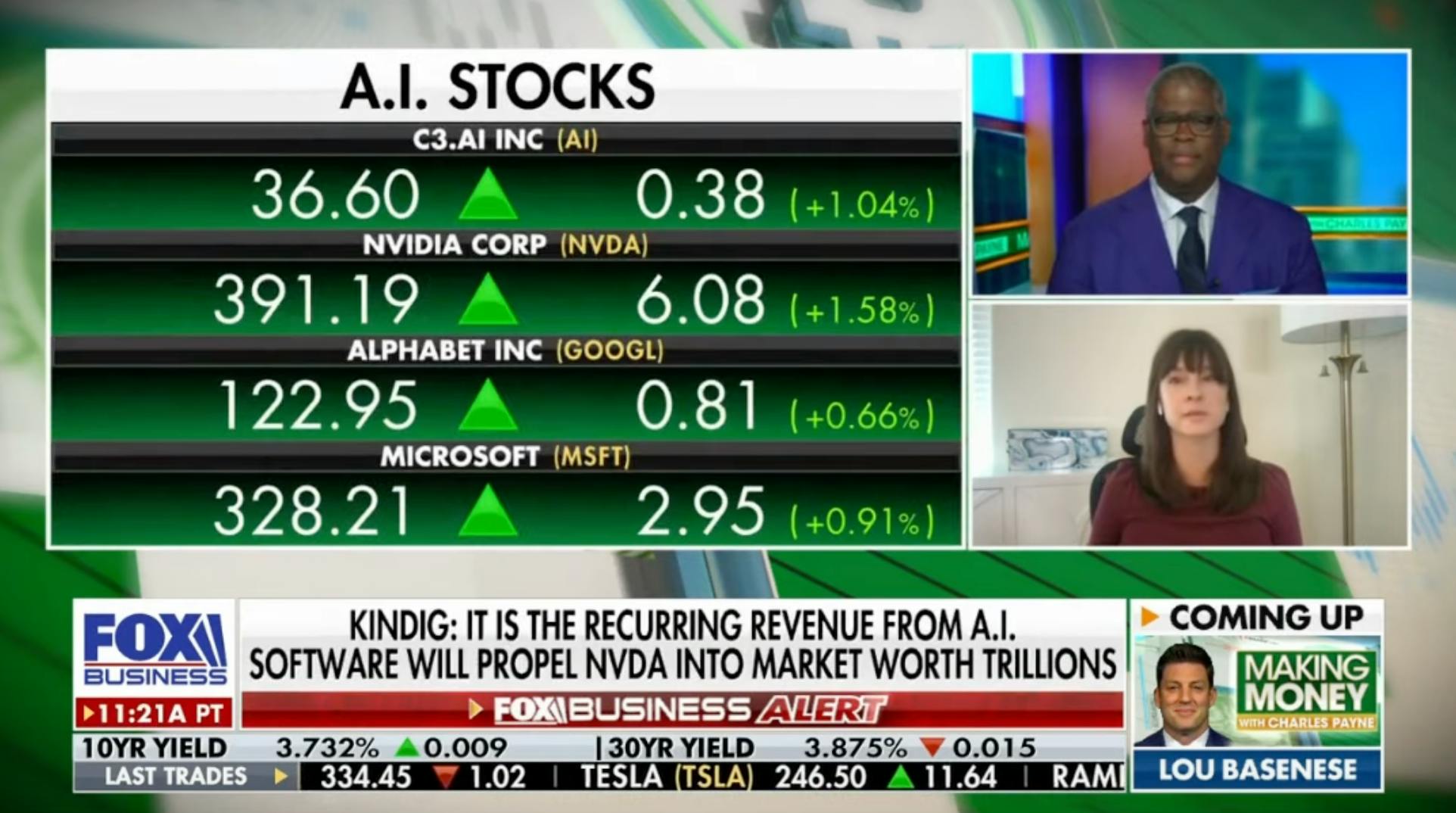
Hardware has allowed Nvidia to become a $700B market cap company, but it is the recurring revenue from AI software that will propel Nvidia into a market cap worth trillions.

You know this story well: the relationship between a hardware company leveraging their position to capture the lion’s share of software —- because that’s exactly what Apple did. My contention is that the iPhone was successful because of the moat iOS developers created, and the additional flywheel from the App Store. I discussed this more in a webinar “The New Kings of Tech”

The H100 delivers 9X more throughput in AI training, and 16X to 30X more inference performance. The company also states in HPC application-specific workloads, the H100 is 7X faster. The goal of the H100 was not only to add more transistors and make the H100 faster, but to also offer function-specific optimizations. This is achieved through the transformer engine.

The transformer engine is one of the key aspects of the H100. Transformers are becoming one of the most popular neural-network models by applying self-attention to detect how data elements in a series influence and depend on one another.

Prior to transformer models, labeled datasets had to be used to train neural networks. Transformer models eliminate this need by finding patterns between elements mathematically, which substantially opens up what datasets can be used and how quickly. Transformers are partial to the parallel processing that GPUs offer.

The Hopper architecture aims to answer one of the bigger challenges facing superfast compute, which is that moving data into traditional servers overloads the CPU and system memory and becomes bottlenecked by PCI-Express.

By improving the bandwidth issue, Nvidia’s goal is to create more demand for their DGX Pod and SuperPod Systems, which in turn, will create more demand for their software.

The DGX SuperPods scale into a super-GPU capable of 768 terabytes per second. To compare, the entire internet requires 100 terabytes per second. This results in 1 exaflop of FP8 AI performance that runs trillions of parameters. FP8 is most commonly used for inference yet may be used for training in the future due to boosting throughput.

Whereas traditional workloads required many connections exchanging small amounts of data, the workloads of the future will require data to be shared quickly between GPUs and storage. This is accomplished by bypassing the CPU and sending data directly to the GPU while using the network hardware to move the data.

This is ideal for enterprise use cases where people are more likely to use Ethernet while AI and HPC workloads continue to use the Quantum-2 based off Mellanox’s InfiniBand.

Not only will Nvidia begin to monetize through software on the DGX systems but accessibility will improve through CSPs, or cloud service providers. This is an attempt to democratize AI development while driving software sales. On a trailing 4-quarter basis, cloud service providers drove 40% of data center revenue. This is important as cloud service providers will help move DGX Cloud along and AI-as-a-service.

Nvidia’s TAM of $600 Billion is Easily and Quickly Achievable

“The conclusion to my analysis is the same as the introduction, which is that I believe Nvidia is capable of out-performing all five FAAMG stocks and will surpass even Apple’s valuation in the next five years.” – Forbes and Free Newsletter, August 2021Forbes and Free Newsletter, August 2021

Last year, CEO Jensen Huang provided a total addressable market of $300 billion in hardware and $300 billion in software. Meanwhile, Elon Musk is deploying 10,000 GPUs in the cloud and there will likely be tens of thousands more to inference a widely deployed model for a social media generative AI project.

Per the analyst on the call: “So it seems like the incremental TAM is easily in the several hundred thousands of GPUs and easily in the tens of billions of dollars. But I'm kind of wondering what this does to the TAM numbers you gave last year. I think you said $300 billion hardware TAM and $300 billion software TAM. So how do you kind of think about what the new TAM would be?”

Huang aptly answered: “I think those numbers are really a good anchor still. The difference is because of the, if you will, incredible capabilities and versatility of generative AI and all of the converging breakthroughs that happened towards the middle and the end of last year, we're probably going to arrive at that TAM sooner than later.”

Today, Nvidia trades at 1.5X this TAM at $773 billion compared to an achievable TAM of $600 billion. This would suggest the stock price does not yet fully reflect the future market opportunity. Also, compare this TAM of $600 billion to Apple’s revenue of $394 billion, which helps illustrate why I said in the past that Nvidia Will Surpass Apple’s Valuation.

Every Thursday at 4:30 pm Eastern, the I/O Fund team holds a webinar for premium members to discuss how to navigate the broad market, as well as various stock entries and exits. We offer trade alerts plus an automated hedging signal. The I/O Fund team is one of the only audited portfolios available to individual investors. Learn more here.Learn more here.

What to Expect in the Upcoming Earnings:

If we set aside the AI thesis for a moment, you can see below why Nvidia has rallied as the revenue is expected to rebound from (-21.4%) for the upcoming quarter to as much as +32% growth by fiscal Q3 ending in September. The popularity of the H100 could lead to a beat somewhere across these next few quarters. In addition, the RTX40 Series lower-end model will be released today for $299 and up, and this may further help the gaming revenue for Q2 and beyond.

Nvidia is unique in that the healthy growth is expected to continue into the foreseeable future — long after the company laps the quarters of the crazy gaming miss. What we don’t want is to invest in companies propped up temporarily by low comps. This is not the case with Nvidia.

Here is Nvidia’s revenue growth over the past five quarters, which shows the effects of the gaming segment:

Nvidia Revenue YoY 2022

Source: I/O FUND

As stated in our previous earnings coverage on Nvidia, all segments are expected to grow sequentially. I believe this is a major contributor for the rally we are seeing. The market saw what we saw, which was a sharp rebound in the fundamentals and that is critical to understanding why Nvidia is the top stock in the market right now.

Compare that picture to this one:

Nvidia Revenue YoY 2023

Source: I/O FUND

It’s not only the top line that is rebounding but also the bottom line too (which makes sense but is important to point out):

Adjusted EPS YoY

Source: I/O FUND

Moving along, data center revenue was $3.75B in Q1 FY23. The projected mid-point above is $4.075B, representing 8.7% YoY growth and 12.7% growth sequentially. Here is what was said on the call:

“Thanks for the question. First, talking about our data center guidance that we provided for Q1. We do expect a sequential growth in terms of our data center, strong sequential growth. And we are also expecting a growth year-over-year for our data center. We actually expect a great year with our year-over-year growth in data center probably accelerating past Q1.”

Data Center YoY

Source: I/O FUND

So, what we don’t see in the graph above is what the “accelerating past Q1” will be and this is the one data point that can get the stock to move AH.

Where Nvidia’s Price Will Go Next:

With the cash we raised throughout 2022, NVDA was the primary target of deploying some of this cash once our analysis signaled a bottom was in place. The below is a real-time trade notification we sent to our members on the October 13th.

I/O Fund Buy Notification

Source: I/O FUND

Since February of 2022, we have been systematically taking gains at key levels. Even with logging sizable wins in this position in 2023, it remains our top position while still having enough cash to buy at lower levels.

It is our belief that NVDA is setting up for a sizable pullback, which we believe will open the door for better long-term entries. The reasons for this are below:

The structure/pattern of NVDA’s bounce signals caution. If we look at the pattern off the October low, it may feel like a straight line up; however, you can clearly see 3 swings (marked a, b, c). The first swing up off the low (a), a bearish retrace that makes a higher low (b), and the current swing that we are still in (c).

Nvidia Bounce Chart

Source: I/O FUND

When we see a 3 wave pattern off of a major low, more times than not, it is a corrective bounce in a larger downtrend. While it may feel impossible at such heights, please keep in mind how sentiment can and does work against us as investors. It felt like tech could never go down in late 2020, and then it felt like it would never go up in Q4 of 2022.

Nvidia is no different, and what we have is a pattern that suggests a larger pullback than most expect is likely, at minimum. So, until this 3 wave pattern can morph into a 5 wave pattern, the odds favor a sizable pullback soon.

Further evidence of this can be seen in how NVDA is now at a significant supply region that marked the top in late 2023. We are now in the region that would constitute a double top playing, and note how price keeps trending higher with less momentum.

We are approaching a double top in conjunction with one of my favorite “sell signals” – when you have price making 3 higher highs, while the momentum indicator being used is making 3 lower highs. This is clearly happening on multiple time frames, which we believe warrants caution.

Similar patterns can be seen on the weekly chart of NVDA below. As price pushes higher, it is doing so on less momentum and less volume. When we see the same pattern on multiple time frames, it further builds the case for caution.

Nvidia Buy Targets

Source: I/O FUND

Regarding the targets we are tracking for entries, there are two general paths I see playing out from the price data in the above charts.

The Blue Count suggests that we completed the large degree uptrend that started in 2018. This would put is in a very large corrective rally with the final leg lower coming later this year/early next year. This would have us retest the October lows, and possibly slightly lower. The big tell for this count playing out will be if the coming pullback is a 5 wave pattern pointing down. If we see a large 5 wave drop from the highs, it is signaling that NVDA will likely go lower than most are anticipating.

The Red Count suggests that the October low was THE low. This will still set us up for a sizable pullback into the $220 – $167 region before setting up to make a run to new highs. This count implies that the large uptrend that started in 2018 is not complete and will be targeting fresh highs in the coming year. The tell for this scenario will be if the coming pullback is a 3 wave pattern. If we see a 3 wave pullback, we will look to be heavy buyers in the general target box just outlined.

Conclusion:

My firm tracks Nvidia very closely due to its leading allocation in our portfolio. We saw evidence of a gaming bottom in November, which we published about here. We also felt Nvidia had masterfully timed it’s RTX40 Series with the Ada Lovelace architecture plus the H100 release to drop exactly when the crypto mining selloff would be most felt. We discussed this here in September. These points were entirely overlooked by Nvidia critics.

Yes, a $2.5 billion revenue miss is crazy – but what was lying beneath the surface for chances of a quick recovery? The devil is in the details and not a lot of investors or analysts care to look into Nvidia’s complex hardware products.

For my readers, it has worked out in their favor that talking heads prefer to discuss stocks after they are up triple digits in price, and that the masses are collected around hindsight narratives. My firm is carefully and patiently building an AI portfolio that we believe will outperform institutions and hedge funds. Taking our sweet time to enter Nvidia at the lows – as we have done for the past five years and will continue to do so for the next five years — is part of that strategy.

Our firm issues real-time trade alerts when we buy, sell or trim stocks. You can learn more and view our other notable wins here.

Recommended Reading:

  • Nvidia Stock Is Ready To Rumble With RTX 40 Series And H100 GPUs
  • Nvidia Stock: Evidence Gaming Bottomed And Why It’s Important
  • Here’s Why Nvidia Will Surpass Apple’s Valuation In 5 Years
Posted in Ai Platforms, AI StocksLeave a Comment on Nvidia Will “Still” Surpass Apple’s Valuation

Big Tech Capex, the Next Act – AI Take a Bow

Posted on February 10, 2023June 30, 2026 by io-fund

In the past, we have written about the importance of Big Tech’s capex programs and its impact on demand for semiconductors. Particularly in 2021 and 2022, where there was a significant increase in data center and cloud computing related capex. It has been our position that Big Tech capex – which includes Google, Meta, Amazon and Microsoft – is a leading indicator for AI semiconductor companies and has been a secular tailwind for our holdings such as Nvidia and AMD.  Now that Big Tech have reported their fiscal 2022 earnings, we thought it’d be a good time to review the 2023 capital expenditure outlook for the IT market and Big Tech.

2023 IT Market Spending Forecasts

In January 2023, Gartner released their 2023 forecasts for overall IT spending. Gartner forecasts growth of $4.5 trillion, an increase of 2.2% from 2022. Looking at the breakdown, Software and IT services continue to see meaningful y/y growth. Meanwhile, after exhibiting healthy 12% growth in 2022, Data Centers is forecasted to be almost flat at 0.7% in 2023. Devices continues to be negatively impacted by inflationary pressures impacting consumer demand.

In contrast to Gartner’s 2023 forecast of flat growth in overall Data Center spending. The growth in Hyperscale Data Centers is forecasted to grow at levels that vastly outpaces Data Centers. Hyperscale Data Centers are large data centers operated by Amazon, Microsoft and Google.

According to Precedence Research, The global hyperscale data center market size was estimated at USD 62 billion in 2021 and is expected to hit around USD 593 billion by 2030, a forecasted growth rate (CAGR) of 28.52% during the forecast period 2022 to 2030.

 This growth is also reflected in forecasts for the Artificial Intelligence Chip market. In December 2022, Allied Market Research forecasts that the global artificial intelligence chip market will grow from $11.2 billion in 2021 to reach $263.6 billion by 2031, growing at a CAGR of 37.1% from 2022 to 2031. AI chips – supplied by Nvidia and AMD – will provide the computing power necessary to drive these hyperscale data centers.

Big Tech FY2023 Earnings Commentary

How did the recent Big Tech commentary on 2023 capex align with these market forecasts? Overall, Big Tech has forecasted capex to be flat to slightly down y/y. However, an important theme was a shift toward higher ROI capex such as technical infrastructure and reduction in lower ROI capex, such as office facilities. After embarking on an aggressive capex program in 2021 and 2022, Big Tech has taken a pause to reassess their cost base and to reprioritize capex in light of the current macro environment. 

Put another way, the size of the capex pie isn’t expected to grow in 2023 compared to 2022, but the slice spent on technical infrastructure (i.e. Cloud and AI), will grow at the expense of labor, office facilities etc. A change in capex mix that we believe is supportive in the medium-term of NVDA and AMD.

In 2016, Big Tech in total spent $30b in capex, in 2022 they spent $150b, a five-fold increase. Big Tech commentary indicates 2023 capex will be flat to slightly lower than 2022.

What did FAAMG say about 2023?

Alphabet:

Google spent $31.5b on capex in 2022 compared to $24.6b in 2021 and forecasted 2023 to be at a similar level to 2022. Although the forecasted growth rate in capex is lower than historical levels. Management commentary around  capex was very telling on where the priorities lay. On the Q422 call, management referenced AI a total of 56 times in relation to its importance to the future growth of the company. Here are a few snippets that stood out with an emphasis on AI being Google’s #1 priority. 

Sundar Pichai, CEO

  • I'll focus on two major things today in a bit more detail, and then I'll give a shorter-than-usual quarterly snapshot from across our business. First, how we unlock the incredible opportunities AI enables for consumers, our partners and for our business; and second, how we focus our investments and make necessary decisions as a company to get there … the AI opportunity ahead. AI is the most profound technology we are working on today. Our talented researchers, infrastructure and technology make us extremely well positioned, as AI reaches an inflection point.
  • Our AI is a powerful enabler for businesses and organizations of all sizes and we have much more to come here. There's a few flavors of this. Google Cloud is making our technological leadership in AI available to customers via our Cloud AI platform, including infrastructure and tools for developers and data scientists like Vertex AI.
  • AI also continues to improve Google's other products dramatically
  • On the AI side, it is a really exciting time. I think we've been investing for a while, and it's clear that the market is ready. Consumers are interested in trying out new experiences. I think I feel comfortable with all the investments we have made in making sure we can develop AI responsibly.

Philip Schindler, CMO

  • Going forward, we are focused on growing revenues on top of this higher base through AI-driven innovation. Sundar highlighted the incredible opportunities underway with AI and the transformative impact it will have on businesses. Already, breakthroughs in everything from natural language understanding to generative AI are fueling our ability to deliver results that drive meaningful performance for advertisers and are useful to users.

Ruth Porat, CFO

  • And as I indicated in opening comments, when we look at capex for 2023, we do expect it's going to be generally in line with 2022 with an important mix shift. We're increasing our investments in technical infrastructure. And that's not just for AI. That's to support investments across Alphabet, in particular in Cloud as well. And at the same time, we're meaningfully decreasing our capex for office facilities.
  • With AI, this is obviously an Alphabet strategic priority, and we see huge opportunity ahead

Meta:

For Meta, capital expenditures, including principal payments on finance leases, was $32b billion for 2022 compared to $19.3b in 2021. 2022 capex was driven by investments in servers, data centers and network infrastructure. Meta forecasted 2023 capex to be between $30-33b down from their prior guidance of $34-37b. Similar to Google, management commentary around AI and capex was very telling on where the priorities lay.

Mark Zuckerberg, CEO

  • Now before getting into our product priorities, I want to discuss my management theme for 2023, which is the Year of Efficiency. We closed last year with some difficult layoffs and restructuring some teams. And when we did this, I said clearly that this was the beginning of our focus on efficiency and not the end. And since then, we have taken some additional steps, like working with our infrastructure team on how to deliver our roadmap while spending less on capex
  • And next, I want to give some updates on our priority areas. Our priorities haven’t changed since last year. The two major technological waves driving our roadmap are AI today and over the longer term, the metaverse.
  • AI, it’s the foundation of our discovery engine and our ads business. And we also think that it’s going to enable many new products and additional transformations in our apps. Generative AI is an extremely exciting new area with so many different applications. And one of my goals for Meta is to build on our research to become a leader in generative AI in addition to our leading work in recommendation AI.
  • Yes, I can start with generative AI. Yes, I think this is a really exciting area. And I mean, I’d say the two biggest themes that focused on for this year and one is efficiency and then the kind of the new product area is going to be the generative AI work.
  • A lot of the trends that we are seeing here is, we are using larger models, which require more computation. We have shifted the models from being more CPU-based to being GPU-based

There is a positive readthrough on Zuckerberg’s comment on the shift from CPU to GPU models. This could potentially benefit Nvidia and their H100 GPU.

Susan Li, CFO

  • Turning now to the capex outlook for 2023, we expect capital expenditures to be in the range of $30 billion to $33 billion, lowered from our prior estimate of $34 billion to $37 billion. The reduced outlook reflects our updated plans for lower data center construction spend in 2023 as we shift to a new data center architecture that is more cost efficient and can support both AI and non-AI workloads
  • So we’re shifting our data centers to a new architecture that can more efficiently support both AI and non-AI workloads. And that’s going to give us more optionality as we better understand our demand for AI over time. Additionally, we’re expecting that the new design will be cheaper and faster to build than previous data center architecture. Along with the new data center architecture, we’re going to optimize our approach to building data centers. So we have a new phased approach that allows us to build base plans with less initial capacity and less initial capital outlay, but then flex up future capacity quickly if needed. We’re still planning to grow AI capacity significantly, and that connects
  • The current surge in capex is really due to the building out of AI infrastructure, which we really began last year and are continuing into this year. We will be measuring the ROI of these AI investments, and their returns will continue to inform our future spend. Our intention is still to bring capex as a percent of revenue down, but capital intensity in the nearest term is really going to depend, in part, on the revenue outlook and our needs to further build AI capacity for future demand

Javier Olivan, COO

  • I think if you look at the strategy on ads, we really have two parts, which is continue investing in AI and that’s where we are seeing a lot of the improvement in ads relevance.

Microsoft:

For Microsoft FY 2022 capex, including assets acquired under financial leases, was $29.2 and compared $24.2 to FY 2021. For FY 2023, Microsoft has stated “… we expect a sequential decrease on a dollar basis with normal quarterly spend variability in the timing of our cloud infrastructure buildout.”

Satya Nadella – Chairman and Chief Executive Officer

The age of AI is upon us and Microsoft is powering it. We are witnessing non-linear improvements in capability of foundation models, which we are making available as platforms. And as customers select their cloud providers and invest in new workloads, we are well positioned to capture that opportunity as a leader in AI. We have the most powerful AI supercomputing infrastructure in the cloud. It’s being used by customers and partners like OpenAI to train state-of-the-art models and services, including ChatGPT.

Amazon:

For Amazon, capex including equipment financial leases, was $58.3b in 2022 compared to $55b in 2021. These expenditures primarily reflect investments in technology infrastructure. In the past, management has indicated that about 50% of total capex has gone toward infrastructure. Management gave no guidance for 2023 other that these investments will continue.

Conclusions

Big Tech is not immune to the weaker macroeconomy nor consumer. This has been evident in their earnings releases. For Big Tech’s next capex act, their commentary focused on shifting capex to higher ROI investments with a focus on cost efficiency. These comments have increased our conviction that investments in AI are a key strategic priority and will continue.

From an investing perspective, it supports our investment thesis in Nvidia and AMD. Nvidia’s new H100 GPU chip has positioned it to benefit from the buildout in AI related and hyperscale data center infrastructure. Critically, given their dominant market position in AI chips, this will enable Nvidia to then monetize and gain a greater share in the software stack. In addition, AMD plans to commercially release its MI300 GPU this year.

Per the most recent AMD earnings call:

“MI300 will be the industry's first data center chip that combines a CPU, GPU and memory into a single integrated design, delivering 8x more performance and 5x better efficiency for HPC and AI workloads, compared to our MI250 accelerator currently powering the world's fastest supercomputer. MI300 is on track to begin sampling to lead customers later this quarter and launch in the second half of 2023.”

In the most recent earnings report, Nvidia management commented that the H100 adoption rate and software monetization at the enterprise level is happening faster than expected. We will further outline how Nvidia is well positioned to benefit from this spending in AI and what to look for in Nvidia’s upcoming earnings report. We’ve recently covered AMD here.

Keep a look out for future posts.

Posted in Ai Platforms, AI Stocks, SemiconductorsLeave a Comment on Big Tech Capex, the Next Act – AI Take a Bow

CrowdStrike Stock: Cloud Darling Reports Weak Sequential Key Metrics

Posted on January 4, 2023June 30, 2026 by io-fund
CrowdStrike Stock: Cloud Darling Reports Weak Sequential Key Metrics

This article was originally published on Forbes on Dec 29, 2022,09:41pm ESTForbes on Dec 29, 2022,09:41pm EST

CrowdStrike has one of the better fundamental profiles out of the cloud category. This is due to its 50%+ revenue growth rate, GAAP operating margin of (7%) and free cash flow margin of 31%. The company also has one of the best Rule of 40 numbers in the cloud category at 89%. The companies that have higher growth rates or higher Rule of 40 numbers tend to be IPOs, which are designed to be strong out the gate and then fade over time. Meanwhile, CrowdStrike has consistently offered best-of-breed performance for over three years.

Therefore, it’s important to look into what caused CrowdStrike’s weak price action following its earnings report particularly because the stock is widely recognized as one of the strongest cloud stocks on the market. CrowdStrike’s steep selloff of (27%) over the past 30 days isn’t fully satisfied by the $10 million miss on forward revenue and ARR in the last earnings report. Forward Q4 revenue was expected to be $634M and the company guided $619M to $628M for a miss of about $10 million, if we take a midpoint of $624 million (about 1.5% miss). ARR was $2.34 billion compared to analyst expectations of $2.35 billion, for a $10 million miss (less than 1% miss).

Although this likely contributed, I believe the analyst we quoted in our Pre-ER write-up for premium members may be providing a missing link. An analyst from Barclays was modeling for net new ARR of $224M to $230M-plus for this key metric compared to actual results of $198 million.

At the midpoint, this would be more of a miss of 14.6%.

Here is what was said in the Pre-ER write-up for our premium members:

“An analyst note from Barclays’ Saket Kalia is modeling ARR net addition of $224 million “but thinks upside could be $230M-plus given strong pipeline commentary.” At $230M, it would represent 5% sequential growth and 35% YoY growth. This would be down from 15% sequential growth in the previous quarter and 45% YoY.”

Sign up for I/O Fund's free newsletter with gains of up to 221% – Click hereClick hereClick here

The reason we flagged this prior to earnings is because the net new ARR at a high point of $230M would still mark a strong deceleration to 5% sequential growth down from 15% sequential growth last quarter. This means the company would have to meet the number the Barclays analyst modeled or we would be nearing flat to negative sequential growth on net new ARR. Therefore, we emphasized the importance of this number prior to the earnings report as it was truly a “line in the sand” moment for CrowdStrike’s earnings performance.

With the actual of $198 million reported, this dropped the net new ARR to negative sequential decline of (9%) down from $218 million last quarter. This marks a change compared to the comp of +13% sequential growth from Q2 2022 to Q3 2022.

In August/September time frame, during the Q2 reports, we also emphasized that the market is nervous that cloud will become the other shoe to drop by stating: “I also want to be a messenger and say that another reason we are seeing strong price activity [with cloud stocks] is that analysts are concerned that enterprise spend will be the next shoe to drop. This concern was expressed across quite a few cloud companies’ [Q2] earnings calls. The thinking is that enterprise spend will follow consumer spend, (eventually), yet is slower because budgets are cut more slowly and added back more slowly.”

Because enterprise and cloud budgets are slower to be cut than ad or marketing budgets, there is outsized pressure being placed on sequential growth. The market does not care about YoY because it’s assuming enterprise spending wasn’t affected yet this time last year. We cautioned in a previous analysis two weeks ago “Slowing Growth in Cloud Stocks: When Will We Hit a Bottom” to be careful of YoY guidance as QoQ growth in cloud saw a remarkable slowdown.

CrowdStrike Q3 Financials:

CrowdStrike beat both top line and bottom line for Q3. In fact, an area where CrowdStrike continues to stand out from its peers is the health of the bottom line and both Q3 actual and Q4 guide was no exception in this regard.

For example, the free cash flow margin of 30% is exceptional for the cloud category. The company reported revenue of $581 million for growth of 53% compared to revenue of $574 million expected for growth of 51%. This is a slight deceleration from 58% last quarter.

For Q4, the company guided for revenue of $619 million to $628 million compared to expectations of $634 million. At the midpoint of $623.5million, this is a $10.5 million miss. This represents growth of 44.7%.

Adjusted EPS for Q3 came in at $0.40 compared to $0.32 expected. Adjusted EPS guide for Q4 also beat at $0.42 to $0.45 compared to $0.34 EPS expected.

GAAP operating margin of (9.70%) compares to (9%) last quarter and (10.5%) in the year ago quarter. This resulted in GAAP operating loss of ($56.4) million which is a tad higher than the $48 million losses last quarter and the $40 million losses in the year ago quarter.

The adjusted operating margin was a beat in Q3 and Q4. This was a bright spot in the report with adjusted OM of 15.4% compared to 13% estimated. This compares to 16% Adj OM last quarter and Adj OM of 13% last year. This was essentially flat and it’s important it did not contract. The guide on adjusted operating income of $87.2M to $93.7M implies an adjusted operating margin of 14.5%.

CrowdStrike is very strong on cash flow and is one of the top-ranking cloud stocks in this regard. This quarter the company reported a free cash flow margin of 30% for FCF of $174 million. The company is guiding for a FCF margin of 28% to 30% next quarter. The operating cash flow was $242.9 million for a margin of 41.8%.

There is $2.47 billion in cash on the balance sheet. The company paid $140 million in stock-based compensation for a margin of 23.7%.

Subscribe to I/O Fund's Essentials:Subscribe to I/O Fund's Essentials:Subscribe to I/O Fund's Essentials:

The I/O Fund has launched a new$99/year Premium Newsletter called "Essentials" — this newsletter delivers premium samples for our readers who want more actionable analysis for their tech portfolios. This month, we released a stock pick that we believe will be a leader in 2023 plus a video with the buy plan.$99/year Premium Newsletter $99/year Premium Newsletter called "Essentials" — this newsletter delivers premium samples for our readers who want more actionable analysis for their tech portfolios. This month, we released a stock pick that we believe will be a leader in 2023 plus a video with the buy planbuy plan.

Key Metrics:

To recap, CrowdStrike reported a quarter with 52% growth and forward growth in Q1 of 44.7%. The company leads popular cloud stocks on free cash flow with a 30% margin and has a healthy adjusted operating margin of 15%. Although stock based compensation weighs on GAAP operating margin, it still ranks high compared to peers with a GAAP operating margin of (9.7%) —- so why did the stock selloff after hours and is down (27%) over the last 30 days?

The answer is found in the key metrics.

RPO was up 44% year-over-year for $2.797 billion and was up 11.6% sequentially. However, management reminded analysts that ARR is the leading key metric for their business.

Ending ARR grew 54% year-over-year to $2.34 billion and grew 9.3% sequentially. Therefore, because ending ARR was strong, the net new ARR could be easily underestimated in terms of impact. The net new ARR at $198 million in fiscal Q3 compared to $218 million net new ARR in fiscal Q2 indicates a 9% sequential decline.

The market has the jitters right now so the sequential decline is important to pay attention to especially because management said to expect further weakness in the upcoming Q4 quarter. Here is what the CFO said:

“Even though we entered Q3 with a record pipeline, we are expecting the elongated sales cycles due to macro concerns to continue, and we are not expecting to see the typical Q4 budget flush given the increased scrutiny on budgets. While we do not provide net new ARR guidance given the current macro uncertainty, we believe it is prudent to assume that Q4 net new ARR will be below Q3 by up to 10%.”While we do not provide net new ARR guidance given the current macro uncertainty, we believe it is prudent to assume that Q4 net new ARR will be below Q3 by up to 10%.”

This implies a net new ARR of $178.3 million for Q4 (10% lower than the current quarter at $198.1M) compared to net new ARR of $216 million in the year ago quarter. This is important because it’ll mark not only a sequential decline but a year-over-year decline in net new ARR. The market had already sold off for what I presume was a sequential decline in CrowdStrike’s leading key metric, and management then stated the decline would be steeper for Q4 on the call. Once the comment above was made, we were certainly not going to see a reversal in the stock price from the earnings call.

Customer count was strong at 44% growth. The mix of domestic versus international was slightly lower than usual for North America at 69% with EMEA being slightly higher at 15%. Deferred revenue grew 56.4% year-over-year and backlog grew 19%.

Additional Commentary:

CrowdStrike was transparent about the importance of ARR even in the face of net new ARR being lower than expected.

Here is what was said by the CFO:

“And then finally, just to comment on ARR. You pointed out that's how we run our business. ARR, though, is really an X-ray into the contracts themselves. And as we view that as the most important — or most transparent metric into the outlook for our business, that's the one where we're focused on. So, hopefully, that gives some more clarity on how we think about cRPO and ARR.

Later on, an analyst did zero-in on the (9%) decline.

“Andrew Nowinski

Great. Thank you for taking the question this afternoon. So total ARR of $2.3 billion, growing 54% is still absolutely amazing, I was – and it's at scale. But I was wondering, were you surprised that the net new logos that you added were down 9% this quarter?

Burt Podbere

Thanks, Andy. So when we think of the net new logos, it really corresponds to what we talked about in terms of what we saw in that SMB space. The SMB space is the one that drives the velocity of our net new logos. And as we talked about, we saw an 11% increase in our sales cycle in the SMB space. And that actually equated into $15 million in terms of deals in that space that could push out. And so when you think about 15 million in that space and what it means in terms of logos, where you can do the math, it's a pretty big number.

So that's how we think about net new logos corresponding to what we saw in net new ARR from the SMB space. So from that perspective, we weren't surprised at the end of the day when we saw that what happened with respect to the increased sales cycles and the amount of money that got pushed out in the SMB space.

“Push out” refers to a delayed sales cycle for an impact of $15 million. The CFO did reiterate the 10% further sequential decline in net new ARR between Q3 and Q4 when he said:

“When we do talk about net new ARR, I did talk about in the prepared remarks about how we think about up to 10% headwinds going into Q4 from Q3, and that's just to coincide with some of the headwind activity that we saw accelerated at the end of this quarter. So that's how we think about that.”

Conclusion:

The market is cooling off from previously popular cloud stocks. The reason is that QoQ likely hints at what is to come for enterprise budgets that are typically determined in January of the new year. There will certainly be some cloud stocks that are stronger than others, comparatively. Attempting to guess which ones these will be carries outsized risk if the QoQ trends we saw in Q4 continue into Q1.

The quarter from CrowdStrike sounded very familiar, in my opinion.

Here is a brief overview from our Microsoft’s post-earnings report:

“Microsoft is guiding down for next quarter with analyst expectations for the December quarter at $56.04 billion compared to management guidance on the call for revenue of $52.75 billion, at the midpoint. This represents 2% growth. […] That’s a 11% deceleration over the next few months. Some of this is coming from Azure as the company is expected Azure to decline 5% next quarter for its current growth rate. This will be 37% growth on a constant currency basis, down from 42% this quarter.”

While some investors believe this is a stock picker’s market – we disagree with this thinking. In May, we pivoted to hedging up to 100% of the I/O Fund portfolio as macro will eventually affect even the strongest companies. We are seeing that now with Tesla – a strong consumer company that is following its consumer peers into a material slowdown that is entirely macro based. Our macro coverage, such as Divergences Point Toward the Market Moving Higher, which called the October low, is published bi-monthly for our free readers and published daily for our premium readers along with real-time trade alerts. The hedging strategy has proven successful since we pivoted 8 months ago, primarily it has removed the pressure of the market’s intense selloff while allowing us to build key positions at valuations that are extremely low.

Ultimately, we started to move toward a neutral stance with cloud after Q2 reports after we saw initial signs of weakness and continued to trim/cut following some Q3 reports. We continue to hold one cloud name at a high allocation and we hold three more at medium sized allocations. We call this a neutral stance to where we are participating but not overweight. If we get additional signs that cloud is too weak to withstand macro pressure, we have a short candidate in mind. If we get signs that cloud will be resilient in 2023, we will buy into those with underlying strength.

Notably, the I/O Fund portfolio manager sees a relief rally of sorts coming in the early part of this year. That will be the time that we determine what to do with our remaining cloud positions — whether we sell into strength or buy into weakness.

Note: This analysis was originally published on November 30th 2022 and accompanies our previous free analysis: Slowing Growth on Cloud Stocks: When Will We Hit a Bottom.Note: This analysis was originally published on November 30th 2022 and accompanies our previous free analysis: Slowing Growth on Cloud Stocks: When Will We Hit a Bottom.Slowing Growth on Cloud Stocks: When Will We Hit a Bottom.

Please note: The I/O Fund conducts research and draws conclusions for the Fund’s positions. We then share that information with our readers. This is not a guarantee of a stock’s performance. Please consult your personal financial advisor before buying any stock in the companies mentioned in this analysis.

Posted in Ai Platforms, AI Stocks, Cloud Platforms, Cloud Software, CybersecurityLeave a Comment on CrowdStrike Stock: Cloud Darling Reports Weak Sequential Key Metrics

CrowdStrike Q3 Earnings: Closer Look at Net New ARR

Posted on November 30, 2022June 30, 2026 by io-fund

The question of “why did Crowdstrike sell-off” doesn’t seem to be satisfied by the $10 million miss on forward revenue and ARR.

Forward Q4 revenue was expected to be $634M and the company guided $619M to $628M for a miss of about $10 million, if we take a midpoint of $624 million (about 1.5% miss). ARR was $2.34 billion compared to analyst expectations of $2.35 billion, for a $10 million miss (less than 1% miss).

Although this likely contributed, I believe the analyst we quoted in our Pre-ER write-up that was modeling for net new ARR of $224M to $230M-plus may be providing a missing link between analyst expectations for this key metric and actual results of $198 million. At the midpoint, this would be more of a miss of 14.6%.

Here is what was said in the Pre-ER write-up:

“An analyst note from Barclays’ Saket Kalia is modeling ARR net addition of $224 million “but thinks upside could be $230M-plus given strong pipeline commentary.” At $230M, it would represent 5% sequential growth and 35% YoY growth. This would be down from 15% sequential growth in the previous quarter and 45% YoY.”

The reason we flagged this is because the net new ARR at high point of $230M would still mark a strong deceleration to 5% sequential growth down from 15% sequential growth last quarter. This means this would have to be met or we would be nearing flat to negative sequential growth on net ARR.

With the actual of $198 million reported, this drops the net new ARR at negative sequential growth of negative (9%) down from $218 million last quarter. This marks a change compared to the comp of 13% in sequential growth from Q2 2022 to Q3 2022.

The market is nervous with cloud becoming the other shoe to drop as enterprise budgets will slow long after consumer slows due to annual billing cycles, annual budget reviews (i.e., likely to produce budget cuts) and due to higher switching costs (or in cloud’s case, slower to switch off than consumer or ad spending, for example).

In my opinion, this is why outsized pressure is being placed on sequential growth. The market does not care about YoY because it’s assuming enterprise spending wasn’t affected yet.

CrowdStrike Q3 Overview:

CrowdStrike beat both top line and bottom line for Q3. In fact, an area where CrowdStrike continues to stand out from its peers is the health of the bottom line and both Q3 actual and Q4 guide was no exception in this regard. For example, the free cash flow margin of 30% is exceptional.

The company reported revenue of $581 million for growth of 53% compared to revenue of $574 million expected for growth of 51%. This is a slight deceleration from 58% last quarter.

For Q4, the company guided for revenue of $619 million to $628 million compared to expectations of $634 million. At the midpoint of $623.5 million, this is a $10.5 million miss.

The GAAP EPS of ($0.24) compares to ($0.22) EPS from the year ago quarter and ($0.25) EPS last quarter.

Adjusted EPS for Q3 came in at $0.40 compared to $0.32 expected. This compares to $0.36 last quarter and $0.17 in the year ago quarter.

Adjusted EPS guide for Q4 also beat at $0.42 to $0.45 compared to $0.34 EPS expected.

GAAP gross margin was 72.7% which was in line with a range of 73% to 74% over the past five quarters. The adjusted gross margin this quarter was at 75% compared to 76%-77% over the past five quarters. Subscription gross margins were also in line.

GAAP operating margin of (9.70%) compares to (9%) last quarter and (10.5%) in the year ago quarter. This resulted in GAAP operating loss of ($56.4) million which is a tad higher than the $48 million losses last quarter and the $40 million losses in the year ago quarter.

The adjusted operating margin was a beat in Q3 and Q4. This was a bright spot in the report with adjusted OM of 15.4% compared to 13% estimated. This compares to 16% Adj OM last quarter and Adj OM of 13% last year. This was essentially flat and it’s important it did not contract.

The guide on adjusted operating income of $87.2M to $93.7M implies an adjusted operating margin of 14.5%.

The GAAP net margin of (9.4%) and adjusted net margin of 16.5% was in line with previous quarters. The guide for adjusted net margin is also in line at 16.6%.

CrowdStrike is very strong on cash flow margins and is one of the top ranking cloud stocks in this regard. This quarter the company reported a free cash flow margin of 30% for FCF of $174 million. The company is guiding for a FCF margin of 28% to 30% next quarter. The operating cash flow was $242.9 million for a margin of 41.8%. There is $2.47 billion in cash on the balance sheet.

The company paid $140 million in stock-based compensation for a margin of 23.7%.

Key Metrics:

As stated in the Intro, the key metrics are likely causing the sell-off.

RPO was up 44% year-over-year for $2.797 billion and was up 11.6% sequentially. However, management reminded analysts that ARR is the leading key metric for their business.

Ending ARR grew 54% year-over-year to $2.34 billion and grew 9.3% sequentially. Therefore, because ending ARR was strong, the net new ARR could be easily underestimated in terms of impact. The net new ARR at $198 million in fiscal Q3 compared to $218 million net new ARR in fiscal Q2 indicates a 9% sequential decline.

The market has the jitters right now so the sequential decline is important to pay attention to especially because management said to expect further weakness in the upcoming Q4 quarter. Here is what the CFO said:

“Even though we entered Q3 with a record pipeline, we are expecting the elongated sales cycles due to macro concerns to continue, and we are not expecting to see the typical Q4 budget flush given the increased scrutiny on budgets. While we do not provide net new ARR guidance given the current macro uncertainty, we believe it is prudent to assume that Q4 net new ARR will be below Q3 by up to 10%.”

If I understand the CFO correctly, then this implies a net new ARR of $178.3 million for Q4 (10% lower than the current quarter at $198.1M) compared to net new ARR of $216 million in the year ago quarter. This is important because it’ll mark not only a sequential decline but a year-over-year decline in net new ARR. The market had already sold off for what I presume was a sequential decline in Crowdstrike’s leading key metric, and management then stated the decline would be steeper for Q4 on the call. Once the comment above was made, we were certainly not going to see a reversal in the stock price from the earnings call.

Customer count was strong at 44% growth. The mix of domestic versus international was slightly lower than usual for North America at 69% with EMEA being slightly higher at 15%.

Deferred revenue grew 56.4% year-over-year and backlog grew 19%.

Additional Commentary:

CrowdStrike was transparent about the importance of ARR even in the face of net new ARR being lower than expected. Here is what was said by the CFO:

“And then finally, just to comment on ARR. You pointed out that's how we run our business. ARR, though, is really an X-ray into the contracts themselves. And as we view that as the most important — or most transparent metric into the outlook for our business, that's the one where we're focused on. So, hopefully, that gives some more clarity on how we think about cRPO and ARR.”

Later on, an analyst did zero-in on the (9%) decline.

“Andrew Nowinski

Great. Thank you for taking the question this afternoon. So total ARR of $2.3 billion, growing 54% is still absolutely amazing, I was – and it's at scale. But I was wondering, were you surprised that the net new logos that you added were down 9% this quarter?

Burt Podbere

Thanks, Andy. So when we think of the net new logos, it really corresponds to what we talked about in terms of what we saw in that SMB space. The SMB space is the one that drives the velocity of our net new logos. And as we talked about, we saw an 11% increase in our sales cycle in the SMB space. And that actually equated into $15 million in terms of deals in that space that could push out. And so when you think about 15 million in that space and what it means in terms of logos, where you can do the math, it's a pretty big number.

So that's how we think about net new logos corresponding to what we saw in net new ARR from the SMB space. So from that perspective, we weren't surprised at the end of the day when we saw that what happened with respect to the increased sales cycles and the amount of money that got pushed out in the SMB space.

My note: Just to be clear, when they say “push out” they are referring to a delayed sales cycle for an impact of $15 million.

The CFO did reiterate the 10% further sequential decline in net new ARR between Q3 and Q4 when he said:

“When we do talk about net new ARR, I did talk about in the prepared remarks about how we think about up to 10% headwinds going into Q4 from Q3, and that's just to coincide with some of the headwind activity that we saw accelerated at the end of this quarter. So that's how we think about that.”

Conclusion:

Given the tough macro, our goal is to fully understand why the market may favor some stocks and deeply discount others after an earnings report. The market is getting nervous on cloud. We talked about this with Microsoft and also saw this following Datadog’s report.

As a reminder, here is a brief overview of Microsoft’s report:

“Microsoft is guiding down for next quarter with analyst expectations for the December quarter at $56.04 billion compared to management guidance on the call for revenue of $52.75 billion, at the midpoint. This represents 2% growth. […] That’s a 11% deceleration over the next few months. Some of this may be coming from Azure as the company is expected Azure to decline 5% next quarter for its current growth rate. This will be 37% growth on a constant currency basis, down from 42% this quarter.”

Here is a snippet from our Datadog ER write-up:

“RPO decelerated and is a concern. The deceleration we noted in our last earnings report and our pre-earnings write-up where we noted the deceleration went from 85% to 51%. This quarter, the deceleration steepened to 31% year-over-year growth for $941 million. RPO is still up on a sequential basis with $858M in RPO in Q1, $881M in RPO in Q2 and $941M in RPO this quarter. If it were to decline on a QoQ basis, the stock would be deeply penalized, so we will monitor this as we go along.”

What we saw today from CrowdStrike sounded very familiar, in my opinion. The market is nervous about cloud and is swiftly discounting these stocks on slowing revenue plus any additional signs revenue may slow in the future. We will need to see more information to draw any conclusions, most especially we will need SentinelOne’s report coming next week.

Most recent coverage on product:

Forum: Crowdstrike’s Pre-Earnings Report

https://io-fund.com/premium/crowdstrike-cybersecurity-is-techs-leading-sector

https://io-fund.com/premium/cybersecurity-stock-faceoff-crowdstrike-vs-zscaler-vs-cloudflare

https://io-fund.com/cloud-software/cybersecurity-continues-to-lead-cloud-stocks

Posted in Ai Platforms, AI Stocks, Cloud Platforms, Cloud Software, CybersecurityLeave a Comment on CrowdStrike Q3 Earnings: Closer Look at Net New ARR

Posts navigation

Older posts
Newer posts

Recent Posts

  • The IPO Glut of 2020: Why Valuations Have Gone Too Far
  • Zoom Discusses Two Important Catalysts In Q1 Earnings
  • Three Risk Management Tools the I/O Fund Offers
  • Micron Is Up 900%. Here’s Why the AI Memory Trade May Still Have Room to Run
  • Credo: Reliability Leader Aggressively Moves into Optics

Recent Comments

No comments to show.

Archives

  • June 2026
  • May 2026
  • April 2026
  • March 2026
  • February 2026
  • January 2026
  • December 2025
  • November 2025
  • October 2025
  • September 2025
  • August 2025
  • July 2025
  • June 2025
  • May 2025
  • April 2025
  • March 2025
  • February 2025
  • January 2025
  • December 2024
  • November 2024
  • October 2024
  • September 2024
  • August 2024
  • July 2024
  • June 2024
  • May 2024
  • April 2024
  • March 2024
  • February 2024
  • January 2024
  • December 2023
  • November 2023
  • October 2023
  • September 2023
  • August 2023
  • July 2023
  • June 2023
  • May 2023
  • April 2023
  • March 2023
  • February 2023
  • January 2023
  • December 2022
  • November 2022
  • October 2022
  • September 2022
  • August 2022
  • July 2022
  • June 2022
  • May 2022
  • April 2022
  • March 2022
  • February 2022
  • January 2022
  • December 2021
  • November 2021
  • October 2021
  • September 2021
  • August 2021
  • July 2021
  • June 2021
  • May 2021
  • April 2021
  • March 2021
  • February 2021
  • January 2021
  • December 2020
  • November 2020
  • October 2020
  • September 2020
  • August 2020
  • July 2020
  • June 2020
  • May 2020
  • April 2020
  • March 2020
  • February 2020
  • January 2020
  • December 2019
  • November 2019
  • October 2019
  • September 2019
  • August 2019
  • July 2019
  • June 2019
  • May 2019
  • April 2019
  • March 2019
  • February 2019
  • January 2019
  • December 2018
  • November 2018
  • October 2018
  • September 2018
  • August 2018
  • July 2018
  • June 2018
  • May 2018
  • April 2018
  • February 2018
  • January 2018

Categories

  • 5G
  • About
  • Accounting Tips
  • AdTech
  • Ai Platforms
  • Ai Platforms
  • Ai Platforms
  • Ai Platforms
  • Ai Platforms
  • Ai Platforms
  • Ai Platforms
  • Ai Platforms
  • Ai Platforms
  • Ai Platforms
  • Ai Platforms
  • Ai Platforms
  • Ai Platforms
  • Ai Platforms
  • Ai Platforms
  • Ai Platforms
  • AI Stocks
  • AI Stocks
  • Analysts
  • Application Monitoring
  • Application Monitoring
  • Applications
  • Applications
  • Applications
  • Applications
  • Applications
  • Applications
  • Applications
  • AR
  • Audit Reports
  • Autonomous Vehicles
  • Autonomous Vehicles
  • Autonomous Vehicles
  • Autonomous Vehicles
  • Autonomous Vehicles
  • Autonomous Vehicles
  • Autonomous Vehicles
  • Avod
  • Avod
  • Battery Charging
  • Bear Market
  • Bitcoin
  • Bitcoin
  • Bitcoin
  • Bitcoin
  • Bitcoin
  • Bitcoin
  • Bitcoin
  • Blockchain
  • Blockchain
  • Blockchain
  • Blockchain
  • Blockchain
  • Blockchain
  • Blockchain
  • Broad Market Today
  • Bull Market
  • Bull Market
  • Chainlink
  • Chainlink
  • Chainlink
  • Chainlink
  • China Stocks
  • Cloud
  • Cloud Infrastructure
  • Cloud Infrastructure
  • Cloud Infrastructure
  • Cloud Infrastructure
  • Cloud Infrastructure
  • Cloud Infrastructure
  • Cloud Infrastructure
  • Cloud Platforms
  • Cloud Platforms
  • Cloud Software
  • Cloud Software
  • Cloud Software
  • Cloud Software
  • Cloud Software
  • Cloud Software
  • Cloud Technology
  • Company
  • Company
  • Console Gaming
  • Console Gaming
  • Console Gaming
  • Consumer
  • Consumer
  • Consumer
  • Consumer
  • Consumer
  • Consumer
  • Consumer
  • Consumer
  • Consumer
  • Consumer
  • Consumer
  • Consumer
  • Consumer
  • Consumer
  • Consumer Tech
  • Corrections
  • Crypto Investment
  • Ctv
  • Ctv
  • Ctv
  • Ctv
  • Ctv
  • Ctv
  • Ctv
  • Ctv
  • Ctv
  • Ctv
  • Cybersecurity
  • Cybersecurity
  • Cybersecurity
  • Cybersecurity
  • Cybersecurity
  • Cybersecurity
  • Cybersecurity
  • Cybersecurity
  • Cybersecurity
  • Cybersecurity
  • Cybersecurity
  • Cybersecurity
  • Data
  • Data Analytics
  • Data Analytics
  • Data Analytics
  • Data Center
  • Data Center
  • Data Center
  • Data Center
  • Data Center
  • Data Center
  • Data Center
  • Data Center
  • Data Center
  • Data Center
  • Data Center
  • Data Center
  • Data Center
  • Data Center
  • Data Center
  • Data Center and Processing
  • Data Warehousing
  • Data Warehousing
  • Data Warehousing
  • Data Warehousing
  • Databases
  • Databases
  • Databases
  • Databases
  • Dating
  • Defi
  • Digital Ads
  • Digital Ads
  • Digital Ads
  • Digital Ads
  • Digital Ads
  • Digital Ads
  • Digital Ads
  • Digital Ads
  • Digital Ads
  • Digital Ads
  • Digital Ads
  • Digital Ads
  • Digital Ads
  • Digital Ads
  • E-Commerce
  • Earning Updates
  • Earning Updates
  • Earning Updates
  • Earning Updates
  • Earning Updates
  • Earnings Report
  • Earnings Report
  • Earnings Report
  • Earnings Report
  • Earnings Report
  • Earnings Report
  • Earnings Report
  • Earnings Report
  • ECommerce
  • Electric Vehicles
  • Electric Vehicles
  • Electric Vehicles
  • Electric Vehicles
  • Electric Vehicles
  • Electric Vehicles
  • Electric Vehicles
  • Energy Stocks
  • Enterprise
  • Enterprise
  • Enterprise
  • Enterprise
  • Enterprise
  • Enterprise
  • Enterprise
  • Enterprise
  • Enterprise
  • Ethereum
  • Events1
  • Events1
  • Exchange
  • Faq
  • Finance
  • Financial Analysis
  • Financial Analysis
  • Financial Analysis
  • Financial Analysis
  • Financial Analysis
  • Financial Analysis
  • Financial Analysis
  • Financial Analysis
  • Financial Analysis
  • Financial Analysis
  • Financial Analysis
  • Financial Analysis
  • Financial Markets
  • FinTech
  • Fundamental Analysis
  • Gambling
  • Gaming
  • Genomics
  • Glossary
  • Green Energy
  • Growth Stocks
  • Growth Stocks
  • Growth Stocks
  • Headsets
  • Headsets
  • Health Tech
  • Hydrogen
  • Identity
  • Identity
  • Identity
  • Inflation
  • Inflation
  • Inflation
  • Internet of Things
  • Interviews
  • Interviews
  • Interviews
  • Interviews
  • Investing
  • Investing
  • Ltbh
  • Ltbh
  • Ltbh
  • Ltbh
  • Ltbh
  • Macro Trends
  • Macro Trends
  • Market Trends
  • Market Trends
  • Market Trends
  • Market Trends
  • Market Trends
  • Market Trends
  • Market Trends
  • Market Updates
  • Market Updates
  • Market Updates
  • Market Updates
  • Market Updates
  • Market Updates
  • Market Updates
  • Market Updates
  • Market Updates
  • Market Updates
  • Media
  • Membership
  • Mining
  • Mobile
  • Mobile
  • Mobile
  • Mobile
  • Mobile Gaming
  • Mobile Gaming
  • Mobile Gaming
  • Multimedia
  • Music Streaming
  • NVDA | NVIDIA Corporation
  • Performance Updates
  • Pin Content
  • Podcasts
  • Podcasts
  • Podcasts
  • Portfolio
  • Premium Research
  • Press Releases
  • Press Releases
  • Productivity
  • Productivity
  • Productivity
  • Productivity
  • Productivity
  • Productivity
  • Productivity
  • Reports and Whitepapers
  • Research Services Preview
  • Resources
  • Resources
  • Semiconductor Stocks
  • Semiconductors
  • Semiconductors
  • Semiconductors
  • Semiconductors
  • Semiconductors
  • Semiconductors
  • Semiconductors
  • Semiconductors
  • Semiconductors
  • Semiconductors
  • Semiconductors
  • Semiconductors
  • Semiconductors
  • Social Media
  • Social Media
  • Social Media
  • Social Media
  • Social Media
  • Social Media
  • Social Media
  • Software
  • Software
  • Software
  • Software
  • Software
  • Software
  • Software
  • Software
  • Software
  • Software
  • Software
  • Software
  • Software
  • Software
  • Software
  • Solar
  • Solar
  • Stock Analysis PDFs
  • Stock Updates
  • Stock Updates (Blogs)
  • Supplychain
  • Supplychain
  • Supplychain
  • Supplychain
  • Supplychain
  • Supplychain
  • Svod
  • Svod
  • Svod
  • Svod
  • Svod
  • Svod
  • Tech Podcast
  • Tech Stock News
  • Tech Stock News
  • Tech Stock News
  • Tech Stock News
  • Tech Stock News
  • Tech Stocks
  • Tech Stocks
  • Tech Stocks
  • Tech Stocks
  • Tech Stocks
  • Tech Stocks
  • Tech Stocks
  • Tech Stocks
  • Tech Stocks
  • Tech Stocks
  • Tech Stocks
  • Tech Stocks
  • Tech Stocks
  • Tech Stocks
  • Technical Analysis
  • Telehealth
  • Telehealth
  • Telehealth
  • Telehealth
  • Testing Equipment
  • Testing Equipment
  • Top Tech Stock News
  • Travel
  • Trends Report
  • Tutorials
  • Uncategorized
  • Updates
  • Updates
  • Updates
  • Video
  • Video
  • Video
  • Video
  • Video Footage
  • VR
  • Webinar Alerts
  • Webinar Alerts
  • Webinars
Proudly powered by WordPress | Theme: iofund by iofund.co.uk.