Lead Tech Analyst Beth Kindig had the pleasure of joining Darius Dale, CEO and co-founder of 42 Macro. Darius has a strong background in macroeconomics and specializes in a quantitative economic outlook and investment strategy.
In the interview, the two of them discuss the I/O Fund’s idea generation process, outlook for where we are in the tech cycle, why the I/O Fund is not buying Nvidia right now, and other active risk management strategies that help our firm to outperform the market.
You can watch the full 1-hour video interview here.
Current Tech Cycle
In the clip below, Beth explains why the I/O Fund is not buyers of stocks at the moment. She stated: “Over the next three to six months, we are not buyers […] of the stocks are reaching our price targets and [we are] waiting for the next sell-off to buy quality names at lower price levels. So, in terms of the tech cycle this is not a time that we are buying stocks.”
Every Thursday at 4:30 pm Eastern, the I/O Fund team holds a webinar for premium members to discuss how to navigate the broad market, as well as various stock entries and exits. We offer trade alerts plus an automated hedging signal. The I/O Fund team is one of the only audited portfolios available to individual investors. Learn more here.Learn more here.
Rolling the Dice on Getting Nvidia Lower:
In the interview, Beth Kindig stated: “We ultimately think you can get Nvidia lower than where it is trading now. We are likely to take gains between $120 and $150 based on technical levels. The valuation has finally caught up to the fundamentals, and we have about six to nine months before Blackwell arrives.”
Earlier this year, Beth Kindig also spoke on Yahoo Finance that Blackwell Shipments are ‘not a concern’ to clear the noise that investors had about the delay in Blackwell chips. Also, we could expect fireworks in the first half of 2025 due to Blackwell. She also boldly wrote The Information was exaggerating the Blackwell delay, and recently stated Nvidia would reach a $10 trillion market cap following her prescient call years ago that Nvidia would surpass Apple’s valuation.
Despite Beth’s bullish stance, she stresses the importance of using technical analysis, as tech investing is sentiment-driven and has proven to have stellar returns in the past. I/O Fund has a history of buying Nvidia at low prices. The first entry was $3.15 in December 2018 and provided 9 buy alerts below $20 for Nvidia. The I/O Fund is preparing to repeat the process of buying low for the benefit of their Premium Members, who receive real-time trade alerts for every entry.
Nvidia is NOT Cisco: Why AI is Nothing Like Dot-Com
In this interview, Beth Kindig explains the key difference between the dot-com bubble period and the current AI opportunity. The internet is open source and democratized. Any person can easily put up a website and nobody owns the internet. On the other hand, AI is proprietary and the companies own their own models. The number of companies that can invest in training LLMs are very few, at this time. This fundamental difference suggests that a direct parallel between the dot-com bubble and the current AI boom is not applicable.
The company also highlighted earlier this year that the NVIDIA Omniverse Enterprise software subscription is $4,500 per GPU per year, which further highlights the point that Nvidia cannot be compared to Cisco.
Colette Kress, CFO of Nvidia, highlighted in the Q1 earnings call the return on investment for Cloud Service Providers by renting GPUs. “For every $1 spent on NVIDIA AI infrastructure, cloud providers have an opportunity to earn $5 in GPU instant hosting revenue over four years. NVIDIA's rich software stack and ecosystem and tight integration with cloud providers makes it easy for end customers up and running on NVIDIA GPU instances in the public cloud.” This sheds light on why capex budgets continue to grow.
Sign up for I/O Fund's free newsletter with gains of up to 2600% because of Nvidia's epic run – Click hereClick hereClick here
Beth Kindig has also discussed on X.com that even though shares rose more than 1,000% since 2022 lows, Nvidia’s forward P/E did not reach the heights of Cisco in 2022, suggesting that it’s not accurate to drawing parallels between the two:
Risk Management
Beth also says that diversification is not a good strategy for tech investors. Instead, the I/O Fund allocates 20% of our portfolio to a promising stock. She also points out that broad market performance is equally important for tech stocks to perform well and, finally, to adhere to stop-loss orders. The I/O Fund has cut positions on the stocks that we are long-term bullish in an attempt to buy at lower levels. She provides the example of how our firm has actively managed Microsoft in the interview.
While Wall Street is worried about how much AI is costing, the I/O Fund is busy calculating how big the AI opportunity can get in the next few years and how investors can participate. Learn more about the I/O Fund’s holdings, including when the firm plans to buy Nvidia next, plus consistent deep dive research on AI stocks, crypto and more here.here.
Disclaimer: The I/O Fund conducts research and draws conclusions for the company’s portfolio. We then share that information with our readers and offer real-time trade notifications. This is not a guarantee of a stock’s performance and it is not financial advice. Please consult your personal financial advisor before buying any stock in the companies mentioned in this analysis. Beth Kindig and the I/O Fund own shares in NVDA at the time of the writing.
TSMC is a leading foundry that manufactures the world’s most advanced chips. Most importantly, the company has over 90% market share in the manufacturing of advanced AI chips. The most advanced node in production today is the 3-nanometer process technology, which is primarily used by Apple for iPhones and MacBooks. Nvidia is also expected to use the 3nm for the new Blackwell architecture. The 5-nanometer process technology is popular for HPC and smartphone applications and will be moving to 3-nanometer and 2-nanometer process technology.
One of TSMC’s niches for success is its unique business model as a pure-play foundry. This approach, which focuses on manufacturing for its customers rather than designing or manufacturing semiconductor products under its own name, has been a significant factor in its growth. TSMC's customer base includes leading companies like Apple, Nvidia, AMD, Qualcomm, Marvell, and Intel.
We have revamped the Essentials Portfolio by including TSMC. The stock was previously in our I/O Fund Portfolio and we sold for +20% profits due to technical and geopolitical risk. Yet, we continue to monitor the company due to its strong revenue growth, profits, and cash flows. TSMC is benefiting from economies of scale and its leadership position in the foundry industry, best illustrated by the company maintaining strong profitability while increasing production. Many companies have struggled with rising costs, while TSMC has successfully navigated these challenges by controlling costs and negotiating better prices with its customers.
For our Essentials Members, we want to demonstrate that a successful entry is often planned months in advance. We will most likely enter in Q4 2024 to Q1 2025 for a long-term position. We think it’s a mistake to buy stocks without a strategy, and thus, we present our strategy on TSMC below. We crowned TSMC as the stock that got away for H1 2024. Our firm closed our TSMC position late last year for a +20% gain, when it was at $92.28. We decided to instead focus on stocks with heavier AI concentration with less geo-political risk.
Market Dominance
According to Trend Force research, TSMC is the leading global foundry in terms of revenue. It has a market share of 62.3% in Q2 2024. Samsung ranks a distant second with a market share of 11.5% in Q2 2024. SMIC ranks third with a market share of 5.7% and UMC ranks fourth with a market share of 5.3%.
Product and business model
Fabless semiconductor companies benefit from outsourcing their fabrication of chips to companies like TSMC. They hereby save the high costs of building and maintaining facilities for chip manufacturing. The fabless companies instead spend their resources on R&D for designing chips. There is a third category of semiconductor companies which are called integrated device manufacturers (IDMs), who design and manufacture chips like Samsung and Intel.
TSMC was founded by Morris Chang in 1987. He is known as the father of Taiwan’s chip industry and is credited to the concept of the foundry business. The company successfully developed a business model that ensures it will not compete with its customers as it does not manufacture under its own name. The company was able to win Apple’s business from Samsung since the latter is a direct competitor of Apple. The company’s chips are mainly used in five platforms: smartphones, high-performance computing, Internet of Things, Automotive, and Digital Consumer Electronics.
Revenue
The analyst revenue estimates are trending higher reflecting strong AI demand.
Q2 2024 revenue grew by 32.8% YoY and 10.3% QoQ to $20.82 billion beating guidance of $19.6 billion to $20.4 billion, driven by strong AI demand and partially offset by smartphone seasonality.
Management guide for the third quarter is between $22.4 billion and $23.2 billion. This represents year-over-year growth of 31.9% at the midpoint, primarily driven by anticipated strong demand for smartphones and AI-related technologies.
Analyst consensus estimates are trending higher. They expect revenue to grow 38.8% YoY in the next quarter, up from the 32.5% YoY growth expected in mid-June.
Note: The below analyst consensus estimates will differ slightly from the actual reported numbers in the company IR due to the currency conversion. However, we use the estimates below to understand the expected growth rate trend.
TSMC’s Aug monthly revenue grew by 33% YoY and down (-2.4%) MoM to NT$250.87 billion. It recorded its highest ever August sales and second highest monthly sales this year suggesting strong AI and smartphone demand. July monthly revenue grew by 44.7% YoY and 23.6% MoM to NT$256.95 billion.
During the Q2 earnings call, management increased full year 2024 revenue guidance from low to mid-20% to slightly above mid-20% in US dollar terms. “Over the past three months, we have observed strong AI and high-end smartphone related demand from our customers, as compared to three months ago, leading to increasing overall capacity utilization rate for our leading-edge 3-nanometer and 5-nanometer process technologies in the second half of 2024. Thus, we continue to expect 2024 to be a strong growth year for TSMC. We are raising our full-year guidance and now expect our 2024 revenue to increase slightly above mid-20s percent in US dollar terms.”
Margins
Due to the economies of scale and its leadership position in the foundry industry, the company maintained strong profitability. Despite the rising costs, the company has mitigated these challenges through cost controls and negotiating favorable pricing with its customers. Management is confident of achieving a long-term gross margin of 53% and higher.
According to DigiTimes, TSMC has notified its clients that prices for its 3-nanometer and 5-nanometer process products will increase by 3 to 8% in 2025. In the last earnings call, management hinted that prices will increase due to cost escalation.
“To ensure a proper return from our investment, both pricing and cost are important. TSMC's pricing strategy is strategic, not opportunistic to reflect the value that we provide […] Today, we are investing heavily in leading-edge specialty and advanced packaging technologies to support our customers' growth and enable their success. If customers do well, TSMC should do well. For example, we are happy to see many of our customers' structural profitability improving in these past few years. At the same time, we face rising cost challenges due to increasing process complexity, a leading load, higher electricity costs in Taiwan, global fiber expansion in higher cost regions, and other cost inflation challenges. Therefore, we will continue to work closely with our customers to share our value. We will also work diligently with our suppliers to deliver on cost performance.”
The Q2 gross margin was 53.2% compared to 54.1% in the same period last year and 53.1% in Q1. It beat the management guide of 51% to 53%, primarily helped by better capacity utilization, cost improvement, favourable foreign exchange rate, and partially offset by margin dilution from N3 ramp. TSMC will see headwinds in the initial ramp phase before ultimately realizing higher margins once 3nm has scaled. The price increase and yield improvement is expected to improve the margins next year.
Management has guided Q3 gross margin to increase 1.3 percentage points sequentially to 54.5% at the mid-point due to the better capacity utilization, cost improvements, productivity gains. The margin is partially offset by the N3 ramp, N5 to N3 tool conversion costs, and higher electricity prices in Taiwan. Electricity prices in Taiwan increased by 17% last year and another 25% in April this year.
The Q2 operating margin was 42.5% compared to 42% in the same period last year and Q1. Due to the operating leverage the operating expenses were lower at 10.5% of revenue compared to 11.1% in Q1 that helped to expand the margins. Management guide for Q3 is 43.5% at the midpoint.
Net income was $7.66 billion or 36.8% of revenue compared to $5.9 billion or 37.8% of revenue in the same period last year. Return on equity was 26.7% compared to 23.2% in the same period last year.
EPS
EPS is expected to increase substantially moving forward.
Q2 GAAP EPS was $1.48, up 29.8% YoY and beat estimates by 4.2% due to better capacity utilization, cost improvement and operating leverage. Analysts expect GAAP EPS to grow 36.4% YoY in Q3 to $1.76 and $1.94 in Q4.
Cash Flows and Balance Sheet
The company’s financial stability is evident in its cash flow growth, which has more than doubled YoY.
Operating cash flow was $11.68 billion or 56.1% of revenue compared to $5.45 billion or 35% of revenue in the same period last year and 73.6% in Q1. The operating cash flows was lower in Q2 last year due to the income tax payment of $3.85 billion.
Free cash flow was $5.32 billion or 25.5% of revenue compared to (-$2.72 billion) or (-17%) of revenue in the same period last year and 43% in Q1. Capex was down (-22.2%) YoY to $6.36 billion in Q2. The foundry industry is capital-intensive and free cash flows could be lumpy as capex could vary each quarter. The company had negative free cash flows last year due to the income tax payment of $3.85 billion and also higher capex of $8.17 billion.
Management expects strong AI demand to continue and raised the midpoint of the capex for 2024 to $31 billion from the previous $30 billion.
Inventories were $8.39 billion compared to $8.35 billion in Q1. Inventory turnover days decreased seven days sequentially to 83 days due to higher N3 wafer shipment.
Cash and marketable securities were $63.05 billion and debt of $30.4 billion compared to $60 billion and $30.25 billion in Q1. The company paid $2.8 billion in dividends in Q2.
Revenue by Platform
As the leading foundry for AI accelerators, TSMC is riding the enormous wave of demand from Big Tech. The chipmaker’s high-performance computing (HPC) revenues rose 28% QoQ to $10.8 billion and accounted for 52% of Q2 revenue, up from 46% of revenue in Q1. It is above the 50% mark for the first time.
Smartphone revenues declined (-1%) QoQ due to seasonality and accounted for 33% of revenue compared to 38% of revenue in Q1. In the Q2 earnings call, management mentioned that they are witnessing strong AI and high-end smartphone-related demand, suggesting strong HPC and smartphone revenues in Q3.
Internet of Things revenue grew by 6% sequentially and accounted for 6% of revenue.
Automotive revenue increased 5% sequentially and accounted for 5% of revenue. Digital Consumer Electronics increased 20% sequentially accounting for 2% of revenue. Other revenue increased 5% and accounted for 2% of revenue.
Advanced Nodes
The Advanced nodes are defined as 7-nanometer and below. We discussed in our editorial on the advanced nodes and AI-related revenue reaching fresh records. Most of the AI chips produced by the company utilize 5-nanometer and 4-nanometer process technology. However, 3-nanometer revenue is expected to triple this year. Volume production for 2-nanometer is expected in 2025 and should have a meaningful revenue contribution in the first half of 2026.
We mentioned, “Currently, AI accelerators use TSMC’s 5nm process. Nvidia’s Hopper and Blackwell are built with a N4X process that is tailored for high-performance computer applications. This is a customized variant called “4N” that Nvidia uses, yet TSMC recognizes this as 5nm revenue in their earnings report. AI accelerators are expected to quickly move to smaller nodes to help lower power consumption. TSMC’s 3nm process is more energy efficient, and energy efficiency will improve further with the 2nm process.”N4X process that is tailored for high-performance computer applications. This is a customized variant called “4N” that Nvidia uses, yet TSMC recognizes this as 5nm revenue in their earnings report. AI accelerators are expected to quickly move to smaller nodes to help lower power consumption. TSMC’s 3nm process is more energy efficient, and energy efficiency will improve further with the 2nm process.”
Due to its leadership position, management has been optimistic about the long-term opportunity in the manufacturing of AI chips. C.C. Wei said in the Q1 earnings call, “In summary, our technology leadership enable TSMC to win business and enables our customer to win business in their end market. Almost all the AI innovators are working with TSMC to address the insatiable AI-related demand for energy-efficient computing power. We forecast the revenue contribution from several AI processors to more than double this year and account for low-teens percent of our total revenue in 2024.Almost all the AI innovators are working with TSMC to address the insatiable AI-related demand for energy-efficient computing power. We forecast the revenue contribution from several AI processors to more than double this year and account for low-teens percent of our total revenue in 2024.
For the next 5 years, we forecast it to grow at 50% CAGR and increase to higher than 20% of our revenue by 2028. Several AI processors are narrowly defined as GPUs, AI accelerators and CPU's performing, training and inference functions and do not include the networking edge or on-device AI. We expect several AI processors to be the strongest driver of our HPC platform growth and the largest contributor in terms of our overall incremental revenue growth in the next several years.”For the next 5 years, we forecast it to grow at 50% CAGR and increase to higher than 20% of our revenue by 2028. Several AI processors are narrowly defined as GPUs, AI accelerators and CPU's performing, training and inference functions and do not include the networking edge or on-device AI. We expect several AI processors to be the strongest driver of our HPC platform growth and the largest contributor in terms of our overall incremental revenue growth in the next several years.”
3-nanometer process technology contributed 15% of wafer revenue, while 5-nanometer and 7-nanometer accounted for 35% and 17% respectively in Q2 2024.
3-nanometer process technology contributed 9% of wafer revenue, while 5-nanometer and 7-nanometer accounted for 37% and 19% respectively in Q1 2024.
Advanced Packaging
The AI wave has also boosted the company’s advanced packaging business, particularly Chip-on-wafer-on-substrate (CoWoS) services. Taiwan Semi’s CoWoS capacity is expected to rise to 85,000 wafers by the end of next year. This lines up with recent estimates from Morgan Stanley, with analysts now expecting CoWoS capacity to reach 80,000 to 90,000 wafers per month by the end of 2025, up from a prior estimate of 70,000. The 2025 production capacity would suggest over 430% increase from 15,000 at the end of 2023.
Management said in the earnings call Q&A that the supply is expected to continue to be tight next year. They also mentioned in the Q2 earnings call they are working with OSAT (Outsourced Semiconductor Assembly and Test) partners to increase production capacity.
Gokul Hariharan
“How do you think about supply demand balance for AI accelerator and CoWoS advanced packaging capacity? And I think in your symposium you talked about 60% CAGR, component growth for CoWoS capacity in the next four, five years. So, could you talk a little bit about how much capacity for CoWoS would you be planning to build next year as well?”
C. C. Wei
“Gokul, I also try to reach the supply and demand balance, but I cannot today. The demand is so high, I have to work very hard to meet my customers' demand. We continue to increase, I hope sometime in 2025 or 2026 I can reach the balance. You're talking about the CAGR or those kind of increase of the CoWoS capacity. Now it's out of my mind. We continue to increase whatever, wherever, whenever I can. Okay. The supply continues to be very tight, all the way through probably 2025 and I hope it can be eased in 2026. That's today's situation.”
Gokul Hariharan
“Any thoughts on next year capacity? Are you going to double your capacity again next year for CoWoS?”
C. C. Wei
“The last time I said that, this year I doubled it, right? More than double. Okay. So next year, if I say double, probably I will answer your question again next year and say more than double. We are working very hard, as I said. Wherever we can, whenever we can.”
—End Quote
The company’s other advanced packaging technology, system-on-integrated chips (SoIC), is also in robust demand. According to TrendForce, the company is expected to increase the monthly capacity to 5,000 to 6,000 units by the end of this year, up 2.5x to 3x from 2,000 units in 2023. Furthermore, by the end of next year, it is expected to scale to 10,000 units. According to the Economic Daily News, the company has secured Apple as the second major customer of SoIC.
The gross margin for advanced packaging was previously lower than the corporate average. However, due to cost controls and economies of scale, it is now close to the corporate average.
Due to the strong demand TSMC is expected to assign the orders of the initial stage of CoWoS packaging, Chip on Wafer (CoW) to OSAT partner SPIL. This is the first time the company is outsourcing this process since the demand is high and previously WoS (Wafer-on-Subtrate) process was outsourced while keeping the higher margin CoW process in-house. This is line with the management comments in the earnings call to increase production by collaborating with OSAT partners.
Valuation
The company trades at a P/E ratio of 32.8 and a forward P/E ratio of 27.8. The P/S ratio is 12.4 and a forward P/S ratio of 10.9. In the last five years, the P/E ratio peaked at 41.8 in February 2021 and hit a low of 10.3 in November 2022. The stock is now trading above its five-year average P/E ratio of 24.1.
TSMC Technical Analysis
By Portfolio Manager Knox Ridley
Since the 2022 top, every time the S&P 500 makes a new high while semiconductors make a lower high, we have seen a correction follow. In June and July of 2024, most semiconductors put in a top and have since made a series of lower highs. When we compare this to the S&P 500 that is currently pushing to new all-time highs today, we are seeing the largest divergence between semiconductors and the broad market on record. This does not guarantee volatility, but the history of this pattern, especially considering the importance of semiconductors in the new AI economy, warrants patience.
Like most AI related semiconductor stocks that we track, TSM appears to be setting up for one more drop in this on-going correction. All corrections, whether we are dealing with a multi-year secular bear market, or an intraday pullback, consists of 3 waves: The initial drop down (the A wave), followed by a corrective bounce (B wave), and then the final drop lower, which tends to be the most dramatic part of a correction (C wave).
Based on the pattern analysis, TSM, like most semis, put in a top in June/July, and is currently completing what appears to be the B wave bounce. Note the 3 waves higher off the August low. It looks like the B wave needs one more minor swing to the $190 – $207 region to complete. This should lead to the final C wave drop into the $138 – $125 region, which is where we will target our entry. If this plays out, it will complete multi-month correction pattern, which should lead to the next push to new highs. If TSM instead drops below $168 before making a swing high, then we will consider the B wave complete.
The alternative scenario that we are tracking is that the correction ended at the August lows. This would mean that the current pattern taking us to the +$230 region is an ending diagonal pattern, which needs to prove itself to us before we buy into it. Once this bounce completes, we will need to see a larger corrective drop that makes a higher low, or a direct breakout on heavy volume over the $207 region. If this plays out, we will likely pivot our buy plan to accommodate this scenario.
Conclusion
TSMC is the common denominator to the market’s biggest AI winners as it supplies Nvidia, Apple, AMD, Marvell, and Qualcomm. As the AI economy continues to grow, Taiwan Semi’s importance will only increase. The HPC segment recently soared to its highest levels ever, and although TSMC is lumpy at times within particular revenue segments, it is remarkably consistent on margins and earnings growth.
The company is negotiating better prices with its customers, is making cost improvements, and is maintaining strong margins and cash flows. We look forward to adding this stock to our portfolio in the coming months and will provide the play-by-play for our entries and adds to Essentials Members.
Royston Roche, Equity Analyst at the I/O Fund, contributed to this article.
This article was originally published on Forbes on Updated Sep 26, 2024, 10:29pm EDTForbesForbes on Updated Sep 26, 2024, 10:29pm EDT
Cybersecurity is becoming increasingly important in the age of AI, as the number and sophistication of threats increase. Combining cybersecurity with AI has a natural affinity as cyberattacks are computer generated, and in turn, computers are uniquely capable of finding computer-generated threats. Utilizing AI to identify threats and for pattern recognition and anomaly detection is not new by any means, but rather what is now rapidly coming to market are platforms enabled with generative AI, to enable threat detection and prevention before attacks occur.
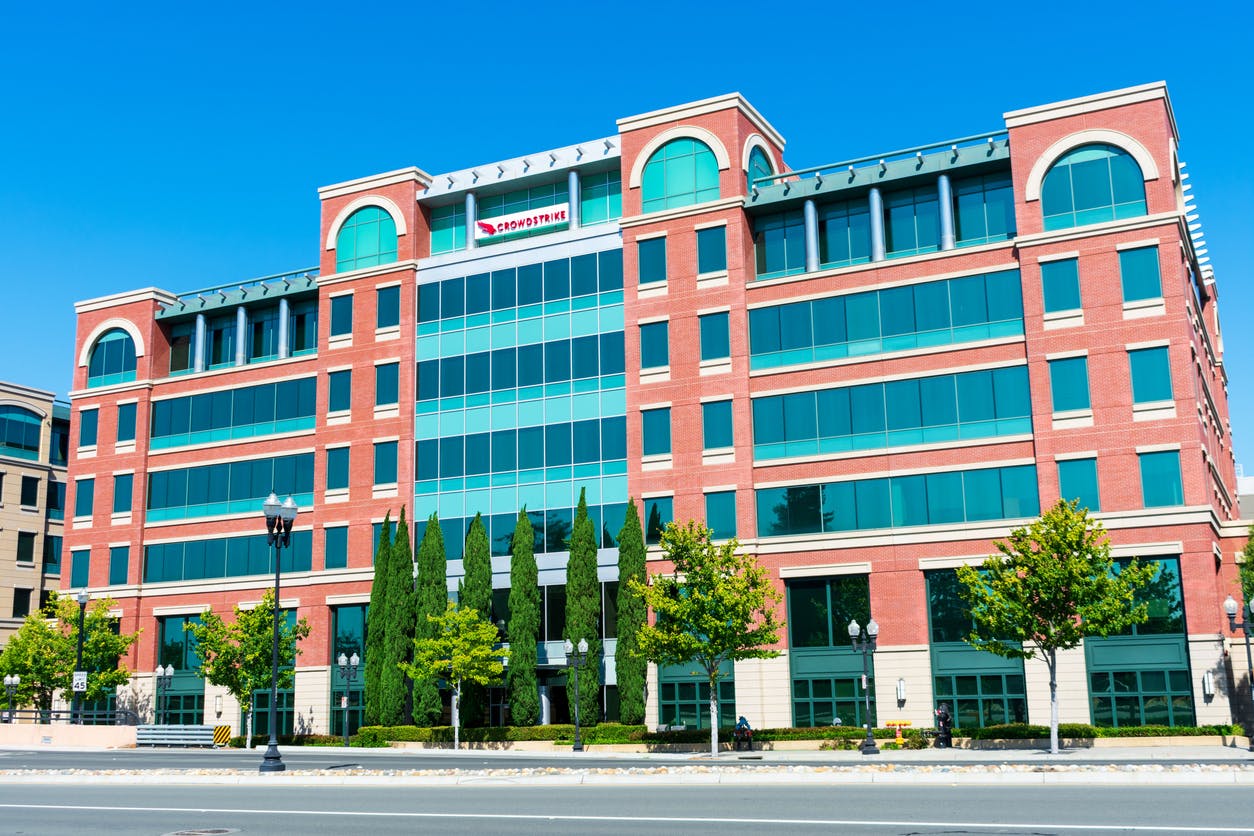
Despite cybersecurity being one of the most promising sectors to reap the benefits from AI, popular stocks have stumbled this year. CrowdStrike had a faulty update that caused global outages with high profile airlines affected. Palo Alto also recorded its largest-ever one-day decline as it cut its outlook; the company is taking a near-term hit as it pivots toward becoming a platform, which will fare better for AI purposes rather than a collection of disparate vendor products.
AI offerings are becoming more prevalent, and the first signs of AI-related growth are arising in the leading names in the industry. Below, I look at the demand environment for leading cybersecurity stocks CrowdStrike, Zscaler, Palo Alto, and Fortinet, and which ones have key metrics hinting toward underlying strength.
AI Opening New Opportunities as Threats Rise
Nearly one year ago, the I/O Fund discussed for its free newsletter readers how cybersecurity was the next industry to be disrupted by AI, not only by improving threat detection and prevention capabilities but also because AI-based attacks were on the rise. AI is aiding enterprises to expedite threat prevention, yet hackers are similarly expediting the end-to-end attack life cycle, and could potentially execute larger and more complicated attacks faster than ever before.
According to McKinsey, 51 percent of organizations believe generative-AI is driving new risks in cybersecurity, down slightly from 53 percent in a similar survey from 2023. However, only 33 percent of organizations are actively working to mitigate AI-related cybersecurity risks, with 16 percent already witnessing a negative consequence or event.
A report from the World Economic Forum predicts that AI could push cyber incidents and data breaches to a new record high in 2024, even after a 72% YoY increase in data breaches in 2023. Palo Alto said it is seeing an “uptick in mega-breaches” with multi-billion dollar impacts, as ransomware public extortion activity has risen more than 50% from 2022. Zscaler also sees ransomware attacks continuing to rise, up 18% YoY, though victims and payloads have gotten increasingly large, with 57% more victims and 144% more payloads.
Zscaler sees ransomware attacks continuing to rise, up 18% YoY, though victims and payloads have gotten increasingly large, with 57% more victims and 144% more payloads
Source: I/O Fund
The new dynamic created by AI in the industry from both a threat and protection standpoint offers a long-term growth runway. As Palo Alto puts it, the year 2024 “will be a phenomenal year in the utilization of AI in cybersecurity,” but it “will pale by comparison to what is yet to come.”
Sign up for I/O Fund's free newsletter with gains of up to 2600% because of Nvidia's epic run – Click hereClick here
Palo Alto Networks: 4x Growth to $200M AI ARR
Palo Alto’s management believes AI “continues to generate significant excitement in the market,” and “adoption is proceeding at a rapid pace faster [than] any other new technology.” They see AI not only creating “transformative use cases” enabling new revenue streams and efficiencies, but also enabling cybercriminals to broaden attacks, improve targeting, and scale beyond what can currently be controlled by humans.
Palo Alto is rolling out a comprehensive AI product suite, with the launch of AI Access, AI SPM, and AI Runtime Security in May, combined with its AI-driven SecOps platform Cortex and AI integrations in its Prisma Cloud and SASE offerings. Palo Alto noted in Q4’s earnings call that its AI Access could be deployed to its 5,000+ Prisma Access customers, while nearly 1,000 customers were also interested in AI Access. This is an incredibly strong response given that early access to the solution was launched in July, only one month prior to management’s comment.
In fiscal Q4, Palo Alto disclosed that its AI ARR (AI Access, AI SPM, AI Runtime) had surpassed $200 million to close out the year, for 4x YoY growth. While growth is rapid, AI’s scale is still small, due to the recent timing of launches. However, AI already accounts for nearly 5% of Next-Gen Security (NGS) ARR, and is set to grow its share of NGS ARR as products scale.
Palo Alto is also seeing strong growth in Cortex, with ARR surpassing $900 million in fiscal 2024. Cortex XSIAM delivered north of $500 million in bookings, with customer count rising 4x YoY. Palo Alto has previously noted that XSIAM drives much higher ARR, with customers who adopt XSIAM having >5x ARR compared to those that do not. Continuing to accelerate customer adoption of XSIAM while growing Cortex’s customer base (up nearly 20% YoY to >6,100) can drive strong long-term growth for the fastest-growing product in Palo Alto’s history.
With the strengths arising in AI, Palo Alto is expecting NGS ARR growth to remain robust, though headline growth is decelerating due to the law of large numbers. NGS ARR is guided to increase 34% to 36% YoY in Q1 of fiscal 2025, reaching between $4.33 billion to $4.38 billion. On a dollar basis, that represents YoY growth of $1.13 billion, marginally higher than the $1.12 billion it added from Q1 2023 to Q1 2024, where YoY growth was reported at 53% — essentially, Palo Alto is maintaining the same growth in dollar terms despite operating at a larger scale.
Zscaler: AI Contributing 3 Points to Growth
Zscaler launched its AI Analytics solutions at the end of 2023, and is already seeing strong contributions from these new products, including its Risk360, Business Insights, Unified Vulnerability Management and more. Zscaler’s management believes that “the increasing use of AI is creating new avenues of growth,” and “the rising adoption of Gen AI is exposing new gaps in organizations' security posture.”
Management said that AI Analytics was “seeing strong traction” in Q4, and “contributed nearly 3 points to new and upsell business growth in Q4 and 2 points for the entire fiscal '24,” even with the products being available for just a portion of the year. While Zscaler did not break out AI’s contribution in dollar terms, it noted that it saw record new and upsell business in Q4 and a record $1 billion-plus in quarterly bookings (driven by the new and upsell business), suggesting that the AI Analytics was a strong driver for the quarter under the hood.
Zscaler is also prioritizing data center and AI investments to support this growth in AI Analytics. For fiscal 2025, management said that they expect “data center CapEx to be approximately 3 points higher as a percent of revenue compared to fiscal 2024,” due to investments to upgrade cloud and AI infrastructure. Property and equipment purchases have been accelerating on a quarterly basis to nearly $50 million in Q4, and totaled 7% of revenue for the entirety of FY24, so Zscaler looks to be eyeing a move closer towards the 10% range. As a result of these increased data center investments, free cash flow margin is expected to decline from 27% in FY24 to 23.5% to 24% in FY25.
Zscaler's property and equipment purchases have been accelerating on a quarterly basis to nearly $50 million in Q4, and totaled 7% of revenue for the entirety of FY24
Source: I/O Fund
Additionally, despite closing out its fiscal 2024 with a double beat in Q4, Zscaler’s guide for FY25 was light, pointing to a revenue growth deceleration of ~6 percentage points YoY. Zscaler also left clues that AI Analytics and other new products will continue to see strength in FY25, saying that sales productivity was better than expected, driven by new and upsell business. The trend is set to continue in FY25 and strengthen in the second half of the fiscal year.
Fortinet: AI-Driven Ops Account for 10% of Billings
Fortinet did not break out AI revenue or ARR like Palo Alto has, but management said that in fiscal Q2, “AI-driven SecOps accounted for 10% of total billings,” an increase of 1 point QoQ but flat YoY. Fortinet’s FortiAI solution is currently available in its FortiAnalyzer, FortiSIEM, and FortiSOAR products but will be expanded to more products in the future.
However, AI-driven SecOps’ billings have been lumpy, and are lower in Q2 than they were in Q4. Based on the 10% figure, Q2’s AI-driven SecOps billings were approximately $154 million, up just over 22% QoQ but down more than (17%) from $186 million in Q4. AI-driven SecOps also has not surpassed 10% of total billings in each of the last four quarters.
Fortinet's Q2 AI-driven SecOps billings were approximately $154 million, up just over 22% QoQ but down more than (17%) from $186 million in Q4
Source: I/O Fund
Management guided for billings to be approximately flat to up low single-digits QoQ in Q3, implying that AI-driven SecOps’ contribution will not rise significantly unless SASE or Secured Networking declines significantly, which is unlikely to be the case. As a result, Fortinet may not see its AI-driven products meaningfully contribute to billings growth or drive a newfound acceleration in the metric.
Despite this, Fortinet took steps to broaden its AI security portfolio, acquiring Lacework in Q2. Management expects Lacework’s “organically developed AI-driven cloud-native application protection platform will be combined with the power of Fortinet’s Security Fabric platform, ensuring broad protection across the network, cloud, and endpoint.” The move is expected to add $10 billion to Fortinet’s TAM, per management’s projections.
Every Thursday at 4:30 pm Eastern, the I/O Fund team holds a webinar for premium members to discuss how to navigate the broad market, as well as various stock entries and exits. We offer trade alerts plus an automated hedging signal. The I/O Fund team is one of the only audited portfolios available to individual investors. Learn more here.Learn more here.
CrowdStrike Discusses AI Opportunities Without Disclosing AI Numbers
While peers Palo Alto and Zscaler put forth some early AI revenue and growth numbers, CrowdStrike has not, but management has discussed AI-related opportunities in some detail.
CrowdStrike has not broken out any AI-specific growth numbers or contribution, but arguably has a very strong product suite with its Falcon platform and its new generative AI-powered security analyst Charlotte AI. Management sees a long runway ahead for AI in cybersecurity, with a $225B 2028 AI-native security TAM, explaining that “decreasing TCO and increasing efficiencies through AI and automation are clearly voiced organizational priorities and will be for years to come.”
CrowdStrike believes Charlotte AI holds “an incredible amount of promise,” and has been training this AI security assistant to “be a malware reverse engineer, … to translate threat hunting queries, … to help automate reporting, … [and] to do some incident response use cases,” to improve efficiency and accelerate back-end processes when working in conjunction with humans. Management says that its “best-in-class module adoption” is “supercharged by Charlotte AI [and] makes the Falcon platform sticky for all users.”
Adoption rates for CrowdStrike’s modules remain strong, with adoption of 6+ and 7+ rising 1 point each sequentially to 45% and 29%. Additionally, similar to Palo Alto, CrowdStrike’s ‘hypergrowth’ products (LogScale next-gen SIEM, Cloud and Identity Security) are witnessing strong growth, with ending ARR for the group surpassing $1 billion, up 85% YoY.
Conclusion
Cyberattacks are rising in both number and sophistication. While 2024 has been a bit of a wild ride for the industry, cybersecurity is only growing in importance in the age of AI. The industry’s leading companies are progressing with AI-powered product deployments, seeing long runways ahead despite minimal signs of growth at the moment.
Palo Alto’s AI portfolio is contributing ~$200 million, or 5%, of total ARR, while Zscaler’s products are contributing just 3 points to upsell growth. Fortinet is seeing AI-driven SecOps contribute 10% of billings, though that has been relatively unchanged for four quarters. Meanwhile, CrowdStrike has yet to put a firm number on AI-related growth, though next-gen products are recording rapid growth.
Cybersecurity stocks command a premium to the broad SaaS universe with early signs of AI growth.
Due to their early exposure to AI and revenue streams, cybersecurity stocks command a premium to the broad SaaS universe. Despite its valuation crunch after its incident, CrowdStrike remains the third most-expensive software stock on a top-line basis, with Palo Alto also in the top ten. Fortinet and Zscaler both trade around the 10x forward revenue level, nearly double the median 5.5x multiple for the sector.
Our goal (always) is to perform deep dive research to identify winners, and then to subsequently identify a good entry. I will be direct and say our firm is not a buyer in this market as I believe most tech stocks will trade lower in the next 3-6 months. Yet, it’s never too early to perform research and get our ducks in a row for when the market affords solid entries. Interestingly, despite cybersecurity AI revenue numbers looking low, it’s one of the only software verticals where there is AI revenue. I think investors should pay attention to these early green shoots.
While Wall Street is worried about how much AI is costing, the I/O Fund is busy calculating how big the AI opportunity can get in the next few years and how investors can participate. Learn more about the I/O Fund’s holdings and consistent deep dive research on AI stocks, crypto and more here.here.
Please note: The I/O Fund conducts research and draws conclusions for the Fund’s positions. We then share that information with our readers. This is not a guarantee of a stock’s performance. Please consult your personal financial advisor before buying any stock in the companies mentioned in this analysis.